


Within a 2km radius of Unazuki Onsen Station, 9 lodging properties with 629 rooms were confirmed on sale as of November 2026. The Kurobe Gorge Railway (黒部峡谷鉄道) resumed full-line service between Unazuki and Keyakidaira on October 1, and the next day, October 2, tours began on the “Kurobe Unazuki Canyon Route” (黒部宇奈月キャニオンルート) linking Kurobe Dam and Keyakidaira. In that same October, the estimated settled ADR in Kurobe City was ¥19,500, 23.9% above the ¥15,700 recorded a year earlier. This article examines how this autumn’s tourism-infrastructure openings have overlapped with an onsen town whose room supply has been shrinking, looking in turn at room stock, rates, booking pace, disaster-risk zoning and the ADR required to justify reinvestment.
• ADR (average daily rate) = estimated settled rate (tax-excluded equivalent), calculated by applying segment-specific adjustment factors to the lowest-plan price level each property publishes on OTAs (per room, double occupancy, tax-included). Benchmarked against property-level results disclosed by listed hotel REITs (91 properties, most recent 3 months), the median error is about 7%. These are estimates and differ from each property’s actual settled prices and accounting figures.
• ADR at the area level (prefecture, city/town) is the median of the estimated settled rates of the properties covered (i.e., the level of a typical property in the area).
• Where listed prices are mentioned, they are per-room rates for double occupancy (tax-included).
• OCC (occupancy) = share of rooms sold relative to total rooms in the area (an estimate based on OTA sales inventory).
• Source: MetroEngines Research (continuously tracking OTA public prices for about 168,000 properties in Japan, of which about 27,000 are confirmed operating)
Room stock in this article covers lodging properties with at least one room (excluding leisure/love hotels) within a 2,000m radius of Unazuki Onsen Station. “Operating” refers to properties with sale prices confirmed on major booking sites in the most recent 3 months (September–November 2026) (as of November 16, 2026, compiled by MetroEngines Research). Estimated OCC and booking curves are based on listed inventory for Kurobe City as a whole (10 properties / 558 rooms, based on major booking-site listings), using only observations within a 45-day lead time.
To state the conclusion first: October’s rate increase is not as large as the citywide median suggests. Comparing, one by one, the 9 properties within 2km of the station that had sales in both years, the median YoY change was +7.5%, with 7 of the 9 rising. The increase was broad-based, but the city median is sensitive to which properties fall in the middle and should be discounted accordingly. Meanwhile, estimated OCC in October was a high 92.1%, and no property currently occupies the 70–100 room, ¥30,000–45,000 band. A renovation would put the required ADR at around ¥30,000, which can be described as an extension of the current level of the ryokan segment.
- — 9 properties, 629 rooms: lodgings within 2km of Unazuki Onsen Station confirmed on sale in the most recent 3 months (September–November 2026). On a known-opening-year basis, rooms fell −8.5% over nine years from 749 in 2017.
- — +23.9%: Kurobe City’s estimated settled ADR reached ¥19,500 in October 2026 (N=15 properties). However, a same-property comparison of the 9 lodgings within 2km of the station shows a median of +7.5%, and other areas of the prefecture also rose, such as Nanto City at +33.5%.
- — Est. OCC 92.1%: Kurobe City in October 2026 (10 properties / 558 rooms, listed-inventory basis). For Saturday, October 10, 83.9% of inventory had already been absorbed 45 days before check-in.
- — 49.9%: share of rooms at the 9 operating properties whose representative coordinates fall within a landslide (sediment disaster) warning zone (5 properties, 314 rooms). One property with 50 rooms lies in a flood inundation zone.
- — Required ADR approx. ¥31,000: full renovation of an 80-room ryokan (annual OCC 65%, NOI margin 25%, yield 6%). A rebuild requires about ¥65,000, above the highest level within 2km in October 2026 (¥45,300).
Tourism Infrastructure — Full-Line Service to Keyakidaira and the Canyon Route Opened in the Same Autumn
First, let us confirm from primary sources what changed this autumn. The Kurobe Gorge Railway was damaged in the January 2024 Noto Peninsula Earthquake, and in FY2025 it ran a shuttle service only between Unazuki and Nekomata from May 10 to November 30. In other words, last October it was not possible to reach Keyakidaira by the trolley train. In FY2026 too, trains turned back at Nekomata through the end of September, and full-line service between Unazuki and Keyakidaira resumed on October 1.
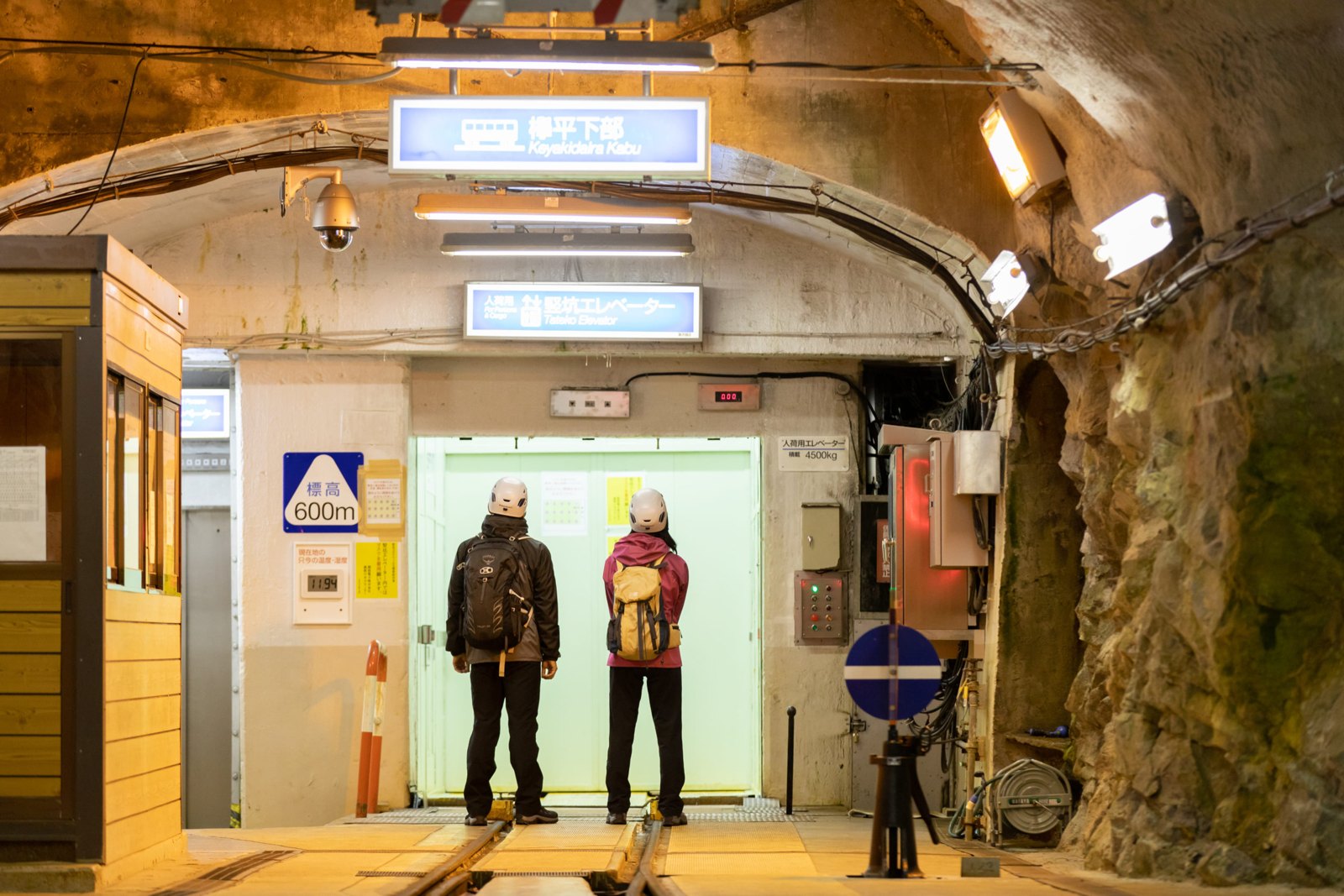
The Canyon Route is a construction route built by Nihon Denryoku and Kansai Electric Power during construction of the Kurobe River No. 3 and No. 4 power stations, opened to the public and packaged as a travel product under a 2018 agreement between Kansai Electric Power and Toyama Prefecture. The roughly 18km stretch from Keyakidaira to Kurobe Dam is traversed by a construction trolley, a vertical-shaft elevator and an incline. It was originally scheduled to open in 2024, but was postponed because the earthquake prevented the railway from reopening its full line.
| Item | Details | Source |
|---|---|---|
| Kurobe Gorge Railway full-line service resumes | October 1, 2026 (Unazuki–Keyakidaira). Boarding/alighting at Nekomata Station is no longer handled from that date | Kurobe Gorge Railway / Tetsudo Channel |
| Service section in the prior year (FY2025) | Shuttle service between Unazuki and Nekomata from May 10 to November 30 | Kurobe Gorge Railway (announced March 24, 2025) |
| Canyon Route tours begin | Friday, October 2, 2026. Travel products sold at travel agencies nationwide from July 23 | Toyama Prefecture Tourism Promotion Bureau |
| First-year operating period | October 2 – November 30 | Tabiris travel research institute (Toyama Prefecture announcement) |
| How to use | Independent passage by individuals is not permitted. Visitors join a travel agency tour accompanied by a guide | Same as above |
| Product lineup | Four 2-day/1-night courses; first-year capacity about 2,700 people. Course D, departing from Kurobe Dam, overnights in Unazuki; Courses A and B depart from Unazuki | Travel Watch (Toyama Prefecture announcement, May 14) |
From a lodging-investment perspective, what matters is that the tours are designed to start and end in Unazuki. Course D, entering from the Kurobe Dam side, includes an overnight in Unazuki, while courses departing from Unazuki look to the onsen town to absorb the night-before stay. First-year capacity of about 2,700 people is small relative to the total room stock, but it is significant that a circular route linking the Tateyama Kurobe Alpine Route and Kurobe Gorge in a single sweep has been productized for the first time. Where the lodging capacity sits during the autumn-foliage season on the Alpine Route side is covered in Tateyama Kurobe Autumn 2026: 542 Rooms Near Trailhead, 8,519 in Toyama. Note that, as of this writing, we have not been able to confirm a primary announcement of the 2027 operating period, so it is not addressed here.
Room Stock — From 749 Rooms in 2017 to 685, With 9 Properties and 629 Rooms Currently on Sale
Next, we look at the volume of rooms available to absorb demand. Among listed properties with a known opening year, rooms within 2km of the station fell from 20 properties and 749 rooms in 2017 to 17 properties and 685 rooms in 2026, a contraction of 64 rooms (−8.5%) over nine years. After falling to 670 rooms in 2021, the total recovered to 733 rooms in 2022 when an 81-room resort hotel opened. This is not a phase of rapidly accumulating room count; rather, it is an onsen town that has maintained its overall volume by replacing existing facilities.
“Operating” lodgings with sale prices confirmed in the most recent 3 months total 9 properties and 629 rooms. By segment, there are 6 ryokan with 288 rooms, 2 resort hotels with 199 rooms and 1 property in the business-hotel category with 142 rooms; the 2 large properties of 101–200 rooms account for 260 rooms, over 40% of the total. Mid-sized properties of 51–100 rooms number 3 with 224 rooms, and those of 50 rooms or fewer number 4 with 145 rooms, revealing a structure in which the layer between large and small properties is thin.
| Property | Rooms | Straight-line distance from station |
|---|---|---|
| Kurobe Unazuki Onsen Yamanoha (黒部・宇奈月温泉やまのは) | 142 | 411m |
| Oedo Onsen Monogatari Unazuki Grand Hotel (大江戸温泉物語 宇奈月グランドホテル) | 118 | 339m |
| Entaiji-so (延対寺荘) | 82 | 507m |
| Granvillio Hotel Unazuki Onsen (グランヴィリオホテル宇奈月温泉) | 81 | 431m |
| Unazuki Onsen Enraku (宇奈月温泉 延楽) | 61 | 481m |
| Hotel Togen (黒部峡谷 宇奈月温泉 ホテル桃源) | 50 | 512m |
| Hotel Kurobe (黒部峡谷・宇奈月温泉 ホテル黒部) | 43 | 728m |
| Feel Unazuki (黒部峡谷トロッコ電車駅前 フィール宇奈月) | 30 | 278m |
| San Ryutei (サン柳亭) | 22 | 660m |
Location Assessment — Station-Front Commercial Land Price Down 12.5% vs. 2019; About Half of Rooms Sit in Landslide Warning Zones
Let us start with land prices. The official land price for the commercial site adjoining Unazuki Onsen Station peaked at ¥54,500/㎡ in 2018 and 2019 before turning down, with declines widening to −4.3% in 2021 and −3.3% in 2022. From 2023 the pace of decline eased to −1.2% for four consecutive years, reaching ¥47,700/㎡ as of January 1, 2026. That is 12.5% below the peak, and land cost accounts for a small share of total project cost. For reinvestment in onsen towns, the economics are determined by building renovation or rebuilding costs rather than acquisition cost.
Flood and Landslide Hazard Zones Along the Kurobe River
For an onsen town that opens out at the mouth of a gorge, checking disaster-risk zoning is essential. We overlaid the MLIT Real Estate Information Library’s flood inundation zones (maximum assumed scale) and landslide warning zones on the representative coordinates of the 9 operating properties. Five properties with 314 rooms have representative coordinates within a landslide warning zone, equal to 49.9% of rooms. By type, 3 properties with 249 rooms are in debris-flow zones and 2 properties with 65 rooms are in steep-slope-failure zones. One property with 50 rooms (7.9%) lies within the Kurobe River flood inundation zone, and that property also overlaps a landslide warning zone.
| Category | Properties | Rooms | Share of rooms |
|---|---|---|---|
| Landslide warning zone (debris flow) | 3 | 249 | 39.6% |
| Landslide warning zone (steep-slope failure) | 2 | 65 | 10.3% |
| Flood inundation zone (maximum assumed scale, Kurobe River) | 1 | 50 | 7.9% |
| Within any zone | 5 | 314 | 49.9% |
| Not within any zone in this overlay | 4 | 315 | 50.1% |
Because the assessment uses a single representative coordinate per property, cases where only part of a site or building falls within a zone are not captured. Likewise, “not within any zone” for the 4 properties does not mean that public records confirm they are outside the zones. No property had representative coordinates within a special warning zone in this overlay, but any acquisition or renovation review should be premised on checking Kurobe City’s hazard map and individual site plans. Whether evacuation routes and relocation of functions to upper floors can be built into a renovation is likely to be a deciding factor in how regional banks and funds evaluate a project. Reinvestment in an onsen town where a full-line railway reopening coincides with disaster-risk zoning is also covered in Hitoyoshi Onsen 543 Rooms: 82% in Flood Zone, Post-Rail Reinvestment.
Rates — Kurobe City Up 23.9% in October; Same-Property Median Up 7.5%
Overlaying monthly rate movements, Kurobe City’s estimated settled ADR has exceeded the prior year in many months since November 2025. In 2026, peaks came in January at ¥19,900, May at ¥19,800 and August at ¥19,000, with a trough in February at ¥14,700. October was ¥19,500 (N=15 properties), up 23.9% from ¥15,700 a year earlier (N=16 properties). Given that October 2024 was ¥15,000 and the prior year’s growth was only +4.4%, the October 2026 increase stands out.
However, it is premature to read this growth as a Kurobe-only phenomenon. YoY changes for the same October were +33.5% in Nanto City (¥11,400, N=14 properties), +17.2% in Toyama City (¥8,400, N=57 properties), +17.1% in Himi City (¥12,400, N=14 properties) and +11.0% for Toyama Prefecture as a whole (¥8,500, N=169 properties). It was an autumn in which rates rose across tourist areas throughout the prefecture; Kurobe City’s +23.9% ranks near the top but cannot be called exceptional. The full-line railway reopening and the Canyon Route launch coincided in time, but the rate increase cannot be attributed to them alone. For differences in rate levels among the prefecture’s municipalities, see also Toyama’s 14 Municipalities 2026: 3.3x ADR Gap, Four Price Tiers.
Moreover, a city median is sensitive to how properties are distributed. Kurobe City’s sample is small at 15–16 properties and mixes lodgings in very different price ranges, so the level can move simply because a different property lands in the middle. We therefore compared estimated settled ADR for October 2025 and October 2026 property by property for the 9 operating lodgings within 2km of the station. Seven of the 9 rose, with a median growth rate of +7.5% and a maximum of +32.7%. By segment, Kurobe City’s ryokan category held at ¥25,200 (N=7 properties), roughly in line with the prior year, while the top growers were the two large properties of more than 100 rooms and lodgings in the ¥10,000–29,999 range.
November is estimated at ¥20,900 (N=15 properties) based on listed levels at the time of the survey. However, this figure is on a listing-snapshot basis and uses a different calculation basis from the prior-year ¥18,000 (finalized-month history basis), so it should not be read as a YoY comparison. Where rates land through November 30, the end of the Canyon Route tour period, should be judged once finalized figures are available.
Booking Pace — October Est. OCC 92.1%; Saturdays Over 80% Filled at LT45
Alongside rates, we also check how inventory was absorbed. Kurobe City’s estimated OCC on a listed-inventory basis was 92.1% in October 2026 (10 properties / 558 rooms, 31 days). November remained high at 91.1% based on observations for the 1st–15th. September was 84.3% for the 16 days observed in the second half (7 properties / 383 rooms), reaching 98–100% over the September 19–22 holiday period. Because data accumulation began in March 2026, a YoY comparison is not possible, but 21 of October’s 31 days exceeded 90%.
| Month | Properties | Rooms | Days observed | Est. OCC |
|---|---|---|---|---|
| September 2026 (15th–30th) | 7 | 383 | 16 | 84.3% |
| October 2026 | 10 | 558 | 31 | 92.1% |
| November 2026 (1st–15th) | 10 | 558 | 15 | 91.1% |
Looking at booking curves, for Saturday, October 10, 83.9% of listed inventory had already been absorbed 45 days before check-in, reaching 99.1% on the day before. Weekday Wednesday, October 21 also started at 86.7% at LT45, close to weekend levels. Saturday, November 21 was 81.4% at LT45 and advanced to 98.2% at LT7. A structure in which inventory fills early indicates room to raise prices in stages, and provides a basis for building up rates on renovated rooms.
Positioning — No Property Occupies the 70–100 Room, ¥30,000–45,000 Band
Plotting the 9 properties by room count and October estimated settled ADR makes the shape of the market clear. The 2 large properties of 101+ rooms split between the ¥20,000s and the ¥40,000s, while small properties of 50 rooms or fewer are widely scattered from the ¥10,000s to the ¥40,000s. By contrast, the 3 mid-sized properties of 51–100 rooms sit at around ¥15,000, ¥25,000 and ¥42,000, and the 2 with more than 70 rooms are both at or below the ¥25,000 range. None of the 9 properties falls in the 70–100 room, ¥30,000–45,000 band.
Cluster 70+ rooms × ¥15,000–25,000
Two ~80-room properties sit in this band, functioning as capacity for groups and circuit tours.
Opportunity 70–100 rooms × ¥30,000–45,000
None. Sits between small high-rate ryokan and large mid-priced properties; a band reachable through renovation.
Reference ~60 rooms or fewer × ¥40,000s
Small and mid-sized high-rate ryokan have a track record in this band, a reference point when scaling up to around 80 rooms.
Reinvestment Model — An 80-Room Ryokan Needs ADR of About ¥31,000 if Renovated, About ¥65,000 if Rebuilt
So what rate would be needed to reinvest into this vacant band? Assuming an 80-room ryokan, we back-calculated the ADR required to meet a target yield under two options: a full renovation of the existing building and a rebuild as new construction. For the rebuild, we used a construction cost of ¥2.026 million/tsubo from MLIT’s Building Construction Starts statistics (2025, hotels or ryokan, RC construction), and for land the station-front commercial official land price of ¥47,700/㎡. Renovation unit cost, NOI margin, target yield and gross floor area are editorial assumptions.
| Item | A. Full renovation Recommended | B. Rebuild (new construction) |
|---|---|---|
| Rooms | 80 | 80 |
| Gross floor area (100㎡ per room; editorial assumption) | 8,000㎡ (approx. 2,424 tsubo) | 8,000㎡ (approx. 2,424 tsubo) |
| Construction unit cost | ¥1.0M/tsubo (editorial assumption) | ¥2.026M/tsubo (Building Construction Starts 2025, RC) |
| Construction cost | approx. ¥2.42bn | approx. ¥4.91bn |
| Land (4,000㎡ × ¥47,700/㎡) | Not included (already owned) | approx. ¥0.19bn |
| Total project cost | approx. ¥2.42bn (approx. ¥30.3M per room) | approx. ¥5.10bn (approx. ¥63.8M per room) |
| Assumptions: annual OCC / NOI margin on room revenue / target NOI yield | 65% / 25% / 6% | 65% / 25% / 6% |
| Required ADR (double occupancy, tax-excluded equivalent) | approx. ¥30,700 | approx. ¥64,500 |
For OCC, we assumed 65% on an annual basis rather than October’s peak-season value. The Kurobe Gorge Railway’s FY2025 operating season ran from April 20 to November 30, and railway-driven tourism demand is hard to count on in winter. Indeed, Kurobe City’s estimated settled ADR bottoms out in February at ¥14,700. October’s estimated OCC of 92.1% is a peak-month value on a listed-inventory basis and cannot be used directly as an annual assumption.
| Sensitivity (required ADR) | Annual OCC 55% | Annual OCC 65% (base) | Annual OCC 75% |
|---|---|---|---|
| A. Full renovation · NOI margin 25% | ¥36,200 | ¥30,700 | ¥26,600 |
| A. Full renovation · NOI margin 20% | ¥45,300 | ¥38,300 | ¥33,200 |
| A. Full renovation · NOI margin 30% | ¥30,200 | ¥25,500 | ¥22,100 |
| B. Rebuild · NOI margin 25% | ¥76,200 | ¥64,500 | ¥55,900 |
The renovation option’s required ADR of about ¥31,000 is roughly 20% above Kurobe City’s October ryokan-category level of ¥25,200, but given that three lodgings within 2km of the station have a track record in the ¥40,000s, it is not out of reach. It also overlaps with the vacant band noted above (70–100 rooms × ¥30,000–45,000). The rebuild option’s roughly ¥65,000, on the other hand, far exceeds even the highest October level within 2km (¥45,300). With construction costs remaining high, the numbers show that a renovation making use of existing buildings is more likely to pencil out.
The sensitivity table back-calculates required ADR from a target yield, but from a capital provider’s standpoint, the question is how the yield swings with the rates and occupancy actually achieved. For the renovation option (total project cost approx. ¥2.42bn), we present three scenarios — downside, base and upside — and a yield grid of ADR × annual OCC.
| Scenario | ADR | Annual OCC | NOI margin | Annual room revenue | NOI | NOI yield | Assumption |
|---|---|---|---|---|---|---|---|
| Downside | ¥25,200 | 55% | 20% | approx. ¥0.40bn | approx. ¥81M | 3.3% | Rate held at Kurobe City’s October 2026 ryokan-category level; winter occupancy does not improve |
| Base | ¥30,700 | 65% | 25% | approx. ¥0.58bn | approx. ¥146M | 6.0% | This article’s base case (exactly the required ADR) |
| Upside | ¥36,000 | 75% | 30% | approx. ¥0.79bn | approx. ¥237M | 9.8% | After renovation, rates raised to about 1.2x the required ADR, with winter programs building year-round occupancy |
| ADR \ Annual OCC | 55% | 60% | 65% | 70% | 75% |
|---|---|---|---|---|---|
| ¥25,000 | 4.1% | 4.5% | 4.9% | 5.3% | 5.6% |
| ¥28,000 | 4.6% | 5.1% | 5.5% | 5.9% | 6.3% |
| ¥31,000 | 5.1% | 5.6% | 6.1% | 6.5% | 7.0% |
| ¥34,000 | 5.6% | 6.1% | 6.7% | 7.2% | 7.7% |
| ¥37,000 | 6.1% | 6.7% | 7.2% | 7.8% | 8.4% |
In the downside scenario the yield is only 3.3%, short of the 6% target. The base case matches the target at 6.0%, and the upside extends to 9.8%. In the grid, at 65% annual OCC a rate of ¥31,000 yields 6.1%, above target, but at 55% annual OCC even ¥34,000 yields only 5.6%, and it takes ¥37,000 to reach 6.1%. In an onsen town where the railway operates only from late April to the end of November, how much winter occupancy can be built up affects yield as much as rate does.
Investment Summary — Center Reinvestment on Renovation, Factoring In Winter Demand and Hazard Zoning
To summarize the analysis, the opportunity for reinvestment in Unazuki Onsen lies less in “adding volume” than in “lifting the rate band of existing facilities.” Rooms have contracted over nine years, and operating lodgings are consolidated into 9 properties with 629 rooms. Autumn estimated OCC has held in the 90% range, and over 80% of inventory is filled 45 days before check-in. The 70–100 room tier above ¥30,000 is vacant, and the renovation option’s required ADR overlaps with that band.
| Issue | Details | Evaluation perspective |
|---|---|---|
| Demand | Full railway reopening and the Canyon Route launch coincided in October; tours start and end in Unazuki | Confirm primary announcements of operating periods and capacity from 2027 onward |
| Rates | City median +23.9%; same-property median +7.5% | Other areas of the prefecture also rose; do not attribute to a single factor |
| Seasonality | Railway operates late April to end of November; February is the ADR trough | Set annual OCC conservatively and lift the floor with winter programs |
| Hazard zoning | 49.9% of rooms in landslide warning zones (representative-coordinate basis) | Site-level hazard checks and evacuation-route design at renovation |
| Construction cost | Rebuild requires ADR of about ¥65,000, far above current levels | Prioritize stepwise rate increases through renovation |
For ryokan owners, a realistic first step is to raise rates in stages starting with renovated rooms, on the premise of early inventory absorption in peak season. For turnaround funds and regional banks, the design of Canyon Route products from the second year onward and how winter demand is built will likely be the deciding factors. The onsen town’s upside lies in whether the tailwind of new tourism infrastructure can be tied to upgrading the quality of its facilities.
Frequently Asked Questions
Q. How many lodgings are there around Unazuki Onsen Station?
A. Within a 2km radius of the station, 9 properties with 629 rooms had sale prices confirmed between September and November 2026 (as of November 16, 2026, compiled by MetroEngines Research).
Q. Can individuals travel the Kurobe Unazuki Canyon Route on their own?
A. Independent passage is not permitted; visitors join a travel agency tour. The first-year operating period is October 2 – November 30, 2026, and a guide accompanies each tour.
Q. What was the lodging rate in Kurobe City in October 2026?
A. The estimated settled ADR was ¥19,500 (N=15 properties), up 23.9% YoY. Comparing the 9 properties within 2km of the station individually, the median growth rate was +7.5%.
Q. What rate is needed to justify reinvestment in a ryokan?
A. Assuming 80 rooms, 65% annual OCC, a 25% NOI margin and a 6% target yield, the required ADR is about ¥30,700 for a full renovation and about ¥64,500 for a rebuild (simplified editorial model).
⚠ Note on ADR for future dates: ADR for November and December 2026 in this article is estimated from sale prices published on OTAs etc. at the time of the survey and will change as check-in dates approach. Please note that prices currently set high may fall due to last-minute discounting.
Related Articles
- Tateyama Kurobe Autumn 2026: 542 Rooms Near Trailhead, 8,519 in Toyama
- Japan’s 12 Winter-Closure Lodging Towns: Tateyama 13→5, ¥19.9k ADR
- Hitoyoshi Onsen 543 Rooms: 82% in Flood Zone, Post-Rail Reinvestment
- Toyama Business Hotels Oct 2026: Sat 97.7% vs Sun 80.7% OCC Gap
- Onsen Rate Peaks: Kusatsu in December, Takayama & Nikko in October
References and Sources
■ Data Sources
Estimated settled ADR calculated from OTA public prices (MetroEngines Research, continuously tracking about 168,000 properties in Japan) (Kurobe City N=14–17 properties, July 2024 – January 2027; from November 2026 onward, estimates on a listing-snapshot basis); estimated OCC and booking curves on a listed-inventory basis (Kurobe City, 10 properties / 558 rooms, observations from September 15 to November 15, 2026, lead time within 45 days); room stock within a 2,000m radius of Unazuki Onsen Station (as of November 16, 2026); MLIT Real Estate Information Library (official land prices, flood inundation zones, landslide warning zones); Building Construction Starts Survey (2025).
■ Model Assumptions
80-room ryokan, gross floor area 8,000㎡ (100㎡ per room, approx. 2,424 tsubo). Renovation unit cost ¥1.0M/tsubo (editorial assumption); rebuild at ¥2.026M/tsubo from Building Construction Starts statistics plus land of 4,000㎡ × ¥47,700/㎡. Base assumptions are annual OCC 65%, NOI margin on room revenue 25% and target NOI yield 6%, with required ADR = total project cost × 6% ÷ (80 rooms × 365 days × OCC × NOI margin). Tables 7 and 8 hold the renovation option’s total project cost fixed at approx. ¥2.42bn and calculate NOI yield = ADR × 80 rooms × 365 days × annual OCC × NOI margin ÷ total project cost.
■ Limitations and Caveats
ADR and OCC are estimates based on OTA listing information and differ from each property’s actual settled prices and occupancy. Estimated OCC is based on observations from March 2026 onward, so YoY comparisons are not possible. The city median depends on the composition of the 15–16 properties covered. Hazard exposure is judged by a single representative coordinate per property, not on a site-by-site basis. Values for November and December 2026 are on a listing-snapshot basis, which differs from the finalized-month history basis. The model is simplified and excludes ancillary revenue, taxes and public dues, repair reserves and financing terms.
■ Market Data
- MetroEngines Research & Consulting — room stock (within 2km of Unazuki Onsen Station, as of November 16, 2026), estimated settled ADR (Kurobe City N=14–17 properties, etc.), estimated OCC and booking curves (Kurobe City, 10 properties / 558 rooms)
■ Government Statistics and Public Data
- MLIT Real Estate Information Library — official land prices, flood inundation zones (maximum assumed scale), landslide warning zones
- MLIT “Building Construction Starts Survey” (2025, hotels or ryokan, RC construction)
- Toyama Prefecture Tourism Promotion Bureau, “Kurobe Unazuki Canyon Route” official site
■ Transport Operators and News
- Kurobe Gorge Railway official site
- Kurobe Gorge Railway: FY2025 operations from April 20 (Tetsudo Channel)
- Kurobe Gorge Railway resumes full-line service from October 1, 2026 (Tetsudo Channel)
- Kurobe Unazuki Canyon Route travel products go on sale (Travel Voice, July 6, 2026)
- Kurobe Unazuki Canyon Route: four tour courses and capacity (Travel Watch, June 22, 2026)
- Kurobe Unazuki Canyon Route runs October 2 – November 30 (Tabiris, July 20, 2026)