

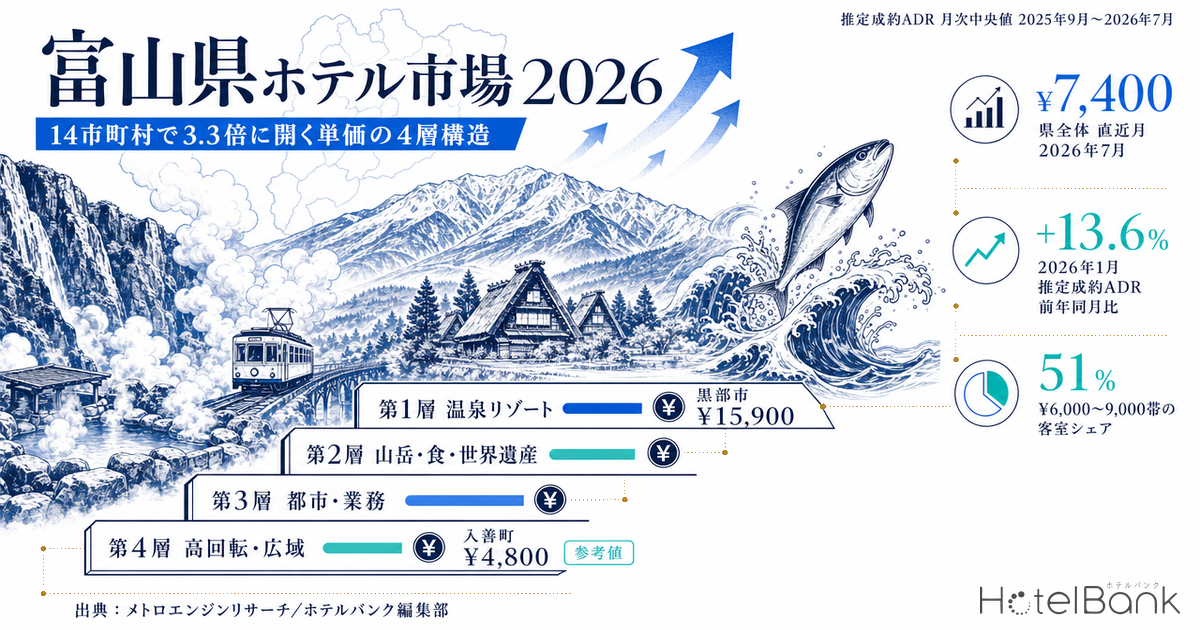
Toyama’s accommodation market runs several distinct commercial zones in parallel inside a single prefecture. There is Kurobe City, home to Unazuki Onsen; Tateyama Town, the gateway to the Tateyama Kurobe Alpine Route; Nanto City with the World Heritage village of Gokayama, and Himi City with its winter yellowtail; and the urban belt of Toyama City, Takaoka City and Imizu City linked by the Hokuriku Shinkansen. When the monthly data MetroEngines Research compiled for 14 municipalities is lined up, the estimated settled ADR spreads 3.3-fold from top to bottom and separates into four clear tiers. This article works through the municipal price structure, the seasonal curves, the skew in new supply, and the white space that remains in the price bands.
Metric Definitions Used in This Article
- ADR (average daily rate): an estimated settled rate (tax-exclusive equivalent) calculated by applying category-specific adjustment coefficients to the lowest published plan level each property lists on OTAs and similar channels (double occupancy, per-room rate, tax-inclusive). Cross-checked against property-level results disclosed by listed hotel REITs (91 properties, most recent three months), the median error is approximately 7%. These are estimates and differ from each property’s actual transaction prices and accounting figures. Area-level ADR is the median of the target properties (the level of a typical property in that area).
- Published price (all-plan average): the average of all plans published on OTAs and similar channels, from room-only through meal-inclusive. Per-room rate at double occupancy (tax-inclusive). This is a separate metric from estimated settled ADR, and the two are clearly distinguished throughout this article.
- Data source: MetroEngines Research. Approximately 168,000 properties nationwide are tracked, of which roughly 27,000 properties and 1.26 million rooms confirmed active on OTAs form the analysis set.
- Treatment of reference values: municipalities where fewer than 5 properties qualify for the estimated settled ADR calculation are labeled “reference value” and no definitive assessment is made.
- — 3.3x — estimated settled ADR across the 14 municipalities spans ¥15,900 in Kurobe City down to ¥4,800 in Nyuzen Town, splitting at ¥13,000 / ¥10,000 / ¥6,500 into four tiers: onsen resort, mountain/cuisine/World Heritage, urban business, and outlying areas.
- — 4.2x and 2.0x — the distance between published price (all-plan average) and estimated settled ADR is 4.2x in Tateyama Town and 2.0x in Imizu City. That multiple is itself an indicator of how wide an area’s product mix is.
- — Published +8–12% / actuals flat — prefecture-wide published prices ran ahead at +8.1% to +12.0% year on year from May to July 2026, while estimated settled ADR moved −2.3% to +0.6%. Winter is the exception: December 2025 +9.8% and January 2026 +13.6% show actuals rising too.
- — All 573 rooms are limited-service — three large openings in 2025 added 573 rooms, and the two large 2026 openings (104 rooms combined) point the same way. New supply over the past two years has thickened the ¥5,000–10,000 band.
- — 11% room share — the ¥13,000–25,000 upper-midscale band holds just 19 properties and 1,289 rooms, and narrowing to 50 rooms or more leaves only 9 properties in the prefecture. With the Kurobe Gorge Railway resuming full-line service in October 2026, room remains in the mid-size segment.
A 3.3x Spread Across 14 Municipalities — Toyama’s Four-Tier Price Structure
Start with the overall picture. For the 11 months from September 2025 through July 2026, the monthly median estimated settled ADR was calculated for each municipality, and the median of those months taken. At the top is Kurobe City, home to Unazuki Onsen, at roughly ¥15,900; at the bottom is Nyuzen Town at roughly ¥4,800 (reference value) — a 3.3-fold gap. Prefecture-wide estimated settled ADR in the most recent month (July 2026) was ¥7,400 with N=170 properties, meaning the prefectural average is pulled toward the lower tiers by the sheer number of urban properties.
Ranked by price level, these 14 municipalities form four step-like clusters. The boundaries can be placed roughly at ¥13,000, ¥10,000 and ¥6,500, and what makes Toyama distinctive is how cleanly each tier corresponds to a type of tourism asset.
N=14 municipalities (monthly medians, September 2025–July 2026). Source: MetroEngines Research; compiled by the HotelBank Editorial Team
| Tier | Municipality | Est. settled ADR | Published price | Properties observed | Primary demand source |
|---|---|---|---|---|---|
| Tier 1 Onsen resort | Kurobe City | ¥15,900 | ¥38,700 | 15–17 | Unazuki Onsen, Kurobe Gorge |
| Kamiichi Town reference value | ¥13,100 | ¥33,100 | 4–5 | Mt. Tsurugi trailhead, Oiwa | |
| Tier 2 Mountain, cuisine, World Heritage | Himi City | ¥12,600 | ¥34,600 | 34–36 | Winter yellowtail, Himi Onsen district |
| Nanto City | ¥11,300 | ¥26,900 | 27–35 | World Heritage Gokayama | |
| Tateyama Town reference value | ¥10,800 | ¥44,700 | 5–15 | Tateyama Kurobe Alpine Route | |
| Tonami City | ¥10,400 | ¥36,300 | 12–16 | Shogawa Onsen district, tulips | |
| Tier 3 Urban and business | Asahi Town reference value | ¥8,800 | ¥24,300 | 4–6 | Hisui Coast, Spring Quartet |
| Namerikawa City reference value | ¥7,300 | ¥22,500 | 2–4 | Firefly squid, business demand | |
| Toyama City | ¥7,000 | ¥17,800 | 70–86 | Prefectural capital, Hokuriku Shinkansen | |
| Uozu City | ¥6,800 | ¥13,600 | 11–14 | Mirages, Kintaro Onsen | |
| Imizu City reference value | ¥6,800 | ¥13,300 | 4–7 | Shinminato, industrial cluster | |
| Oyabe City reference value | ¥6,500 | ¥22,200 | 4–5 | Outlet mall, Miyajima Onsen | |
| Tier 4 High-turnover, wide-area | Takaoka City | ¥5,700 | ¥15,000 | 22–29 | Western Toyama regional hub |
| Nyuzen Town reference value | ¥4,800 | ¥12,300 | 4 | Kurobe River alluvial fan, spring water |
Both estimated settled ADR and published price are monthly medians for September 2025–July 2026 (rounded to the nearest ¥100). Observed property counts are the monthly range over the same period. Source: MetroEngines Research; compiled by the HotelBank Editorial Team
What Tiers 1 and 2 share is that the stay itself is the purpose of the trip. The ryokan of Unazuki Onsen, the gassho-style villages of Gokayama and the cuisine-focused ryokan of the Shogawa Onsen district all treat one night with two meals as standard, so rates naturally sit high. Tiers 3 and 4, by contrast, are led by limited-service hotels absorbing business and transit demand in the prefectural capital and the western districts, building revenue through high occupancy. Within a single prefecture, the very way revenue is generated differs by tier.
The Gap Between Published and Actual Rates — 4.2x in Tateyama, 2.0x in Imizu
The next point of interest is the distance between published price (all-plan average) and estimated settled ADR. The two metrics are different in nature, so it is only natural that their levels do not match — but how far they diverge varies widely by municipality. Prefecture-wide, published price of ¥21,700 against estimated settled ADR of ¥8,000 (November 2025) works out to roughly 2.7x. Tateyama Town, however, comes in at 4.2x, Tonami City at 3.5x and Oyabe City at 3.4x, well above the average, while Imizu City and Uozu City stay at around 2.0x.
N=13 municipalities (those for which both published price and estimated settled ADR could be calculated). Source: MetroEngines Research; compiled by the HotelBank Editorial Team
Areas with a wide gap can be read as places where high-end meal-inclusive plans and premium-room plans stay listed on OTAs for long stretches, pushing the all-plan average up. Judging an area to be “high-rate” from the published price level alone paints a picture quite different from the rates actually being transacted. Tateyama Town’s median published price of ¥44,700 is the highest in the prefecture, yet its estimated settled ADR of ¥10,800 (reference value) places it in Tier 2 — a textbook case of high listings, different actuals.
Conversely, areas that stay within roughly 2.0–2.5x, such as Imizu City, Uozu City and Nyuzen Town, are centered on limited-service properties with simple plan structures, so the distance between published price and actuals is short. When comparing areas, this multiple itself is usable as an indicator of how complex an area’s product mix is.
Monthly Curves — Autumn Foliage, Crab and Winter Yellowtail, and the Winter Closure
Overlaying the seasonal curves by tier makes clear what drives demand in Toyama. Below is the monthly progression of estimated settled ADR (September 2025–July 2026, all months with finalized actuals).
N=6 municipalities over 11 months (September 2025–July 2026). Source: MetroEngines Research; compiled by the HotelBank Editorial Team
The widest amplitude belongs to Nanto City, climbing from ¥8,400 in September 2025 to ¥15,600 in November — roughly 85% in just two months. That is when Gokayama’s autumn foliage, the illumination of the gassho-style villages and the winter flavors of the Sea of Japan converge. January 2026 was also high at ¥14,900, with winter draws such as “Shiki no Gokayama Yuki Akari 2026,” held on January 24–25, 2026, supporting the level. (Shiki no Gokayama Executive Committee)
Himi City points the same way. It rose from ¥12,400 in September 2025 to ¥15,200 in November, held the ¥13,000s through February 2026, then eased to around ¥11,400 in summer. The winter-to-summer difference is roughly +33% — the Himi winter yellowtail season showing up directly in rates. That said, catches have not kept up this most recent season: yellowtail landings from October to December 2025 totaled roughly 80 tonnes, about 40% of a typical year, and reports indicate the “Himi Kanburi Declaration” would not be issued within the year. (Hokuriku Chunichi Shimbun) Resource volatility can move the rate curve, and that is an essential premise for reading Himi’s accommodation market.
Kurobe City holds Tier 1 levels year-round while forming two peaks — ¥19,900 in January 2026 and ¥19,800 in May — a bimodal curve of winter cuisine and the fresh-greenery, gorge-railway-reopening season. Toyama City and Takaoka City, meanwhile, stay within a gentle band of about ±15% year-round, with a small peak in May (Toyama City ¥8,000, Takaoka City ¥7,200). Urban markets, in other words, move by day of week and event calendar rather than by season. Exactly how event demand moves inventory is shown concretely in our analysis of Owara Kaze no Bon 2026 and its three weekdays tracked from 45 days out.
For Tateyama Town, it is the observed property count rather than the rate that tells the seasonal story. The Tateyama Kurobe Alpine Route is scheduled to operate from April 15 to November 30 in 2026, with the main sections closed in winter. (Toyama Prefecture official tourism site) In step with that, the number of properties whose prices can be observed on OTAs shrinks by two-thirds, from 15 in summer to 5 in winter. The accommodation supply in this area, defined by that operating season, is currently in a period of restructuring — most visibly with the end of overnight operations at Hotel Tateyama, the route’s flagship mountain property.
Tateyama Town, N=5–15 properties (monthly count of properties observed on OTA listings). Source: MetroEngines Research; compiled by the HotelBank Editorial Team
From December through March the estimated settled ADR calculation drops to a single property, so rates for that stretch are excluded from assessment in this article. Put the other way round, Tateyama Town is an area where “the operating season is the product,” and a design that concentrates demand into June through November works. 2026 marks the 55th anniversary of the route’s full opening. (Tateyama Kurobe Kanko)
Prefecture-Wide, Published Prices Lead While Actuals Stay Flat
Setting the municipalities aside for a moment, it is worth looking at prefecture-wide year-on-year movement. Published price (all-plan average) shows clear gains: +12.0% year on year in May 2026, +8.1% in June and +8.3% in July. Estimated settled ADR, on the other hand, ran at +0.6% in May 2026, −2.3% in June and −0.3% in July — essentially flat.
Toyama Prefecture overall, N=159–170 properties (monthly, qualifying for the estimated settled ADR calculation). Source: MetroEngines Research; compiled by the HotelBank Editorial Team
Winter, however, looks different. December 2025 recorded estimated settled ADR at +9.8% year on year and January 2026 at +13.6% — close to double digits. That movement indicates rates for cuisine-led, meal-inclusive plans genuinely rising, and it outpaces the growth in published prices (+3.3% in December, +4.8% in January). In Toyama, in other words, the year-round rise in published prices and the winter-concentrated rise in actuals advance on separate rhythms.
Broadening inbound demand sits in the background. Compiled from the Japan Tourism Agency’s Accommodation Survey, foreign overnight stays in Toyama in 2025 rose 54.5% year on year, a high rate of growth even among regional areas. (Yamatogokoro) For a prefecture holding assets with international appeal such as Tateyama Kurobe and Gokayama, that trend is a factor supporting rates in Tiers 1 and 2.
It is worth checking whether this movement is specific to Toyama by placing it alongside neighboring prefectures. Calculating estimated settled ADR for Hokuriku and the adjacent prefectures over the same period on the same basis, a shape particular to Toyama appears in both its level and its distance from published prices.
| Prefecture | Est. settled ADR | Published price | Multiple | July 2026 N |
|---|---|---|---|---|
| Toyama | ¥7,600 | ¥21,900 | 2.88x | 170 |
| Niigata | ¥9,200 | ¥21,900 | 2.37x | 421 |
| Fukui | ¥10,700 | ¥26,500 | 2.48x | 218 |
| Ishikawa | ¥10,900 | ¥24,700 | 2.26x | 242 |
| Gifu | ¥11,200 | ¥26,400 | 2.35x | 382 |
| Nagano | ¥11,700 | ¥26,800 | 2.29x | 820 |
Two things stand out. First, Toyama’s prefecture-level estimated settled ADR of ¥7,600 sits closest to the bottom among the six. That is because Toyama City, which has by far the thickest observed property count in the prefecture (around 58 properties monthly), strongly determines the prefectural median; the levels in Tiers 1 and 2 (¥11,000–16,000) are on par with the prefectural averages of the neighbors. Discussing Toyama through its prefectural average drifts away from the reality of its individual municipalities.
Second, the 2.88x multiple between published price and estimated settled ADR is the largest of the six. While the neighbors fall within 2.26–2.48x, Toyama’s plan mix is wider — that is, the coexistence of room-only and high-end meal-inclusive plans within the same property extends across the prefecture. This is a market where looking tier by tier and area by area carries that much more meaning.
Mapping Properties and ADR — Gorges in the East, World Heritage in the West, Cities in the Center
Plotting the 127 properties (12,109 rooms in total) for which estimated settled ADR could be calculated shows visually that Toyama’s accommodation supply splits into three clusters. Circle size indicates room count; color indicates the estimated settled ADR band.
Source: MetroEngines Research; compiled by the HotelBank Editorial Team
To the east, small and mid-size ryokan above ¥25,000 cluster densely in Unazuki Onsen along the Kurobe River. A similar high-rate band appears in Gokayama and the Shogawa Onsen district to the west, though these are mostly small properties of 20–30 rooms each. And through the center, from around Toyama Station out toward Takaoka and Imizu, runs a belt of 100-plus-room properties in the ¥5,000–¥9,000 band. High rates go with small scale, large scale with low rates — a clean inverse relationship visible on the map.
New Supply Over the Past Two Years Is Concentrated in the Urban Tiers
Turning to the supply side. Within the range MetroEngines Research could confirm through OTA listings, Toyama saw 8 new openings in 2025 and 7 in 2026 (as of August). Lining up those with the largest room counts makes the direction of supply clear.
| Opening | Property | Location | Rooms | Category |
|---|---|---|---|---|
| May 2025 | Hotel Route Inn Imizu (ホテルルートイン射水) | Imizu City | 222 | Business hotel |
| August 2025 | Super Hotel Premier Toyama Jyoshi-koen-mae (スーパーホテルPremier富山・城址公園前) | Toyama City | 124 | Business hotel |
| August 2025 | Hotel Enoe Toyama (ホテルエノエ富山) | Toyama City | 227 | Business hotel |
| December 2025 | HOTEL R9 The Yard Kamiichi | Kamiichi Town | 38 | Business hotel |
| January 2026 | HOTEL R9 The Yard Uozu | Uozu City | 64 | Business hotel |
| March 2026 | HOTEL R9 The Yard Namerikawa | Namerikawa City | 40 | Business hotel |
| January 2026 | Elm Stay (エルム・ステイ) | Within Toyama Prefecture | 13 | — |
Source: MetroEngines Research & Consulting (based on confirmed OTA listings, 2025 N=8 / 2026 N=7)
The three large 2025 openings alone added 573 rooms, all of them limited-service. In 2026 as well, the projects with meaningful room counts are the two HOTEL R9 The Yard properties (104 rooms combined), pointing in the same direction. The rest are one- and two-room rental villas, cottages and auberges, whose impact on a room-count basis is limited.
Looking at estimated settled ADR for these new properties: Hotel Route Inn Imizu at ¥6,900, Hotel Enoe Toyama at ¥7,100, Super Hotel Premier Toyama Jyoshi-koen-mae at ¥9,800, and HOTEL R9 The Yard Uozu at ¥4,900. All land in the Tier 3 and Tier 4 price bands. New supply over the past two years, in short, has added still more depth to the ¥5,000–¥10,000 band that already holds the largest number of properties in the prefecture.
How to read the supply data: new-opening data aggregates properties whose OTA listings could be confirmed. Because OTA listings appear several months before opening, counts for the most recent and subsequent months may increase as further listings are confirmed. Opening counts for the second half of 2026 onward are observations as of now, not a confirmed supply volume.
Room Left in the Price-Band Map — White Space in Mid-Size Upper-Midscale
Finally, sorting the prefecture’s 127 properties by estimated settled ADR band reveals the distribution. This is where Toyama’s growth headroom shows up most clearly.
N=127 properties, 12,109 rooms (September 2025–July 2026). Source: MetroEngines Research; compiled by the HotelBank Editorial Team
| Est. settled ADR band | Properties | Rooms | Room share | Avg. rooms per property |
|---|---|---|---|---|
| Under ¥6,000 | 39 | 2,494 | 21% | 64 |
| ¥6,000–9,000 | 43 | 6,192 | 51% | 144 |
| ¥9,000–13,000 | 14 | 1,464 | 12% | 105 |
| ¥13,000–18,000 | 9 | 940 | 8% | 104 |
| ¥18,000–25,000 | 10 | 349 | 3% | 35 |
| ¥25,000 and above | 12 | 670 | 6% | 56 |
N=127 properties, 12,109 rooms (properties of 15 rooms or more for which estimated settled ADR could be calculated for 6 months or more between September 2025 and July 2026). Source: MetroEngines Research; compiled by the HotelBank Editorial Team
51% of rooms are concentrated in the ¥6,000–9,000 band. That is the backbone of Toyama’s accommodation supply. The ¥13,000–25,000 upper-midscale band, meanwhile, holds 19 properties and 1,289 rooms — a room share of just 11%. And the average property in that band runs 35 to 104 rooms, sitting between the bands above and below it.
Narrowing this band to properties of 50 rooms or more leaves only 9 in the prefecture: DoubleTree by Hilton Toyama (ダブルツリーbyヒルトン富山) in Toyama City (201 rooms, ¥17,000); Natural Hot Spring Tsurugi no Yu Onyado Nono Toyama (天然温泉 剱の湯 御宿 野乃富山) (151 rooms, ¥15,600); Hotel JAL City Toyama (ホテルJALシティ富山) (252 rooms, ¥13,600); Ooedo Onsen Monogatari Unazuki Grand Hotel (大江戸温泉物語 宇奈月グランドホテル) in Kurobe City (118 rooms, ¥15,500); Grandvrio Hotel Unazuki Onsen (グランヴィリオホテル宇奈月温泉) (81 rooms, ¥13,300); Himi Onsen-go Uo Meguri no Yado Eihokaku (氷見温泉郷 魚巡りの宿 永芳閣) in Himi City (50 rooms, ¥16,800); Amaharashi Onsen Isohanabi (雨晴温泉 磯はなび) in Takaoka City (50 rooms, ¥24,400); Hotel Morinokaze Tateyama (ホテル森の風立山) in Toyama City (60 rooms, ¥24,200); and Hotel Ogawa (ホテルおがわ) in Asahi Town (51 rooms, ¥22,800, reference value). All are well-established, popular properties in their respective areas, demonstrating that there is ample demand at this price point.
Read the other way, “¥13,000–25,000 × 50–150 rooms” — mid-size upper-midscale capable of absorbing groups, tours and inbound demand at scale — is still a thin segment in the prefecture. Given that the Kurobe Gorge Railway is set to resume full-line service between Unazuki and Keyakidaira on October 1, 2026, with tourist use of the Kurobe Unazuki Canyon Route also beginning that month, (TRAICY) there is room for demand in this band to widen further, centered on the eastern part of the prefecture.
Indeed, listings for Kurobe City are progressing at estimated settled ADR levels of ¥19,400 for October 2026 and ¥19,700 for November (estimates based on listing levels as of the survey date, N=14–15 properties). For existing properties, combining their already strong draw with staged pricing offers upside to lift the revenue opportunity in this period further. Tier 3 and Tier 4 urban properties also retain room to reach toward the ¥9,000–13,000 band by designing higher-tier plans that bundle add-ons such as breakfast and late checkout.
Conclusion — A Different Play for Each of the Four Tiers
Toyama’s accommodation market loses its essence when discussed through a single prefectural average. Tier 1, centered on Unazuki Onsen, holds above ¥15,000 year-round and rises further in winter. Tier 2, taking in Gokayama, Himi and Shogawa, traces a wide-amplitude curve tightly linked to autumn foliage and winter cuisine. Tiers 3 and 4, carrying the prefectural capital and the western districts, are high-turnover markets that move by day of week and event calendar rather than by season.
And prefecture-wide, published prices lead at +8–12% year on year while estimated settled ADR sits flat. Only in winter do actuals clearly rise, at +10–13%, showing that cuisine-led product design translates directly into rate.
On the supply side, nearly all new openings over the past two years concentrated in the ¥5,000–¥10,000 band. As a result, room remains in the ¥13,000–25,000 upper-midscale band, and particularly in the mid-size segment of 50 rooms or more. With the tailwinds of the Kurobe Gorge Railway’s full-line resumption and the start of Canyon Route tourism in October 2026, plus the 55th anniversary of the Tateyama Kurobe Alpine Route’s full opening, how that white space gets filled will be the next source of growth for Toyama’s accommodation market.
Note on ADR for future dates: figures in this article referring to months from August 2026 onward are estimates based on selling prices published on OTAs and similar channels as of the survey date, and will move as the check-in date approaches. Please note that current levels may rise or fall with subsequent price adjustments. The core analysis period, September 2025–July 2026, consists of months with finalized actuals.
Related Reading
- Owara Kaze no Bon 2026: 85.0% OCC on 3 Weekdays, 45 Days Out
- Ishikawa ADR H1 2026: City +3.6%, Business −1.3%, a 14.2pt Gap
- Yamaguchi’s 4-Tier Hotel Market: ADR ¥6,100–¥12,500 and White Space
- Kagawa’s 16 Municipalities: 9.4x ADR Gap and Four Autumn Price Tiers
- Japan’s Autumn Marathons 2026: Race-Eve Hotel Rates Up to +49.1%
References and Sources
■ Data sources
Daily data for properties in Toyama Prefecture whose OTA selling prices could be continuously observed, aggregated to a monthly basis. Municipal figures cover the 11 months from September 2025 to July 2026 (14 municipalities); prefecture-wide figures cover August 2024 to July 2026. The property-level distribution covers 127 properties and 12,109 rooms of 15 rooms or more for which estimated settled ADR could be calculated for 6 months or more over the same period. New openings are an aggregation of properties whose OTA listings could be confirmed (2025 N=8 / 2026 N=7). The neighboring-prefecture comparison is calculated over the same period on the same basis.
■ Calculation assumptions
Estimated settled ADR is an estimated settled rate (tax-exclusive equivalent) derived by applying category-specific adjustment coefficients to the lowest published plan level each property lists on OTAs and similar channels (double occupancy, per room, tax-inclusive). Area values take the median of the target properties, and the monthly median is then used as the representative value. Published price is the all-plan average (double occupancy, per room, tax-inclusive) and is a separate metric from estimated settled ADR. For Tateyama Town only, the representative value is calculated excluding December 2025–March 2026, when the estimated settled ADR calculation drops to a single property. Year-on-year comparisons are between identical metrics.
■ Limitations and caveats
Estimated settled ADR is an estimate and differs from each property’s actual transaction prices and accounting figures (cross-checked against property-level disclosures by listed hotel REITs, the median error is approximately 7%, across 91 properties over the most recent three months). Municipalities with fewer than 5 qualifying properties are treated as reference values and no definitive assessment is made. Observed property counts fluctuate with season and listing status, so changes in the sample affect how levels appear. Months from August 2026 onward are estimates based on published prices as of the survey date and will move as the check-in date approaches. New-opening counts are based on confirmed OTA listings, and counts for the most recent and subsequent months may increase as further listings are confirmed.
■ Market data
- MetroEngines Research — municipal estimated settled ADR and published price (September 2025–December 2026, N=14 municipalities); property-level estimated settled ADR (N=127 properties, 12,109 rooms)
- MetroEngines Research & Consulting — new-opening data (based on confirmed OTA listings, 2025 N=8 / 2026 N=7)
■ Government bodies and tourism statistics
- Japan Tourism Agency, “Accommodation Survey”
- Toyama Prefecture official tourism site, “Complete Guide to the Tateyama Kurobe Alpine Route (2026 edition)”
- Toyama Prefecture, “Toyama Prefecture Tourist Arrivals”
■ News and company announcements
- Tateyama Kurobe Kanko Co., Ltd., “Tateyama Kurobe Alpine Route marks the 55th anniversary of its full opening in 2026” (@Press)
- “Kurobe Gorge Railway to resume full-line service between Unazuki and Keyakidaira from the first train on October 1” (TRAICY, August 5, 2026)
- “When will the poor winter yellowtail catch prompt a ‘declaration’? Landings just under 80 tonnes” (Hokuriku Chunichi Shimbun)
- Shiki no Gokayama Executive Committee, “Shiki no Gokayama Yuki Akari 2026”
- “Foreign overnight stays reached a record-high level of 180 million in 2025” (Yamatogokoro.jp)
- Hospitality Operations Inc., “Hotel Enoe Toyama rebrand opening on August 29, 2025” (PR TIMES)