

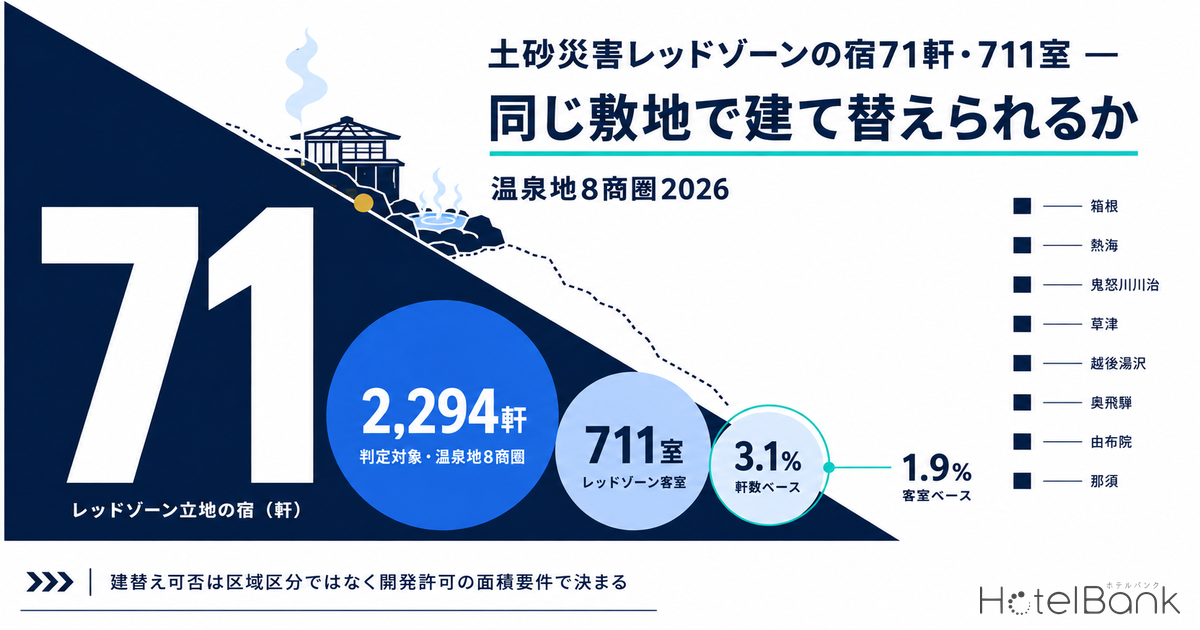
Before asking how much disaster risk should be priced in, there is a more decisive question: can you build on that site again? For onsen ryokan and mountain resorts located in a Sediment Disaster Special Hazard Area (the “red zone”), a rebuild or extension may be stopped at the permitting layer even after acquisition. In this article, we tested 2,294 lodging properties across eight onsen and mountain-resort market areas in Japan, one by one, against the zone data published by the Ministry of Land, Infrastructure, Transport and Tourism (MLIT) Real Estate Information Library, and measured how many properties and rooms sit in red zones. We then break down exactly which provisions of the amended City Planning Act and the Building Standards Act Enforcement Order, both in force since April 1, 2022, actually stop a rebuild — and at what scale.
How this article differs from our earlier coverage. HotelBank has previously covered the quantification of disaster risk as a fourth axis of site evaluation (how to price risk in), river-flood risk at onsen ryokan and the payback period of resilience capex (how many years it takes for a disaster-prevention investment to pay back), and how the Embankment Regulation Act changed land-preparation costs for slope resorts (the procedures and costs of site grading itself). This article deals with the layer that comes before all of those — development permits and structural regulation, i.e. whether you can build at all — and draws on different legal provisions and datasets.
Metric Definitions Used in This Article
- ADR (Average Daily Rate) = an estimated settled rate (tax-excluded equivalent) calculated by applying a segment-specific adjustment factor to the lowest-plan price level each property publishes on OTAs and other channels (per room, 2 guests, tax-included). Checked against property-level results disclosed by listed hotel REITs (91 properties, most recent 3 months), the median error is approximately 7%. These are estimates and differ from each property’s actual settled prices and accounting figures. Area-level ADR is the median of the properties covered (the level of a typical property in the area).
- Red zone = the “areas unsuitable for development activities” listed in Article 33, Paragraph 1, Item 8 of the City Planning Act and Article 23-2 of its Enforcement Order: Disaster Risk Areas, Landslide Prevention Areas, Sediment Disaster Special Hazard Areas, Inundation Damage Prevention Areas, and Steep Slope Collapse Hazard Areas. The zone tests in this article cover the four designations that dominate in onsen and mountain areas (Sediment Disaster Special Hazard Areas, Steep Slope Collapse Hazard Areas, Disaster Risk Areas, and Landslide Prevention Areas).
- Yellow zone = Sediment Disaster Hazard Area (Article 7, Paragraph 1 of the Sediment Disaster Prevention Act). No structural regulations apply to buildings, but the area is subject to the establishment of warning and evacuation systems.
- Zone test method = a point-in-polygon test of whether each property’s representative point (latitude/longitude) falls inside a zone polygon. It does not determine whether the entire site is inside or outside a zone; please treat it as a practical screening indicator.
- — Point-testing 2,294 lodging properties across eight onsen and mountain-resort market areas found 71 properties / 711 rooms in sediment-disaster red zones (3.1% by property count / 1.9% by rooms) and 694 properties / 12,018 rooms in yellow zones (30.3% / 31.4%).
- — Even in a red zone, the prefectural governor’s permit under Article 10 of the Sediment Disaster Prevention Act does not apply to ryokan or hotels (the restricted uses are limited to non-owner-occupied housing, social welfare facilities, schools, and medical facilities). By contrast, the structural regulation in Article 80-3 of the Building Standards Act Enforcement Order applies to every building regardless of size.
- — The “tighter rules in Urbanization Control Areas” highlighted in the April 2022 amendment barely reach onsen towns. Only 9 of the tested properties (0.4%) are in Urbanization Control Areas, while 86.2% (1,977 properties) are in City Planning Areas without area division.
- — What actually decides whether a rebuild is possible is not the area classification but the area thresholds for development permits (3,000㎡ in undivided areas, 1 ha outside City Planning Areas, down to 300㎡ where lowered by ordinance). Rebuilding on the same lot with the same ground profile is not a development activity, but the moment grading or an extension crosses the area threshold, the project falls on the “prohibited in principle” side.
- — How many nights of ADR the added structural cost represents differs by a constant 1.96x across market areas (Atami ¥29,000 vs. Yuzawa ¥14,800, estimated settled ADR, August 2026). This ratio does not move whatever cost premium is assumed — the rate level of the market area itself determines how heavy the constraint is.
“No development in red zones” is only half true for lodging properties
Let us first pin down the legal text precisely. The explanation that “development in disaster red zones is prohibited in principle” is common, but the rules that apply to lodging properties are split into three independent layers, one of which does not apply to ryokan or hotels at all. Confusing these three layers during acquisition review leads to killing deals that should proceed and missing deals that should be stopped.
The first layer is Article 33, Paragraph 1, Item 8 of the City Planning Act. It provides that, for development activities other than those carried out mainly for building a house for the developer’s own residence, “the development area shall not include land within (omitted) Disaster Risk Areas, Landslide Prevention Areas, Sediment Disaster Special Hazard Areas and Inundation Damage Prevention Areas (omitted) or other areas specified by Cabinet Order as unsuitable for development activities.” The 2020 amendment added “facilities used for the developer’s own business” to the scope of this item, effective April 1, 2022. In other words, development activities for building a ryokan that the company itself operates became squarely subject to regulation from that date. The Cabinet Order (Enforcement Order Article 23-2) additionally designates Steep Slope Collapse Hazard Areas, bringing the red zones to five designations in total. However, the item contains a proviso: “this shall not apply when it is found that there is no hindrance in light of the conditions of the development area and its surrounding area.” The prohibition is not absolute; the permitting authority retains discretion.
The second layer is the permit system for specified development activities under Article 10 of the Sediment Disaster Prevention Act — and this is the most misunderstood point in practice. Paragraph 2 of that article exhaustively lists the restricted uses as “housing (excluding that used for one’s own residence), and social welfare facilities, schools and medical facilities used by the elderly, persons with disabilities, infants and other persons who particularly require consideration for disaster prevention.” Ryokan and hotels are not among these restricted uses. Development activities to build lodging properties in a red zone are therefore outside the scope of the governor’s permit under Article 10. The belief that “a red zone means a governor’s development permit is required” is wrong for lodging properties.
The third layer is structural regulation. Article 24 of the Sediment Disaster Prevention Act provides that structural strength standards for buildings with habitable rooms in Special Hazard Areas shall be set by Cabinet Order under Article 20, Paragraph 1 of the Building Standards Act; accordingly, Article 80-3 of the Building Standards Act Enforcement Order requires the exterior walls and principal structural parts of buildings with habitable rooms to be built so that they “will not be destroyed even when subjected to the impact assumed from natural phenomena.” Under Article 25 of the same Act, compliance is subject to building confirmation. A ryokan is by definition a “building with habitable rooms,” and is caught by this layer regardless of its size. The second layer does not apply but the third does — that is the accurate picture for lodging properties located in red zones.
| Layer | Legal basis | Applies to ryokan / hotels? | Trigger condition |
|---|---|---|---|
| Location criteria for development permits | City Planning Act Art. 33(1)(viii) / Enforcement Order Art. 23-2 | Yes (from April 2022) | When a “change in lot layout or land form” of a scale requiring a development permit is involved |
| Governor’s permit for specified development activities | Sediment Disaster Prevention Act Art. 10 | No (not a restricted use) | Only non-owner-occupied housing, social welfare facilities, schools, medical facilities |
| Structural regulation of buildings | Sediment Disaster Prevention Act Arts. 24–25 / Building Standards Act Enforcement Order Art. 80-3 | Yes (regardless of size) | Every building confirmation for buildings with habitable rooms |
| Special provision for relocation outside the zone | City Planning Act Art. 34(viii-2) | Urbanization Control Areas only | When building a replacement building for the same use outside the zone |
The row not to overlook in this table is the bottom one: Article 34, Item 8-2. Newly created by the 2020 amendment, this item added to the permissible activities development for building a “replacement building” for a building located in a red zone within an Urbanization Control Area — for the same use, outside the zone. The legislative stance is clear: rather than rebuilding on the same site, relocation outside the zone is provided as the exit. Buyers of red-zone lodging properties need to design their exit strategy on the premise of this legislative intent.
Measuring 2,294 properties in 8 onsen market areas — 3.1% red, 30.3% yellow
With the legal framework sorted out, we measured where the actual inventory stands. The eight market areas are Hakone, Atami, Kinugawa/Kawaji, Kusatsu, Echigo-Yuzawa, Okuhida, Yufuin, and Nasu. We extracted from the MetroEngines Research property master all lodging properties within a 3–8 km radius of each onsen town’s center (2,294 properties, 38,276 rooms in total), and point-tested each one against the polygons for Sediment Disaster Hazard Areas, Steep Slope Collapse Hazard Areas, Disaster Risk Areas, and Landslide Prevention Areas distributed by the MLIT Real Estate Information Library.
The result: 71 properties / 711 rooms in red zones (3.1% by property count, 1.9% by rooms), and 694 properties / 12,018 rooms in yellow zones (30.3% and 31.4%, respectively). The honest reaction is probably that red is less common than expected and yellow more common. The fact that the red share by rooms is lower than by property count (1.9% < 3.1%) shows that the properties standing in red zones are skewed toward small facilities. Indeed, of the 71, 47 have 9 rooms or fewer, 19 have 10–29 rooms, and 5 have 30–99 rooms; the largest has just 81 rooms. Large ryokan, which require sizeable flat land, are generally not built directly below steep slopes in the first place.
| Market area (test radius) | Properties tested | Total rooms | Red properties | Red rooms | Red share | Yellow properties | Yellow share |
|---|---|---|---|---|---|---|---|
| Hakone Onsen area (Hakone Town, 7 km radius) | 408 | 8,233 | 2 | 14 | 0.5% | 90 | 22.1% |
| Atami Onsen (Atami City, 4 km radius) | 269 | 6,240 | 21 | 187 | 7.8% | 86 | 32.0% |
| Kinugawa / Kawaji Onsen (Nikko City, 6 km radius) | 76 | 3,663 | 1 | 10 | 1.3% | 26 | 34.2% |
| Kusatsu Onsen (Kusatsu Town, 3 km radius) | 220 | 3,832 | 7 | 95 | 3.2% | 9 | 4.1% |
| Echigo-Yuzawa Onsen (Yuzawa Town, 6 km radius) | 373 | 5,875 | 3 | 28 | 0.8% | 204 | 54.7% |
| Okuhida Onsen area (Takayama City, 8 km radius) | 171 | 3,109 | 12 | 194 | 7.0% | 91 | 53.2% |
| Yufuin Onsen (Yufu City, 5 km radius) | 332 | 2,552 | 1 | 1 | 0.3% | 176 | 53.0% |
| Nasu Onsen area (Nasu Town, 6 km radius) | 445 | 4,772 | 24 | 182 | 5.4% | 12 | 2.7% |
| Total | 2,294 | 38,276 | 71 | 711 | 3.1% | 694 | 30.3% |
The differences between market areas directly reflect how the terrain was formed. Nasu (5.4%), Atami (7.8%), and Okuhida (7.0%) have small inns clinging to the foot of steep slopes, pushing their red shares to roughly twice the overall average. Meanwhile, Echigo-Yuzawa (54.7%), Okuhida (53.2%), and Yufuin (53.0%) have yellow shares above 50%. This is because the projected debris-flow inundation zones broadly cover town centers on alluvial fans and valley floors, placing more than half of the inns inside Hazard Areas. Kusatsu (4.1% yellow) and Nasu (2.7% yellow), conversely, have designations confined to the edges of steep slopes, leaving town centers almost entirely outside the zones. A rough assumption that “mountain areas are uniformly heavily regulated” cannot explain the differences between market areas.
There is one more piece of good news for due diligence. For all 694 properties in yellow zones, we checked the “Special Hazard Area not yet designated” flag in the zone data and found that Special Hazard Area designation has been completed in all eight market areas (zero properties fell in zones carrying the not-yet-designated flag). The uncertainty of additional red zones being designated later as basic surveys progress is small for these eight market areas. In other words, the zone test at the time of acquisition can be treated as final.
What stops a rebuild is not the area classification but the scale threshold for development permits
This is the most important finding of this article. For the amendment in force from April 2022, both media coverage and local-government notices center on “tighter regulation in Urbanization Control Areas”: disaster hazard areas were excluded from the ordinance-designated areas under Article 34, Items 11 and 12, closing off locations previously allowed by ordinance. Yet this explanation barely applies to onsen-town inventory.
Testing the area classification of the 2,294 properties shows that only 9 (0.4%) are in Urbanization Control Areas. The overwhelming majority, 1,977 properties (86.2%), are in City Planning Areas without area division (City Planning Areas where no urbanization promotion/control split has been set), 253 (11.0%) are outside City Planning Areas, and 55 (2.4%) are in Urbanization Promotion Areas. In the Okuhida Onsen area, all 171 properties tested are outside City Planning Areas. The tightened rules based on Article 34 therefore have almost no bearing on whether onsen properties can be rebuilt. The structure in which the distribution of area classifications itself dictates the time to opening is not unique to onsen towns: our nationwide analysis of new openings found that 61% of hotels opening in 2026 are located outside Urbanization Promotion Areas.
So what does bite? Article 33, Paragraph 1, Item 8 applies to every development activity requiring a development permit, regardless of area classification. It therefore bites in onsen towns too — but only “when the development activity is of a scale requiring a development permit.” This is where the area threshold for development permits becomes the deciding variable.
| Area | Properties | Scale requiring a development permit | When Art. 33(1)(viii) is triggered |
|---|---|---|---|
| City Planning Area without area division | 1,977 (86.2%) | 3,000㎡ or more (can be lowered to 300㎡ by ordinance) | Rebuilds involving grading or lot changes, extensions, additional buildings |
| Outside City Planning Areas | 253 (11.0%) | 1 ha (10,000㎡) or more | Only new builds or full rebuilds involving large-scale grading |
| Urbanization Promotion Area | 55 (2.4%) | 1,000㎡ or more (can be lowered to 300㎡ by ordinance) | Easily triggered even by small-scale grading |
| Urbanization Control Area | 9 (0.4%) | Development permit regardless of scale (plus Art. 34 location criteria) | Virtually all development activities; an Art. 43 building permit is also required separately |
The practical conclusion that follows may be counterintuitive, but it is clear. A development activity is defined as “a change in the layout or land form of a lot carried out for the purpose of constructing buildings”; simply rebuilding on an existing flat site with the same lot and the same ground profile is not a development activity at all. If it is not a development activity, Article 33, Paragraph 1, Item 8 never comes into play. For the 86% of properties in City Planning Areas without area division, a rebuild proceeds without passing through the development-permit layer — even in a red zone — unless it involves grading exceeding 3,000㎡ (or 300㎡ where lowered by ordinance).
Put the other way, the regulation is triggered the moment you cut into the site and rebuild retaining walls, add buildings, or grade a parking lot to add a guest-room wing. The classic value-add moves — “increasing room count through extensions,” “building a new large-bath wing,” “upgrades involving site grading” — fall on the “not permitted in principle” side in a red zone once they exceed the area threshold. The real meaning of this regulation is that the post-acquisition upside is capped not by the building’s potential but by whether the site can be graded. The procedures and costs of grading itself fall under the Embankment Regulation Act, and forest development exceeding 1 ha requires a separate Forest Land Development Permit; both warrant their own review.
What applies regardless of the scale threshold is the third layer from the previous section: Article 80-3 of the Building Standards Act Enforcement Order. As long as you build a building with habitable rooms in a red zone, its exterior walls and principal structural parts must be designed not to be destroyed by the assumed impact, according to the “magnitude of maximum force, etc.” and the “height of debris, etc.” set by the prefectural governor at the time of zone designation. In practice, designs converge on either installing a debris-catching retaining wall or making the portion below the debris height a reinforced-concrete load-bearing wall. This structural premium applies without exception, even to small rebuilds that do not require a development permit. According to MLIT’s Building Construction Starts Statistics, the planned construction cost of lodging buildings rose by roughly 40% per tsubo between 2022 and 2024, with 2025 market levels said to be around ¥2.4 million per tsubo for steel construction and around ¥2.0 million per tsubo for RC construction. For red-zone sites, business plans need to assume the structural premium plus ground and retaining-wall works on top of these levels.
Atami: how the zones and the inns overlap
We check Atami — which had the most red-zone properties of the eight market areas (21) — on a map. Special Hazard Areas run in bands along the steep slopes looming behind the town and the edges of the coastal terraces, and the pattern of small inns scattered just inside those bands is clearly visible. The test radius is 4 km from the center of Atami Onsen, covering 269 properties.
Red shaded areas are Sediment Disaster Special Hazard Areas (red zones); circles are lodging properties, sized by room count. The aggregate finding from the previous section — larger circles sit outside the zones, while only small circles sit inside — is confirmed visually as well. Atami’s 21 red-zone properties total 187 rooms, an average of 8.9 rooms each. Most are below the size of a typical commercial real estate transaction.
Where does rebuild demand lie dormant? — The distribution of aging stock
The regulatory discussion only matters in practice when there is aging stock that actually needs to consider rebuilding. Of the 2,294 properties tested, we look at the distribution by opening decade for the 1,817 whose opening year could be confirmed.
Properties opened in 1969 or earlier number 176, with 6,855 rooms — the largest block by room count among the inventory that could be dated. That is 18% of the 38,276 total rooms in the eight market areas, confirming that the core inventory of onsen towns is housed in buildings built more than half a century ago. Including those opened through the 1980s, the figure reaches 345 properties and 13,292 rooms. That is the size of the population that will be forced to decide between rebuilding and major renovation over the next decade.
This figure does require a caveat, however. Opening years are based on OTA listing confirmation and do not reflect actual construction years or histories of extensions and renovations. If a long-established ryokan has replaced its building in the past, the building may be new even though the opening year is old. Please read it strictly as a rough indicator of the size of the population that may consider rebuilding. Of the 71 red-zone properties, 12 (289 rooms) opened before 1990, so the volume of aging stock inside the zones is limited. The severity of regulation and the depth of aging do not necessarily overlap in the same places. For the decision framework of renovation versus rebuild itself, see our nationwide analysis Japan’s Pre-1981 Hotel Stock: 236k Rooms, 19.1% — Retrofit or Rebuild.
The market backdrop — ADR levels and YoY in the 8 market areas
Whether a site can be rebuilt only takes on meaning when set against the revenue that site can generate. We review the August 2026 estimated settled ADR and its YoY change at the municipal level for the municipalities containing the eight market areas (note that while the zone tests use circles around onsen town centers, ADR is aggregated across entire municipalities).
| Municipality | Aug 2026 ADR | YoY | Properties covered | Properties covered (prior year) |
|---|---|---|---|---|
| Atami City | ¥29,000 | -1.4% | 108 | 99 |
| Hakone Town | ¥28,200 | -3.4% | 186 | 179 |
| Nasu Town | ¥24,700 | -13.8% | 53 | 48 |
| Yufu City | ¥22,400 | -6.5% | 142 | 136 |
| Kusatsu Town | ¥19,500 | -5.6% | 92 | 81 |
| Nikko City | ¥19,100 | -10.5% | 122 | 118 |
| Takayama City | ¥18,100 | -2.4% | 138 | 129 |
| Yuzawa Town | ¥14,800 | -6.1% | 40 | 36 |
In August 2026, all eight market areas came in below the same month of the previous year. The declines range from -13.8% in Nasu Town to -1.4% in Atami City, but the direction is uniform. The number of properties covered increased year on year in every market area (881 vs. 826 in total), so the decline is not due to a shrinking sample. In a phase where rates are not growing, whether the structural premium of a red-zone site can be absorbed clearly depends on the market area. Between Atami and Hakone at ADR ¥28,000–29,000 and Yuzawa at ¥14,800, the same structural premium takes nearly twice as long to recover. The weight of regulation should not be treated as a uniform discount rate; it needs to be evaluated together with the market area’s rate level. Seasonal rate swings in Hakone, Kusatsu, and Yufuin — including the autumn foliage season — should also be factored into this assessment, since a single month’s ADR does not capture them.
For reference, 9 of the 2,294 properties tested in these eight market areas are owned by seven listed hotel REITs. Of these, 1 fell in a red zone, 2 in yellow zones, and 6 outside any zone. Once again, properties held by institutional investors tend to be relatively large and located on flat land. Conversely, red-zone inventory is concentrated in small-scale stock outside the listed market.
How much does the structural premium bite by market area? — Two-axis sensitivity and three scenarios
At the end of the previous section, we wrote that “the same structural premium takes nearly twice as long to recover depending on the market area.” This proposition can be tested. The added cost of the structural measures required by Enforcement Order Article 80-3 depends on the scale of debris-catching retaining walls and the “magnitude of maximum force, etc.” set at zone designation, and cannot be fixed in advance as a single amount. We therefore use the level of added cost itself as a sensitivity axis and cross it with the market area’s rate level. The metric is “how many nights of the market area’s estimated settled ADR the added cost per room is equivalent to.”
Nature of this estimate (please read)
- The vertical axis — added cost per room — is an assumed value. No public statistics or local-government documents provide a nationwide figure for the cost premium of red-zone structural measures (none could be confirmed at the time of writing). We therefore do not estimate the amount; instead we lay out a plausible range.
- Cell values are nominal nights assuming the full ADR is applied to the added cost, not an investment payback period net of operating and financing costs. Please read them as a relative indicator for comparing the weight of the constraint across market areas on a single scale.
- ADR is the August 2026 estimated settled ADR (aggregated across the entire municipality). The same caveat as in the previous section applies: zone tests use circles around onsen town centers, while ADR covers the entire municipality.
| Added cost / room | Atami ¥29,000 |
Hakone ¥28,200 |
Nasu ¥24,700 |
Yufuin ¥22,400 |
Kusatsu ¥19,500 |
Kinugawa ¥19,100 |
Okuhida ¥18,100 |
Echigo-Yuzawa ¥14,800 |
|---|---|---|---|---|---|---|---|---|
| ¥500,000 | 17 | 18 | 20 | 22 | 26 | 26 | 28 | 34 |
| ¥1,000,000 | 34 | 35 | 40 | 45 | 51 | 52 | 55 | 67 |
| ¥1,500,000 | 52 | 53 | 61 | 67 | 77 | 79 | 83 | 101 |
| ¥2,000,000 | 69 | 71 | 81 | 89 | 103 | 105 | 111 | 135 |
| ¥3,000,000 | 103 | 106 | 121 | 134 | 154 | 157 | 166 | 202 |
Added cost per room is an assumed value (a range is shown). ADR: MetroEngines Research & Consulting (estimated settled ADR, August 2026, N=881 properties). Cell = added cost ÷ ADR, rounded.
The key to reading this table lies not in individual cell values but in the constant ratio within each row. Whether the added cost is set at ¥500,000 or ¥3,000,000, Echigo-Yuzawa requires 1.96 times as many nights as Atami. Since the cost cancels out in the ratio, this is arguably self-evident — but the practical implication is significant. The most uncertain variable — how much the structural premium is estimated to cost — affects neither the ranking between market areas nor the size of the gap. What decides whether a deal works is not the accuracy of the cost estimate but the rate level of the market area where the property sits.
| Scenario | Added cost / room (assumed) |
High-rate market Atami ¥29,000 |
Median of 8 areas ¥20,900 |
Low-rate market Echigo-Yuzawa ¥14,800 |
|---|---|---|---|---|
| Optimistic Existing retaining walls reused; exterior-wall measures suffice | ¥800,000 | 28 | 38 | 54 |
| Base RC exterior walls plus partial debris-catching retaining wall | ¥1,500,000 | 52 | 72 | 101 |
| Pessimistic High debris height; full-scale retaining walls and ground improvement | ¥2,500,000 | 86 | 119 | 168 |
Scenario added costs are assumed values, neither measured nor based on cost estimates. Each scenario description sets out, in stages, typical combinations of the structural methods required by Enforcement Order Article 80-3 (reinforced-concrete exterior walls, etc., and installation of debris-catching retaining walls). The median ADR is the median of the August 2026 estimated settled ADR for the municipalities containing the eight market areas (¥20,943).
Putting this into practice is simple. The gap between the optimistic and pessimistic cases (28 vs. 86 nights in Atami, 54 vs. 168 nights in Echigo-Yuzawa) can be narrowed considerably before acquisition by checking the “magnitude of maximum force, etc.” and “height of debris, etc.” stated in the zone-designation public notice. That is why it is item 4 in the due diligence procedure below: this single item most strongly determines the actual cost range of the structural premium. Conversely, in low-rate market areas, once costs reach the pessimistic-scenario level, it is quicker to consider relocation outside the zone (Article 34, Item 8-2) as the exit before a same-site rebuild.
Pre-acquisition due diligence procedure
We translate the above into a checking sequence for acquiring onsen ryokan and mountain resorts. The order matters: it is faster to pin down the area classification and site area before checking the zone color.
| # | What to check | Where to check | Impact on the decision |
|---|---|---|---|
| 1 | Area classification (Urbanization Control Area, undivided, or outside City Planning Areas) | Municipal city planning division / Real Estate Information Library | Determines the development-permit area threshold and whether an Art. 43 building permit is needed |
| 2 | Whether the area threshold has been lowered by ordinance (down to 300㎡) | Development permit ordinances of the prefecture / designated city | If the assumed 3,000㎡ becomes 300㎡, the rebuild plan changes fundamentally |
| 3 | Whether the site overlaps any of the five red zones (even partially) | Erosion control / river divisions; building guidance division | Art. 33(1)(viii) requires such land “not be included in the development area,” so even partial overlap matters |
| 4 | The “magnitude of maximum force, etc.” and “height of debris, etc.” set at zone designation | Zone-designation public notice and notice documents | Sets the structural design conditions under Enforcement Order Art. 80-3, i.e. the actual construction cost premium |
| 5 | Whether the planned rebuild or extension constitutes a “change in lot layout or land form” | Prior consultation with the development guidance division | If not, Art. 33(1)(viii) is not triggered; this sets the ceiling on value-add potential |
| 6 | Track record of applying the proviso (“no hindrance given surrounding conditions”) | Prefectural development permit review standards / development review board criteria | Possibility of a permit conditional on countermeasure works; large variation between local governments |
From a collateral valuation perspective, the combination of items 3 and 5 is what matters. For a site that overlaps a red zone and whose extension potential is blocked by the area threshold, one must price in the possibility that rebuilding at the same scale becomes difficult once the building’s remaining value is exhausted. Conversely, if the site overlaps a zone but is large enough to secure flat, buildable land in the portion outside the zone, the practical constraint is limited to the cost of the structural premium. Even within the same “red zone,” these are two entirely different assets.
Summary
Zone testing of 2,294 lodging properties in eight onsen and mountain-resort market areas found 71 properties / 711 rooms (3.1%) in red zones and 694 properties / 12,018 rooms (30.3%) in yellow zones. Red-zone properties are skewed toward small facilities with 9 rooms or fewer, and the largest has just 81 rooms.
The “tighter regulation in Urbanization Control Areas” discussed in connection with the amended City Planning Act in force from April 2022 barely reaches onsen towns in practice. Only 9 of the tested properties (0.4%) are in Urbanization Control Areas, while 86.2% are in City Planning Areas without area division. What actually constrains rebuilds is not the area classification but two axes: the area thresholds for development permits (3,000㎡ in undivided areas, 1 ha outside City Planning Areas, 300㎡ where lowered by ordinance), and the structural regulation of Article 80-3 of the Building Standards Act Enforcement Order, which applies regardless of size.
The practical question is therefore not “is it in a red zone?” but “does the planned rebuild or extension involve a change in lot layout or land form that exceeds the area threshold?” A rebuild on the same site and lot does not pass through the development-permit layer and can proceed if the structural premium is accepted. But the moment it involves grading to add rooms, it runs squarely into the in-principle prohibition of Article 33, Paragraph 1, Item 8. The ceiling on value-add is set not by the building but by whether the site can be graded — this is the most fundamental constraint when investing in onsen ryokan located in red zones.
Limitations of this analysis: The zone tests determine whether each property’s representative point (latitude/longitude) lies inside a zone polygon; they do not determine whether the entire site is inside or outside a zone. Actual feasibility should be confirmed by checking the overlap of site boundaries and zone boundaries on surveyed maps, and through prior consultation with the competent development guidance and building guidance divisions. In addition, Article 33, Paragraph 1, Item 8 contains a proviso (when it is found that there is no hindrance in light of surrounding conditions, etc.), and practice regarding permits conditional on countermeasure works varies by local government. This article is not legal advice on the interpretation of laws and regulations, but a quantitative analysis for understanding the structure of the overall market.
Related Articles
- Japan’s Pre-1981 Hotel Stock: 236k Rooms, 19.1% — Retrofit or Rebuild
- Who Owns the Hot Spring? Water Rights and Ryokan Valuation
References and Sources
■ Data sources
Zone tests use the polygons for Sediment Disaster Hazard Areas, Steep Slope Collapse Hazard Areas, Disaster Risk Areas, Landslide Prevention Areas, and City Planning Areas / area classification distributed by the MLIT Real Estate Information Library (version distributed in November 2025). Property master and room counts: MetroEngines Research & Consulting (as of September 2026; 8 market areas, N=2,294 properties, 38,276 rooms). ADR: the same company’s estimated settled ADR (August 2026 / August 2025; 881 / 826 properties covered). Legal provisions refer to the current texts on e-Gov Law Search.
■ Estimation assumptions
Zone tests are point-in-polygon tests of whether each property’s representative point (latitude/longitude) lies inside a zone polygon. Market areas are defined as circles with a 3–8 km radius from the center of each onsen town; the radius for each market area is stated in the table in the body. The opening-decade distribution uses only the 1,817 properties whose opening year could be confirmed. In the structural-premium sensitivity analysis, the added cost per room is set as an assumed value in the range of ¥500,000 to ¥3,000,000, and cell values are “added cost ÷ estimated settled ADR,” rounded (nominal nights assuming the full ADR is applied). Operating costs, financing costs, and occupancy are not factored in.
■ Limitations and caveats
Point tests are a screening indicator and do not determine whether the entire site is inside or outside a zone. ADR is aggregated across entire municipalities and does not match the circles used for zone tests. Opening years are based on OTA listing confirmation and do not reflect histories of extensions or renovations. For the added cost of structural measures, no nationwide premium figure could be confirmed in public statistics or local-government documents, so this article does not estimate the amount and instead presents an assumed range as a sensitivity. Practice regarding the proviso of Article 33, Paragraph 1, Item 8 (when it is found that there is no hindrance in light of surrounding conditions, etc.) varies widely by local government, and this article is not legal advice.
■ Laws and regulations (primary sources)
- City Planning Act (Act No. 100 of 1968), Art. 29, Art. 33(1)(viii), Art. 34(viii-2), Art. 43 (e-Gov Law Search)
- Order for Enforcement of the City Planning Act (Cabinet Order No. 158 of 1969), Arts. 19, 22-2, 23, 23-2 (e-Gov Law Search)
- Act on Promotion of Sediment Disaster Countermeasures for Sediment Disaster Hazard Areas (Act No. 57 of 2000), Arts. 9, 10, 24, 25 (e-Gov Law Search)
- Order for Enforcement of the Building Standards Act (Cabinet Order No. 338 of 1950), Art. 80-3 (e-Gov Law Search)
■ Government and local-government documents
- MLIT, “Q&A on the Amendments to the City Planning Act and the Act on Special Measures concerning Urban Reconstruction (Restricting Development in Disaster Hazard Areas)” (Japanese)
- MLIT, “City Planning: Development Permit System” (Japanese)
- MLIT, “Overview of the Sediment Disaster Prevention Act” (Japanese)
- Sendai City, “Tighter Regulation in Areas at High Risk of Disaster (effective April 1, 2022)” (Japanese)
- Saitama Prefecture, “On the Amendment of the City Planning Act (2020 Amendment)” (Japanese)
- Gunma Prefecture, “The Amended City Planning Act (Development Permit System) Takes Effect April 1, 2022” (Japanese)
- Tokyo Metropolitan Government Bureau of Construction, “Legal Restrictions within Sediment Disaster Special Hazard Areas (Red Zones)” (Japanese)
- MLIT National Land Numerical Information, “Sediment Disaster Hazard Area Data (A33)” attribute specifications (Japanese)
- MLIT, “Building Construction Starts Statistics” — trends in planned construction costs for lodging buildings
■ Spatial data
- MLIT Real Estate Information Library — Sediment Disaster Hazard Areas, Steep Slope Collapse Hazard Areas, Disaster Risk Areas, Landslide Prevention Areas, City Planning Areas / area classification
■ Market data
- MetroEngines Research & Consulting — lodging property master (8 market areas, N=2,294 properties, 38,276 rooms), estimated settled ADR (August 2025 / August 2026), opening years (based on OTA listing confirmation, N=1,817 properties), listed hotel REIT ownership master