

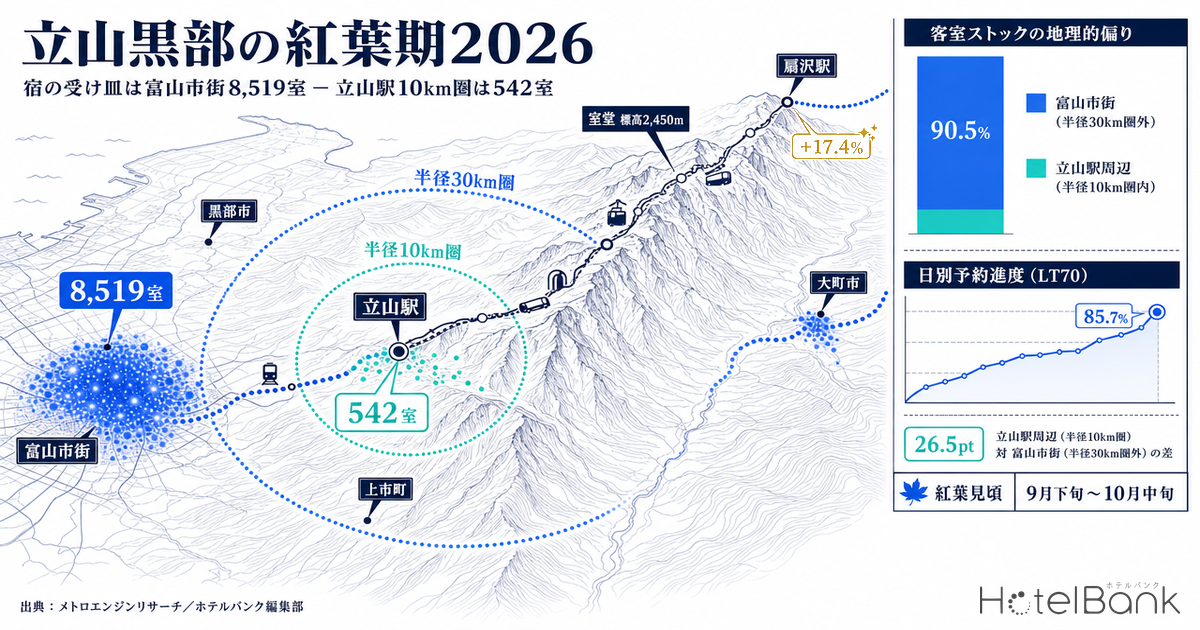
Autumn color on the Tateyama Kurobe Alpine Route starts at Murodo-daira, 2,450m above sea level, and works its way down the mountain over roughly three weeks. The route operates from April 15 to November 30 in fiscal 2026, and demand for autumn foliage is heaviest in the four weeks from late September to mid-October. Yet across that window, the supply of rooms near Tateyama Station — the mountain gateway on the Toyama side — is extremely thin. Aggregating lodging properties within a 30km radius of Tateyama Station, MetroEngines Research counts 286 properties and 11,528 rooms, of which 10,433 rooms (90.5%) sit in the outer 20-30km band — that is, in the city of Toyama. This article quantifies autumn supply and demand along two axes — the geographic skew of room stock, and day-by-day booking progress — to show which areas still have capacity left.
Metric Definitions Used in This Article
- ADR (average daily rate): an estimated settled rate (tax-excluded equivalent) derived by applying category-specific adjustment factors to the lowest published plan rate each property lists on online travel agencies and similar channels (double occupancy, per-room, tax-included). Benchmarked against property-level results disclosed by listed hotel REITs (Invincible Investment Corporation, 184 property-months, April-May 2026), the median error is 7.5% (6.6% at the area-median level for the two-channel ensemble). These are estimates and differ from each property’s actual transacted rates or accounting figures. Area-level ADR is the median across covered properties — the level of a typical property in that area.
- Listed price (all-plan average): the average published price across every plan, from room-only to meals-inclusive (double occupancy, per-room, tax-included). Because its basis differs from the ADR above, this article uses the listed price for all year-on-year comparisons.
- OCC (occupancy): sold rooms as a share of total rooms in the area, estimated from sales inventory published on online travel agencies and similar channels. This article uses it only at the municipal and prefectural level; no figures are computed for individual properties.
- LT (lead time): days remaining until check-in. LT0 = the day itself. “Booking progress” in this article refers to the most recently observed OCC for each check-in date.
- Data source: MetroEngines Research
- — Of the 11,528 rooms within 30km of Tateyama Station, 90.5% (10,433 rooms) sit in the outer 20-30km band in the city of Toyama. The 10km ring holds just 542 rooms, or 4.7%.
- — 53.6% of rooms in the catchment (63 properties, 6,176 rooms) are business hotels. Through the foliage season, weekday corporate demand and leisure demand compete for the same inventory.
- — At the LT70 cross-section for Toyama Prefecture as a whole, Saturday October 3 leads at 85.7%, a 24.1pt gap over the 61.6% average for non-holiday Tuesdays, Wednesdays and Thursdays.
- — Tateyama Town lists 197 rooms and shows only 0-7 rooms left on the key dates from September 19 to October 10. By contrast, Kamiichi Town runs at roughly 50% progress even on peak dates, leaving capacity about 12km from Tateyama Station.
- — Year-on-year listed prices split sharply: Kurobe +17.4%, Tateyama Town +15.6%, Toyama City +15.0% against Uozu −3.3% and Kamiichi −12.5% — the mountain side and eastern municipalities pulling away from the plain.
The Demand Window Shifts Three Weeks with Elevation
Start with the fixed points: the transport calendar and the season, both from official sources. Tateyama Kurobe Kanko, the route operator, states that the fiscal 2026 season runs from Wednesday, April 15, 2026 to Monday, November 30. The Toyama-side gateway is Tateyama Station (about 65 minutes from Dentetsu-Toyama Station, with roughly 900 free parking spaces); the Nagano-side gateway is Ogizawa (about 1 hour 45 minutes by express bus from Nagano Station, or about 1 hour 35 minutes from Matsumoto via Shinano-Omachi).
Peak color arrives at different times by elevation. The official site puts Murodo at mid-September to early October, and the Daikanbo-Kurobedaira stretch at early to mid-October. In practice that gives demand two peaks: travellers who want the alpine grass foliage come in the second half of September, while those after the ropeway-section color come in mid-October. The route is also designed as a one-way traverse, and even a day trip runs six to eight hours round trip, so a night before, a night after, or both is common. That is why lodging demand builds continuously from late September through mid-October.
One more premise: Hotel Tateyama, at Murodo 2,450m above sea level, has announced that it will end its lodging business on August 31, 2026, while continuing to operate its restaurant and shop. The set of options for staying on the mountain itself has therefore changed, and that is part of the starting condition for this season’s capacity picture.
Only 542 Rooms Within 10km of Tateyama Station — 4.7% of the Catchment
Taking Tateyama Station (36.5806°N, 137.4278°E) as the centre, we extracted lodging properties within a 30km radius and stacked room counts by straight-line distance band. The result is unambiguous. The 0-10km band holds 40 properties and 542 rooms; 10-20km holds 31 properties and 553 rooms; and 20-30km concentrates 215 properties and 10,433 rooms. Across the full catchment: 286 properties and 11,528 rooms (MetroEngines Research, operating properties only, N=286 properties). Rooms inside 10km are just 4.7% of the total, and even extending to 20km reaches only 9.5%.
Source: MetroEngines Research; compiled by the HotelBank Editorial Team (straight-line distance from Tateyama Station, operating properties only, N=286 properties / 11,528 rooms)
The skew is partly a matter of terrain. Private vehicles cannot proceed beyond Tateyama Station, and there is little flat land on which lodging can be built. The 20-30km band, meanwhile, takes in the whole of urban Toyama. Toyama City alone accounts for 161 properties and 8,519 rooms — 73.9% of the catchment’s rooms in a single municipality. The starting point, then, is that lodging demand generated by a “go see the autumn colours at Tateyama Kurobe” itinerary is, geographically, absorbed almost entirely by the city of Toyama.
Source: MetroEngines Research; compiled by the HotelBank Editorial Team. Circle size represents rooms by municipality; dashed rings mark 10km and 30km from Tateyama Station
53.6% of Rooms Are Business Hotels — the Mix Is Skewed Too
Volume is only half the story; the mix of property types matters too. Breaking the 11,528 rooms inside 30km down by category, business hotels account for 63 properties and 6,176 rooms — 53.6% of the total. City hotels follow with 12 properties and 1,819 rooms (15.8%), then ryokan with 71 properties and 1,301 rooms (11.3%). Ryokan are the most numerous type by property count, but at an average of 18.3 rooms each they are small, and their share on a room basis stops just above 10%.
| Property type | Properties | Rooms | Share | Avg per property |
|---|---|---|---|---|
| Business hotels | 63 | 6,176 rooms | 53.6% | 98.0 rooms |
| City hotels | 12 | 1,819 rooms | 15.8% | 151.6 rooms |
| Ryokan | 71 | 1,301 rooms | 11.3% | 18.3 rooms |
| Resort hotels | 7 | 500 rooms | 4.3% | 71.4 rooms |
| Deluxe hotels | 2 | 207 rooms | 1.8% | 103.5 rooms |
| Other (lodges, pensions, minshuku, etc.) | 131 | 1,525 rooms | 13.2% | 11.6 rooms |
| Total | 286 | 11,528 rooms | 100.0% | 40.3 rooms |
Source: MetroEngines Research; compiled by the HotelBank Editorial Team (within 30km of Tateyama Station, operating properties only, N=286 properties)
Autumn foliage travel is driven by leisure parties of two or more, which would normally pair well with dinner-inclusive ryokan and resort hotels. The catchment’s room mix, however, is more than half urban Toyama stock built around weekday corporate demand. Layering foliage-season leisure demand onto that base widens the gap between weekdays and weekends or long weekends beyond the usual. The day-by-day booking progress in the next section reflects exactly this structure.
Booking Progress by Date — October 3 Leads, 24.1pt Above Weekdays
Next, the demand side. If you simply line up “current occupancy” by check-in date, the nearer dates will naturally look further along, and that trivial difference contaminates the comparison. So this section aligns every check-in date at LT70 — 70 days before check-in. Comparing at a single lead-time cross-section isolates the genuine demand difference between dates.
Source: MetroEngines Research; compiled by the HotelBank Editorial Team (all of Toyama Prefecture, at LT70, 133-193 properties observed / 12,567-12,913 total rooms)
Across Toyama Prefecture at LT70, the furthest-booked date was Saturday, October 3, at 85.7%. Next came Sunday September 20 at 84.2%, Saturday October 10 at 80.4%, Saturday September 19 at 80.1%, Friday October 2 at 78.4%, and Monday September 21 (Respect for the Aged Day) at 77.7%. The average across the 14 non-holiday Tuesdays, Wednesdays and Thursdays, by contrast, was 61.6% — a 24.1pt gap to the peak date.
What stands out is how sharply progress splits inside the long weekend itself. In 2026, Tuesday September 22 falls between Monday September 21 (Respect for the Aged Day) and Wednesday September 23 (Autumn Equinox Day) and therefore becomes a citizens’ holiday, creating a five-day break from Saturday September 19 through Wednesday September 23. The first two days run high (September 19 at 80.1%, September 20 at 84.2%), then day three, September 21, sits at 77.7%, day four, September 22, at 67.2%, and the final day, September 23, drops all the way to 55.2%. The Sports Day weekend of October 10-12 behaves the same way: October 10 at 80.4% and October 11 at 72.1%, but the closing day, October 12, falls to 57.4% — level with an ordinary weekday. The last night of a long weekend is the night people travel home, so lodging demand does not form. Even where the holiday calendar shows three to five days, the lodging peak is effectively only two nights. The pattern of September 23 in the back half of Silver Week falling to the level of a normal Wednesday is observed nationally as well, and we examined it as a lead-time-aligned fixed-point comparison in Silver Week 2026 Back Half at T-47.
The other thing not to miss is the week of Friday October 2 (78.4%) and Saturday October 3 (85.7%), which belongs to no long weekend at all. That Saturday outrunning the long-weekend Saturday (October 10, 80.4%) is consistent with the Daikanbo-Kurobedaira stretch entering peak colour in early October. The pattern of demand forming on the eve of a holiday is observed in other foliage areas too, but in the Tateyama Kurobe catchment an ordinary Saturday in the middle of peak colour beats the long weekend.
By Municipality, Where Capacity Remains Is Clearly Split
Splitting the catchment by municipality, here is the most recent booking progress observed as of the survey date. The table below shows the latest observation for each check-in date, and within a given date every municipality is aligned to the same lead time. Note, however, that different date columns carry different lead times (September 19 is LT32, October 16 is LT59), so the table is not suited to comparison across columns.
| Municipality | Listed rooms | Sep 19 (Sat) LT32 | Sep 20 (Sun) LT33 | Sep 26 (Sat) LT39 | Oct 3 (Sat) LT46 | Oct 10 (Sat) LT53 | Oct 16 (Fri) LT59 |
|---|---|---|---|---|---|---|---|
| Tateyama Town | 197 rooms 9 properties | 99.4% 1 left | 99.4% 1 left | 98.8% 2 left | 99.0% 2 left | 100.0% 0 left | 81.2% 37 left |
| Toyama City | 6,467 rooms 61 properties | 93.6% 397 left | 98.7% 79 left | 93.1% 450 left | 92.8% 466 left | 86.9% 845 left | 81.4% 1,203 left |
| Kurobe | 782 rooms 14 properties | 87.6% 97 left | 94.5% 43 left | 86.6% 105 left | 89.9% 79 left | 83.4% 130 left | 90.4% 75 left |
| Uozu | 936 rooms 13 properties | 95.2% 45 left | 99.8% 2 left | 65.4% 324 left | 90.0% 94 left | 83.9% 151 left | 89.0% 103 left |
| Kamiichi | 100 rooms 4 properties | 69.0% 31 left | 100.0% 0 left | 49.0% 51 left | 50.0% 50 left | 52.0% 48 left | 61.0% 39 left |
| Omachi Nagano / Ogizawa side | 1,075 rooms 33 properties | 89.3% 115 left | 96.1% 42 left | 75.3% 266 left | 80.3% 212 left | 89.3% 115 left | 71.1% 310 left |
Source: MetroEngines Research; compiled by the HotelBank Editorial Team (latest observation as of the survey date, August 19, 2026. Properties observed: Tateyama Town 3-7, Toyama City 39-54, Kurobe 11-14, Uozu 9-13, Kamiichi 4, Omachi 26-31)
Tateyama Town lists 197 rooms and shows between zero and seven rooms remaining on every key date from September 19 to October 10. Only on Friday October 16 does it loosen to 37 rooms left (81.2%). That figure does not, however, mean every inn in Tateyama Town is full. Its 197 listed rooms represent just 43% of the 460 rooms (29 properties) registered in the area master, and only three to seven of nine properties are observable. Several explanations for the small online allotment are plausible: channel strategies centred on direct sales through official sites or on travel agencies, a practice of releasing inventory in small increments as check-in approaches, or contractually small allocations to online channels. What the data supports is a narrower statement — the inventory bookable through online channels is close to full on the key dates of the foliage season.
Source: MetroEngines Research; compiled by the HotelBank Editorial Team (latest observation for each date; lead time is aligned across all municipalities within a given date)
Kamiichi Town, by contrast, shows real slack. It is small — 100 listed rooms across four observed properties — but holds close to half its rooms open even on key dates: 49.0% on September 26, 50.0% on October 3, 52.0% on October 10. It sits about 12km from Tateyama Station in a straight line, the second closest after Tateyama Town. Similarly, Uozu runs at 65.4% on September 26 (324 rooms left) and Kurobe at 83.4% on October 10 (130 rooms left), so a meaningful amount of capacity remains in the eastern municipalities beyond urban Toyama.
Toyama City holds the largest absolute capacity: 466 rooms left on October 3, 845 on October 10, and 1,203 on October 16. Progress runs around 90%, but with a base of 6,467 rooms the raw count of remaining rooms is the thickest in the catchment. Sunday September 20 is the exception, tightening to 79 rooms left (98.7%) — on the middle day of the Respect for the Aged Day weekend, even the city centre is hard to book.
Listed Prices Up 9-21% Year on Year — Gains Concentrated Inland and East
Now the price side. For year-on-year comparison we use the listed price (all-plan average), which is measured on a consistent basis. For Toyama Prefecture as a whole, the listed price in September 2026 was ¥24,400 (¥21,500 a year earlier, +13.4%) and in October ¥24,900 (against ¥21,600, +15.5%) — a mid-teens increase at the prefectural level.
Source: MetroEngines Research; compiled by the HotelBank Editorial Team (listed price, all-plan average, double occupancy, per-room, tax-included)
Split by municipality, the picture is uneven. For September, year-on-year gains were largest inland and toward Kurobe-Unazuki: Kurobe +17.4% (¥38,100 to ¥44,800), Tateyama Town +15.6% (¥32,200 to ¥37,200) and Toyama City +15.0% (¥18,000 to ¥20,700). In October, Kurobe stretches further to +20.6% (¥41,300 to ¥49,700). Uozu, on the other hand, came in below the prior year at −3.3% in September and −6.6% in October, as did Kamiichi at −12.5% and −7.2%. Kamiichi’s figure covers only five properties, so turnover in the property mix moves the number easily and it should be read with that discount.
| Municipality | Sep 2026 listed price | YoY | Oct 2026 listed price | YoY | Est. settled ADR Sep 2026 |
|---|---|---|---|---|---|
| Kurobe | ¥44,800 | +17.4% | ¥49,700 | +20.6% | ¥17,400 15 properties |
| Tateyama Town | ¥37,200 | +15.6% | ¥36,000 | +14.3% | ¥18,800 4 properties |
| Omachi (Nagano) | ¥30,600 | +48.2% | ¥31,200 | +35.4% | ¥16,500 20 properties |
| Kamiichi | ¥30,900 | −12.5% | ¥32,100 | −7.2% | ¥14,700 4 properties |
| Toyama City | ¥20,700 | +15.0% | ¥20,300 | +9.0% | ¥11,500 54 properties |
| Uozu | ¥15,100 | −3.3% | ¥15,100 | −6.6% | ¥10,800 12 properties |
| Toyama Prefecture total | ¥24,400 | +13.4% | ¥24,900 | +15.5% | ¥11,500 163 properties |
Source: MetroEngines Research; compiled by the HotelBank Editorial Team. Year-on-year figures are based on listed price (all-plan average). Estimated settled ADR for September-October 2026 is inferred from listing conditions at the survey date and is computed on a different basis from settled past months, so it is not used for year-on-year calculations
Lining up estimated settled ADR levels for September 2026: Tateyama Town ¥18,800, Kurobe ¥17,400, Omachi ¥16,500, Kamiichi ¥14,700 and Toyama City ¥11,500. The gap between Tateyama Town and Toyama City is about 1.6x — narrower than the listed-price gap (¥37,200 against ¥20,700, or 1.8x). The reading is that high-priced plans on the mountain side lift the listing average, while the band at which rooms actually sell sits somewhat lower. As we found in Toyama’s 14 municipalities and their four price tiers, spanning a 3.3x gap, the Tateyama Kurobe catchment is an unusual area in which the top two tiers sit directly alongside the bottom one.
On the Nagano Side, Omachi Lists 1,075 Rooms — Looser on Some Dates
Aggregating a 30km radius around Ogizawa, the route’s other gateway, Omachi emerges with 135 properties and 2,224 rooms — the nearest capacity of any scale to Ogizawa. That 30km ring also takes in Hakuba Village (1,021 properties, 9,567 rooms) and Otari Village (193 properties, 2,690 rooms), so the full catchment reaches 1,689 properties and 18,273 rooms, 1.6 times the size of the Toyama side. Hakuba and Otari are fundamentally ski-resort clusters and sit around an hour away from a Tateyama Kurobe foliage itinerary, but they can function as an overflow destination when demand spills over.
Looking at booking progress for Omachi’s online-channel inventory (33 properties, 1,075 rooms): key dates tighten — 96.1% on September 20 (42 rooms left) and 89.3% on October 10 (115 rooms left) — but several dates run looser than their Toyama-side equivalents, at 75.3% on September 26 (266 rooms left), 80.3% on October 3 (212 rooms left) and 71.1% on October 16 (310 rooms left). October 3 is notable: it was the furthest-booked date for Toyama Prefecture at the LT70 cross-section, yet Omachi still had more than 200 rooms open. For itineraries that can be built from Ogizawa, shifting to the Nagano side widens the options.
Note also that Nagano Prefecture’s accommodation tax took effect on June 1, 2026. The main driver of Omachi’s large listed-price gain (+48.2% year on year in September) appears to be a change in the property mix, but any pass-through of the tax is also included in listed prices.
⚠ A note on forward-dated data: the price and inventory figures for September-October 2026 in this article are estimates based on sales information published on online travel agencies and similar channels as of the survey date, August 19, 2026, and will move as check-in approaches. Every analysed date falls more than 30 days beyond the survey date, so this article makes no assertion of “sold out” or “early sell-out” and presents the figures as booking progress at the current point in time. Hotels may release additional inventory in stages, and cancellations may return inventory to the market.
Conclusion — Capacity Remains in the East and Outside the Long Weekends
Pulling the numbers together, here is where the capacity actually sits.
First, there is almost no volume headroom near Tateyama Station. The 10km ring holds 542 rooms, and even out to 20km only 1,095 — 9.5% of the catchment’s 11,528 rooms. Tateyama Town’s 197 rooms of online-channel inventory sit at zero to seven rooms remaining across the key dates from September 19 to October 10. Planning a stay at the foot of the mountain during the foliage season tends to come down to two options: lock it in early, or build the itinerary around a different area from the outset.
Second, the capacity that remains in bulk is in urban Toyama and the three eastern municipalities. Toyama City runs at around 90% progress, but with a base of 6,467 rooms it carries the thickest absolute remainder (466 rooms left on October 3, 1,203 on October 16). Kamiichi Town is small at 100 listed rooms, yet holds around 50% progress even on key dates — and at roughly 12km from Tateyama Station, it is the nearby area with the most slack in the catchment. Uozu and Kurobe likewise hold remainders in the 100-300 room range from September 26 through mid-October.
Third, the troughs are outside the long weekends and on their final days. At the LT70 cross-section for Toyama Prefecture, Wednesday September 23 (Autumn Equinox Day) sits at 55.2% and Monday October 12 (Sports Day) at 57.4% — the closing day of a long weekend falls to weekday levels. The average for non-holiday Tuesdays, Wednesdays and Thursdays is 61.6%, 24.1pt below the 85.7% peak. Dates with thin demand exist right in the middle of peak colour, immediately adjacent to the long weekends.
Fourth, the Nagano side is looser than the Toyama side on certain dates. Omachi (33 properties, 1,075 rooms) had 212 rooms left on October 3 and 310 on October 16. Where an Ogizawa-based itinerary is feasible, there is capacity to absorb travellers on the dates when the Toyama side tightens.
Translated into an operator’s view, this structure points to several revenue opportunities. Business hotels hold 53.6% of the catchment’s rooms, so on foliage-season weekdays leisure and corporate demand compete for the same inventory — while on the closing days of long weekends and on Tuesdays, Wednesdays and Thursdays within the peak window, inventory sits at around 60% progress. There is meaningful room to push multi-night offers tied to foliage-timing information, and for eastern-area properties to position themselves as the alternative on the key dates when the foothills fill. The Tateyama Kurobe catchment is a textbook case of a mountain gateway that peaks in autumn, with demand peaks and troughs alternating on a two-week cycle. Whether a property can design day-level inventory allocation around that amplitude is what will separate outcomes across the four weeks of the season.
Related Reading
- Toyama’s 14 Municipalities 2026: 3.3x ADR Gap, Four Price Tiers
- Japan’s 15 Trailhead Towns: Autumn ADR Peaks vs Winter Ski Premiums
- Culture Day 2026 Falls Tuesday: Demand Peaks on Holiday Eve, +9.3pt
- Nagano Accommodation Tax June 1: 2nd Prefecture, ADR Impact & Pass-Through Scenarios
- Silver Week 2026 Back Half at T-47: Sep 23 Matches a Normal Wednesday
- Japan Autumn ADR 2026: 20 Prefectures Peak in Nov, Kyoto +81.8%
References and Sources
■ Transport and season information (official)
- Tateyama Kurobe Alpine Route, “Group reservations for the fiscal 2026 Tateyama Kurobe Alpine Route” (Tateyama Kurobe Kanko) — fiscal 2026 season: Wednesday, April 15, 2026 to Monday, November 30, 2026
- Tateyama Kurobe Alpine Route, “Tateyama Kurobe Autumn Travel” — peak colour at Murodo mid-September to early October; Daikanbo to Kurobedaira early to mid-October
- Tateyama Kurobe Alpine Route, “Publication of the Tateyama Kurobe Alpine Route timetable”
- Toyama Kanko Navi (official Toyama Prefecture tourism site), “Complete guide to the Tateyama Kurobe Alpine Route” — access to Tateyama Station and Ogizawa Station
- Travel Voice, “Hotel Tateyama on the Tateyama Kurobe Alpine Route to end its lodging business at the end of August 2026; restaurant and shop to continue”
■ Data sources
This article uses lodging data compiled by MetroEngines Research from information published on online travel agencies and similar channels. Specifically: listed price and estimated settled ADR by municipality and by prefecture (September 2025 to October 2026); sell-through of listed inventory by check-in date (Toyama Prefecture as a whole plus Tateyama Town, Toyama City, Kurobe, Uozu, Kamiichi and Omachi, for check-ins from September 12 to October 20, 2026); and property counts, room counts and property-type aggregates within 30km of Tateyama Station and of Ogizawa (N=286 properties / 11,528 rooms and 1,689 properties / 18,273 rooms). The transport season and peak-colour timing come from information published by Tateyama Kurobe Kanko and Toyama Kanko Navi.
■ Calculation assumptions
Distance bands are cut by straight-line distance from Tateyama Station (36.5806°N, 137.4278°E) and from Ogizawa (36.5678°N, 137.7003°E), covering operating properties only. Booking progress is compared at a common lead-time cross-section: the prefecture-wide day-by-day comparison is standardised at LT70, while the municipality table uses the latest observation for each check-in date with lead time aligned within each row (no comparison is drawn across columns). Rooms remaining are calculated as listed rooms x (1 − progress). Year-on-year comparisons use the listed price (all-plan average, double occupancy, per-room, tax-included), which is measured on a consistent basis; estimated settled ADR is used only for cross-sectional level comparison.
■ Limitations and caveats
Coverage is limited to inventory listed on online travel agencies and similar channels and excludes direct sales through official sites and travel-agency allotments (Tateyama Town’s 197 listed rooms represent 43% of the 460 rooms registered in the area master). Every analysed date falls more than 30 days beyond the survey date of August 19, 2026 and will move with staged inventory releases and cancellations, so this article makes no assertion that any date is sold out. Kamiichi and Tateyama Town are covered by only four to five properties each, so turnover in the property mix moves their figures easily. Estimated settled ADR for September-October 2026 is inferred from a listing snapshot and is computed on a different basis from settled past months.
■ Market data
- MetroEngines Research — listed price and estimated settled ADR (monthly, by municipality); estimated occupancy and booking curves based on inventory listed on online travel agencies and similar channels (Toyama and Nagano Prefectures, check-ins from September 12 to October 20, 2026); room counts and property-type aggregates for lodging properties in the catchment (within 30km of Tateyama Station and Ogizawa, N=286 properties / 1,689 properties)