

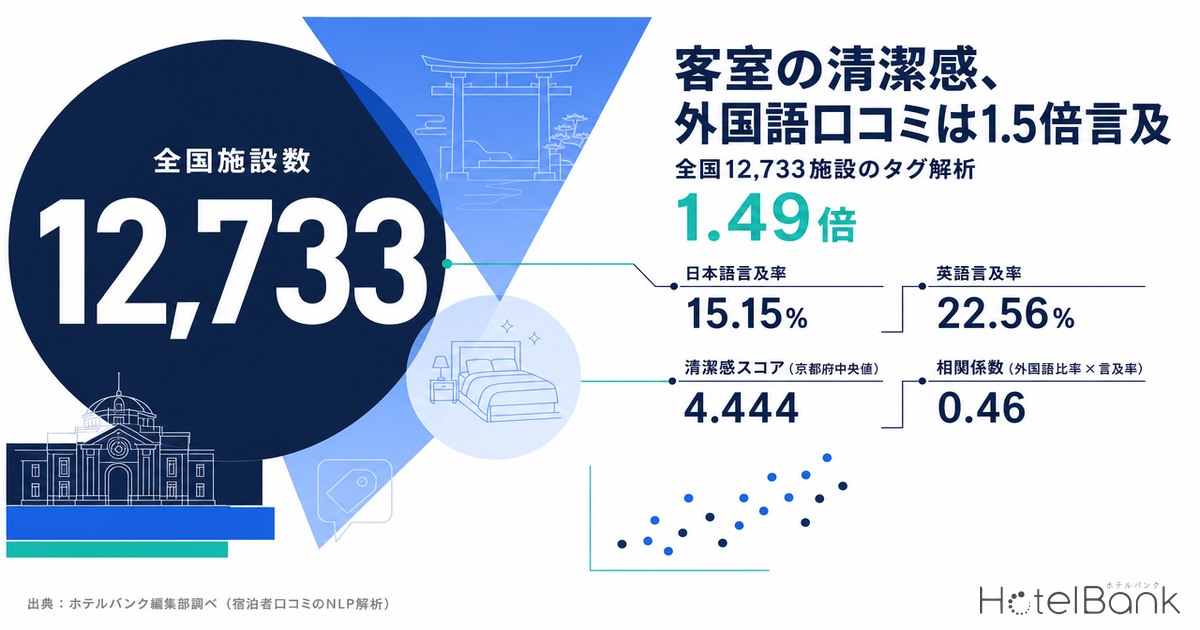
When guests talk about their room, the single thing they mention most is how clean it was. The HotelBank Editorial Team ran NLP (natural language processing) over 1,537,404 guest reviews covering 12,733 lodging facilities across Japan, and found that cleanliness is the second most frequently mentioned evaluation axis after location — and that it comes up roughly 1.5 times more often in foreign-language reviews than in Japanese ones. At the same time, the facilities where cleanliness is mentioned most are not necessarily the ones that score highest on it. This article reads the review-tag data quantitatively to show how room cleanliness is evaluated, and where the real differences lie.
- — English reviews mention it 1.49× as often as Japanese ones: the mention rate for room cleanliness is 15.15% in Japanese versus 22.56% in English. Inbound guests talk about room cleanliness more (Tokyo, 24 months).
- — The gap between facilities is wider than the gap between areas: the spread of prefectural medians is 0.444 points. Within a single prefecture, the facility-to-facility spread (p25–p75) averages 0.579 points — 1.3 times as wide.
- — Mention rate does not explain the score: across the 88 sampled facilities the correlation is −0.174. What does move with the score is the negative share (−0.481) — what matters is the substance of the mentions, not how many there are.
- — Foreign-language share and mention rate move together: correlation 0.46. Facilities in the top quartile for foreign-language share show a 26.09% mention rate, versus 18.73% in the bottom quartile.
- — Cleanliness is described as an overall impression: component-level mentions such as bedding or odour barely accumulate. What decides the evaluation is the impression formed the moment a guest walks into the room.
Metric Definitions Used in This Article
- Cleanliness score: the per-facility average of guest-review ratings relating to cleanliness, aggregated on a 5-point scale. At area level we use the median, first quartile (p25) and third quartile (p75) of the score distribution across the facilities covered.
- Mention rate: the share of a facility’s total reviews that touch on room cleanliness. A quantitative measure of how much it is talked about — not of how highly it is rated.
- Negative share: the share of cleanliness mentions that are framed in a negative context. A qualitative measure, independent of the mention rate.
- Period and population: the 24 months from August 2024 to August 2026. The area analysis covers 12,733 facilities and 1,537,404 reviews nationwide; the facility-level analysis covers the 88 top-scoring facilities for cleanliness in Tokyo, Kyoto and Osaka (250+ reviews each; 216,311 reviews, 46,586 cleanliness mentions).
- Data source: HotelBank Editorial Team research (NLP analysis of guest reviews)
Cleanliness is the room attribute guests discuss second only to location
Start with what guests actually say, broken out by language. Splitting reviews posted for lodging facilities in Tokyo into Japanese (571,221 reviews) and English (357,800 reviews), the mention rate for cleanliness is 15.15% in Japanese versus 22.56% in English — a 1.49× gap. In Japanese it ranks second, behind location and station access (24.04%); in English it ranks third, behind station access (26.03%) and location overall (24.19%).
This structure is not specific to Tokyo. Kyoto shows almost exactly the same ratio: 15.38% in Japanese versus 22.55% in English. For inbound guests, the cleanliness of the room appears to have become an unavoidable talking point when describing a stay in Japan.
Source: HotelBank Editorial Team research (NLP analysis of guest reviews; Tokyo, 571,221 Japanese-language / 357,800 English-language reviews)
The items where the two languages diverge most are worth noting. Alongside cleanliness (+7.4pt), English reviews are heavier on staff service overall (9.99% in Japanese to 17.35% in English, +7.4pt) and room size (8.76% to 13.04%, +4.3pt). Dining runs the other way: 11.40% in Japanese against 8.94% in English. Japanese reviews devote space to the food; English reviews concentrate on the physical state of the room and on personal service. We test this difference in evaluation axes across a wider set of languages in our tag analysis of 3.46 million reviews in 8 languages.
The prefectural gap is 0.44 points; the gap between facilities is 1.3× that
Next, how much cleanliness scores vary by region. Across the 47 prefectures, Kyoto has the highest median at 4.444 and the lowest prefecture sits at 4.000 — a spread of just 0.444 points. Twenty-two prefectures fall at 4.2 or above, so regional differences in level are limited.
Within a single prefecture, by contrast, the spread between facilities (p25 to p75) averages 0.579 points across the 47 prefectures, running from 0.477 in the tightest prefecture to 0.683 in the widest. In other words, which facility you stay in matters more for the cleanliness experience than which area you stay in. Judging your own position against an area average risks misreading the competitive environment you are actually in. For the procedure of checking your position against the distribution in your own trade area, see our price-position check built on the review distribution in central Sapporo.
Source: HotelBank Editorial Team research (NLP analysis of guest reviews; 12,733 facilities and 1,537,404 reviews nationwide)
Kyoto (median 4.444, 396 facilities) and Nara (4.324, 101 facilities) lead, while the large metropolitan markets sit near the national average — Tokyo at 4.229 (868 facilities) and Osaka at 4.183 (437 facilities). In Kyoto and Nara, a diverse mix of formats including ryokan and apartment-type accommodation is distributed at a high level, which appears to lift the median.
| Prefecture | Facilities | Reviews | Median | p25 | p75 | Facility spread |
|---|---|---|---|---|---|---|
| Kyoto | 396 | 39,355 | 4.444 | 4.110 | 4.706 | 0.596 |
| Nara | 101 | 10,789 | 4.324 | 4.014 | 4.599 | 0.585 |
| Nagano | 686 | 46,193 | 4.304 | 3.923 | 4.556 | 0.633 |
| Okinawa | 373 | 34,697 | 4.268 | 3.897 | 4.500 | 0.603 |
| Hyogo | 407 | 49,066 | 4.261 | 3.938 | 4.548 | 0.610 |
| Tokyo | 868 | 155,878 | 4.229 | 3.898 | 4.430 | 0.532 |
| Kanagawa | 440 | 66,223 | 4.203 | 3.904 | 4.459 | 0.555 |
| Osaka | 437 | 81,534 | 4.183 | 3.857 | 4.379 | 0.522 |
| Hokkaido | 711 | 101,262 | 4.162 | 3.854 | 4.423 | 0.569 |
| Aichi | 372 | 50,527 | 4.079 | 3.752 | 4.353 | 0.601 |
Source: HotelBank Editorial Team research (NLP analysis of guest reviews)
A high mention rate does not necessarily mean a high score
From here we move to the facility level. Aggregating mention rate and score by hotel type across the 88 top-scoring facilities for cleanliness in Tokyo, Kyoto and Osaka, the two point in opposite directions.
| Hotel type | Facilities | Cleanliness mention rate | Negative share | Cleanliness score |
|---|---|---|---|---|
| Business hotels | 40 | 26.00% | 9.67% | 4.728 |
| City hotels | 31 | 21.10% | 8.89% | 4.765 |
| Deluxe hotels | 13 | 17.08% | 8.22% | 4.802 |
Source: HotelBank Editorial Team research (NLP analysis of guest reviews; hotel types with 5 or more of the 88 top cleanliness-scoring facilities in Tokyo, Kyoto and Osaka)
At business hotels more than one review in four (26.00%) touches on cleanliness, against 17.08% at deluxe hotels. Yet the highest score belongs to deluxe hotels, at 4.802. Across all 88 facilities the correlation between mention rate and score is −0.174, slightly negative. Note that these 88 facilities were selected as the top cleanliness scorers among facilities with 250 or more reviews in Tokyo, Kyoto and Osaka, so the score distribution is narrow by construction. The correlation coefficients below should be read as relationships within that restricted range.
This does not mean lower ratings. At upper-grade properties, guest attention is spread across several axes — staff service, dining, views — so less space goes to cleanliness, which is treated as a given. Among the top cleanliness scorers in Tokyo, The Tokyo Station Hotel (東京ステーションホテル) (score 4.905, 1,773 reviews) has a cleanliness mention rate of 9.02%, and Hotel Chinzanso Tokyo (ホテル椿山荘東京) (4.896, 2,288 reviews) just 6.64%. Both score among the highest in the country; because cleanliness is taken as a shared premise, review attention shifts to service and the wider on-property experience. Put the other way round, a facility with a high cleanliness mention rate is being chosen for that one thing, and remembered for it.
Source: HotelBank Editorial Team research (NLP analysis of guest reviews; N=88 facilities)
The higher the foreign-language review share, the more cleanliness gets discussed
So what pushes the mention rate up? Sorting the 88 facilities by the foreign-language share of their reviews produces a clear pattern. In the bottom quartile (33.3% foreign-language on average) the cleanliness mention rate is 18.73%; in the top quartile (84.4% on average) it is 26.09% — 7.4 points higher. The correlation between foreign-language share and mention rate is 0.46.
Source: HotelBank Editorial Team research (NLP analysis of guest reviews; 88 top cleanliness-scoring facilities in Tokyo, Kyoto and Osaka)
Put differently, at facilities with a high inbound share, cleanliness is where the review battle is fought. Read alongside inbound share by facility type, the more a facility expands its inbound intake, the more its housekeeping quality comes to shape the overall tone of its reviews. Investment in cleaning operations can reasonably be framed as an issue directly tied to a shifting demand mix.
The real signal is in the substance of the mentions
While the mention rate explains almost nothing about the score, one metric clearly moves with it: the share of cleanliness mentions framed in a negative context — the negative share. Across the 88 facilities the correlation between negative share and score is −0.481, far stronger than the mention rate’s −0.174. Pooled across the 88 facilities the negative share is 9.25%, meaning roughly one cleanliness mention in eleven is framed around room for improvement.
Below are the facilities with a particularly low negative share — that is, where cleanliness is consistently rated highly. All are limited to facilities that have accumulated 200 or more cleanliness mentions.
| Facility | Area | Cleanliness mentions | Negative share | Mention rate | Score |
|---|---|---|---|---|---|
| Mercure Tokyo Haneda Airport (メルキュール東京羽田エアポート) | Tokyo | 1,069 | 2.4% | 26.5% | 4.863 |
| Hotel Musse Kyoto Shijo Kawaramachi Meitetsu (ホテルミュッセ京都四条河原町名鉄) | Kyoto | 210 | 2.9% | 23.8% | 4.837 |
| Nippon Seinenkan Hotel (日本青年館ホテル) | Tokyo | 478 | 2.9% | 26.8% | 4.785 |
| Hotel Metropolitan Haneda (ホテルメトロポリタン羽田) | Tokyo | 958 | 3.2% | 24.5% | 4.792 |
| Kyoto Brighton Hotel (京都ブライトンホテル) | Kyoto | 343 | 3.5% | 15.7% | 4.848 |
| MONday Apart Premium Hamamatsucho | Tokyo | 249 | 3.6% | 36.7% | 4.892 |
| The Royal Park Hotel Kyoto Umekoji (ザ ロイヤルパークホテル 京都梅小路) | Kyoto | 561 | 3.6% | 28.7% | 4.719 |
| Oakwood Hotel Oike Kyoto (オークウッドホテル京都御池) | Kyoto | 303 | 3.6% | 29.4% | 4.788 |
| Hotel Nikko Kansai Airport (ホテル日航関西空港) | Osaka | 1,041 | 3.7% | 17.5% | 4.759 |
| NOHGA HOTEL KIYOMIZU KYOTO (ノーガホテル 清水 京都) | Kyoto | 548 | 4.0% | 19.8% | 4.942 |
Source: HotelBank Editorial Team research (NLP analysis of guest reviews; August 2024 to August 2026, limited to facilities with 200 or more cleanliness mentions)
Seven of these ten facilities have a foreign-language review share above 55%. The combination of a high volume of mentions and a low negative share means the high rating has been tested repeatedly by guests of many nationalities and has held. These are properties in a position to market cleanliness as a genuine strength.
Facilities with renovation mentions also sit a notch higher on cleanliness
An adjacent axis to cleanliness is how often renovation or refurbishment is mentioned. Renovation mentions were confirmed at 71 of the 88 facilities. The group with a renovation mention rate of 3% or more (28 facilities) averages a cleanliness score of 4.776 with a 7.90% negative share, against 4.744 and 9.75% for the group below 3% (60 facilities) — the former ahead on both. The question of when to renovate is covered in measuring renovation timing with the 10-year opening cohort.
Actual reviews also link newness to cleanliness. Shizutetsu Hotel Prezio Tokyo Tamachi (静鉄ホテルプレジオ東京田町) drew “a new hotel with a real sense of cleanliness” (January 2025); Miyako City Tokyo Takanawa (都シティ 東京高輪) “new and beautiful” (September 2024); and Hotel Metropolitan Haneda (ホテルメトロポリタン羽田) “the new facilities were a pleasure” (December 2025).
That said, the correlation between renovation and score is only 0.204 — this is not a metric determined by building age alone. Set against the vintage profile of existing stock, renovation investment is one lever for lifting cleanliness ratings, but it appears to work only in combination with day-to-day cleaning operations. At Premier Hotel -CABIN PRESIDENT- Tokyo (プレミアホテル-CABIN PRESIDENT-東京), a guest wrote “the room was clean too, and having the bath and toilet separate was very welcome” (November 2024) — specification and cleanliness described in the same breath.
Cleanliness is not broken down; it is described as an overall impression
What is striking is that cleanliness is not discussed in a granular way. While all 88 facilities showed mentions relating to room cleanliness, not one had a meaningful volume of mentions specific to the cleanliness of bedding and linen. Bath-area cleanliness appears at only 15 facilities, and room odour at 17.
Source: HotelBank Editorial Team research (NLP analysis of guest reviews; number of facilities with the tag, out of N=88)
Guests, in other words, do not say “the sheets were clean” or “the ventilation was good” component by component; they evaluate cleanliness as the overall impression formed the moment they enter the room. One caveat: bedding and linen cleanliness is an item for which no facility shows an accumulated volume of mentions even at national scale, so a count of zero does not mean guests never touch on it — it means there are not enough mentions to isolate it as an independent evaluation axis. Room bathrooms, by contrast, appear at 85 facilities, so wet areas are clearly registered as an axis distinct from cleanliness. When looking for headroom on cleanliness, the fit-out and usability of the bathroom is worth treating as a separate question.
What the reviews actually say
It is worth checking the voices behind the numbers. Reviews at highly rated facilities include the following (all partial quotations, translated from the Japanese).
“Very clean and spacious — really comfortable.” / “Everywhere in the building was clean and easy to spend time in.” (Nippon Seinenkan Hotel (日本青年館ホテル), June 2025 and June 2026)
“The cleaning of the building and the room is flawless.” (The Tokyo Station Hotel (東京ステーションホテル), May 2025)
“The atmosphere and the cleanliness were excellent.” (Hotel Niwa Tokyo (庭のホテル東京), January 2026)
“The location, the room size, the cleanliness and the ease of use were all very good.” (JR-East Hotel Mets Premier Gotanda (JR東日本ホテルメッツ プレミア 五反田), June 2026)
“The room was large, clean and very comfortable.” / “A spacious, clean room.” (Kyoto Brighton Hotel (京都ブライトンホテル), November 2025 and September 2025)
“The room had been cleaned with real care.” (Shizutetsu Hotel Prezio Tokyo Tamachi (静鉄ホテルプレジオ東京田町), July 2026)
“A very convenient hotel — I am grateful for the cleanliness and the kindness of the staff.” (HOTEL THE FLAG Shinsaibashi (HOTEL THE FLAG 心斎橋), June 2025)
Source: HotelBank Editorial Team research (partial quotations from guest reviews)
What these share is that cleanliness is never described on its own — it comes bundled with space, location and service. “The cleanliness and the kindness of the staff”, “the location, the room size, the cleanliness and the ease of use”: cleanliness is mentioned as the foundation on which stay satisfaction is built. That structure suggests housekeeping quality functions not as a standalone evaluation item but as the precondition that lets a property’s other strengths register at all.
Summary — how to read the cleanliness data
The points that emerge from this analysis, in order.
First, cleanliness is an evaluation axis whose level is fairly uniform nationally, and the gap between facilities (0.579 points on average) is wider than the gap between areas (0.444 points). Comparing against an area average alone cannot tell you your relative position; you have to read it against the distribution of facilities within your own trade area.
Second, mention rate and score are different metrics. A high mention rate is a sign that cleanliness is the main reason a facility gets chosen — it does not mean the rating is low. The correlation is −0.174, essentially none. What to track is the substance of the mentions: the negative share (correlation with score −0.481).
Third, a rising inbound share raises the weight placed on cleanliness. The correlation between foreign-language review share and mention rate is 0.46, and facilities in the top quartile for foreign-language share reach a 26.09% mention rate. The more a facility captures inbound demand, the more its cleaning operation drives the overall tone of its reviews. Investment in housekeeping headcount and inspection routines is better framed as a source of rating upside than as a pure cost.
Fourth, cleanliness is described as an overall impression. Component-level mentions barely accumulate; what decides the evaluation is the impression at the moment of entering the room. The elements that make up that first impression — the state of the bathroom above all — are worth examining as independent improvement headroom.
Cleanliness is often called a “must-be” quality, but what the review data shows is that it is the room attribute discussed most often and remembered most strongly. In thinking about how review ratings form after opening, early housekeeping quality may well set the starting point of the rating curve.
Related Reading
- New Hotel Reviews Rise +0.38pt in 2 Months: 1,728 Japan 2025 Openings
- City Hotels: 45.9% of Guest Nights Are Foreign — Ryokan +3.7%
- 226k Hotel Rooms in 32 Regional Cities: 42.7% Built Before 1996
- In-Room Dining Ryokan TOP 30: 58.3% Still Offer It, ADR +91%
- Japan’s Top 30 Hotels for Friend Group Trips: 65,744 Reviews Analyzed
- What Guests Write About in 8 Languages — 3.46M Review Tag Analysis
- Tokyo Hotel Review Gap by Language: How Japanese vs Inbound Guests Differ
- A 4.1 Review Score Is Average, Not a Strength: Sapporo Price Position
- Hotels at Year 10: The Renovation Gap Is +13.6% Below 100 Rooms
References and Sources
■ Review analysis data
- HotelBank Editorial Team research — NLP (natural language processing) analysis of guest reviews. 12,733 facilities and 1,537,404 reviews nationwide (the 24 months from August 2024 to August 2026). The facility-level analysis covers the 88 top cleanliness-scoring facilities in Tokyo, Kyoto and Osaka (250+ reviews each; 216,311 reviews, 46,586 cleanliness mentions).
- HotelBank Editorial Team research — mention analysis by language. Tokyo: 571,221 Japanese-language / 357,800 English-language reviews. Kyoto: 226,415 Japanese-language / 159,373 English-language reviews.
■ Official statistics
- Japan Tourism Agency, “Overnight Travel Statistics Survey”
- Japan National Tourism Organization (JNTO), “Foreign Visitor Statistics”
■ Aggregation method
Review text posted by guests is analysed with natural language processing; tags are assigned per evaluation target and each mention is classified as positive or negative context before aggregation. The area analysis uses the distribution of facility-level scores within each prefecture (median, first quartile, third quartile). The facility-level analysis covers the 88 top cleanliness-scoring facilities among those with 250 or more reviews in Tokyo, Kyoto and Osaka. The mention rate is the number of qualifying reviews divided by the facility’s total review count; the negative share is the proportion of qualifying reviews framed in a negative context. All correlation coefficients are Pearson correlations with the facility as the unit of observation. The aggregation period is the 24 months from August 2024 to August 2026.
■ Limitations and caveats
(1) The 88 facilities in the facility-level analysis are a sample screened on both review volume and cleanliness score, and are not representative of facilities nationwide. Because the score distribution is narrow, correlation coefficients involving the score are biased towards being smaller than the underlying relationship. (2) Everything shown here is a contemporaneous association, not evidence of causation. On the relationship between foreign-language share and mention rate in particular, these data cannot distinguish whether taking more inbound guests increases cleanliness mentions, or whether inbound guests gravitate towards facilities that are rated well on cleanliness. (3) Because tags are assigned by natural language processing, counts shift with vocabulary variation and with the version of the classification criteria. For granular tags with few qualifying facilities, it is not possible to separate “guests do not mention it” from “it is not extracted as an independent axis”. (4) Reviews are added daily, so facility-level mention rates and scores vary slightly depending on when the data is retrieved. (5) Hotel-type and area classifications are our own and do not match those used in official statistics.