

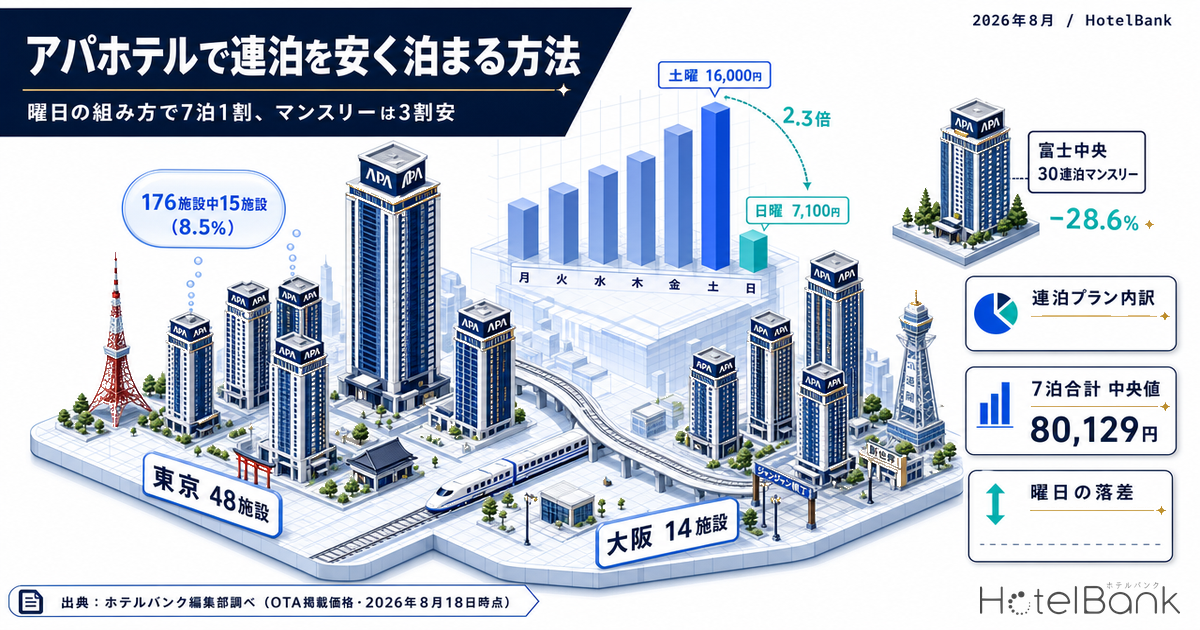
At APA Hotel, what you pay for a multi-night stay swings widely depending on which days of the week you book and which plan you pick. As of August 2026, only 15 of the 176 APA Hotel and APA Villa Hotel properties listed on the OTAs in our dataset (8.5%) offer a plan that requires consecutive nights. Eight of those cut the price; the other seven hold the price identical to the standard plan and add a loyalty point multiplier instead. What works at every property is the choice of which days of the week to include — get that right and the seven-night total moves by roughly 10%. Across 62 properties in Tokyo and Osaka, the median seven-night total for a single-type room, single occupancy, room-only comes to ¥80,100 (¥11,400 per night), well above seven times the Monday rate (¥52,600). What drives the bill is the price movement within the week, and Saturday stands out as the most expensive night. Building the stay to avoid it is what pays off.
All prices in this article are OTA listed prices (tax included — the amount you actually pay), compiled as of 18 August 2026. Unless otherwise noted, the target dates are check-ins from 19 August to 20 September 2026, and figures are the lowest listed price for one room, single occupancy, room-only. The “176 properties” figure is the number of properties our editorial team confirmed as listed on the OTAs in our dataset since mid-July 2026, and does not match the property count published by APA Hotel itself (which includes franchise properties).
- — 15 properties offer a plan conditional on consecutive nights (8.5% of 176). Eight cut the price; seven keep the same price and add a loyalty point multiplier.
- — What works everywhere is advance-purchase and prepaid plans plus the day-of-week mix. You are not limited to dedicated multi-night plans — the advance-purchase and prepaid plans listed for the same dates are strong options.
- — The median seven-night total across 62 Tokyo and Osaka properties is ¥80,129 (¥11,447 per night), or 1.39x the first night (Monday) multiplied by seven.
- — The day-of-week mix is the lever. Across the 62 properties, the median is ¥7,100 on Sunday against ¥16,000 on Saturday — a 2.3x spread.
- — The exception is long-stay plans. The 30-night monthly plan at Fuji-Chuo (富士中央) is 28.6% below the standard plan.
The 15 properties with multi-night plans — two types: price discount and point bonus
Checking the plan names listed for all 176 properties as of 18 August 2026, 15 properties had a plan conditional on “2 nights or more”, “3 nights or more”, “4 consecutive nights or more”, “7 consecutive nights or more”, “weekly” or “monthly” (N=176 properties, based on plan names). They split into the two types below.
| Type | Properties | Price difference (vs standard room-only plan, same room and same date, median) | Examples |
|---|---|---|---|
| Price-discount type | 8 properties | −2 to −9% (3+ nights / 4+ consecutive nights / 7+ consecutive nights / 2+ night eco stay) The 30-night monthly plan is −29% (1 property) | Isehara-Ekimae (伊勢原駅前, 3+ nights, −8.7%), Joetsu-Myoko-Ekimae (上越妙高駅前, 3+ nights, −6.1%), Uozu-Ekimae (魚津駅前) and Kanazawa-Nomachi (金沢野町) (4+ consecutive nights, −3 to −4%), Kagoshima-Tenmonkan (鹿児島天文館) and Fuji-Chuo (富士中央) (2+ night eco stay, no housekeeping, −3 to −4%), Fukushima-Eki-Higashi (福島駅東, 7+ consecutive nights, −2.2%), Fuji-Chuo (富士中央, 30-night monthly, −28.6%), APA Hotel Stay Toyama (アパホテルステイ〈富山〉, 4-night discount and weekly discount) |
| Point-bonus type | 7 properties | ±0% (identical to the standard plan; only the point multiplier is added) | Osaka-Tanimachi-4-chome-Ekimae-Kita (大阪谷町四丁目駅前北), Midosuji-Honmachi-Ekimae (御堂筋本町駅前), Midosuji-Honmachi-Eki-Higashi (御堂筋本町駅東) and Sakai-Ekimae (堺駅前) (2+ nights only); TKP Tokyo Nishi-Kasai (TKP東京西葛西); Isesaki-Eki-Minami (伊勢崎駅南); Maebashi-Eki-Kita (前橋駅北) |
| No multi-night-conditional plan | 161 properties | — (the sum of the daily listed prices is what you pay) | Most properties in Tokyo, 10 properties in Osaka and others |
Source: HotelBank Editorial Team analysis (aggregated OTA public data, as of 18 August 2026. Price differences are medians for check-ins from 19 August to 20 September 2026, one room, single occupancy, room-only, compared against the standard plan for the same property, same room type and same date. N=52–264 pairs per property)
Source: HotelBank Editorial Team analysis (based on OTA listed plan names, N=176 properties, as of 18 August 2026)
Even among the price-discount type, the reduction is only a few hundred yen per night: at Isehara-Ekimae, the “3+ nights” plan is 8.7%% below the standard plan (median: ¥7,600 vs ¥8,300). Advance-purchase and prepaid room-only plans are listed for the same dates, so the reliable move is to compare them against the multi-night plan and take whichever is cheaper (at Kagoshima-Tenmonkan the 2+ night eco stay and at Isehara-Ekimae the 3+ nights plan came in below even the cheapest alternative). The exception is the “30-night monthly” plan at Fuji-Chuo: at ¥5,000 for one room, single occupancy, it is roughly 30%% below the standard room-only plans listed for the same dates (¥7,000–¥8,000 range; median −28.6%%). At APA Hotel Stay Toyama, the only listings on the OTAs in our dataset were prepaid plans — “4-night discount, no housekeeping” and “weekly discount, no housekeeping” — at ¥7,700 for one room, single occupancy. In its February 2024 opening release, the same property advertised a weekly rate of ¥6,000 per night for a 7-night stay and a monthly rate of ¥5,500 per night for a 30-night stay.
The “2 nights or more” plans at the four Osaka properties are point-bonus type: the price stays identical to the standard plan (median difference 0%, N=66–227 pairs) and only the point multiplier is added. If you want a lower price, look at the advance-purchase and prepaid plans for the same dates; if you want points, take this type — you can choose by objective. For how many nights it takes before multi-night discounts start to bite, our cross-format measurements — 15% at 7 nights and 20% at 30 nights — are covered in Japan Hotel Long-Stay Discounts: 15% at 7 Nights, 20% at 30 Nights.
What 7 and 14 nights actually cost — modelled on single-type rooms at 48 Tokyo and 14 Osaka properties
At the 161 properties without a multi-night plan, what you pay is simply the sum of the daily listed prices. So for 48 properties in Tokyo and 14 in Osaka (N=62 properties), we fixed one room type per property — the type with the most observation days, mostly singles — picked up the lowest listed price for a room-only plan that allows consecutive nights on each day, and totalled seven and 14 nights.
| Dates (2026) | Area (properties) | Total (median) | Per night | First night (Monday), single night | Total ÷ (first night × nights) |
|---|---|---|---|---|---|
| 7 nights: check-in 7 Sep (Mon) to 13 Sep (Sun) | Tokyo + Osaka (62) | ¥80,129 | ¥11,447 | ¥7,515 | 1.39x |
| Tokyo (48) | ¥85,930 | ¥12,276 | ¥8,550 | 1.42x | |
| Osaka (14) | ¥53,086 | ¥7,584 | ¥6,608 | 1.17x | |
| 14 nights: check-in 31 Aug (Mon) to 13 Sep (Sun) | Tokyo + Osaka (62) | ¥153,205 | ¥10,943 | ¥6,700 | 1.51x |
| Tokyo (48) | ¥165,324 | ¥11,809 | ¥6,906 | 1.62x | |
| Osaka (14) | ¥104,339 | ¥7,453 | ¥6,390 | 1.18x |
Source: HotelBank Editorial Team analysis (OTA listed prices, as of 18 August 2026. Lowest price for one room, single occupancy, room-only, on plans that allow consecutive nights. One room type fixed per property; medians of the per-property totals. “Total ÷ (first night × nights)” is the median of the ratios calculated property by property)
Source: HotelBank Editorial Team analysis (48 Tokyo and 14 Osaka properties, median of per-property totals of the lowest listed price for one room, single occupancy, room-only, as of 18 August 2026)
The reason “total ÷ (first night × nights)” exceeds 1.0 is that listed prices rise towards the back half of the week. Put another way, you can bring the total down simply by choosing your days. Taking day-of-week medians for the same 62 properties over the three weeks from 24 August to 13 September, Sunday is ¥7,100 and Monday ¥7,400, against ¥12,700 on Thursday and ¥16,000 on Saturday — more than a 2x spread within the week. Osaka’s ratio stays at 1.17x because its within-week movement is smaller than Tokyo’s, and the per-night average landed in the ¥7,400–¥7,600 range for both 7 and 14 nights. The size of this within-week gap is itself a structural feature of urban business hotels; for how the weekend premium is distributed market by market, see Weekend Premium 2026: Tokyo Business 24% vs Hakone Ryokan 10%.
Source: HotelBank Editorial Team analysis (62 APA Hotel properties in Tokyo and Osaka, check-ins 24 August to 13 September 2026, per-property medians of the lowest listed price for one room, single occupancy, room-only, then taken to a median by day of week, as of 18 August 2026)
Four ways to build a cheaper multi-night stay at APA Hotel
1. Make Sunday or Monday check-in and Friday or Saturday check-out your default. What sets the bill is which days you include. As the day-of-week medians above show, dropping a single Saturday night moves the seven-night total by roughly 10%. If a business trip straddles a weekend, switching to a different hotel or going home just for the Saturday is a realistic option.
2. Limited-inventory plans marked “no consecutive nights” can safely be passed over for a multi-night stay. Limited-inventory plans that explicitly bar consecutive nights are listed at 163 of the 176 properties, but comparing them against consecutive-night-eligible plans for the same room and the same date at 25 Tokyo and Osaka properties, the consecutive-night-eligible room-only plan was equal or cheaper in about 97% of cases (N=1,660 pairs, 19 August to 20 September 2026). You do not have to give up the cheapest band in order to book consecutive nights.
3. Look at advance-purchase and prepaid plans before multi-night plans. Even the price-discount multi-night plans only take −2 to −9% off the standard plan, and the advance-purchase and prepaid plans listed for the same dates are often cheaper. Rather than choosing a property by whether it has a dedicated multi-night plan, it is faster to compare all plans day by day at the property you actually want to stay in.
4. Beyond two weeks, consider “monthly” and “54-hour stay” plans too. The 30-night monthly plan runs 28.6% below the standard plan at Fuji-Chuo (富士中央), and APA Hotel Stay Toyama keeps weekly and 4-night discount plans without housekeeping permanently listed. Separately, 21 properties offer a “maximum 54-hour stay, no housekeeping” plan running from 13:00 check-in to 19:00 check-out on the third day (in effect two nights bundled into one), which has to be compared against two standard nights on the total for the stay rather than on a per-night rate. For choosing a room and packing in a way that makes a long stay easier in the first place, see Hotel Living in Japan: 4 Room Criteria, Packing & Daily Routines. One note on history: in the listing records of the OTAs in our dataset, multi-night plans that skip housekeeping under the name “eco cleaning” appeared at 157–159 properties between 2022 and 2025, but they could not be found in the August 2026 listings. If you are staying a month or more and want to compare monthly totals including cooking and laundry, options outside business hotels come into view, such as the kitchen-equipped extended-stay hotels compared by monthly structure in this five-property comparison in Nagoya’s Fushimi–Marunouchi area (in Japanese).
Where to look next
For comparisons of specific properties, these articles go deeper (both in Japanese).
Top 5 for multi-night business trips that “carry the rhythm of home” — stay-type hotels in Sendai’s Aoba ward where cooking, laundry and a work desk matter (HotelPicks, in Japanese)
Compares five properties suited to week-plus business stays between Sendai Station’s west exit and Ichibancho: Richmond Hotel Premier Sendai Ekimae (リッチモンドホテルプレミア仙台駅前), three minutes on foot from the west exit with a larger desk and a lounge; Hotel Metropolitan Base Sendai (ホテルメトロポリタンベース仙台), with a microwave and fridge-freezer in every room and mini-kitchens in some; and Dormy Inn Sendai Ekimae (ドーミーイン仙台駅前), where a natural hot-spring public bath and coin laundry wash off the fatigue of a long stay — lined up by indicative price and facilities.
Five kitchen-equipped extended-stay hotels in Nagoya’s Fushimi–Marunouchi area — comparing month-long stays in the Chukyo region by in-room facilities and monthly pricing structure (innippon, in Japanese)
For month-long postings, compares five properties with in-room kitchens and laundry facilities by monthly rate and multi-night discount structure: Nagoya B’s Hotel ANNEX (名古屋ビーズホテル ANNEX), five minutes on foot from Fushimi Station with a mini-kitchen and a drum-type washer-dryer in its annex; Grand Base Osu (グランドベース大須), with a full kitchen and washing machine in every room and a 50% discount structure from four nights; and Espacio Time Sharing Four Urban (エスパシオ タイムシェアリング フォーアーバン), with an IH kitchen and washer-dryer in all 54 rooms.
Frequently asked questions
How can I make a multi-night stay at APA Hotel cheaper?
Plans conditional on consecutive nights are offered at 15 of the 176 APA Hotel and APA Villa Hotel properties listed on the OTAs in our dataset (8.5%), as of 18 August 2026. At the other properties you can still bring the bill down through advance-purchase and prepaid plans and through your day-of-week mix.
At properties that do have multi-night plans, how much cheaper are they?
The price-discount type covers eight properties, at −2 to −9% (median) against the standard room-only plan for the same property, same room type and same date. The “3+ nights” plan at Isehara-Ekimae (伊勢原駅前) is −8.7% (¥7,600 vs ¥8,300). The remaining seven properties are point-bonus type, where the price stays identical to the standard plan and only the point multiplier is added.
What does a 7-night or 14-night stay cost in Tokyo and Osaka?
Modelled on single-type rooms at 48 Tokyo and 14 Osaka properties, one room, single occupancy, room-only, the median 7-night total (check-ins 7–13 September 2026) was ¥80,129 (¥11,447 per night) and the 14-night total (31 August to 13 September) was ¥153,205 (¥10,943 per night). By area, the 7-night total was ¥85,930 in Tokyo and ¥53,086 in Osaka.
Why does the per-night average rise as the stay gets longer?
Because listed prices rise towards the back half of the week. The flip side is that you can lower the per-night average by choosing your days. Across the same 62 properties, day-of-week medians run ¥7,100 on Sunday and ¥7,400 on Monday against ¥12,700 on Thursday and ¥16,000 on Saturday — more than a 2x spread within the week. The 7-night total came to 1.39x the first night (Monday) multiplied by seven.
How should I structure the stay to pay as little as possible?
Make Sunday or Monday check-in and Friday or Saturday check-out your default: dropping a single Saturday night alone moves the 7-night total by roughly 10%. The reliable approach is to compare dedicated multi-night plans against advance-purchase and prepaid plans and take whichever is cheaper, and beyond two weeks the monthly plans and the “maximum 54-hour stay” plans (21 properties) become candidates.
Should I avoid limited-inventory plans marked “no consecutive nights”?
You lose nothing by avoiding them. Limited-inventory plans barring consecutive nights are listed at 163 of the 176 properties, but comparing the same room type on the same date at 25 Tokyo and Osaka properties, the consecutive-night-eligible room-only plan was equal or cheaper in about 97% of cases (N=1,660 pairs, 19 August to 20 September 2026).
References and sources
■ Data sources
Publicly listed prices and listed plan names from the OTAs in our dataset (HotelBank Editorial Team analysis). Coverage is the 176 APA Hotel and APA Villa Hotel properties confirmed as listed as of 18 August 2026; the 148 franchise properties are counted separately and are not included in this analysis. Prices are the lowest listed price for one room, single occupancy, room-only (tax included — the amount you actually pay), and unless otherwise noted the target dates are check-ins from 19 August to 20 September 2026.
■ Modelling assumptions
The 7-night and 14-night totals were built for 48 properties in Tokyo and 14 in Osaka by fixing one room type per property — the type with the most observation days, mostly singles — and summing the lowest listed room-only price on consecutive-night-eligible plans day by day. Area figures are medians of the per-property totals. “Total ÷ (first night × nights)” is derived by calculating the ratio property by property and then taking the median, so it does not equal the median total in the table divided by the median first-night rate. Price differences for multi-night plans are comparisons (medians) against the standard room-only plan for the same property, same room type and same date. Day-of-week medians are per-property medians for check-ins from 24 August to 13 September 2026, taken to a further median by day of week.
■ Limitations and caveats
Whether a property has a multi-night plan is judged from listed plan names and plan descriptions, so discounts that do not state a multi-night condition in the plan name cannot be captured. This analysis covers OTA listings only, and does not include member rates or exclusive plans available solely on the official website or app. Listed prices move daily, so every figure in this article is a snapshot as of the compilation date (18 August 2026) and may not match the price at the time you actually book. The “176 properties” figure is the number our editorial team confirmed as listed within our coverage, and does not match the property count published by the company itself.
Related articles
- Japan Hotel Long-Stay Discounts: 15% at 7 Nights, 20% at 30 Nights
- Hotel Living in Japan: 4 Room Criteria, Packing & Daily Routines
- Weekend Premium 2026: Tokyo Business 24% vs Hakone Ryokan 10%, N=659
- Tokyo Business Hotel ADR 12-Month Trend: 30% Central vs Outer Ward Gap
- Business Hotel Price Surge: National ADR Analysis & 10 Cost-Effective Prefectures