

Hikers in Japan are already spending a night before they even reach the trailhead. A night before, to catch the first shuttle bus; a night after, to wash off the sweat before heading home — separate from the tourist idea of an “autumn foliage inn,” nobody has yet laid out in one place where the beds that serve climbers actually are, how many there are, and what they sell for. This article selects 15 major mountain gateways across Japan (trailheads and access hubs), then cross-references the number of properties and rooms within a 5–12 km radius against the seasonal structure of lodging rates at the municipal level.
The conclusion first. Among the 15 gateways, in areas that host ski resorts, autumn — the climbing season — turns out to be the cheapest time of the year. In Hakuba, the October estimated settled ADR ran 25% below the annual average, making it the cheapest month across the 11-month observation window. Conversely, at gateways that do not earn their keep from snow — Okunikko, Yatsugatake, Kamikochi, Hirayu — autumn forms the annual peak band. For climbers, the best time to book differs sharply from mountain to mountain; for the inns at the foot of those mountains, capturing autumn demand becomes a design problem.
Metric Definitions Used in This Article
- ADR (average daily rate): an estimated settled rate (tax-exclusive equivalent) calculated by applying property-type correction coefficients to the lowest publicly listed plan level each property posts on OTAs and similar channels (double occupancy, per-room rate, tax included). Cross-checked against property-level actual rates disclosed by listed hotel REITs, the median error is approximately 7%. These are estimates and differ from each property’s actual transacted prices or accounting figures. Municipal-level ADR is the median across the covered properties (the level of a typical property in that area).
- Seasonal index: each municipality’s monthly ADR divided by the average across the 11 months for which verified actuals are available (August 2025 – June 2026), multiplied by 100. Months above 100 are high-rate months for that municipality; months below 100 are cheap months.
- Autumn index / winter index: within the seasonal index, the average of September–November is the autumn index, and the average of December–February is the winter index.
- Bed base (properties and rooms): only properties within the specified radius of each gateway point that also show confirmed sales activity on OTAs within the past 90 days are counted. Coverage is limited to properties whose municipality matches the target municipality.
- Data sources: lodging rates and property counts from MetroEngines Research; review analysis by the HotelBank Editorial Team.
- — 310 properties and 8,454 rooms sit around the 15 mountain gateways. From one property with 21 rooms at Ubasawa on Mt. Gassan to 52 properties at Sawando, the depth of the bed base varies by more than 20-fold.
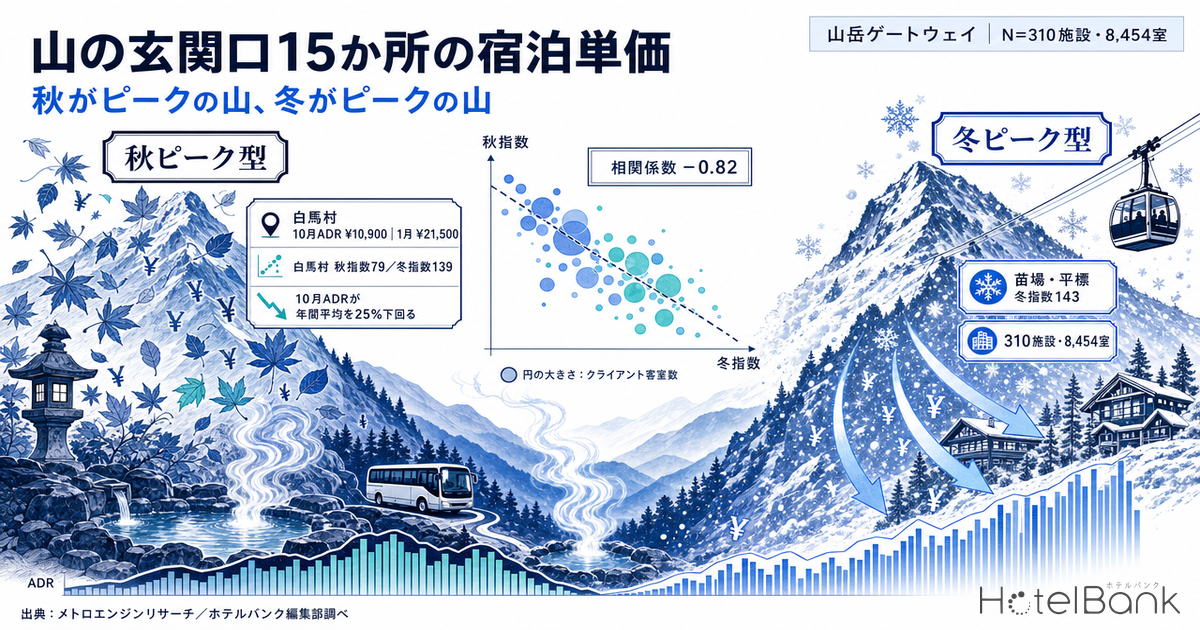
- — The correlation coefficient between the autumn index and the winter index is −0.82. At gateways that host ski resorts, autumn — the climbing season — is instead the annual trough.
- — In Hakuba, the October estimated settled ADR was ¥10,900, the cheapest of the 11 observed months. Against ¥21,500 in January, that is roughly half — structurally, a pure “winter mountain.”
- — The bed base comes in two shapes. Sounkyo averages 131 rooms per property in a few large boxes, whereas Happo and Sarukura average 9.4 rooms across many small inns — and the total room count flips between them.
- — Okunikko (autumn index 109), Utsukushi-mori & Kiyosato (108), Sawando & Kamikochi (107) and Hirayu & Norikura (107) are the “no-snow-income” gateways where autumn forms the annual peak band.
310 properties and 8,454 rooms within 5–12 km of the trailhead — counting the bed base at Japan’s mountain gateways
First, the scope. What is covered here is not “inns in tourist areas” but “inns at access hubs for trailheads.” Sounkyo for the Daisetsuzan range; Sawando, Ogizawa, Hirayu, Happo and Tsugaike for the Northern Alps; Suganodai for the Central Alps; Utsukushi-mori and the Aoki-kosen side for the Southern Alps and Yatsugatake; Yumoto for Okunikko; the foot of Mt. Hakkai for the Echigo Sanzan; the Naeba and Mt. Tairappyo trailheads; Ubasawa for Mt. Gassan; the northern base of Mt. Fuji; and Daisenji for Hoki-Daisen — circles of 5–12 km radius were drawn around these 15 points. The radius was deliberately not fixed at a single value, because the practical reach of a “bed base a few minutes away on foot or by car” differs between terrain where inns are strung out along a valley, as at Ogizawa, and terrain where they cluster densely, as at Hakuba Happo.
The result: within the range MetroEngines Research tracks, 310 properties and 8,454 rooms qualified. That total, however, is far from evenly distributed. The thinnest is Ubasawa and Shizu on Mt. Gassan with one property and 21 rooms, followed by the foot of Mt. Hakkai in the Echigo Sanzan with 4 properties and 84 rooms, and the Nirasaki side toward the Hoo Sanzan with 4 properties and 79 rooms. At the thick end were Sawando (52 properties), Utsukushi-mori & Kiyosato (45) and Happo & Sarukura (40).
Source: compiled by the HotelBank Editorial Team from MetroEngines Research (circle size represents the room count of each gateway catchment, N=310 properties)
| Mountain gateway | Radius | Properties | Rooms | Sep ADR | Oct ADR | Nov ADR | Autumn index | Winter index |
|---|---|---|---|---|---|---|---|---|
| Okunikko Yumoto (Mt. Nantai / Nikko-Shirane) Nikko, Tochigi / Okunikko・Mt. Nantai | 5km | 13 | 363 | ¥18,300 | ¥21,300 | ¥20,300 | 109 | 102 |
| Utsukushi-mori & Kiyosato (Yatsugatake) Hokuto, Yamanashi / Southern Alps・Yatsugatake | 7km | 45 | 594 | ¥14,700 | ¥15,700 | ¥14,400 | 108 | 103 |
| Sawando (Kamikochi & Hotaka) Matsumoto, Nagano / Northern Alps (Kamikochi) | 5km | 52 | 664 | ¥13,700 | ¥14,800 | ¥14,400 | 107 | 89 |
| Hirayu & Norikura (South Northern Alps) Takayama, Gifu / Norikura・Hotaka | 8km | 31 | 791 | ¥16,200 | ¥20,900 | ¥18,500 | 107 | 97 |
| Suganodai (Central Alps) Komagane, Nagano / Central Alps | 6km | 12 | 519 | ¥13,300 | ¥12,800 | ¥18,200 | 103 | 115 |
| Ogizawa (Ushirotateyama & Tateyama) Omachi, Nagano / Northern Alps (Ushirotateyama) | 12km | 21 | 954 | ¥15,600 | ¥17,000 | ¥15,800 | 101 | 105 |
| Sounkyo (Daisetsuzan & Mt. Kurodake) Kamikawa, Hokkaido / Daisetsuzan | 6km | 6 | 785 | ¥9,200 | ¥10,100 | ¥7,500 | 99 | 119 |
| Mt. Fuji Station & northern base (Yoshida Route) Fujiyoshida, Yamanashi / Mt. Fuji | 6km | 25 | 939 | ¥11,300 | ¥11,700 | ¥12,100 | 95 | 98 |
| Aoki-kosen area (Hoo Sanzan) Nirasaki, Yamanashi / Southern Alps | 10km | 4 | 79 | ¥4,400 | ¥5,000 | ¥5,400 | 95 | 107 |
| Mt. Hakkai ropeway base (Echigo Sanzan) Minamiuonuma, Niigata / Echigo Sanzan | 6km | 4 | 84 | ¥9,700 | ¥11,600 | ¥11,600 | 94 | 122 |
| Ubasawa & Shizu (Mt. Gassan) Nishikawa, Yamagata / Mt. Gassan | 8km | 1 | 21 | ¥10,600 | ¥10,800 | ¥15,300 | 89 | 116 |
| Daisenji (Hoki-Daisen) Daisen, Tottori / Hoki-Daisen | 6km | 16 | 217 | ¥9,000 | ¥9,100 | ¥10,000 | 89 | 114 |
| Tsugaike Kogen (Hakuba-Norikura) Otari, Nagano / Hakuba・Northern Alps | 5km | 22 | 560 | ¥9,400 | ¥9,300 | ¥8,700 | 85 | 124 |
| Naeba & Mt. Tairappyo trailhead Yuzawa, Niigata / Naeba・Tanigawa range | 7km | 18 | 1,509 | ¥11,500 | ¥12,100 | ¥14,400 | 83 | 143 |
| Happo & Sarukura (Mt. Shirouma) Hakuba, Nagano / Mt. Shirouma | 5km | 40 | 375 | ¥11,100 | ¥10,900 | ¥12,600 | 79 | 139 |
Source: compiled by the HotelBank Editorial Team from MetroEngines Research. ADR figures are actuals for September–November 2025 (estimated settled rate, tax-exclusive equivalent). The autumn and winter indices are indexed to 100 against the 11-month average from August 2025 to June 2026. Property and room counts cover properties within the stated radius of each gateway point that showed confirmed OTA sales activity within the past 90 days (N=310 properties, 8,454 rooms). Kamikawa, Komagane, Nishikawa, Nirasaki and Daisen have only 5–11 properties in the ADR sample, so their rates should be treated as indicative
The bed base comes in two shapes — “a few large boxes” versus “dozens of small inns”
Placing property counts and room counts side by side reveals that two equally “thick” bed bases can be built of entirely different material. Sounkyo has 785 rooms across 6 properties, an average of 131 rooms each — a structure in which a handful of large hot-spring hotels supply the rooms. Naeba and Mt. Tairappyo are similar, with 1,509 rooms across 18 properties, averaging 84 rooms.
At the opposite pole is Happo & Sarukura, with 375 rooms across 40 properties — an average of 9.4 rooms per property. This is a landscape of pensions and small lodges spread across an area. Sawando (52 properties, averaging 12.8 rooms), Utsukushi-mori & Kiyosato (45 properties, 13.2 rooms) and Daisenji (16 properties, 13.6 rooms) share the same type.
The difference feeds directly into how climbers stay. Large-box gateways come equipped for groups and families and tend to retain some inventory even in peak season, though their rates are pulled along by property grade. Small-inn gateways have few rooms per property, so individual inns fill up early on weekends and peak dates. Happo & Sarukura has 40 properties but only 375 rooms in total; Naeba & Tairappyo has 18 properties and 1,509 rooms. The property count differs by more than two-fold, yet the actual volume of bookable rooms runs four-fold in the opposite direction.
Source: compiled by the HotelBank Editorial Team from MetroEngines Research (N=15 gateways, 310 properties). Circle size represents the average number of rooms per property
Mountains that peak in autumn, mountains that peak in winter — a clear split in the seasonal index
Here is the core of it. Dividing each municipality’s monthly ADR by its annual average produces a seasonal index; plotting the September–November average (autumn index) against the December–February average (winter index) places the 15 gateways on a scatter chart.
The result was unambiguous. The correlation coefficient between the autumn index and the winter index is −0.82. Gateways that are expensive in autumn are cheap in winter, and gateways that are expensive in winter are cheap in autumn — an almost mutually exclusive relationship.
The eight locations with a winter index of 114 or above (Naeba & Tairappyo 143, Happo & Sarukura 139, Tsugaike Kogen 124, the foot of Mt. Hakkai 122, Sounkyo 119, Ubasawa 116, Suganodai 115, Daisenji 114) average an autumn index of 90.1. The seven locations with a winter index below 114 average 103.1 in autumn. A 13-point gap is not a small difference in pricing structure.
The most extreme case is Hakuba, at autumn index 79 and winter index 139. The October estimated settled ADR was ¥10,900 — the cheapest of the 11 months observed. Against ¥21,500 in January, that is roughly half. Despite hosting Mt. Shirouma, Mt. Karamatsu and Mt. Goryu, some of the finest climbing terrain in the Northern Alps, in pricing terms the village is operated purely as a “winter mountain.”
Source: compiled by the HotelBank Editorial Team from MetroEngines Research (N=15 municipalities, 11 months of actuals from August 2025 to June 2026). Circle size represents the room count of each gateway catchment
The monthly curve reveals a “climbing-season trough”
Overlaying the monthly curves across the year makes the split more three-dimensional still. Nikko, which contains Okunikko, shows a twin-peak shape at 116 in August and 116 in October — rates hold up in both the summer climbing season and the foliage season. Takayama, covering Hirayu and Norikura, has a single peak at 121 in October, coinciding with the overlap of Okuhida foliage and peak traffic on the Shinhotaka Ropeway. Matsumoto, covering Sawando and Kamikochi, runs 129 in August and 111 in October — the climbing season is itself the price peak.
Hakuba, by contrast, records 147 in January and 134 in February against 76 in September and 75 in October. Yuzawa runs 151 in January and 142 in February against 75 in September and 79 in October. In both, the two months of the climbing season form the annual floor. Winter demand sets the pricing baseline, and autumn is sold at close to half that level. Winter demand in these two areas is built on early booking behaviour tied to overseas repeat visitors, which follows a demand curve of an entirely different shape from the last-minute pattern seen in autumn.
Source: compiled by the HotelBank Editorial Team from MetroEngines Research. Each municipality’s monthly ADR divided by the average from August 2025 to June 2026 to produce a seasonal index (average = 100). July is not shown, as it falls outside the window of verified actuals
Note that this article does not treat 2026 autumn selling prices as figures. Listings currently posted on OTAs for future dates are work in progress that will shift with subsequent inventory additions and price adjustments, and are therefore different in nature from the settled 2025 autumn actuals. The policy adopted here is to compare actuals only with actuals, and listings only with listings.
What reviews say about “surrounded by nature” and “quiet”
Rates alone cannot measure the quality of the bed base. Guest reviews were therefore analysed with natural language processing to extract, for properties in the 15 target municipalities, the share of posts mentioning “a location surrounded by nature” and “a quiet setting” (posts from the past 24 months).
The properties that could be extracted are shown below. Note that the mention rate is not a rating score but the frequency with which that element came up in reviews. It is an indicator of what guests talked about, not of whether an inn is good or bad overall.
| Property | Location | Nearest gateway | Theme mentioned | Mentions | Mention rate | Reviews analysed |
|---|---|---|---|---|---|---|
| Hakuba Momonoki Hotel (白馬樅の木ホテル) | Hakuba, Nagano | Happo & Sarukura (Mt. Shirouma) | Surrounded by nature | 14 | 3.33% | 420 |
| Hakuba Highland Hotel (白馬ハイランドホテル) | Hakuba, Nagano | Happo & Sarukura (Mt. Shirouma) | Surrounded by nature | 10 | 2.05% | 488 |
| Kaikake Onsen (貝掛温泉) | Yuzawa, Niigata | Naeba & Mt. Tairappyo trailhead | Surrounded by nature | 9 | 4.5% | 200 |
| Tobira Onsen Myojinkan (扉温泉 明神館) | Matsumoto, Nagano | Sawando (Kamikochi & Hotaka) | Surrounded by nature | 9 | 3.63% | 248 |
| onsen hotel OMOTO | Matsumoto, Nagano | Sawando (Kamikochi & Hotaka) | Surrounded by nature | 6 | 3.31% | 181 |
| Satoyama Jujo (里山十帖) | Minamiuonuma, Niigata | Mt. Hakkai ropeway base | Surrounded by nature | 3 | 2.17% | 138 |
| Pals Inn Raicho (パルズイン 雷鳥) | Hakuba, Nagano | Happo & Sarukura (Mt. Shirouma) | Quiet setting | 3 | 4.11% | 73 |
| Seifuso (静風荘) | Matsumoto, Nagano | Sawando (Kamikochi & Hotaka) | Quiet setting | 5 | 2.7% | 185 |
| onsen hotel OMOTO | Matsumoto, Nagano | Sawando (Kamikochi & Hotaka) | Quiet setting | 5 | 2.76% | 181 |
| Akari no Yado Villa Revage (あかりの宿 ヴィラ・リバージュ) | Nikko, Tochigi | Okunikko Yumoto | Quiet setting | 5 | 1.81% | 277 |
| Annex Turtle Hotori-An (アネックスタートル ほとり庵) | Nikko, Tochigi | Okunikko Yumoto | Quiet setting | 4 | 1.37% | 291 |
| Nikko Park Lodge Mountainside (日光パークロッジ マウンテンサイド) | Nikko, Tochigi | Okunikko Yumoto | Quiet setting | 3 | 1.33% | 226 |
Source: HotelBank Editorial Team research (NLP analysis of guest reviews, past 24 months). Mention rate = number of reviews mentioning the theme ÷ number of reviews analysed. Some prefecture-and-theme combinations could not be aggregated, so this is not an exhaustive ranking but a list of what could be extracted
Hakuba Momonoki Hotel in Hakuba had a location surrounded by nature mentioned in 14 of the 420 reviews collected over the past 24 months (3.33%) — the highest count among the 15 target municipalities within the extracted sample. Kaikake Onsen in Yuzawa showed a high mention rate at 9 of 200 (4.50%), and the same property also drew solo-travel mentions in 22 of 200 reviews (11.00%). Its setting in the mountains near Mikuni Pass registers as an evaluation axis that resonates with solo climbers too.
On “a quiet setting,” properties in Nikko stood out. Nikko Park Lodge Mountainside is introduced on Nikko’s official tourism site as an inn where guests “can feel nature,” and the review-side mentions (3 of 226) match that description. Akari no Yado Villa Revage in central Nikko (5 of 277) and Annex Turtle Hotori-An (4 of 291) showed the same pattern.
onsen hotel OMOTO in Matsumoto is one of the few properties extracted on both a location surrounded by nature (6 of 181) and a quiet setting (5 of 181). For a stay built around an early departure, having both hold at once is of practical value.
Always verify the preconditions for an early start against official sources
For an inn at the foot of a mountain, “having a room available” is not enough. Whether the next morning’s itinerary works at all is governed by conditions outside the inn: the first shuttle bus departure, the operating season of lifts and ropeways, the gate hours of entry restrictions. What follows is information within the scope published by the relevant municipalities, transport operators and the Ministry of the Environment.
| Area | Published conditions | Source |
|---|---|---|
| Kamikochi (Matsumoto / Sawando gateway) | Opens 17 April 2026 and closes 15 November. Nagano Prefectural Route Kamikochi Park Line is closed to private vehicles year-round; visitors transfer to a shuttle bus at the Sawando car park (about 30 minutes, ¥1,600 one way for adults). | Kamikochi official website / Nagano Prefecture |
| Tateyama Kurobe Alpine Route (Omachi / Ogizawa gateway) | The 2026 operating season runs from 15 April to 30 November. | Tateyama Kurobe Alpine Route official site |
| Mt. Fuji, Yoshida Route (Fujiyoshida) | The 2026 climbing season runs from 1 July to 10 September. The entry fee is ¥4,000 per person per ascent. The gate is closed from 14:00 to 03:00 the following day, and daily climbers are capped at 4,000. The gate closure and the cap do not apply to those with mountain-hut reservations (the entry fee still applies to hut guests). | Official Mt. Fuji climbing site (Yamanashi Prefecture) |
| Mt. Gassan pair lift (Nishikawa / Ubasawa gateway) | The summer lift operates from early June to mid-October, from 08:00 to 16:30. The Mt. Gassan summer climbing season opens on 1 July. | Gassan Ski Resort (Gassan Kanko Kaihatsu) / Nishikawa Town |
| Daisetsuzan and Mt. Kurodake (Kamikawa / Sounkyo gateway) | Foliage near the summit is said to begin around the end of August, reaching the seventh station in early September and the area around the fifth station in mid-September. Sounkyo Onsen is about 30 minutes by bus from JR Kamikawa Station. | Kamikawa Town Industry & Economy Division / published information on Daisetsuzan National Park |
| Okunikko (Nikko / Yumoto gateway) | In a typical year the high-elevation areas of Okunikko colour in early to mid-October, the area around Lake Chuzenji in mid- to late October, and the city centre in early to mid-November. | Nikko City official tourism site / Ministry of the Environment, Nikko Yumoto Visitor Center |
Source: compiled by the HotelBank Editorial Team from information published by the relevant municipalities, transport operators and the Ministry of the Environment
The Yoshida Route on Mt. Fuji in particular makes the choice of where to stay decisive for the itinerary. Because neither the 14:00–03:00 gate closure nor the 4,000-climber daily cap applies to mountain-hut guests, the preparation required changes entirely depending on whether you stay in a hut or stay at the base and start climbing at dawn. On the Fujiyoshida side at the base there is a bed base of 25 properties and 939 rooms, and at autumn index 95 and winter index 98 it is also a gateway with little price movement across the year (for how demand falls away immediately after the route closes, see Fuji Yoshida Route Closes 9/10: No Slump, Silver Week ADR +26.6% YoY).
Trail passability, mountain-hut operating status and the state of the foliage change from year to year and day to day. What this article sets out is the structure of prices and the bed base; actual itineraries should always be confirmed against the latest information published by the relevant municipalities, the Ministry of the Environment and individual mountain huts. Depending on weather and residual snow, passage may be impossible even within a published season.
Autumn for the inns at the foot of the mountain — the headroom in the bed base
For those running inns at the foot of these mountains, the structure described so far doubles as a map of opportunity.
The first thing worth acknowledging is the strength of the winter-type gateways. A winter index of 143 at Naeba & Tairappyo and 139 at Happo & Sarukura means the pulling power required to sustain high rates in winter has been demonstrated. That pulling power is itself a major asset, and a low autumn index is not a weakness — it means close to a third of the year still sits at rates that have not been pushed up.
What the autumn-type gateways actually sell is instructive. Okunikko (autumn index 109) has terrain in which colour migrates in stages from the high ground in October down to the city centre in November; Hirayu & Norikura (107) forms a single peak in October. Both have the conditions to state clearly that an experience is available only at that time of year. Winter-type gateways also have conditions that hold only in autumn — grass-colour on the ridgelines, the yellowing of Erman’s birch, the window when the first snow-cap and the foliage are visible together.
The shape of the bed base changes the available moves. Small-inn gateways averaging 9–14 rooms per property (Happo & Sarukura, Sawando, Utsukushi-mori & Kiyosato, Daisenji) suit designs built around reliably filling a small number of rooms. Light breakfasts for early departures, moving breakfast service earlier, transfers to the trailhead, post-descent bathing and luggage storage — none of these carry costs proportional to room count, and all of them tend to be talked about in reviews. Indeed, in the review extraction in this article, the properties where “surrounded by nature” and “a quiet setting” were mentioned included many small inns of around ten rooms.
At large-box gateways (Sounkyo, Naeba & Tairappyo, Ogizawa), the sheer capacity to take groups is itself the upside. The cohort walking the ridgelines on autumn weekdays is heavily made up of older groups, and properties with a large communal bath and dinner service are inherently well matched to that demand. There is considerable room to move from operations anchored on winter rates toward designing autumn as an independent product.
For either type, the key is understanding “how many days ahead, and which cohort, moves.” A pre-climb night is often decided at the last minute after checking the weather forecast, drawing a demand curve entirely unlike the early booking of a winter ski trip. Starting from the premise that the same property sells a different product depending on the season, there is still room to work on autumn inventory and pricing design.
Summary
Covering 15 mountain gateways across Japan and 310 properties with 8,454 rooms, this article has organised the bed base around trailheads and the seasonal structure of lodging rates. There are three points.
First, the depth of the bed base differs greatly from gateway to gateway. Ubasawa on Mt. Gassan has one property and 21 rooms, and the foot of Mt. Hakkai in the Echigo Sanzan just 4 properties and 84 rooms, while Sawando has 52 properties and Naeba & Tairappyo holds 1,509 rooms. Even among “mountain gateways,” the total volume of rooms available varies by more than 20-fold.
Second, the bed base splits into “a few large boxes” and “dozens of small inns.” Sounkyo averages 131 rooms per property, whereas Happo & Sarukura averages 9.4. Conflating the two by looking only at property counts leads to misreading how many rooms are actually available.
Third, the autumn and winter indices showed a strong negative correlation of −0.82. At gateways that host ski resorts, autumn — the climbing season — becomes the annual floor, and in Hakuba October was the cheapest of the 11 months. For climbers, the best time to book flips from mountain to mountain; for those running inns, autumn as a period of time remains an unused resource.
Trail conditions, mountain-hut operations and the progression of the foliage all change from year to year. The figures in this article describe the structure of prices and the bed base; decisions about actual itineraries should be based on the latest information published by the relevant municipalities, the Ministry of the Environment, transport operators and individual mountain huts.
Related Reading
- Japan’s Earliest Foliage 2026: Aomori ADR Peaks at ¥15,300 in October
- Golf Town Hotels: ¥5,200–¥21,300 Autumn ADR Across 15 Municipalities
- Japan Intra-Prefecture ADR Gaps Reach 5.2x: 368 Municipalities Ranked
- Japan’s Top 30 Garden Hotels for Autumn Foliage — Review Analysis
- Fuji Yoshida Route Closes 9/10: No Slump, Silver Week ADR +26.6% YoY
References and Sources
■ Market data
- MetroEngines Research — municipal-level estimated settled ADR (11 months of actuals, August 2025 – June 2026); property and room counts (N=310 properties, 8,454 rooms)
- HotelBank Editorial Team research — NLP analysis of guest reviews (past 24 months)
■ Trailheads, transport and natural environment (public bodies and transport operators)
- Official Mt. Fuji climbing site, “Climbing restrictions on Mt. Fuji [Yoshida Route] (2026)” (Yamanashi Prefecture)
- Kamikochi official website, “2026 season opening information for Kamikochi”
- Nagano Prefecture, “Traffic restrictions in Kamikochi”
- Tateyama Kurobe Alpine Route official site (operating season notices)
- Gassan Ski Resort (Gassan Kanko Kaihatsu), “Lift fares and operating periods”
- Nishikawa Town, “Gassan Ski Resort”
- Ministry of the Environment, Nikko Yumoto Visitor Center, “Autumn foliage in Okunikko (Senjogahara)”
- Nikko City official tourism site, Nikko Travel Navi, “Autumn foliage spots in the Nikko and Okunikko area”
- Nikko City official tourism site, Nikko Travel Navi, “Nikko Park Lodge Mountainside”
- Ministry of the Environment, “Daisen-Oki National Park: Mt. Daisen climbing routes”
- Tottori Prefecture, “Mt. Daisen climbing information”
- Hakuba Village official site (accommodation information)
- Oku-Yuzawa Kaikake Onsen official site
- Pals Inn Raicho official site
- Nikko Park Lodge Mountainside official site
- Enzanso official site (lodging reservation information)
■ Data sources
Lodging rates, property counts and room counts are drawn from historical OTA public inventory and public price data collected by MetroEngines Research. Municipal-level estimated settled ADR uses 11 months of actuals from August 2025 to June 2026. Property and room counts for each gateway catchment are limited to properties within the stated radius of each point that showed confirmed OTA sales activity within the past 90 days (N=310 properties, 8,454 rooms). Review mention rates come from natural language processing analysis of guest reviews by the HotelBank Editorial Team (past 24 months). Trail conditions, traffic restrictions, lift operating periods and foliage timing reference information published by the relevant municipalities, the Ministry of the Environment, transport operators and individual properties as primary sources.
■ Calculation assumptions
The seasonal index is each municipality’s monthly estimated settled ADR divided by the average of the 11 months for which verified actuals are available (August 2025 – June 2026), multiplied by 100. The autumn index is the September–November average and the winter index the December–February average. July is excluded from the charts and tables as it falls outside the observation window. Gateway catchment radii were not fixed at a single value across the board: points where inns are spread along a valley were given a larger radius, and points where inns cluster a smaller one. Average rooms per property is rooms divided by properties. ADR is an estimated settled rate (tax-exclusive equivalent) derived by applying property-type correction coefficients to the lowest listed plan level per room at double occupancy; against property-level disclosures by listed hotel REITs, the median error is approximately 7%.
■ Limitations and caveats
(1) ADR is an estimate and differs from each property’s actual transacted prices or accounting figures. (2) Kamikawa, Komagane, Nishikawa, Nirasaki and Daisen have only 5–11 properties in the estimated settled ADR sample, so their rates and indices need to be treated as indicative. Ubasawa and Shizu in particular has one property with 21 rooms, so the municipal rate reflects an individual property’s pricing policy almost directly. (3) The negative correlation between the autumn and winter indices is a relationship observed concurrently and does not demonstrate causation. (4) Review mention rates are not rating scores but the frequency with which a topic came up, and because some prefecture-and-theme combinations could not be aggregated, this is not an exhaustive ranking. (5) Selling prices for autumn 2026 are not treated as figures, as they are work in progress with no settled actuals. (6) Trail passability, mountain-hut operating status and the progression of the foliage change from year to year and day to day, so itinerary decisions should always be confirmed against the latest published information.