

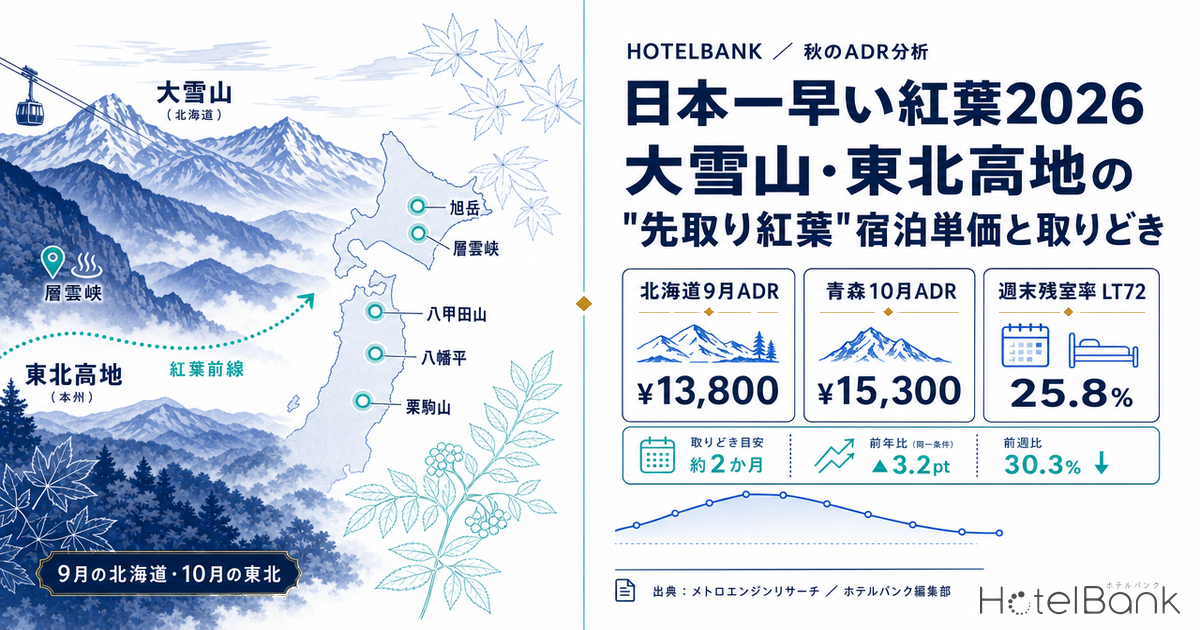
Known as “Japan’s earliest autumn foliage,” Hokkaido’s Daisetsuzan mountain range typically begins to turn color at its summits in mid to late September. That is roughly two months ahead of the late-November peak on the lowlands of Kyoto and Tokyo, and from there the foliage front moves southward, starting from the high mountains of the north. For travelers who want to avoid the crowds, the highlands of Hokkaido and Tohoku in September and October make an ideal destination for catching the colors early. This article reads the September–October movement of area-level ADR (estimated transaction rate) in Hokkaido, Aomori, Iwate and Akita alongside inventory sell-through by booking lead time (LT), and sets out both the nightly rate levels and the right moment to book.
Metric Definitions Used in This Article
- ADR (average daily rate) = an estimated transaction rate (tax-exclusive equivalent) calculated by applying category-specific adjustment coefficients to the lowest publicly listed plan level each property posts on OTAs and other channels (double occupancy, per-room rate, tax-inclusive). Cross-checked against property-level results disclosed by listed hotel REITs (91 properties, most recent 3 months), the median error is approximately 7%. These are estimates and differ from each property’s actual transaction prices and accounting figures. Area-level ADR is the median across the properties covered (the level of a typical property in that area).
- Remaining-inventory rate / occupancy (OTA-listed inventory basis, estimated) = the share of inventory publicly offered for sale on OTAs relative to total guest rooms in the area (remaining-inventory rate), and its inverse (occupancy). These are estimates based on the sell-through of inventory offered on OTAs and differ from each property’s actual overall occupancy. Note that while a check-in date is still far out, some properties have not yet released all of their inventory to OTAs, so levels for distant future dates can look more “sold out” than real demand warrants.
- LT (lead time) = the number of days until the check-in date. LT0 = same day.
- Data source: MetroEngines Research.
- — Foliage roughly two months early: the summits of the Daisetsuzan range turn color in mid to late September, opening the foliage season well ahead of the lowlands of Kyoto and Tokyo (late November).
- — September in Hokkaido is better value than summer: ADR (estimated transaction rate) settles back after the high season, opening a window with genuine rate appeal for crowd-averse travelers.
- — The Tohoku highlands command a premium in October: peak color at Hakkoda, Hachimantai and Kurikoma coincides with weekends, pushing rates higher. Inventory sell-through by booking lead time shows when to book.
The Foliage Front Starts in the Northern Highlands — Peak Color at Daisetsuzan, “Japan’s Earliest”
Autumn color begins where elevation is high and temperatures are low. The earliest peak in Japan comes in Hokkaido’s Daisetsuzan range: the area around the Asahidake ropeway (elevation 2,291m) typically turns in mid-September, while Sounkyo Onsen at the foot of the mountain colors from late September through mid-October. The defining pattern is that the foliage “descends” from the alpine zone toward the base. In Tohoku as well, highlands around the 1,000m mark come early: the summits of Mt. Hakkoda (Aomori), Hachimantai (Iwate and Akita) and Mt. Kurikoma (Miyagi, Iwate and Akita) begin turning in late September, spreading down the slopes and to the foothills in early to mid-October.
Central Kyoto, by contrast, peaks in late November in a typical year (on average around November 23), coinciding with a three-day weekend and drawing considerable crowds. In other words, the northern highlands reach peak color roughly two months ahead of Kyoto. For those looking to avoid the crush, the Hokkaido and Tohoku highlands in September and October are a strong option for seeing the colors early. The same “get there first” dynamic also plays out at popular destinations on Honshu such as Kyoto, Takayama and Nikko, where forward-looking rates for Western long-haul foliage demand are already visible in the booking data.
| Spot | Area | Peak color at summit (typical year) | Foothills / onsen areas |
|---|---|---|---|
| Asahidake (Daisetsuzan) | Hokkaido | Mid-September | Late September – early October |
| Sounkyo | Hokkaido | Late September | Late September – mid-October |
| Mt. Hakkoda | Aomori | Late September | Early – mid-October |
| Hachimantai | Iwate / Akita | Late September – early October | Early – mid-October |
| Mt. Kurikoma (Sukawa) | Iwate / Akita | Mid – late September | Early – mid-October |
| (Reference) Central Kyoto | Kyoto | — | Mid – late November |
Source: compiled by the HotelBank Editorial Team from peak-foliage information published by local tourism associations and weather services (typical-year values)
Source: locations of major foliage spots
Autumn in Hokkaido Is Cheaper Than Summer — The Value Window in the ADR Curve
Start with the monthly movement of ADR (estimated transaction rate) across Hokkaido as a whole. On a 2025 actuals basis, ADR peaked at ¥12,900 in August, then fell to ¥11,000 in September — the foliage season — and ¥9,700 in October. Even as the colors reach their peak, rates sit 15–25% below the summer high season. The first point the data makes is that Hokkaido’s early foliage window offers not only thinner crowds but genuine value on accommodation cost.
The same shape holds in 2026 booking conditions (estimated from OTA listings at the time of the survey). From an August peak of ¥14,900, rates ease gradually into autumn: ¥13,800 in September and ¥12,600 in October. It is the shoulder period after summer’s inbound and domestic leisure demand has run its course, overlaid with a clear demand theme in the foliage season.
Source: MetroEngines Research, compiled by the HotelBank Editorial Team (July–November 2026 are estimates based on listing levels at the time of the survey)
The Tohoku Highlands Command an October Premium — Rate Curves by Area
Placing Hokkaido alongside the three Tohoku prefectures (Aomori, Iwate and Akita) for July–November 2026 shows that the autumn rate “peak” falls at different points depending on the area. Where Hokkaido peaks in September, Aomori jumps to ¥15,300 in October — the highest level of the July–November stretch. In Aomori, home to Hakkoda and the Oirase Gorge, both at their best in October, foliage demand is clearly reflected in October rates. Akita also forms a smaller peak at ¥12,800 in October, above its September level (¥12,200).
Put simply, Hokkaido is the “early bird” pattern — peak color in September with rates below summer — while the Tohoku highlands are the “main event” pattern, with peak color in October and a premium attached to rates. If avoiding crowds and holding down cost are the priorities, September in Hokkaido is the answer; if the goal is Tohoku’s landscapes at their finest, October rewards booking early.
Source: MetroEngines Research, compiled by the HotelBank Editorial Team (each 2026 month is an estimate based on listing levels at the time of the survey)
| Area | Aug | Sep | Oct | Nov | Properties covered (Sep) |
|---|---|---|---|---|---|
| Hokkaido | ¥14,900 | ¥13,800 | ¥12,600 | ¥11,600 | N=877 |
| Aomori | ¥14,300 | ¥12,500 | ¥15,300 | ¥10,800 | N=166 |
| Iwate | ¥11,400 | ¥10,100 | ¥10,300 | ¥9,900 | N=238 |
| Akita | ¥13,200 | ¥12,200 | ¥12,800 | ¥11,800 | N=164 |
Source: MetroEngines Research, compiled by the HotelBank Editorial Team (estimated transaction rate, tax-exclusive equivalent, rounded to the nearest ¥100)
Reading the Right Moment to Book — Inventory Sell-Through by Lead Time
Next, the question of when to lock in a booking, read through inventory sell-through by booking lead time (LT). For Hokkaido as a whole, the chart below tracks the remaining-inventory rate of OTA-listed rooms for late-September check-in dates that coincide with peak color at Sounkyo and elsewhere — a weekday (Thursday, September 24) and a weekend night (Saturday, September 26). At the time of the survey, the observable range runs from LT90 (about three months out) to LT70 (about two months out), and even at this stage the weekend runs consistently tighter, at 28.3% → 25.8% against 32.1% → 30.3% on the weekday. Weekend slots clearly start filling more than two months ahead.
One caveat matters here: while a check-in date is still far out, some properties have not released all of their inventory to OTAs, so the absolute level looks more “sold out” than real demand warrants. The sound reading is therefore not the level itself but the relative gap between weekday and weekend, and the pace at which remaining inventory declines over time. On that basis, the timing guidance is clear — for a weekend or a peak-color date, book earlier than two months out; if cost and choice matter more, take a weekday. The same method of reading booking pace from the decline in remaining inventory is covered by onsen area in our analysis of Silver Week 2026, 76 Days Out: Booking Pace Across 6 Onsen Areas.
Source: compiled by MetroEngine Inc. and the HotelBank Editorial Team (Hokkaido overall; estimated remaining-inventory rate on an OTA-listed inventory basis)
By property category, the pace of sell-through also differs. For the same Saturday, September 26 check-in, the drop in remaining-inventory rate from LT90 to the survey date (LT72) was largest at business hotels (29.0% → 25.8%, −3.2pt), followed by ryokan (32.7% → 30.0%, −2.7pt) and resort properties (28.9% → 26.9%, −2.0pt). Lower-priced business hotels move first, while resorts and ryokan still hold relatively more inventory at this stage. Even in foliage season, the right moment to book shifts with the price band — worth keeping in mind.
Source: compiled by MetroEngine Inc. and the HotelBank Editorial Team (Hokkaido, September 26 check-in, by category)
| Category | Properties covered | Remaining inventory (approx. 3 months out) | Remaining inventory (survey date) | Listed price band |
|---|---|---|---|---|
| Resort | 137 properties | 28.9% | 26.9% | approx. ¥38,500 |
| Business | 357 properties | 29.0% | 25.8% | approx. ¥20,000 |
| Ryokan | 245 properties | 32.7% | 30.0% | approx. ¥33,600 |
Source: MetroEngines Research, compiled by the HotelBank Editorial Team (listed prices are the average across all plans, tax-inclusive, rounded to the nearest ¥100)
For Crowd-Averse Travelers — Building Around “Hokkaido in September, Tohoku in October”
Pulling the data together, there are two places to go for early foliage ahead of Kyoto’s peak. One is Hokkaido (Daisetsuzan, Sounkyo, Asahidake), at its best in September with rates below summer levels — suited to travelers who want to hold down both crowds and cost. The other is the Tohoku highlands (Hakkoda, Hachimantai, Mt. Kurikoma), at their best in October with a premium attached to rates, where booking early pays off for those chasing the scenery. Both sit at the leading edge of the foliage front, and because their demand peaks fall away from the November peak in Kyoto and the Kanto region, securing a choice of accommodation is easier.
As a rule of thumb on timing, the lead-time analysis suggests weekdays are favorable on both rate and availability, while weekends and peak-color dates are safest locked in earlier than two months out. Use the time lag that elevation creates in peak color, and the same autumn colors can be enjoyed clear of the peaks in both crowds and price.
For hotels: plan-naming cues that work for this theme
Appeal elements most common in publicly listed plan names for Hokkaido × autumn foliage (N=500) ——
Room only 43% Seasonal sale 43% Breakfast included 38% OTA sale 17% Points & coupons 12% Close to station 9%
Examples of actual names (anonymized, English rendering with the Japanese original):
- [Autumn SALE] Long-stay plans up to 35% OFF / room only (【秋SALE】ロングステイプランが最大35%OFF/素泊り)
- [Autumn SALE] Long-stay plans up to 35% OFF / breakfast included (【秋SALE】ロングステイプランが最大35%OFF/朝食付)
- [Weekend 72-hour flash sale] High-floor rooms 20% OFF & up to 18x points / get a head start on autumn, breakfast included (【週末72時間タイムセール】高層階客室が20%OFF&ポイント最大18倍/お得に秋を先取り・朝食付)
* These are tendencies based on an aggregation of publicly listed plan names and do not demonstrate that naming causes sales.
⚠ Note on ADR and inventory for future dates: the July–November 2026 ADR figures and the remaining-inventory rates by lead time in this article are estimates based on information publicly listed on OTAs at the time of the survey, and will shift as the check-in date approaches. Because current levels include inventory properties have not yet fully released, they can look more “sold out” than real demand warrants. Please read the figures not as absolute levels but as relative differences between areas, days of the week and property categories.
Related Reading
- Silver Week 2026, 76 Days Out: Booking Pace Across 6 Onsen Areas
- Tohoku 3 Festivals 2026: Aomori ADR Hits 4.2x as Akita Sells Out at 95%
- Hokkaido Defies Tsuyu: 6-City June ADR Comparison 2026 (+11.9% YoY)
- All articles in Seasonal Events
- All articles in Area & Property Analysis
- All articles in Market Trends
- All articles in Travel Styles
References and Sources
- MetroEngines Research — area-level ADR (estimated transaction rate) based on publicly listed OTA price data, and OTA-listed inventory sell-through (remaining-inventory rate) by booking lead time
- Peak foliage information for Daisetsuzan (Hankyu Travel International)
- Foliage information for Daisetsuzan (Sounkyo Onsen) (Weathernews)
- Peak foliage and weather information for the Tohoku region (Japan Weather Association, tenki.jp)
- Foliage information for Hachimantai (Hachimantai City Tourism Association)
- Peak foliage information for Kyoto (Hankyu Travel International)
- Japan Tourism Agency / Japan National Tourism Organization (JNTO)