

Japan had 2,110 golf courses in operation as of mid-April 2025 (survey by Ikki Publishing). Chiba leads with 155 courses, followed by Hyogo with 149 and Hokkaido with 141. At the municipal level the concentration is even sharper: Ichihara City in Chiba is home to 32 clubs and 33 courses, more than any other municipality in the country. Golf means early tee times, and players travelling from a distance tend to stay the night before. So what are the hotels and inns that serve as that “night-before base” actually selling for right now? This article looks at 15 municipalities where golf courses cluster, and reads the autumn (September–November) room rates, the gap between weekday and weekend pricing, and how far the three service elements that matter to golfers — shuttle transfers, early breakfast, and bathing facilities — actually show up in guest reviews and in the way plans are designed.
Metric Definitions Used in This Article
- ADR (average daily rate): An estimated settled rate (tax-exclusive equivalent) calculated by applying a property-category correction coefficient to the lowest published plan level each property lists on OTAs and similar channels (double occupancy, per-room rate, tax included). Cross-checked against property-level actuals disclosed by listed hotel REITs (91 properties, most recent three months), the median error is approximately 7%. These are estimates and differ from each property’s actual transaction prices and accounting figures. Area-level ADR is the median across the properties covered (the level of a typical property in that area).
- Published price: The average across all plans published on OTAs and similar channels (double occupancy, per-room rate, tax included, from room-only through meal-inclusive plans). Day-of-week comparisons in this article use this published price.
- Review mention rate: The share of guest reviews in the analysis period that mention a given theme (hot springs, large public baths, parking, and so on). This is a measure of how often a topic comes up, not a rating score — a higher figure does not mean a better evaluation.
- Data sources: MetroEngines Research; HotelBank Editorial Team research
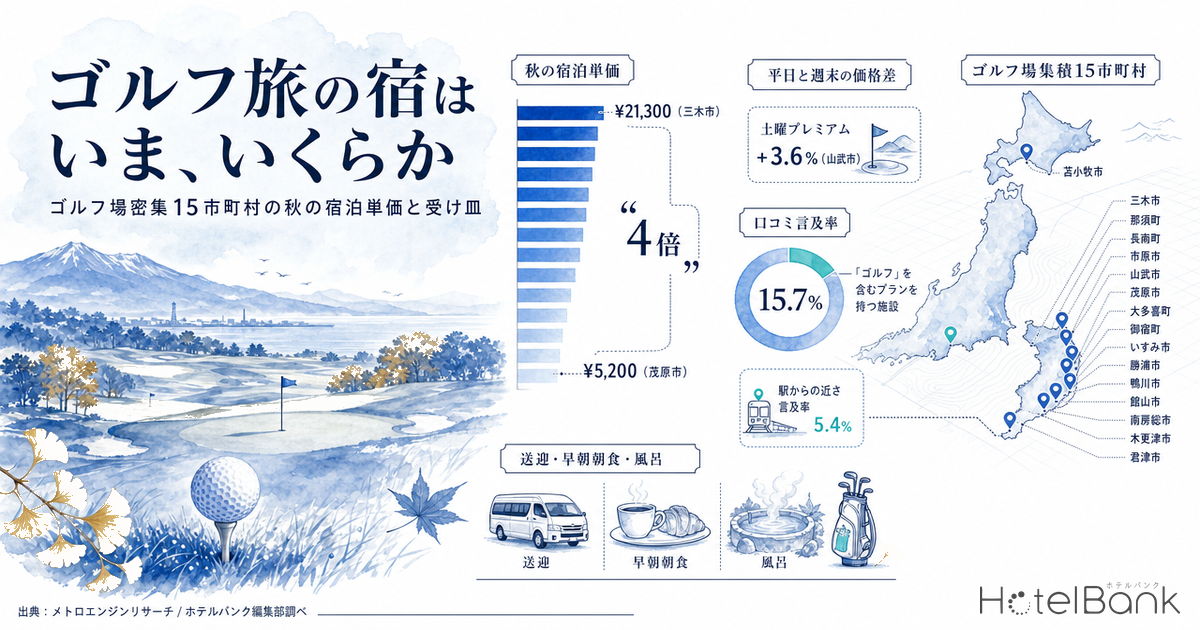
- — ¥5,200–¥21,300 — estimated settled ADR for autumn 2025 across the 15 golf-dense municipalities spans a fourfold range. The gap is explained not by grade but by the role the property plays.
- — The Saturday premium is small — +3.6% in Sanmu and +6.5% in Yaita, against +48.0% in Mito. Weekdays are less prone to becoming a trough, which supports annual revenue.
- — Guests talk about the bath, not the station — station proximity is mentioned in 5.4% of reviews (19.9% in regional core cities), while hot springs run 5.2% against 4.1%. Arrival by car is the assumption.
- — One property in six offers a golf-branded plan — just 21 properties, or 15.7%, and only one in 20 uses the word “early morning.” More than 80% sell without ever making the golf context explicit.
- — Total capacity may become the constraint — Ichihara has 33 courses against 21 properties and 1,301 rooms; Otaki has 13 properties and 148 rooms. There is little slack if inbound golf demand arrives in volume.
Courses keep closing, and demand concentrates on the clusters that remain
According to Ikki Publishing’s survey, the number of golf courses in operation nationwide has fallen by 246 courses (10.4%) from the 2004 peak of 2,356, an 18th consecutive year of decline since 2008. A shrinking total means, conversely, that the relative importance of regions where courses remain densely clustered is rising. The top five prefectures — Chiba with 155, Hyogo with 149, Hokkaido with 141, Tochigi with 116 and Ibaraki with 113 — share a common trait: all are one to two hours by car from a major metropolitan area.
At the municipal level that concentration is sharper still. Golf courses occupy roughly 10% of the land area of Ichihara City in Chiba, which draws on the order of 1.6 million visitors a year. Miki City in Hyogo holds 25 courses within its boundaries, the most in western Japan. In areas like these there is a structural imbalance: very few lodging properties relative to the number of courses. Within the scope MetroEngines Research covers, Ichihara has just 21 operating properties and 1,301 rooms. That is 1,301 rooms against 33 courses.
One caveat before going further. This analysis infers a demand relationship from geographic proximity — golf courses and lodging properties located in the same municipality — and does not directly confirm that individual guests stayed for the purpose of playing golf. What follows should be read as an observation of “how the lodging market looks in areas where golf courses cluster.”
| Municipality | Properties | Total rooms | Composition (leading categories) |
|---|---|---|---|
| Ichihara, Chiba | 21 | 1,301 | 10 business hotels, 5 ryokan |
| Tomakomai, Hokkaido | 17 | 1,566 | 13 business hotels, 2 ryokan |
| Kimitsu, Chiba | 14 | 651 | 6 business hotels, 4 ryokan |
| Otaki, Chiba | 13 | 148 | 8 ryokan (12 rooms on average) at the core |
| Kisarazu, Chiba | 12 | 946 | 4 business hotels, 3 city hotels |
| Kato, Hyogo | 10 | 317 | 4 ryokan, 2 business hotels |
| Sanmu, Chiba | 8 | 145 | 2 resorts, 2 ryokan, plus small properties |
| Yaita, Tochigi | 8 | 282 | 3 business hotels, 2 ryokan |
| Miki, Hyogo | 4 | 262 | 1 resort, 1 business hotel, others |
| Hokota, Ibaraki | 5 | 73 | 2 ryokan, 2 business hotels |
Source: compiled from MetroEngines Research and HotelBank Editorial Team research (operating properties, as of July 2026)
What the table shows is that lodging supply in golf-course clusters skews small in number, small in scale, and towards ryokan. Otaki has 13 properties and 148 rooms in total, with ryokan averaging around 12 rooms at its core. Hokota has just five properties and 73 rooms. Ichihara, Kisarazu and Tomakomai, by contrast, also function as industrial cities or transport nodes, and business hotels in the 100-room class form the backbone of supply. Even among towns that all have plenty of golf courses, the character of the lodging stock differs completely.
Autumn rates run ¥5,200 to ¥21,300 — a fourfold spread
Lining up estimated settled ADR for autumn 2025 (September–November) by municipality, the range runs from ¥5,200 to ¥21,300 — roughly fourfold. At the top are Miki, Hyogo (¥21,300, N=3 properties) and Otaki, Chiba (¥19,500, N=10 properties), both areas where resort hotels and hot-spring ryokan dominate supply. At the other end, Mobara, Chiba (¥5,200, N=8 properties), Sodegaura (¥5,500, N=6 properties) and Ichihara (¥6,300, N=22 properties) sit in the ¥5,000–¥6,000 band.
Source: compiled from MetroEngines Research and HotelBank Editorial Team research (average of monthly estimated settled ADR — the median across covered properties — for September–November 2025. Figures in parentheses are the minimum monthly property count.)
This gap reflects a difference in the role each property plays rather than a difference in grade. Ichihara and Sodegaura sit behind the Keiyo industrial belt, where room-only business hotels carry weekday corporate demand. A pre-golf overnight stay rides on that same supply, which keeps rates low. In Otaki and Miki, by contrast, the stay itself — hot springs, meals and all — is the product, and golf is positioned as one element combined with it. The former is a base for “sleep cheap and get out early”; the latter, a base where “staying is itself the point.”
For reference, over the same period Mito came in at ¥8,200 (N=32 properties), Nasushiobara in Tochigi at ¥14,200 (N=63 properties), and Chitose in Hokkaido at ¥12,300 (N=24 properties). The rate band for golf-dense areas is therefore distributed broadly between regional core cities and resort destinations. Note that Miki, Hokota and Sanmu cover only three to four properties each, so a price revision at a small number of properties can move the overall figure. This should be kept in mind when reading the numbers.
A small Saturday premium — weekdays rarely become a trough
More distinctive still was the way prices move by day of week. Aggregating published prices for September–November 2025 by check-in day and comparing Saturday against Wednesday, the Saturday uplift was small across most of the golf-dense municipalities. Sanmu came in at +3.6%, Yaita in Tochigi at +6.5%, and Kimitsu at +7.4%. The comparison cities, by contrast, showed a much wider spread: +48.0% in Mito and +37.4% in Utsunomiya.
Source: compiled from MetroEngines Research and HotelBank Editorial Team research (check-in September–November 2025; double occupancy, average across all plans at published prices. Ichihara 35 properties, Kisarazu 25, Kimitsu 20, Sanmu and Otaki 21 each, Tomakomai 16, Hokota 13, Kato 10, Yaita 9 and others; reference: Mito 45, Utsunomiya 56, Kamogawa 72, Tateyama 102.)
This small Saturday premium can be read two ways. One is a demand-side explanation: golf play demand, led by older players, tends to be spread thickly across weekdays, so the peaks and troughs are less pronounced than in a general leisure market where demand concentrates on weekends. The other is a supply-side explanation: two-meal plans at ryokan and resort hotels are often priced on a fixed basis, and a certain share of properties simply are not moving prices dynamically by day of week. This data alone cannot separate which factor dominates.
Whichever reading one takes, the practical implication is the same. A market where weekday rates do not fall far below weekend rates has a shallower occupancy trough and a firmer floor under annual revenue. On top of that, identifying the days when demand is genuinely strong and layering in tiered pricing opens room for further revenue growth. That this room is real is shown by the coexistence, within the same set of golf-dense areas, of places achieving large day-of-week differentials — +79.7% in Miki and +35.6% in Hokota.
Source: compiled from MetroEngines Research and HotelBank Editorial Team research (circle size indicates the number of operating properties; colour indicates the autumn 2025 estimated settled ADR level)
What reviews talk about is the bath, not the station
To see how guests perceive these properties as a base, we analysed 11,694 guest reviews from the past 24 months across 134 properties in the 15 golf-dense municipalities. As a comparison set we used 17,902 reviews across 84 properties in Mito and Utsunomiya, regional core cities in the same northern Kanto region.
Source: HotelBank Editorial Team research (15 golf-dense municipalities, 134 properties, 11,694 reviews / reference: Mito and Utsunomiya, 84 properties, 17,902 reviews; both covering the past 24 months)
The widest gap was in how location is discussed. The share of reviews touching on proximity to a station falls from 19.9% in the regional core cities to 5.4% in the golf-dense areas — down to nearly a quarter. Guest attention is clearly not directed at rail access, and it is natural to conclude that arrival by car is the assumption. Mentions of hot springs, meanwhile, were higher in the golf-dense areas at 5.2% against 4.1% — consistent with the finding that the higher-rate areas are supported by hot-spring-ryokan-type supply.
What is interesting is that parking was mentioned in only 2.6% of reviews in the golf-dense areas, below the 7.4% seen in regional core cities. That parking rarely comes up in locations premised on car arrival is likely because being able to park is taken for granted, leaving little reason to write about it. Read the other way, the information that actually matters to guests arriving by car — parking capacity, how golf bags are loaded and unloaded — is a field that has yet to accumulate in guests’ own words. There is considerable room here to communicate.
As for shuttle transfers, mentions were almost absent in both the golf-dense areas and the regional core cities (only two of the 134 properties had any meaningful volume of shuttle mentions). This does not mean shuttle services do not exist; more likely, it is simply a subject that reviews rarely address. Still, given that reviews are what guests consult when making decisions in advance, the fact that shuttle availability and operating conditions are not visible in words remains, as it stands, untapped communication upside.
Properties that stand out on hot springs and breakfast
Looking at individual properties, the golf-dense areas include a number of inns and hotels that clearly draw praise for their hot springs or breakfast. The following are properties with a high share of mentions of hot springs and breakfast buffets, among those that accumulated 50 or more reviews over the past 24 months.
| Property | Location | Rooms | Hot-spring mention rate | Analysed reviews |
|---|---|---|---|---|
| Business Hotel Goi Onsen (ビジネスホテル 五井温泉) | Ichihara, Chiba | 52 | 51.7% | 60 |
| Kotaki Kosen (小滝鉱泉) | Yaita, Tochigi | 7 | 33.3% | 57 |
| Tenryuso (天龍荘) | Otaki, Chiba | 7 | 31.6% | 76 |
| Takimien (滝見苑) | Otaki, Chiba | 33 | 31.2% | 77 |
| Dormy Inn Tomakomai, Tarumae-no-Yu Natural Hot Spring (天然温泉 樽前の湯 ドーミーイン苫小牧) | Tomakomai, Hokkaido | 163 | 29.1% | 536 |
| Hotel The Nesta & Spa (ホテル ザ・ネスタ&スパ) | Miki, Hyogo | 109 | 27.9% | 473 |
| International Resort Hotel Yurakujo (インターナショナルリゾートホテル湯楽城) | Tomisato, Chiba | 490 | 23.4% | 1,310 |
| Ryokan Kawana (旅館 かわな) | Kimitsu, Chiba | 15 | 22.4% | 152 |
Source: HotelBank Editorial Team research (past 24 months; properties with 50 or more analysed reviews)
By breakfast-buffet mention rate, Grand Park Hotel Panex Kimitsu (グランパークホテルパネックス君津) in Kimitsu, Chiba leads at 29.7% (185 analysed reviews), followed by Ooedo Onsen Monogatari Kimitsu no Mori (大江戸温泉物語 君津の森) at 25.0% (152 reviews), Ikoi no Mura Hinuma (いこいの村 涸沼) in Hokota, Ibaraki at 24.0% (146 reviews), and Hotel Green Plaza Tojoko (ホテルグリーンプラザ東条湖) in Kato, Hyogo at 23.4% (175 reviews). Properties that attract comments along the lines of “the variety at breakfast…” or “having a hot spring is much appreciated” show that even in golf-dense areas, the stay experience itself becomes something guests remember.
Only one property in six writes “golf” into its plan design
To probe how far these bases are actually equipped, we aggregated the vocabulary used across 19,293 plan names published by those same 134 properties. The comparison set is 15,698 plan names from the 84 properties in Mito and Utsunomiya.
| Word contained in plan name | 15 golf-dense municipalities (134 properties) | Reference: Mito and Utsunomiya (84 properties) |
|---|---|---|
| Properties with a plan containing “golf” | 21 properties (15.7%) / 183 plans | 6 properties (7.1%) / 69 plans |
| Properties with a plan containing “shuttle” | 14 properties (10.4%) / 64 plans | 2 properties (2.4%) / 17 plans |
| Properties with a plan containing “large public bath” | 20 properties (14.9%) | 11 properties (13.1%) |
| Properties with a plan containing “early morning” | 7 properties (5.2%) / 45 plans | 2 properties (2.4%) / 9 plans |
Source: compiled from MetroEngines Research and HotelBank Editorial Team research (aggregation of published plan names; identical names counted once)
Properties in golf-dense areas run plans branded around “golf” and “shuttle” at more than double the rate of the reference areas. That geographic proximity is reflected in plan design is, of course, an unsurprising result. In absolute terms, though, only one property in six has a golf-branded plan, and only one in 20 has a plan branded around early mornings. More than 80% of properties are selling without ever making the golf context explicit. On how the wording of a plan name plays into sales, Shizuoka Ryokans: What “Full” Inns Name Differently (N=409) compares the naming used by top- and bottom-quartile properties with concrete examples.
Looking at plan names from properties that are further along, the design template is quite clear. In Tomakomai, Hokkaido, “golf and stay packages” form the spine, combining choice of course, caddie or self-play, same-day or next-day play, one night with two rounds, and consecutive nights, with early-booking discounts layered on top. In Ichihara, Chiba, the structure pairs a play voucher for a nearby course with breakfast built in. What both share is that the product is not the room alone but the whole path through to the next morning’s tee time.
There is clear upside here. Golf-dense areas are markets whose ability to draw visitors is already proven, and their geographic advantage is not going to move. Layer onto that an explicit vocabulary — play vouchers bundled in, early breakfast service, golf bag handling, shuttle terms to the course — combined with pricing designed by day of week and by lead time, and there is ample room to build up from current rate levels.
Inbound golf as a second axis of demand
One other source of demand that regional bases cannot ignore is inbound golf. According to Japan National Tourism Organization statistics, visitors from South Korea reached 9.45 million in 2025 (+7.3% year on year) and from Taiwan 6.76 million (+11.9%), both tracking at record levels. Travel from short-haul markets has entered a phase of routine repetition, and purpose-driven trips are increasing. Golf is one of the leading purposes.
Chiba Prefecture has signalled that in fiscal 2026 it will make a full-scale push to attract inbound visitors around its golf courses. The plan invites product planners from travel companies in South Korea, Taiwan and Australia, along with domestic land operators, to courses in the prefecture, and promotes both the climate’s suitability for golf and access from central Tokyo and Narita Airport. It is an effort to connect the country’s largest concentration of golf courses to tourism spending.
This movement could become a genuine opportunity for lodging operators. As noted above, Ichihara’s 33 courses are matched by only 21 properties and 1,301 rooms, and Otaki has just 13 properties and 148 rooms. If inbound golfers arrive in earnest, total capacity itself is likely to become the constraint. Put the other way round, this is a market structure in which existing properties can secure a relative advantage simply by putting multilingual service, shuttle transfers and club-shipping support in place.
Source: compiled from MetroEngines Research and HotelBank Editorial Team research (autumn 2025 on an actuals basis; autumn 2026 estimated from published levels at the time of the survey. Only municipalities retaining roughly 60% or more of their 2025 property count are shown.)
Setting levels estimated from autumn 2026 published listings alongside autumn 2025, most municipalities with a stable property count show upward movement. Ichihara moves from ¥6,300 to around ¥10,000, Tomakomai from ¥8,700 to around ¥14,000, and Kimitsu from ¥9,000 to around ¥12,800. These are estimates drawn from selling prices visible on OTAs and similar channels at the time of the survey, however, and they shift as check-in dates approach and plans are added or prices adjusted. For now they should be treated as a signal of direction rather than a settled level.
Conclusion — a two-tier structure of “stay cheap” and “enjoy the stay”
Three things emerge from looking across the 15 golf-dense municipalities. First, autumn room rates span a fourfold range from ¥5,200 to ¥21,300, and that gap is explained by a difference in the role of the property rather than by grade. Business-hotel-type bases in industrial cities and transport nodes coexist with stay-oriented bases offering hot springs and meals, inside the same category of “town with a lot of golf courses.”
Second, in many of these areas the Saturday price uplift is smaller than in regional core cities, and weekdays rarely become a trough. That is a strength in terms of revenue stability across the year, and layering day-of-week pricing on top of it creates an opportunity to add more. That areas such as Miki and Hokota achieve large day-of-week differentials within the same set of clusters supports that possibility.
Third, the three base elements — shuttle transfers, early breakfast, and bathing facilities — are still not sufficiently expressed in either reviews or plan names. One property in six has a golf-branded plan; one in 20 uses the word “early morning.” Shuttle service scarcely comes up in reviews at all. As the flow of inbound golf demand towards the regions strengthens, making visible what has not yet been put into words is arguably the most accessible source of growth available to properties in these clusters.
For properties: plan-naming cues that work for this theme
Appeal elements most common among published plan names in Chiba that mention golf (N=307) —
Activity 98%Room only 33%Two meals 17%Day-of-week limited 15%Breakfast included 14%Kaiseki course 11%
Examples of actual names (anonymised):
- “[5% OFF] [Major Sale] Weekday / Room Only — Great Value for Solo Travellers Too! Late Check-in OK — Golf and Shrine Visits” (【5%OFF】【大型セール】平日・素泊/お一人様もお得!遅めチェックイン◎ゴルフ、神社参拝)
- “[5 Nights or More] Resort Workation Plan — Hot Spring, Golf, Gym and Pool” (【5泊以上】リゾートワーケーションプラン☆温泉&ゴルフ&ジム&プール)
Note: these are tendencies based on an aggregation of published plan names and do not demonstrate a causal link between naming and sales.
⚠ A note on ADR for future dates: The autumn 2026 figures in this article are estimates based on selling prices published on OTAs and similar channels at the time of the survey, and they will move as check-in dates approach. Prices set high at present may fall through last-minute adjustment. In addition, the relationship between golf courses and lodging properties is inferred from geographic proximity within the same municipality, and it has not been directly confirmed that individual stays were made for the purpose of golf.
Related Reading
References and Sources
■ Data sources
Municipality-level estimated settled ADR (monthly, September 2025 to November 2026), published prices by day of week (check-in September–November 2025, double occupancy, average across all plans), aggregation of published plan names (134 properties across 15 golf-dense municipalities, 19,293 plans / reference: Mito and Utsunomiya, 84 properties, 15,698 plans), and the category and room counts of operating properties are from MetroEngines Research. Mention analysis of guest reviews is HotelBank Editorial Team research (134 properties, 11,694 reviews / reference 84 properties, 17,902 reviews; both covering the past 24 months). Golf course counts are from Ikki Publishing, and inbound visitor numbers from the Japan National Tourism Organization (JNTO).
■ Calculation assumptions
Municipality-level ADR is the average across the three months September–November 2025 of monthly estimated settled ADR (the median across covered properties). Estimated settled ADR is calculated by applying a property-category correction coefficient to the lowest published plan level each property lists on OTAs and similar channels (double occupancy, per room, tax included); cross-checked against property-level actuals disclosed by listed hotel REITs (91 properties, most recent three months), the median error is approximately 7%. Day-of-week comparisons use published prices (average across all plans), contrasting Saturday check-in with Wednesday check-in. Autumn 2026 levels are estimated from published prices at the time of the survey, and only municipalities retaining roughly 60% or more of their 2025 property count are shown. Review mention rate is the share of reviews mentioning a given theme, not a rating score.
■ Limitations and caveats
The relationship between golf courses and lodging properties is inferred from geographic proximity within the same municipality, and it has not been directly confirmed that individual stays were made for the purpose of golf. In areas such as Miki, Hokota and Sanmu, where only three to ten properties are covered, a price revision at a small number of properties can move the overall figure. The autumn 2026 estimates shift as check-in dates approach and plans are added or prices adjusted, so they need to be treated as a signal of direction. As for the small Saturday premium, this article’s data cannot separate whether the demand side (a visit structure centred on weekday play) or the supply side (fixed pricing of two-meal plans) is the dominant cause.
■ Golf course statistics
- Ikki Publishing, “Golf courses in operation nationwide down 11 from last year to 2,110” (7 August 2025; survey as of mid-April 2025)
- Ichihara City official note, “32 clubs and 33 golf course locations — the most in Japan” (31 July 2025)
- Miki City, “Miki, the Town of Golf” (25 courses, the most in western Japan)
- Nippon Golf-course Kanrisha-kai (Japan Golf Course Managers’ Association)
■ Inbound trends and policy
- Japan National Tourism Organization (JNTO), “Statistics on Foreign Visitors to Japan”
- Nikkei, “Chiba Prefecture to attract inbound visitors around golf courses, with tours aimed at travel companies in South Korea and Taiwan”
- Japan Tourism Agency, “Overnight Travel Statistics Survey”
■ Lodging market data
- MetroEngines Research — municipality-level estimated settled ADR (September 2025 to November 2026), published prices by day of week (check-in September–November 2025), aggregation of published plan names, and the category and room counts of operating properties
- HotelBank Editorial Team research — mention analysis of guest reviews (134 properties across 15 golf-dense municipalities, 11,694 reviews / reference two cities, 84 properties, 17,902 reviews; past 24 months)