

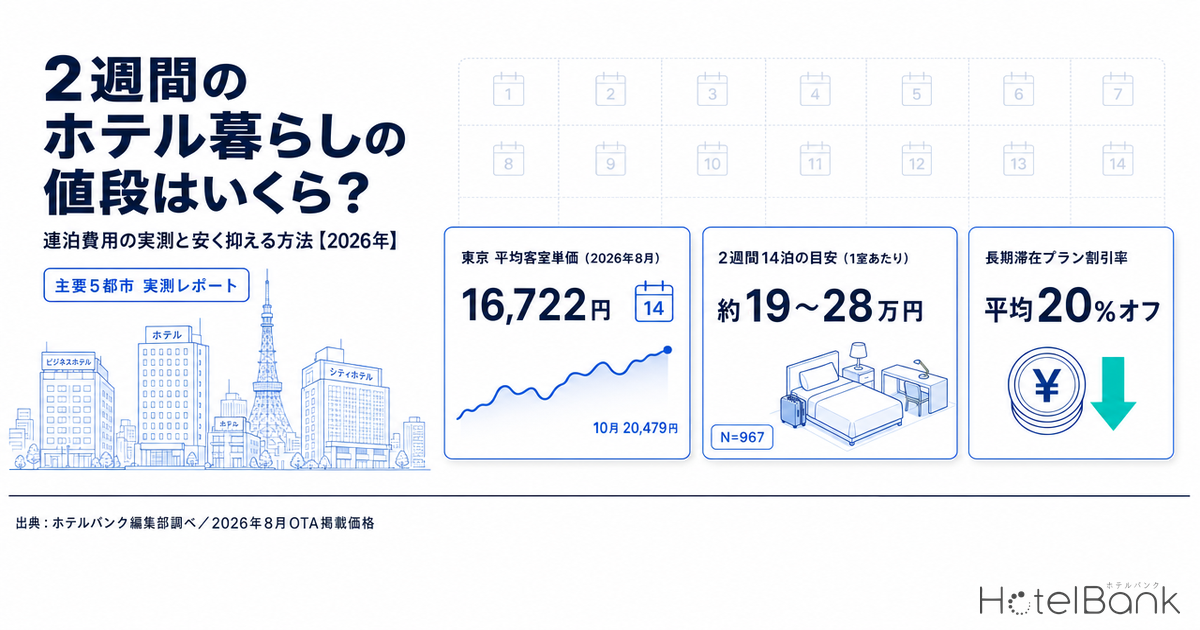
How much does two weeks of hotel living in Japan actually cost? We measured published OTA rates as of August 2026 and worked through the cost of a 14-night stay in five major cities, along with the ways to bring that figure down.
“Hotel living” has a ring of luxury to it. But if you actually end up living in a hotel, what should you watch out for?
• The upsides and downsides of hotel living
• What a two-week stay costs
• Recommended hotels under ¥100,000 for two weeks in major cities
Let’s get straight into it.
Measured for 2026: What Two Weeks of Hotel Living Costs in Five Major Cities
The conclusion first. Below are the average room rates for business hotels in five major prefectures, compiled by the HotelBank Editorial Team from published OTA rates as of August 2026, together with the cost of staying two weeks (14 nights).
| Prefecture | Average room rate (Aug 2026) | 14-night estimate (Aug) | Average room rate (Oct 2026) | 14-night estimate (Oct) | Properties counted |
|---|---|---|---|---|---|
| Tokyo | ¥16,722 | ¥234,108 | ¥20,479 | ¥286,706 | N=967 |
| Osaka | ¥13,844 | ¥193,816 | ¥15,192 | ¥212,688 | N=528 |
| Aichi (Nagoya) | ¥14,473 | ¥202,622 | ¥17,308 | ¥242,312 | N=318 |
| Fukuoka | ¥14,103 | ¥197,442 | ¥14,782 | ¥206,948 | N=347 |
| Okinawa | ¥19,947 | ¥279,258 | ¥17,472 | ¥244,608 | N=204 |
• Average room rate = the monthly average of the lowest plan level each property publishes on OTAs, for the business hotel category in each prefecture.
• Rates are per room for two-person occupancy (tax included). Single-occupancy plans may be priced differently.
• The 14-night estimate = average room rate × 14 nights, a straight multiplication that does not factor in consecutive-night discounts or long-stay plans.
• The property count (N=) is the number of properties listed as of August 2026.
• Source: HotelBank Editorial Team
At standard published rates, two consecutive weeks works out to roughly ¥190,000–280,000 per room on measured data. Single-occupancy plans may be priced differently, and rates move month to month even within the same city. Tokyo rises into the autumn, from ¥16,722 in August to ¥20,479 in October, while Okinawa falls once the summer peak passes, from ¥19,947 to ¥17,472 — so the timing of your stay alone can swing a two-week total by tens of thousands of yen. For how to narrow down properties that suit a long stay, Business Hotels for Long Stays: 6 Checks works through the criteria using the same measured Tokyo figure of ¥16,722.
If that number strikes you as high, don’t worry. The long-stay plans covered below can bring the accommodation cost down substantially. Let’s start with the basics of hotel living.
The Upsides and Downsides of Hotel Living
“Hotel living” sounds elegant, but of course it comes with both advantages and drawbacks. Let’s look at each in detail.
Upsides of hotel living
1. The furniture and appliances are already there
It goes without saying that a hotel comes with the furniture and appliances you need. Unlike renting an apartment, you don’t have to buy furniture and appliances to fit the room, so you avoid that wasted spending. And when you move out, you can leave light.
2. You can move in with no upfront costs
Moving into a new place in Japan — an apartment in particular — usually means paying a deposit and key money upfront. Hotel living requires none of these upfront costs, so relocating is cheaper.
3. Housekeeping
Living alone means handling everything yourself, cleaning and chores included. In a hotel, staff clean the room and take out the rubbish (though not every day), so you can keep things tidy without the effort.
4. Access to the hotel’s facilities
Some hotels have a fitness gym or a pool, and guests can use them freely. Being able to work out and unwind after a day of business or sightseeing is a welcome perk. A plan that includes breakfast is also worth considering — it lets you make good use of the precious morning hours without heading out to find food.
5. Lower fixed costs
Utilities add up more than people expect in day-to-day life. In a hotel, utilities are covered, and at most properties the high-speed internet you need for work is free to use.
Downsides of hotel living
1. It is expensive over time
Unlike living at home, everything you do in a hotel carries a cost. The accommodation cost in particular is nightly rate × number of nights, so the longer you stay, the more it obviously adds up.
2. You cannot cook
Because guest rooms do not come with a kitchen, cooking for yourself is normally out of the question. Some hotel types do offer rooms with a kitchen, but these are mostly aimed at families, which makes the per-room rate high.
3. Noise from the room next door
Ordinary business hotels often have little soundproofing in the walls, so sound carries. There is no guarantee that the guest next door won’t shout or come back drunk and rowdy, and that is a real nuisance when you are trying to concentrate — a genuine drawback.
4. You cannot invite friends to your room
You are paying for the room, but it is not your own home, so you cannot invite friends or acquaintances into it.
5. Very little storage
On a long stay your belongings pile up and there is nowhere to put them. A closet for clothes may hold only a few hangers, making it impossible to hang everything that would otherwise crease. And when you buy something you need, there is no cupboard or storage space, so storage capacity is the weak point. For practical ways to soften these inconveniences, 6 Downsides of Hotel Living in Japan sets out fixes covering your registered address, laundry and cooking.
What Two Weeks of Hotel Living Costs

Broadly speaking, the costs of hotel living break down as follows.
• Accommodation
• Food
• Laundry (coin laundry)
There is some variation by area and region, but staying at a ¥8,000-a-night hotel with breakfast included works out like this:
| Accommodation: | ¥112,000 (¥8,000 × 14 days) |
| Food: | ¥28,000 (¥2,000 × 14 days) |
| Coin laundry: | ¥3,800 (¥800 to wash and dry, every 3 days across 14 days) |
| Total | ¥143,800 |
That is the bare minimum on paper, though — you should assume the real figure will be higher.
How to Make Two Weeks of Hotel Living Cheaper

Hotel living, with nothing but the bare minimum of luggage, is something many people find appealing. It has its upsides and downsides, but the way to stay for less than a normal hotel booking is the monthly hotel — explained in Monthly Hotels in Japan: No Lease, 20% Off at 30 Nights.
Monthly hotels are aimed at long-stay guests, which is why they come with plans averaging about 20% below the standard rate. That makes them a good fit for workations and extended business trips, and there is enough inventory that a last-minute booking is rarely a problem, so you can pick a property that suits you. For the night count at which consecutive-stay discounts start to bite, Japan Hotel Long-Stay Discounts: 15% at 7 Nights, 20% at 30 Nights measures the effect by length of stay.
Two Weeks of Hotel Living for Under ¥100,000 Is Possible

Here are recommended hotels in five of Japan’s major cities — Tokyo, Osaka, Fukuoka, Nagoya and Okinawa — where two weeks comes in under ¥100,000. These are not picked on price alone; location and facilities went into the selection too.
Tokyo
Hotel Trusty Premier Nihonbashi Hamacho (ホテルトラスティ・プレミア日本橋浜町) — Hamacho Station

| Address: | 2-30-4 Nihonbashi Hamacho, Chuo-ku, Tokyo |
| Nearest station: | 1 minute on foot from Hamacho Station (subway) |
| One-week rate: | ¥42,000 and up (about ¥84,000 for two weeks) |
| One-month rate: | ¥168,000 and up |
| Notes: | Rates vary by period. Check the hotel’s official website for current pricing. |
Hotel Trusty Premier Nihonbashi Hamacho sits about 10 minutes by car from Tokyo Station, which makes it very well connected. Alongside standard rooms it has guest rooms designed for long stays, fitted with a fridge, a microwave and a work desk — the secret to its popularity. The building also has a shared mini-kitchen and laundry (two machines) for guests, so simple cooking and washing can be handled without going out.
Depending on the room type, rooms come with a wide desk, and an air purifier with humidifier and high-speed internet are free in every room. A desk lamp, phone charger and extension cord can be borrowed as needed, so nothing feels lacking. A solid choice for two weeks in central Tokyo for under ¥100,000.
[August 2026 update] Hotel Trusty Premier Nihonbashi Hamacho ceased operating on 1 April 2022 and the same building now runs as KOKO HOTEL Premier Nihonbashi Hamacho, which opened in July 2022. The appeal of the location and the room mix carries over. See the operating-status table at the end of this article for details.
Osaka
Hiyori Hotel Osaka Namba Ekimae (日和ホテル大阪なんば駅前) — Namba Station

| Address: | 3-1-2 Nambanaka, Naniwa-ku, Osaka (SAKURA building) |
| Nearest station: | 2 minutes on foot from Nankai Namba Station; 5 minutes from Namba Station (subway) |
| One-week rate: | ¥44,737 and up (about ¥89,480 for two weeks) |
| One-month rate: | ¥178,960 and up |
| Notes: | Rates vary by period. Check the hotel’s official website for current pricing. |
Hiyori Hotel is a chain operating nationwide. Built around the theme of a warm, gentle hotel, it is known as a property with a high share of repeat guests. Standing in Osaka’s entertainment district and within walking distance of the well-known sights, its location is part of the appeal.
Rooms use tatami-style flooring you can walk on barefoot, which makes them exceptionally comfortable. Generous bathtubs to soak away the day and Simmons beds in every room are also popular with guests.
There is plenty more on offer: POLA amenities chosen with female guests in mind, tea bags from George Steuart, the renowned Ceylon tea house, and two-piece loungewear that is easy to move in and soft to the touch. Breakfast is served buffet-style in the restaurant, with fresh vegetables and fruit among the spread. A good choice for two weeks in Osaka for under ¥100,000.
Fukuoka
Vessel Hotel Fukuoka Kaizuka (ベッセルホテル福岡貝塚) — Kaizuka Station

| Address: | 7-10-65 Hakozaki, Higashi-ku, Fukuoka |
| Nearest station: | 10 minutes on foot from Nishitetsu Kaizuka Station; 1 minute by car from the Kaizuka interchange on the Fukuoka Urban Expressway |
| One-week rate: | ¥42,000 and up (about ¥84,000 for two weeks) |
| One-month rate: | ¥168,000 and up |
| Notes: | Rates vary by period. Check the hotel’s official website for current pricing. |
VESSEL HOTEL is one of the brands in the Vessel Hotels group. The brand is aimed at families, with services built around making the whole party comfortable.
Guest perks are generous: breakfast, parking, children sharing a bed and women’s amenities are all free. Rooms are on the larger side, so nothing feels cramped. Breakfast in particular is a point of pride, with Hakata ingredients and local specialities served from the morning — ideal if you want to make the most of Fukuoka. There is even a dessert corner, and the menu is substantial enough not to wear thin over a long stay. A recommended property near the interchange where two weeks in Fukuoka comes in under ¥100,000.
Nagoya
Hotel Resol Nagoya (ホテルリソル名古屋) — Nagoya Station

| Address: | 3-25-6 Meieki, Nakamura-ku, Nagoya, Aichi |
| Nearest station: | 4 minutes on foot from JR Nagoya Station |
| One-week rate: | ¥47,250 and up (about ¥94,500 for two weeks) |
| One-month rate: | ¥189,000 and up |
| Notes: | Rates vary by period. Check the hotel’s official website for current pricing. |
Hotel Resol is a nationwide chain running from Hokkaido in the north to Kyushu and Okinawa in the south. The brand puts its emphasis on relaxation, designing spaces meant to soothe all five senses. Step inside and the lobby carries a faint aroma, with the music, lighting and air all pitched toward calm.
Hotel Resol Nagoya has added a living lobby, a relaxed space for reading or conversation that feels like being at home. Rooms use wood-grain flooring, giving them an open, clean feel you can enjoy barefoot. Between the sleep-friendly pillows and memory-foam mattresses, a deep night’s rest is all but guaranteed.
The ground-floor restaurant is popular for a Western-style set with pizza baked fresh in the morning. You can customise from 40 varieties, and while the breakfast menu itself is simple — a side and a drink — it is filling. Eat in at the restaurant or take it away to enjoy at your own pace in the room. A recommended property where two weeks in Nagoya comes in under ¥100,000.
Okinawa
Hotel Gracery Naha (ホテルグレイスリー那覇) — Kenchomae Station

| Address: | 1-3-6 Matsuo, Naha, Okinawa |
| Nearest station: | 5 minutes on foot from Kenchomae Station on the Yui Rail |
| One-week rate: | ¥39,144 and up (about ¥78,300 for two weeks) |
| One-month rate: | ¥156,600 and up |
| Notes: | Rates vary by period. Check the hotel’s official website for current pricing. |
Hotel Gracery is a brand that positions the hotel as a “third place” alongside home and work. Hotel Gracery Naha has found its audience by leaning into what makes Okinawa a destination. Some rooms are designated Churaumi rooms, where footage of the Churaumi Aquarium shot by a well-known underwater photographer is projected across two walls — a firm favourite with guests.
One universal room is fully barrier-free, and the care staff take to make it comfortable for wheelchair users has drawn attention. The standard rooms are equally well equipped, with women-only floors and family-friendly fittings and amenities that leave guests satisfied.
Restaurant menus change with the season, but as of publication (January 2022) there was a choice of two: a Japanese-Ryukyuan set and a Western plate. Both are popular — the Japanese set weaves in Okinawan champuru and Okinawa soba, while the Western menu offers the chef’s freshly made soup and a Spanish omelette. A recommended property where two weeks in Okinawa comes in under ¥100,000.
Summary

Hotel living, with nothing but the bare minimum of luggage, is a way of life plenty of people aspire to. Even when a business trip comes up at short notice or something unexpected happens, a monthly hotel lets you narrow down by area and budget and stay for around 20% less than a standard hotel booking.
Two weeks of hotel living is normally hard to keep under ¥100,000, but with a monthly hotel it is achievable even in the major cities — Tokyo, Osaka, Fukuoka, Nagoya and Okinawa. Rates differ somewhat by season, but the strength of a long-stay plan is that the total is easier to contain than simply stacking up the standard nightly rate. Use monthly hotels well and hotel living becomes a comfortable option.
Operating Status of the Properties Featured (all re-checked in August 2026)
We re-confirmed the operating status of the five properties featured in this article as of August 2026, against each property’s official website and booking availability.
| Property (name at time of publication) | Status as of August 2026 |
|---|---|
| Hotel Trusty Premier Nihonbashi Hamacho (ホテルトラスティ・プレミア日本橋浜町) — Tokyo | Closed on 1 April 2022. The same building reopened in July 2022 as KOKO HOTEL Premier Nihonbashi Hamacho and is operating. |
| Hiyori Hotel Osaka Namba Ekimae (日和ホテル大阪なんば駅前) — Osaka | Operating |
| Vessel Hotel Fukuoka Kaizuka (ベッセルホテル福岡貝塚) — Fukuoka | Operating |
| Hotel Resol Nagoya (ホテルリソル名古屋) — Nagoya | Operating |
| Hotel Gracery Naha (ホテルグレイスリー那覇) — Okinawa | Operating |
The per-property stay rates quoted in this article are reference figures from the time of publication (2022). For current rates and plans, check each property’s official website.
Related Guides by Length of Stay and Budget
This article focuses specifically on the cost of a two-week stay. If your stay length or budget is different, the articles below will help.
- If you are considering a month or longer: A Month of Hotel Living in Japan: ¥554,900 in Tokyo, or ¥100,000
- If cutting the cost as far as possible is the priority: Japan Hotel Long-Stay Discounts: 15% at 7 Nights, 20% at 30 Nights
Frequently Asked Questions About Two Weeks of Hotel Living
Q. How much does two weeks of hotel living in Japan cost?
A. Based on published OTA rates measured in August 2026 (HotelBank Editorial Team survey), the average room rate for business hotels is ¥16,722 in Tokyo (N=967) and ¥13,844 in Osaka (N=528), which puts two weeks (14 nights) at roughly ¥190,000–280,000 per room. Properties with long-stay plans can bring the same 14 nights closer to ¥100,000.
Q. Are there ways to cut the cost of a 14-night stay?
A. Booking services aimed at long-stay guests carry plans that run about 20% below the standard published rate. Rates also move month to month within the same city — Tokyo goes from ¥16,722 in August 2026 to ¥20,479 in October, while Okinawa drops from ¥19,947 in August to ¥17,472 in October — so timing the stay matters too. Choosing a property with breakfast included and on-site laundry also holds down food and cleaning costs.
Q. What if I am thinking about a month or longer?
A. The longer the stay, the easier it is to bring the per-night rate down. Measured costs for a full month of hotel living are covered in our article on a month of hotel living in Japan, and the discount curve by number of nights is covered in our article on Japan hotel long-stay discounts.
Further reading
- One Week of Hotel Living in Tokyo: ¥88,200 for 7 Nights, Any Start Day
- Business Hotels for Long Stays: 6 Checks and ¥16,722 a Night in Tokyo
- Japan Hotel Long-Stay Discounts: 15% at 7 Nights, 20% at 30 Nights
- Monthly Hotels in Japan: No Lease, 20% Off at 30 Nights (Aug 2026)
- 6 Downsides of Hotel Living in Japan: ¥502,000 per 30 Nights & Fixes
- How to Start Hotel Living in Japan: 5 Steps, ¥479,000 for 30 Nights
- Is Hotel Living Cheaper Than Rent in Tokyo? Break-Even at 24 Nights
- Remote Work Hotel Living in Japan: 3 Options, ¥502,000 a Month
- Hotel Long-Stay Meals in Japan: 3 Patterns & ¥565–2,174 Breakfast Gap