

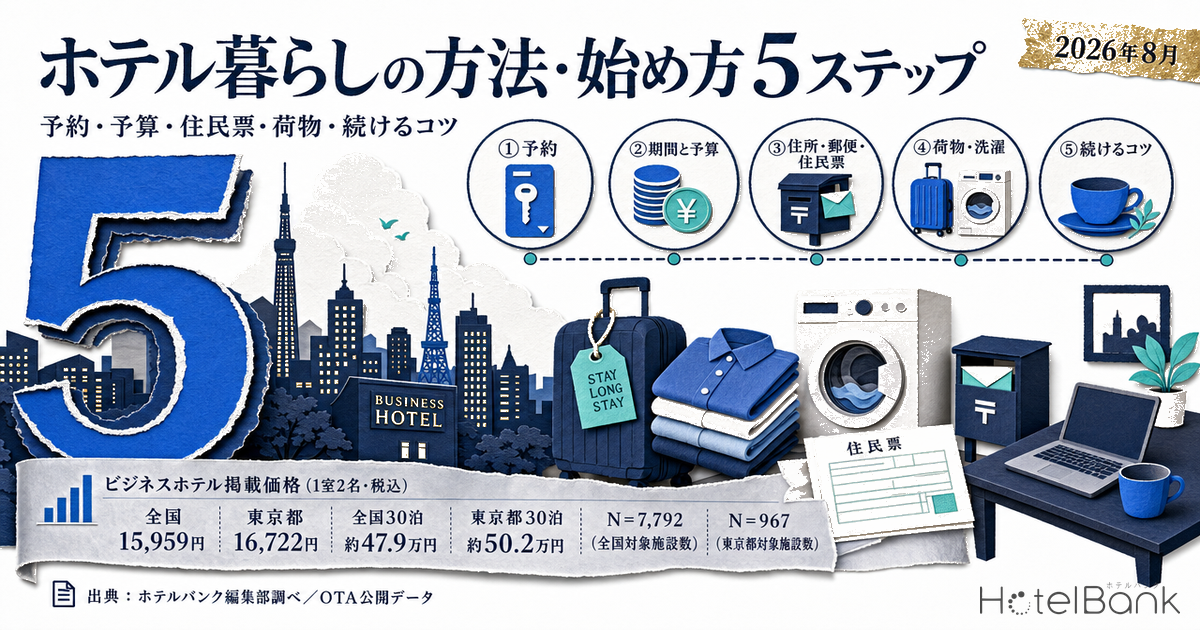
Hotel living can be started in five steps: (1) book an extended-stay or monthly plan, (2) decide how long you will stay and what you will spend, (3) settle where your address, mail, and residence registration sit, (4) plan your luggage and laundry, and (5) build the habits that let you keep going. There is no screening, no security deposit, and no guarantor as there would be with a lease — life begins the day your booking is confirmed. This article lays out the sequence in the order first-timers tend to get stuck, using listed prices from public OTA data (as of August 2026) as the basis for the numbers.
- — Five steps to get started — book an extended-stay or monthly plan, set your length of stay and budget, sort out your address and residence registration, plan luggage and laundry, then build the habits that keep it sustainable. Decide them in that order and the arrangement rarely falls apart midway.
- — No screening, deposit, or guarantor — unlike a lease, life starts the day your booking is confirmed. You are free to extend or stop, so setting one month as your first boundary is the realistic move.
- — Cap your budget at listed price × nights — the listed price for business hotels is ¥15,959 nationwide and ¥16,722 in Tokyo (as of August 2026, two guests per room, per room, tax included). Multiply straight out to 30 nights and the ceiling is roughly ¥479,000 nationwide and ¥502,000 in Tokyo.
- — Keep your residence registration at your “base of daily life” — if you have somewhere else to go home to, leaving it there is by far the least work. Keep the address on your ID, bank accounts, and mobile contract aligned with the registered one.
- — Laundry and housekeeping frequency decide whether you can keep it up — you have three options: an on-site coin laundry, an in-room washer-dryer, or an outside laundry service. An extended-stay plan that lets you choose your housekeeping frequency lets you tune both cost and effort.
Hotel Living Starts in Five Steps (The Whole Picture First)
If you want a one-line answer to “how do you actually start living in a hotel,” it is this: find a plan that lets you stay a long time, and book it. Unlike a one- or two-night trip, though, settling the practical side first — your address, laundry, luggage, and a spending ceiling — is what keeps the arrangement from collapsing halfway through. The order runs as follows.
| Step | What to do | Rough time required |
|---|---|---|
| 1. Booking | Look for extended-stay, weekly, and monthly plans, check the payment terms, and book | 1–3 days |
| 2. Length and budget | Decide “how many nights” and “how much per month” up front, and set a ceiling at listed price × nights | Half a day |
| 3. Address, mail, residence registration | Sort out where your residence registration sits, how you will receive mail, and the address on your ID | 1–2 weeks (including municipal paperwork) |
| 4. Luggage and laundry | Cut what you bring down to one or two suitcases and decide how you will do laundry | 1–2 days |
| 5. Keeping it going | Set routines for meals, exercise, and your work setup so a long stay does not wear you down | Adjust as you go |
Step 1: How to Book an Extended-Stay or Monthly Plan
There are three main ways in. Rather than committing to one, the trick is to compare the same hotel through several of them.
- Use an OTA’s multi-night search: set the length of stay to seven nights or more and the results will surface extended-stay-only plans and conditional plans such as “7 nights or more” or “14 nights or more.” On OTAs these are listed under plan names like “extended stay,” “long stay,” and “weekly,” so entering the number of nights before you compare is the fastest route.
- Check the monthly and weekly plans on the hotel’s own website: flat-rate plans of around 30 nights are frequently listed only on the official site. For chains with membership programs, booking through the official site or app is the cheapest route and also earns points and free-night benefits. Toyoko Inn (東横イン), for example, applies member rates to bookings made on its official site or app and issues a voucher for one free single night for every ten stays, and APA Hotel (アパホテル) awards points on official bookings — both a good fit for hotel living, where consecutive nights are the premise.
- Ask directly by phone or email: questions like “what is the monthly rate for 30 nights,” “does the rate change if I spend a night elsewhere partway through,” and “can I choose the housekeeping frequency” are faster to settle by asking. Some hotels keep a separate rate sheet for long-stay guests.
Payment will be either prepaid (settled in full at booking) or paid on site (at check-in or check-out). Monthly plans are usually prepaid, or settled in instalments at set points during the stay. To avoid exceeding your credit card limit, check whether a full month of accommodation fits within that limit before you book.
Note also that with extended-stay bookings, the listed price per night often steps down at the 7-, 14-, and 30-night thresholds. How the discounts stack up and how to decide on your number of nights is covered in Japan Hotel Long-Stay Discounts: 15% at 7 Nights, 20% at 30 Nights, which is worth a look before you book.
Step 2: Setting Your Length of Stay and Budget (Working Back from Listed Prices)
Set your budget ceiling at “listed price per night × number of nights.” Business hotels are the category most often chosen for hotel living, so their market level is the right yardstick. In public OTA data (as of August 2026, two guests per room, per room, tax included), listed prices for business hotels stood at the following levels.
| Area | Business hotel listed price (per night) | Straight arithmetic for 30 nights | Properties covered |
|---|---|---|---|
| Nationwide | ¥15,959 | approx. ¥479,000 | N=7,792 |
| Tokyo | ¥16,722 | approx. ¥502,000 | N=967 |
Source: HotelBank Editorial Team analysis (public OTA data, August 2026, listed prices for the business hotel category; average per room for two guests per room, tax included). The 30-night column is straight arithmetic — the per-night listed price multiplied by 30 — and differs from the rates offered under extended-stay and monthly plans.
Because this table reflects the average for two guests per room on standard plans, what you actually pay will differ for single occupancy or on an extended-stay plan. In practice, a two-tier approach works well: treat “average listed price × 30 nights” as your ceiling, and the monthly figure quoted on an extended-stay or monthly plan as your working estimate of what you will pay.
As for length, making one month your first boundary is the realistic choice. Unlike a lease, you are free to extend or stop, so there is no need to book three months or six months from the outset. Do a month, look at the cost, your health, and how it fits with work, and extend from there. A cost comparison against renting, including rent, utilities, and communications, is set out in Is Hotel Living Cheaper Than Rent in Tokyo? Break-Even at 24 Nights — worth consulting when you set your monthly ceiling.
Step 3: What to Do About Your Address, Mail, and Residence Registration
The handling of your address is where people most often stumble first. There are three points to settle.
- Residence registration (juminhyo): as a rule your residence registration belongs at your “base of daily life,” and moving it to a hotel address is generally not contemplated. If you have somewhere else to go home to, such as a family home, leaving it there and starting from that position involves by far the least work.
- Mail: mail addressed to you at the hotel will usually be held at the front desk if you tell them in advance that it is for a guest in residence. Long-term storage and items requiring a signature are handled differently from property to property, so confirm at the time of booking. Many people also combine forwarding from the address where their registration sits with poste restante at a post office.
- The address on your ID: the address on your driver’s licence or My Number card follows your residence registration. If you keep the registered addresses for your bank, credit cards, and mobile contract aligned with it as well, moving from hotel to hotel triggers no paperwork.
The finer points — what to watch for when you leave your registration at a family home, and how it interacts with dependant status, taxes, and voting — are covered in detail in Hotel Living: Keep Residence Registration Home, or File Within 14 Days, so this article lists them only as items to settle before you begin.
Step 4: Planning Your Luggage and Laundry
Storage in a hotel room is limited, so the yardstick for luggage is whatever fits in one or two suitcases. Leave out-of-season clothing and books in a storage unit or at a family home and bring only “a week of clothes, your work kit, and daily essentials” into the room — then packing up to move rooms takes an hour.
Laundry is what determines whether you can keep hotel living up. There are three approaches.
- An on-site coin laundry: most business hotels have one. Using it late at night or early in the morning helps you avoid the queue. Choosing a property on the basis of its laundry facilities is a useful lens in itself, particularly for long summer stays when washing loads pile up.
- An in-room washer-dryer: some apartment-style and extended-stay hotels fit every room with a washer-dryer and a kitchenette. Laundry and simple cooking are then handled entirely inside the room, which is why many people choose this type for stays of a month or more. For concrete examples of hotels with a kitchen and washer-dryer where you can stay as though you lived there, When a Business Trip Runs Past Three Nights, Stop Booking “Hotels” — Top 5 Apartment-Style Properties with Kitchens and Washer-Dryers (HotelPicks, in Japanese) compares five properties across Tokyo, Osaka, Fukuoka, and Sapporo.
- An outside laundry service: send dress shirts and suits out through the hotel’s cleaning desk or to a nearby shop. Making it a weekly habit stops things piling up in the room.
Housekeeping can often be selected as “daily,” “every three days,” or “weekly,” and some extended-stay plans are designed so that reducing the frequency reduces the rate. Asking at the time of booking whether combinations are possible — towel changes and rubbish collection daily, linen changes weekly, for instance — takes a lot of friction out of the stay.
Step 5: How to Keep It Going Comfortably
The first week or two feels fresh, but past the one-month mark three things tend to surface: an unbalanced diet, no exercise, and the line between work and life disappearing. People who keep it up rely on the following adjustments. If you would rather start by getting the room conditions and your packing right, Hotel Living in Japan: 4 Room Criteria, Packing & Daily Routines is a useful reference.
- Meals: build around a plan with breakfast included so one meal a day is fixed at the hotel, and mix eating out, takeaway, and self-catering for lunch and dinner. With a microwave and a refrigerator in the room, supermarket prepared dishes and frozen food make it easy to hold food costs down.
- Bathing and rest: hotels with a large communal bath score high on satisfaction for long stays. Dormy Inn (ドーミーイン), for example, has won over repeat long-stay guests with its natural hot-spring communal baths and saunas plus a free “yonaki soba” late-night noodle service from 21:30 to 23:00 daily, making it easy to build a rhythm of soaking in the bath after work to switch off.
- Exercise: either choose a hotel with a fitness gym, or find a nearby public gym or running route in your first week. Trying to keep it all inside the room does not last.
- Your work setup: desk size, chair height, and the number of power outlets are hard to judge from photographs. If it does not suit you in the first week, decide early to move to another hotel at the same budget. Being able to move is hotel living’s single greatest advantage — there is no need to grit your teeth and stay put.
- Nights spent elsewhere: on a monthly plan you are charged even for nights you leave the room empty for a business trip or a visit home. If you will be away several nights or more in a month, renewing in seven-night blocks rather than locking in a fixed 30 nights can sometimes bring the total down.
When your first month is up, review what you actually paid, how you feel, and how work has progressed, then decide whether to continue, move to another hotel, or go back to a lease. For a framework to review against, 6 Downsides of Hotel Living in Japan: ¥502,000 per 30 Nights & Fixes works through cost, address, laundry, and cooking in that order, which makes it easy to use as decision material. This habit of reviewing month by month is the single biggest key to sustaining hotel living without strain.
If You Want to Look at Specific Properties
For hands-on comparisons of specific properties, these articles go deeper.
When a Business Trip Runs Past Three Nights, Stop Booking “Hotels” — Top 5 Apartment-Style Properties with Kitchens and Washer-Dryers (HotelPicks, in Japanese)
Compares five properties — Tokyu Stay Hakata, Tokyu Stay Sapporo Odori, Tokyu Stay Shinjuku Eastside, MIMARU Osaka Namba STATION, and MIMARU Tokyo Ueno EAST — on whether rooms have a washer-dryer and kitchenette, and on indicative prices for two guests per room. Tokyu Stay Hakata fits all 216 rooms with a washer-dryer and microwave (kitchenettes are limited to certain room types such as the residential rooms) and runs a standing long-stay plan for seven nights or more.
Five Extended-Stay Hotels with Kitchens in Nagoya’s Fushimi–Marunouchi District — Comparing a Month-Long Base by Room Facilities and Monthly Rate Structure (innippon, in Japanese)
Compares five properties — Nagoya B’s Hotel ANNEX, Grand Base Osu, Espacio Time Sharing Four Urban, and GOLD STAY Nagoya Sakae / Osu — on kitchen and laundry facilities and on the structure of their monthly and extended-stay discounts. Espacio fits all 54 rooms with an induction kitchen and a washer-dryer, while Grand Base Osu is presented as a whole-building type where discounts kick in from four nights.
Frequently Asked Questions
How do I start living in a hotel?
Start by deciding how many nights you will stay, then look for extended-stay, weekly, or monthly plans for that length and book. Because there is no screening, security deposit, key money, or guarantor as there would be with a lease, life can begin the day your booking is confirmed. Settling three things alongside the booking — where your residence registration sits, how you will receive mail, and how you will do laundry — spares you a scramble once the stay has started.
How much does a month of hotel living cost?
As of August 2026, listed prices for business hotels are ¥15,959 nationwide and ¥16,722 in Tokyo (both averages per room for two guests per room, tax included). Multiply straight out by 30 and you get roughly ¥479,000 nationwide and ¥502,000 in Tokyo. That is a ceiling estimate based on multiplying the standard-plan average by 30, however; in practice the monthly rate on an extended-stay or monthly plan is usually lower. Treat “listed price × 30 nights” as your ceiling and the quoted monthly rate as your working estimate.
Where is the cheapest place to book?
The basic approach is to compare three routes: an OTA’s multi-night search, the monthly and weekly plans on the hotel’s own website, and asking directly by phone or email. Flat-rate plans of around 30 nights are frequently listed only on the official site, and chains with membership programs attach points and free-night benefits to bookings made through the official site or app. Questions like “what is the monthly rate for 30 nights,” “does the rate change if I spend a night elsewhere partway through,” and “can I choose the housekeeping frequency” are faster to settle by asking.
What do I do about my residence registration while living in a hotel?
As a rule your residence registration belongs at your “base of daily life,” and moving it to a hotel address is generally not contemplated. If you have somewhere else to go home to, such as a family home, leaving it there and starting from that position involves the least work. If you also keep the registered address on your driver’s licence or My Number card, bank accounts, credit cards, and mobile contract aligned with it, moving from hotel to hotel triggers no paperwork.
How should I handle laundry and luggage?
The yardstick for luggage is whatever fits in one or two suitcases, with out-of-season clothing and books left in a storage unit or at a family home. For laundry you have three options: an on-site coin laundry, an in-room washer-dryer, or an outside laundry service. If you are staying a month or more, choosing an apartment-style or extended-stay property with a washer-dryer and kitchenette keeps everything inside the room.
Can I stop partway through, or move to a different hotel?
Yes. You are free to extend or stop, and there is none of the notice period or restoration cost that comes with a lease — that is hotel living’s advantage. If the desk size or chair height does not suit you, it is better to decide early to move to another hotel at the same budget. And if you will leave the room empty for several nights or more in a month, renewing in seven-night blocks rather than locking in a fixed 30 nights can sometimes bring the total down.
References and Sources
■ Data source
The listed prices in this article are aggregated at property level by the HotelBank Editorial Team from the prices publicly shown for accommodation plans on OTAs (as of August 2026, business hotel category, average per room for two guests per room, tax included). Properties covered: N=7,792 nationwide and N=967 in Tokyo. These are not the actual results of any particular booking site, but averages of publicly listed prices — not prices at which bookings were actually concluded.
■ Calculation assumptions
The figures under “straight arithmetic for 30 nights” are the per-night listed price multiplied by 30 (¥15,959 × 30 nights = approx. ¥479,000 nationwide; ¥16,722 × 30 nights = approx. ¥502,000 for Tokyo). They do not account for extended-stay discounts, monthly plans, member rates, seasonal variation, or whether meals are included. Actual amounts paid are frequently lower, and the figures are presented here as a ceiling estimate.
■ Limitations and caveats
(1) Because listed prices are based on two guests per room, the per-night unit price differs for single occupancy or on extended-stay plans. (2) The aggregation is an average at the category level, and market reality varies widely among business hotels depending on location, building age, and facilities. (3) The treatment of residence registration, mail, dependant status, and tax turns on individual circumstances and each municipality’s practice, so confirm the final position with the municipal office where you are registered. (4) Plan contents, membership benefits, and complimentary services at each hotel chain are subject to change, so check the latest terms on the official site before booking.
■ Official information from the hotel chains
- Toyoko Inn Club Card member benefits (member rates, discounts on official site / app bookings, one free single night per ten stays): Toyoko Inn official site
- APA Hotel member point awards (accommodation booked via the official site or app): APA Hotel official site
- Dormy Inn complimentary services (the “yonaki soba” late-night noodle service, 21:30–23:00 daily): Dormy Inn official site
Related Reading
- Hotel Living for a New Job: 1 Month Max, ¥17,238 Median Night in Tokyo
- 6 Downsides of Hotel Living in Japan: ¥502,000 per 30 Nights & Fixes
- Is Hotel Living Cheaper Than Rent in Tokyo? Break-Even at 24 Nights
- Hotel Living in Japan: 4 Room Criteria, Packing & Daily Routines
- Japan Hotel Long-Stay Discounts: 15% at 7 Nights, 20% at 30 Nights
- Hotel Living: Keep Residence Registration Home, or File Within 14 Days