

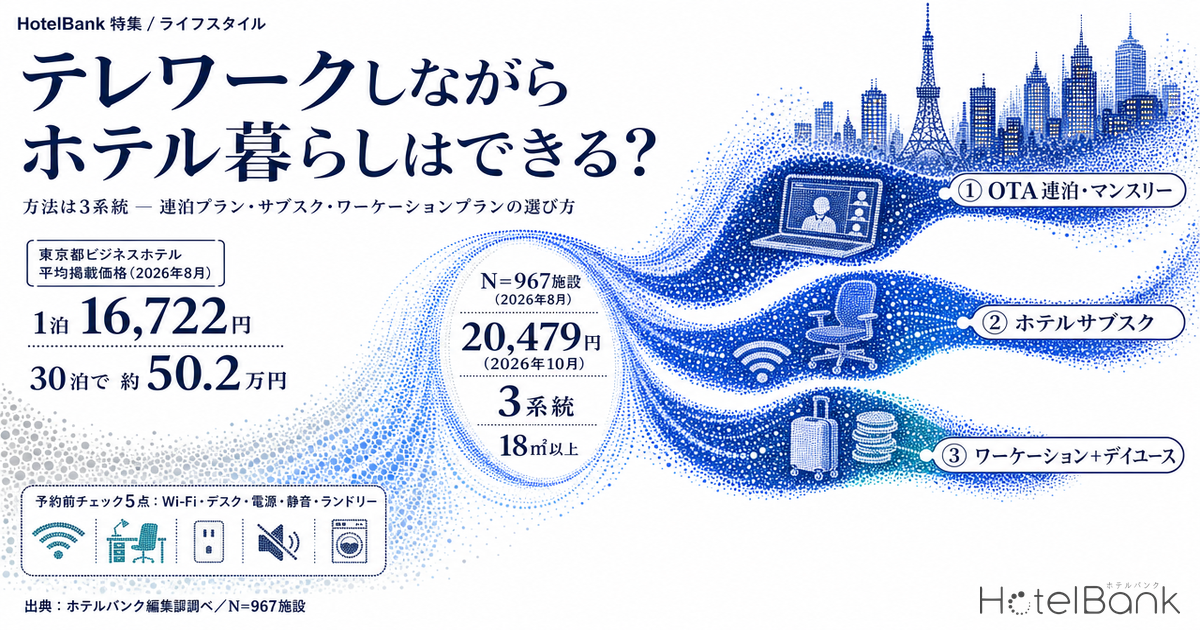
You can live in a hotel while working remotely, and there are three broad ways to do it. (1) Book an OTA consecutive-night, weekly, or monthly plan; (2) sign up for a hotel subscription service; or (3) use a workation or telework plan (including day-use). Which one you choose changes the unit of the contract (per night or per month), the structure of your costs, and how you go about verifying the work environment. This article sorts out how to choose among the three, the work-environment checks worth making before you book, and roughly what a month costs.
- — There are three routes: OTA consecutive-night, weekly, and monthly plans; hotel subscriptions; and workation or telework plans (with day-use alongside). Whether the contract is priced per night or per month changes the cost structure.
- — The average listed price for a business hotel in Tokyo is ¥16,722 per night (as of August 2026, per room at two guests per room, tax included, N=967 properties). Simply multiplying that by 30 nights gives about ¥502,000 as a starting benchmark.
- — What goes wrong is usually the work environment, not the price. Check five things before you book: real-world Wi-Fi speed, desk and chair, power outlet placement, quietness, and laundry.
- — Try day-use first, move to consecutive nights if it suits you, then switch to a monthly subscription if you are staying for several months — working up in that order is the least likely to go wrong.
Three Routes to Hotel Living While Working Remotely
| Route | Unit of contract | Who it suits |
|---|---|---|
| (1) OTA consecutive-night, weekly, and monthly plans | Per night (subject to conditions such as 7+ nights or 30 nights) | People with a fixed period in mind, or who want to try it first |
| (2) Hotel subscriptions | Monthly fee, coin accrual, and similar | People living across several months while moving between bases |
| (3) Workation and telework plans | One to several nights, plus day-use | People keeping their home and changing workplace on an occasional basis |
(1) OTA consecutive-night, weekly, and monthly plans
This is the easiest way in. On OTAs, plans carrying consecutive-night conditions — 7 nights or more, 14 nights or more, 30 nights — are sold separately from ordinary single-night plans. Most are designed to hold the per-night price down in exchange for reducing housekeeping to every other day or a few times a week, and apartment hotels with an in-room kitchen and washer-dryer are the mainstay of this segment. Because the contract is per night, if it does not suit you, you simply do not book the next stay — which makes it a good first step for testing hotel living. For the measured level of how many nights it takes before discounts start to bite, Japan Hotel Long-Stay Discounts: 15% at 7 Nights, 20% at 30 Nights breaks it into three tiers: 2+ nights, 7+ nights, and 30+ nights.
(2) Hotel subscriptions (unito, HafH, goodroom)
If you are genuinely living somewhere for several months, subscription services come into play. Here is how each works according to its official website (as of August 2026).
- unito: Has a mechanism called “rerent,” under which your rent falls for the nights you do not come back. No deposit, no key money, no renewal fee, and no move-out charge, with a minimum contract of one month. The design works best for people who leave the room empty often for business trips or visits home.
- HafH: A coin-accrual model. You set your own monthly accrual anywhere from 100 to 2,000 coins in increments of 50, and stay at properties across Japan and overseas at ¥32 per coin (a flat rate regardless of how much you accrue). It suits changing where you sleep every week rather than settling in one place.
- goodroom “Subsc-Kurashi”: A subscription service that lets you live in hotels and monthly apartments from two weeks. Monthly rates are presented per property on the official website.
All three revise their pricing from time to time, so check the latest figures on the official website before you sign. For the market-side background on why hotels are now widening their acceptance of subscriptions and long stays, see Hotel Subscription Market Tipping Point 2026 — goodroom, unito, HafH Disrupt Settled-Living Hotel Demand.
(3) Workation and telework plans (with day-use alongside)
If you want to keep your home and move only the work environment to a hotel, a day-use telework plan — using a guest room during daytime hours only — is another way in. Check-in to check-out is confined to a few hours in the day, and you use the room as a private office. Overnight workation plans are often designed to bundle in coworking space access or a late check-out. Confirming “can I actually work at this property?” with a day-use stay first, and only then switching to consecutive nights, is the least likely path to go wrong. For the inconveniences that build up over a longer stay — how your address is handled, laundry, cooking for yourself — and how to soften them, 6 Downsides of Hotel Living in Japan: ¥502,000 per 30 Nights & Fixes lays them out in a single table.
Five Work-Environment Checks Before You Book
In hotel living built around remote work, what usually causes trouble is the work environment rather than the price. These are the five things worth confirming before you book.
- Real-world Wi-Fi speed: “Free Wi-Fi” on its own tells you nothing. Properties that state “fiber in all rooms,” “wired LAN available,” or a measured speed in the plan description are conscious of remote-work demand. If nothing is stated, the reliable move is to ask the property directly, before booking, about real-world speed during evening hours and whether wired LAN is available. Video calls consume upload bandwidth too, so ask about upload speed, not just download.
- Whether there is a desk and chair: Judge from the room photos and the floor area. Compact rooms tend to have a shallow counter desk, so if you are working long hours, pick a room where you can see a separate desk and a chair with a backrest in the photos — roughly 18 m² or larger as a guide.
- Outlet placement: Check the room photos for an outlet on the desk, within reach. In rooms where power is only at the bedside and along the wall, bringing an extension cord is the practical fix.
- Video calls and quietness: Check the property page for whether web meetings are allowed in the room, and whether there is coworking space, a rentable meeting room, or a phone booth on site. If quiet matters, one option is to add a request at booking for a room away from the elevator and ice machine, or on a higher floor.
- Laundry: Living is different depending on whether there is a washer-dryer in the room or a shared coin laundry on site. Confirm this in the plan description along with the housekeeping frequency during consecutive nights (daily, every other day, or a few times a week).
The properties most likely to satisfy all five from the outset are apartment-style hotels with a kitchen and washer-dryer. For specific properties, this comparison of apartment-style hotels (HotelPicks, in Japanese) goes into detail.
What a Month Costs — Business Hotels in Tokyo
Here is one reference figure. In OTA listed prices compiled by the HotelBank Editorial Team (as of August 2026), the average for a business hotel in Tokyo is ¥16,722 per night (per room at two guests per room, tax included, N=967 properties). Holding that level and simply staying 30 nights comes to about ¥502,000. Whether that figure is expensive relative to rent flips depending on the length of your stay, and Is Hotel Living Cheaper Than Rent in Tokyo? Break-Even at 24 Nights works through where that break-even point sits using listed prices across Tokyo’s 23 wards.
That said, this is a benchmark for two guests in one room across all plans, and what you actually pay for hotel living will move from there. Single-occupancy rooms, plans with consecutive-night conditions, and subscription monthly fees are each presented at a different price level. Seasonal swings are large as well: for the same business hotels in Tokyo, the average listed price rises into the ¥20,000s in some months (October 2026: ¥20,479, same basis, N=924 properties). The longer you live somewhere, the more it is worth using a consecutive-night plan or a subscription to lock down that per-night volatility.
For comparisons against renting, and for building up living costs including food and laundry, Hotel Living in Japan: 4 Room Criteria, Packing & Daily Routines covers the ground in detail.
If You Want to Search Further
For side-by-side comparisons of specific properties, these articles go into detail.
Once a Business Trip Runs Past Three Nights, Stop Booking a “Hotel” — Top 5 Apartment-Style Properties With a Kitchen and Washer-Dryer for Living Rather Than Staying (HotelPicks, in Japanese)
Picks five properties with an in-room kitchen and washer-dryer from Tokyo, Osaka, Fukuoka, and Sapporo — including Tokyu Stay Hakata, Tokyu Stay Shinjuku Eastside, and MIMARU Tokyo Ueno East — and compares them on consecutive-night rates and the quality of everyday infrastructure. The selection explicitly assumes consecutive-night stays combined with remote work.
Five Extended-Stay Hotels With Kitchens in Nagoya’s Fushimi–Marunouchi Area — Comparing a Month-Long Base in the Chukyo Region by In-Room Facilities and Monthly Cost Structure (innippon, in Japanese)
Compares five properties — including the Nagoya B’s Hotel ANNEX and Espacio Time Sharing For Urban, which has an induction kitchen and washer-dryer in every room — on the structure of their monthly and consecutive-night plans and on in-room facilities. Useful as a set of concrete examples when weighing month-long hotel living on cost.
Frequently Asked Questions
Can you live in a hotel while working remotely?
Yes. There are three broad routes: (1) OTA consecutive-night, weekly, and monthly plans; (2) hotel subscriptions; and (3) workation and telework plans (with day-use alongside). If your period is fixed, an OTA consecutive-night plan fits; if you are moving between bases over several months, a subscription fits; and if you are keeping your home and changing workplace occasionally, a workation or day-use plan fits.
How much does a month of hotel living for remote work cost?
The average listed price for a business hotel in Tokyo is ¥16,722 per night (as of August 2026, per room at two guests per room, tax included, N=967 properties), and holding that level for 30 nights gives about ¥502,000 as a guide. Note that this is a benchmark for two guests in one room across all plans; single-occupancy rooms, plans with consecutive-night conditions, and subscription monthly fees are each presented at a different price level.
Is there a way to check before booking whether the Wi-Fi will hold up for work?
Properties that state “fiber in all rooms,” “wired LAN available,” or a measured speed in the plan description are conscious of remote-work demand. If nothing is stated, the reliable move is to ask the property before booking about real-world speed during evening hours and whether wired LAN is available. Video calls consume upload bandwidth too, so it is worth asking about upload speed and not just download.
How can you tell whether a room has a desk and chair suited to work?
Judge from the room photos and the floor area. Compact rooms tend to centre on a shallow counter desk, so if you are assuming long working hours, choose a room where a separate desk and a chair with a backrest are visible in the photos and the area is roughly 18 m² or larger. Check the photos for an outlet within reach of the desk as well.
What is the minimum commitment for a hotel subscription?
Within what can be confirmed on each company’s official website (as of August 2026), unito starts from a minimum of one month, and goodroom’s “Subsc-Kurashi” can be used from a minimum of 14 nights (two weeks). HafH works by accruing 100 to 2,000 coins a month in increments of 50 and staying at ¥32 per coin, which suits changing where you stay frequently rather than settling in one place. Pricing plans are revised from time to time, so always check the latest figures on the official website before signing.
References and Sources
■ Data source
The average listed prices for business hotels in Tokyo (August 2026: ¥16,722, N=967 properties; October 2026: ¥20,479, N=924 properties) are figures compiled by the HotelBank Editorial Team from publicly listed OTA prices. The price basis is per room at two guests per room, tax included. These are listed prices and do not match actual transacted rates.
■ Official websites of each service (as of August 2026)
- unito — https://unito.life/ (rerent; no deposit, key money, renewal fee, or move-out charge; minimum contract of one month)
- HafH — https://www.hafh.com/ (accrue 100–2,000 coins a month in increments of 50; ¥32 per coin)
- goodroom “Subsc-Kurashi” — https://lp.livingpass.goodrooms.jp/goodroom (hotels and monthly apartments from a minimum of 14 nights)
■ Calculation assumptions
The “roughly ¥502,000 a month” in this article is a reference value obtained by simply multiplying the average listed price for a business hotel in Tokyo, ¥16,722 (as of August 2026), by 30 nights (¥16,722 × 30 nights = ¥501,660). It does not reflect discounts on plans with consecutive-night conditions, subscription monthly fees, or single-occupancy pricing, so what you actually pay will often come in below this level. It also excludes living costs such as food and laundry.
■ Limitations and caveats
Pricing plans and contract terms for each service are subject to revision. What is stated in this article is what could be confirmed on each company’s official website as of August 2026; always check the latest figures and terms on the official website before signing.
Related Reading
- Japan Hotel Long-Stay Discounts: 15% at 7 Nights, 20% at 30 Nights
- Is Hotel Living Cheaper Than Rent in Tokyo? Break-Even at 24 Nights
- 6 Downsides of Hotel Living in Japan: ¥502,000 per 30 Nights & Fixes
- Hotel Living for a New Job: 1 Month Max, ¥17,238 Median Night in Tokyo
- Hotel Living: Keep Residence Registration Home, or File Within 14 Days
- Hotel Subscription Market Tipping Point 2026 — goodroom, unito, HafH Disrupt Settled-Living Hotel Demand