

The short answer is that a salaried worker who commutes to the office every day can give up a rental apartment and live in hotels instead. Three things decide whether it works: how much you can pay per month, whether you can secure a location that keeps your commute intact, and whether you can settle the paperwork with your employer first. This article deals only with those three. Temporary hotel stays around a job change or a first day at a new company are covered in Hotel Living for a New Job: 1 Month Max, so what follows is limited to people with a fixed workplace who commute every day.
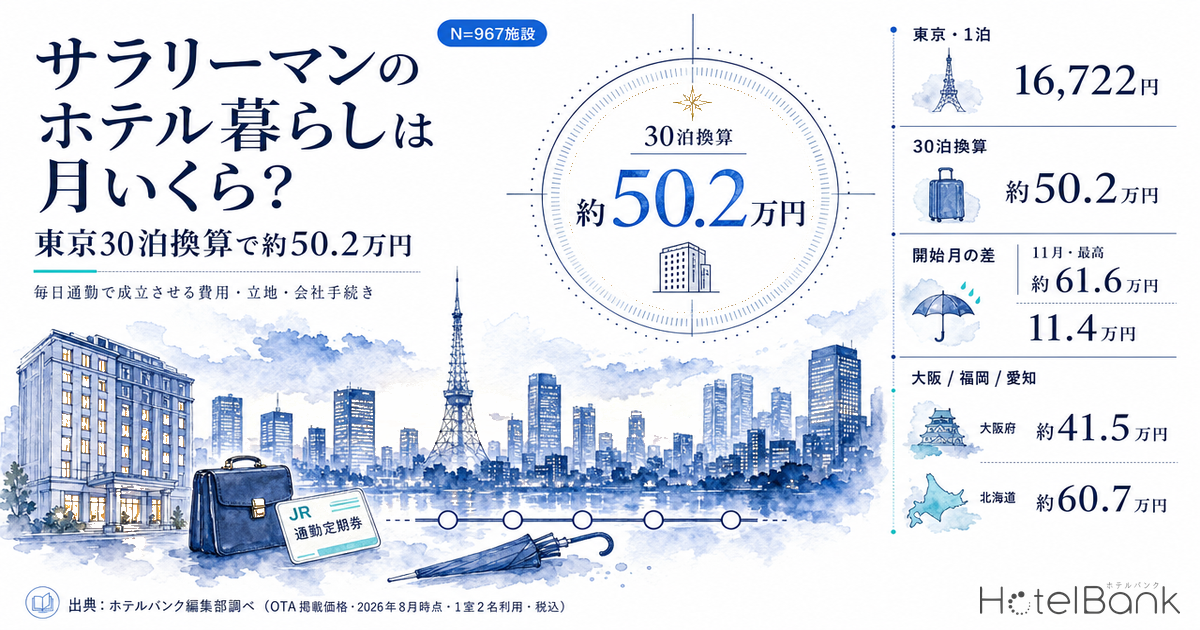
- — Business hotels in Tokyo list at ¥16,722 per night, or about ¥502,000 for 30 nights (August 2026 stays, double occupancy, per room, tax included, 967 properties). The national average is ¥15,959, or about ¥479,000 for 30 nights.
- — The month you start moves the total by ¥114,000. Against ¥502,000 in August, the cheapest month, November comes to ¥616,000. With no move-in costs and no early-termination penalty, you are free to shift the starting date.
- — Working outside Tokyo cuts roughly ¥80,000 a month: Osaka ¥415,000, Fukuoka ¥423,000, Aichi ¥434,000. Hokkaido is the exception at ¥607,000, above Tokyo in August.
- — Pick the location on three axes: inside your commuter-pass route, within a five-minute walk of the station, and weekday living functions. Proximity to tourist sights is irrelevant; one transfer at most and 45 minutes door to door is the threshold that keeps the commute sustainable.
- — Four items to settle with your employer before you start — the eligibility rules for the housing allowance, the notification of a change of commuting route, the address field on the year-end tax adjustment, and whether company housing or a contracted-lodging scheme exists. If the allowance disappears, the cost arithmetic changes.
The direct answer on cost — about ¥502,000 for 30 nights at a Tokyo business hotel
Start with the market level. In listed OTA prices aggregated by the HotelBank Editorial Team (as of August 2026, double occupancy, per room, tax included), average listed prices for business hotels were as follows.
| Area | Listed price per night | Properties | 30-night equivalent |
|---|---|---|---|
| Tokyo | ¥16,722 | N=967 | about ¥502,000 |
| Japan (national) | ¥15,959 | N=7,792 | about ¥479,000 |
Source: HotelBank Editorial Team analysis based on publicly available OTA data (listed prices as of August 2026, double occupancy, per room, tax included). The 30-night equivalent is simply the listed price per night multiplied by 30, and differs from an actual monthly plan or consecutive-night rate.
At a Tokyo business hotel, the straight conversion from listed prices comes to about ¥502,000 a month (¥16,722 × 30 nights). Note that this is a per-room rate on a double occupancy basis, so what you actually pay will differ on single-occupancy plans or if you stay mainly on weekdays. Even so, the order of magnitude is clear. Set against central-Tokyo rent, plus zero utilities, water, internet, furniture and appliances, and zero move-out costs, the honest answer is that this is expensive but a defensible price to pay for freedom from a lease and from possessions. Conversely, matching an ¥80,000 rent with the same spend on hotel living is out of reach in Tokyo on listed prices. The tools for closing that gap — long-stay discounts and how you arrange your nights — are left to the discount article below, but for a head-on comparison against rent and living costs, Is Hotel Living Cheaper Than Rent in Tokyo? Break-Even at 24 Nights tests the question on listed prices across Tokyo’s 23 wards.
By starting month, 30 nights runs ¥502,000 to ¥616,000 — a ¥114,000 spread
The ¥502,000 above is the level for August 2026 stays, which is the cheapest month in the current window. Even at the same Tokyo business hotels, listed prices move month to month. Lined up on a consistent basis (double occupancy, tax included, monthly average) across the next six months, they look like this.
| Stay month | Listed price per night | 30-night equivalent | Properties aggregated |
|---|---|---|---|
| August 2026 | ¥16,722 | about ¥502,000 | 967 |
| September 2026 | ¥18,496 | about ¥555,000 | 949 |
| October 2026 | ¥20,479 | about ¥614,000 | 924 |
| November 2026 | ¥20,539 | about ¥616,000 | 894 |
| December 2026 | ¥20,079 | about ¥602,000 | 859 |
| January 2027 | ¥18,128 | about ¥544,000 | 815 |
Source: HotelBank Editorial Team analysis based on publicly available OTA data (aggregated as of 31 August 2026, double occupancy, per room, tax included). The 30-night equivalent is the monthly average listed price multiplied by 30.
Source: HotelBank Editorial Team analysis based on publicly available OTA data (aggregated as of 31 August 2026, Tokyo, business hotels)
Against ¥502,000 in August, the cheapest month, November is the most expensive at ¥616,000. If you can choose the month you start, the same way of living costs ¥114,000 more or less per month depending on that choice alone. Because hotel living carries neither move-in costs nor an early-termination penalty, unlike a lease, shifting the start by a few months is genuinely available to you. The flip side is that starting in autumn and finding it more expensive than expected is, in most cases, not a matter of how the person chose but of the level of the month. One note on the table: the number of properties aggregated falls as the months run forward because more distant months still include properties that have not yet opened for sale — it does not mean demand or supply is shrinking. The size of that gap is the reason to treat the starting month as a cost decision in its own right, on a par with the choice of city.
Outside Tokyo, the same way of staying costs roughly ¥80,000 less a month
This article is written around a Tokyo workplace, but the character of the cost changes with where you work. On a consistent basis for August 2026 stays, the main regions look like this.
| Prefecture | Listed price per night | 30-night equivalent | Properties aggregated |
|---|---|---|---|
| Tokyo | ¥16,722 | about ¥502,000 | 967 |
| Hokkaido | ¥20,243 | about ¥607,000 | 408 |
| Aichi | ¥14,473 | about ¥434,000 | 318 |
| Fukuoka | ¥14,103 | about ¥423,000 | 347 |
| Osaka | ¥13,844 | about ¥415,000 | 528 |
Source: HotelBank Editorial Team analysis based on publicly available OTA data (listed prices as of August 2026, double occupancy, per room, tax included).
Source: HotelBank Editorial Team analysis based on publicly available OTA data (listed prices as of August 2026, business hotels)
Osaka at ¥415,000 is about ¥87,000 below Tokyo, and Fukuoka at ¥423,000 and Aichi at ¥434,000 sit in much the same band. If you work in the Kansai, Chubu or Kyushu regions, “hotel living for something close to what rent costs” — out of reach in Tokyo — moves a step nearer. Hokkaido, by contrast, comes in above Tokyo at ¥607,000. That is because August is the peak of the tourist season there, and it does not represent the year-round level. For a station-by-station breakdown of business hotels near major stations, 30 Nights of Hotel Living in Japan: ¥494,700 Tokyo, ¥209,300 Nagoya measures the totals directly.
Choosing the location — work backwards from the commuter pass and the station
For someone going to the office every day, choosing a hotel is the reverse of choosing one as a traveller: proximity to tourist sights counts for nothing. The criteria come down to three.
- Choose inside the coverage of your commuter pass. A hotel on the route your pass already covers adds nothing to your out-of-pocket commuting cost. Setting a threshold of one transfer at most and 45 minutes door to door keeps the weekday wear no worse than it was when you rented.
- Give priority to a five-minute walk from the station. With hotel living you walk that same stretch every day, rain included. A 12-minute walk that is forgivable on a trip starts to tell on a commute. Business hotels cluster around station fronts: Toyoko Inn (東横イン), for instance, is known for an expansion policy built on locations at or near station entrances, and its breakfast service makes the morning routine easier to organise. APA Hotel (アパホテル) also offers many options within walking distance of central terminal stations, and booking through its own website and app earns points and benefits, which favours long-stay guests in particular.
- Choose on “weekday living functions.” Coin laundry, 24-hour check-in, the hours breakfast is served (does it fit an early start?), and whether there is a large communal bath. For anyone who wants to unwind in a large bath every evening, a brand such as Dormy Inn (ドーミーイン), which promotes local hot-spring water and equips many of its properties with a large communal bath, is reassuring (whether a large bath or hot spring is available varies by property, so check each one before booking).
For a procedure that adds facilities and pricing to these three axes, Business Hotels for Long Stays: 6 Checks and ¥16,722 a Night in Tokyo sets it out alongside the Tokyo listed price of ¥16,722 per night.
If consecutive nights run beyond two weeks, apartment-style and extended-stay hotels with a kitchen and washer-dryer in the room become an option worth weighing. A concrete comparison of that format is covered in detail in this comparison of apartment-style properties with a kitchen and washer-dryer (HotelPicks, in Japanese).
What to do about residence registration and post
If you are giving up a rental, you need to decide in advance where your residence registration (住民票, juminhyo) will sit and where your post will be delivered. The options and the procedure — registering at a family home, mail forwarding, using a private mailbox service — are set out in Hotel Living: Keep Residence Registration Home, or File Within 14 Days, so this article does not pursue them. There is only one point to carry forward here: keep the address you file with your employer and the address on your residence registration the same, and the year-end tax adjustment described below gives you nothing to puzzle over.
The employer side — settle allowances, commuting costs and the year-end adjustment first
The thing most often overlooked in hotel living for a salaried worker is how it meshes with company rules. Four items are worth confirming with HR or general affairs before you start.
- How the housing allowance or rent subsidy is treated. At most companies the housing allowance is conditional on a lease held in the employee’s own name. Hotel living is an accommodation contract, not a lease, so whether it qualifies depends on the employment rules. An allowance of tens of thousands of yen a month changes the cost arithmetic if it disappears, so check this first.
- Notification of a change of commuting route. The commuting allowance is paid on the basis of the route you have filed. Once you move into a hotel, the rule is to file the change of route; leaving it unfiled can make the discrepancy an issue when a commuting accident is assessed for workers’ compensation. If you have chosen a hotel inside the coverage of your pass, this step is light.
- The address field on the year-end tax adjustment. The address written on documents such as the dependent deduction declaration is, in principle, the address where your residence registration sits as of 1 January of that year — your base of living. If your registration is at a family home, that is the address you write. Entering a hotel room number is not standard practice, so put the residence registration in order first.
- Whether company housing or a dormitory scheme exists. Some employers have leased company housing or contracted-lodging arrangements that work out better than paying for a hotel yourself. Asking once before you give up the rental costs nothing.
Because the treatment of the housing allowance and the commuter pass turns on the exact wording of the employment rules and the travel expense regulations, the practical step is to read those two documents at clause level — the eligibility condition for the housing allowance and the definition of the commuting route — rather than relying on what colleagues say. Eligibility varies from employer to employer, so the wording is what decides it.
How to bring the monthly total below the listed price
The 30-night equivalents above (about ¥502,000 in Tokyo) are a straight conversion from the nightly listed price; in practice the total you pay can be changed with long-stay plans at the 7-night, 14-night and 30-night thresholds and with how you arrange your nights. The mechanics of those discounts and how to use them are set out systematically in Japan Hotel Long-Stay Discounts: 15% at 7 Nights, 20% at 30 Nights, which is the place to go when you get to squeezing the cost. The only thing to hold on to from this article is the order of operations: 30 times the listed price is your upper bound, and long-stay plans are what you cut from it.
Where to look next
For comparisons of specific properties, these articles go into detail (both in Japanese).
Once a business trip runs past three nights, stop booking “hotels” — Top 5 apartment-style properties with a kitchen and washer-dryer (HotelPicks, in Japanese)
Compares five extended-stay properties with a kitchen and washer-dryer in the room — including Tokyu Stay Hakata (東急ステイ博多), Tokyu Stay Shinjuku Eastside (東急ステイ新宿イーストサイド) and MIMARU Tokyo Ueno East (MIMARU東京 上野EAST) — within walking distance of major stations in Tokyo, Osaka, Fukuoka and Sapporo, on consecutive-night rates and in-room living facilities. It is a format that suits hotel living while commuting daily.
Five extended-stay hotels serving dinner on site — reading consecutive-night assignments through breakfast times, dinner service hours and monthly plans (innippon.news, in Japanese)
Compares five extended-stay hotels where both breakfast and dinner can be taken on the premises — including Hotel MyStays Premier Narita (ホテルマイステイズプレミア成田), with three restaurants on site and a monthly plan, and Daiwa Roynet Hotel Naha Omoromachi PREMIER (ダイワロイネットホテル那覇おもろまちPREMIER), with an Italian restaurant on site and 24-hour laundry — on dinner service hours and monthly plans. It addresses the daily-dinner problem in hotel living, where there is no cooking at home.
Frequently asked questions
How much does hotel living cost a salaried worker per month in Tokyo?
Listed OTA prices for business hotels in Tokyo were ¥16,722 per night for August 2026 stays (double occupancy, per room, tax included, 967 properties). On a 30-night basis that is about ¥502,000. This is an upper-bound guide obtained by multiplying the listed price by 30; consecutive-night plans and how you arrange your nights bring the amount you actually pay below it. Meals and transport are not included.
Is renting cheaper?
On spending alone, renting normally works out cheaper in Tokyo. Matching an ¥80,000 rent with the same outlay on hotel living is out of reach on listed prices. That said, hotel living carries no deposit, key money, agency fee, furniture and appliances, utilities or move-out costs, and it frees you from a lease and from possessions. The break-even depends on how long you stay; the test on listed prices across Tokyo’s 23 wards is set out in “Is Hotel Living Cheaper Than Rent in Tokyo? Break-Even at 24 Nights.”
When is the cheapest time to start?
Across stays from August 2026 to January 2027, August is the cheapest at ¥16,722 per night (about ¥502,000 for 30 nights) and November the most expensive at ¥20,539 (about ¥616,000). The spread is ¥114,000 a month. Because hotel living carries no move-in costs and no early-termination penalty, shifting the start by a few months is an easier choice to make than it would be with a lease.
What does it cost if I work outside Tokyo?
On the 30-night equivalent for August 2026 stays, Osaka comes to about ¥415,000, Fukuoka about ¥423,000 and Aichi about ¥434,000 — roughly ¥80,000 below Tokyo’s ¥502,000. Hokkaido, at about ¥607,000, is above Tokyo, but that reflects August being the peak of its tourist season rather than the year-round level.
Can I still receive a housing allowance while living in a hotel?
It depends on your employer’s employment rules. At most companies the housing allowance is conditional on a lease held in the employee’s own name, and because hotel living is an accommodation contract rather than a lease, it may fall outside the scheme. An allowance of tens of thousands of yen a month changes the cost arithmetic if it disappears, so confirm it with HR or general affairs before you give up your rental.
Do I need to file a change of commuting route?
As a rule, yes. The commuting allowance is paid on the basis of the route you have filed, so once you move your residence to a hotel, filing the change of route is the default. Leaving it unfiled can make the discrepancy with your actual route an issue when a commuting accident is assessed for workers’ compensation. Choosing a hotel on the route your commuter pass already covers keeps both this step and your out-of-pocket commuting cost light.
Where should I keep my residence registration?
A hotel is not a facility intended to serve as the base of living for residence registration purposes, so registering at a family home or similar address is the common approach. What matters is keeping the address you file with your employer and the address on your residence registration the same, which removes any doubt over the address field on the year-end tax adjustment. The detailed procedure is set out in “Hotel Living: Keep Residence Registration Home, or File Within 14 Days.”
References and sources
■ Data sources
Prices are a continuing aggregation of the listed prices of accommodation plans published on OTAs (HotelBank Editorial Team analysis). Prefecture-level levels for business hotels are for August 2026 stays, covering 967 properties in Tokyo and 7,792 nationally. The monthly series for Tokyo covers stays from August 2026 to January 2027, with 815 to 967 properties per month (aggregated as of 31 August 2026). The comparison of major prefectures is for the same August 2026 stays, covering 528 properties in Osaka, 318 in Aichi, 347 in Fukuoka and 408 in Hokkaido.
■ Calculation assumptions
Listed prices are per-room rates on a double occupancy basis (tax included, averaged across all plans) and include higher-priced rooms on sale. The 30-night equivalent is the monthly average listed price multiplied by 30, and differs from an actual monthly plan, a consecutive-night rate or a single-occupancy rate. The spread by starting month (¥114,000) is the difference between the 30-night equivalents for the cheapest month (August 2026) and the most expensive (November 2026). Differences between prefectures compare the same month (August 2026 stays). Meals, transport, laundry and optional charges are excluded.
■ Limitations and caveats
Every amount here is a mechanical calculation based on monthly averages and does not represent the market price for a particular date or a particular property. Listed prices differ from transacted prices and are correctly read as an upper-bound guide. The smaller number of properties aggregated in more distant months reflects properties that have not yet opened for sale, not a contraction of supply. The level for Hokkaido includes the effect of August being the peak of its tourist season and is not the year-round level. The treatment of housing allowances, commuting allowances and the year-end tax adjustment varies with each employer’s employment rules and travel expense regulations, so the descriptions here are a general account and any individual case needs to be confirmed with your own employer.
■ Primary sources for the properties and brands mentioned
Toyoko Inn (東横イン), “station-front base” expansion policy built on proximity to stations: Toyoko Inn official site / complimentary breakfast: Toyoko Inn official — Breakfast (content and availability vary by property).
APA Hotel (アパホテル) membership and points programme (pricing and point rebates on its own “APA Choku” direct booking): APA Hotel official — earning points.
Dormy Inn (ドーミーイン) “local hot-spring water” policy on large communal baths and hot springs (availability varies by property): Dormy Inn official site.
Related reading
- 30 Nights of Hotel Living in Japan: ¥494,700 Tokyo, ¥209,300 Nagoya
- Is Hotel Living Cheaper Than Rent in Tokyo? Break-Even at 24 Nights
- Business Hotels for Long Stays: 6 Checks and ¥16,722 a Night in Tokyo
- Remote Work Hotel Living in Japan: 3 Options, ¥502,000 a Month
- 6 Downsides of Hotel Living in Japan: ¥502,000 per 30 Nights & Fixes
- How to Start Hotel Living in Japan: 5 Steps, ¥479,000 for 30 Nights