

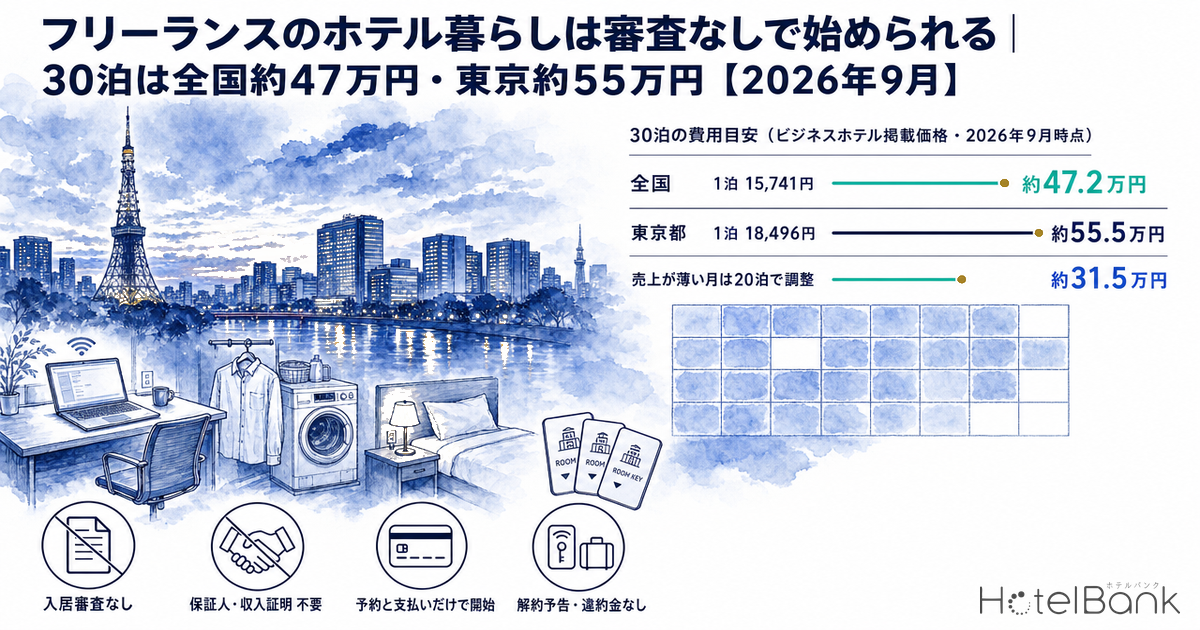
Freelancers and self-employed workers in Japan can start hotel living today, simply by making a booking. Unlike a rental lease, there is no tenant screening, no guarantor or guarantee company, and no requirement to submit proof of income or a tax return. Even someone in their first year of business, without the paperwork a landlord would demand, can complete a hotel booking with a single credit card (or cash, if paying on site). As a cost benchmark, listed prices at business hotels work out to roughly ¥472,000 for 30 nights nationwide and about ¥555,000 in Tokyo (OTA listed prices as of September 2026, tax included). This article walks through the four points freelancers most often get stuck on when considering hotel living: screening, what it actually costs, address and residence registration, and the work environment.
- — No screening, no guarantor, no proof of income. A hotel stay requires only a booking and payment, so freelancers who struggle to pass rental screening can start today
- — 30 nights costs roughly ¥472,000 nationwide and ¥555,000 in Tokyo (business hotel listed prices, September 2026, per room for two occupants, tax included, N=7,453 / 949 properties)
- — Housing becomes a variable cost. In a thin revenue month you can cut back to 20 nights (about ¥315,000 nationwide), adjusting by night count and area
- — Settle residence registration, business address and expense treatment first. Residence registration is covered in a dedicated guide; whether lodging costs are deductible is a question for a tax accountant
No screening, guarantor or proof of income — a hotel takes you even when a landlord will not
Rental screening in Japan is built around the assumption of stable monthly income, so freelancers and the newly self-employed, whose income moves month to month, can fail it even when they can comfortably pay. Hotels sit outside that structure. A hotel stay is closer to a per-night purchase, and all the hotel checks is the booking and the payment (prepaid, or settled at check-in).
- No tenant screening — no questions about occupation, years of service or annual income. The booking form asks for little more than your name and contact details
- No guarantor or guarantee company — no guarantee company review, and none of the upfront guarantee fee paid at contract signing
- No deposit, key money or agency fee — the only upfront cost is the first night’s room rate. No furniture, appliances or internet contract either
- You can stop whenever you like — there is no notice period or cancellation penalty. Stop booking and it ends that day
The starting point for freelance hotel living is not “I can’t find housing because I fail screening,” but “I skip the screening process altogether.”
What 30 nights actually costs — about ¥472,000 nationwide, ¥555,000 in Tokyo (September 2026 listed prices)
The HotelBank Editorial Team aggregated OTA listed prices and found that, as of September 2026, the listed price per night at business hotels was ¥15,741 nationwide (N=7,453 properties) and ¥18,496 in Tokyo (N=949 properties). Both are per-room rates for two occupants (tax included), and they cover utilities, water, Wi-Fi, cleaning, bedding and amenities — the amount you actually pay. Converted straight to 30 nights, the figures look like this.
| Area | Listed price per night | 30 nights | 25 nights | 20 nights |
|---|---|---|---|---|
| Nationwide (business hotels, N=7,453 properties) | ¥15,741 | approx. ¥472,000 | approx. ¥394,000 | approx. ¥315,000 |
| Tokyo (business hotels, N=949 properties) | ¥18,496 | approx. ¥555,000 | approx. ¥462,000 | approx. ¥370,000 |
Source: HotelBank Editorial Team research (OTA listed prices as of September 2026). Aggregated per-room rates for two occupants (tax included); the 30-night figure is simply the nightly price multiplied by 30. Single-occupancy rates, consecutive-night plans and advance-purchase plans will shift the figure from this benchmark.
You do not have to pay this amount every month. Listed prices move sharply by date, day of week and area, so weighting your stay toward weekdays, avoiding central Tokyo in peak periods, and using prepaid consecutive-night plans can bring the actual bill below the benchmark. Conversely, packing in event dates and weekends will push it above. For the equipment to check on a long stay and the specific ways to bring the price down, see “Business Hotels for Long Stays: 6 Checks and ¥16,722 a Night in Tokyo“.
In a thin month, adjust your housing cost by the number of nights
For a freelancer, the biggest advantage of hotel living — beyond the absence of screening — is that it turns housing from a fixed cost into a variable one. Rent goes out in full even in a weak month; with hotel living you can move the night count itself.
- Thin revenue months — stay a few nights with family or friends and hold the total to 20 nights, about ¥315,000 on the nationwide benchmark. Moving to lower-priced suburbs or regional cities brings it down further
- Crunch months before a delivery — book 30 nights somewhere close to the client or well suited to focused work, converting commuting time into working time
- Months when a project moves — relocate your entire base next to the client site. None of the cancellation and re-contracting paperwork a lease would require
Decide first how much you can spend on housing this month, then work backwards to the night count and the area. Only hotel living, free of month-long contracts, lets you plan in that order. Whether it works out more expensive than renting depends on how long you stay, and the analysis in “Is Hotel Living Cheaper Than Rent in Tokyo? Break-Even at 24 Nights” is a useful reference for that call.
Residence registration, business address and expense treatment
For a freelancer, the address used on your business-opening notification, invoices, and bank and credit card registrations is a question to settle even before cost. There are several options for residence registration — leaving it at your family home, or transferring it — and the procedures and trade-offs are set out in “Hotel Living: Keep Residence Registration Home, or File Within 14 Days“, which is worth reading before you start.
For a business address, many freelancers use a virtual office or a coworking space address service — separate from their residence registration — on their business-opening notification, invoices and website. It fixes a single delivery point for mail, which pairs well with hotel living and its constantly changing location.
This article does not take a position on whether lodging costs can be booked as a business expense. The line between a stay for work and a stay for living differs by project and working style, as does the approach to apportionment, and both are matters for a tax accountant or similar professional. If you are unsure how to treat it on your tax return, do not claim the full amount on your own judgment — consult a professional.
Choosing a room you can work in — check only three things: desk, Wi-Fi and laundry
Freelancers who use the guest room as a workplace as well run into fewer problems if they confirm just these three points before booking.
- Desk and chair — long working hours need a fixed desk and a chair with a backrest. Check the depth of the desk in the room photos
- Wi-Fi — if you take a lot of video calls, check the official site for wired LAN availability or Wi-Fi specifications. If in doubt, pair it with a mobile connection
- Laundry — over 30 nights you will wash two or three times a week. An on-site coin laundry, or a room type with its own washer-dryer, means fewer trips out
For the full picture on the facilities and plans that make hotel living comfortable, see “Hotel Living in Japan: 4 Room Criteria, Packing & Daily Routines“. If you also want to hold in-person meetings on site rather than just working in your room, “Five long-stay hotels with a fixed desk in every room and on-site meeting rooms” (innippon, in Japanese) compares long-stay hotels that combine fixed desks in all rooms with meeting facilities. Much of the cost control also applies to salaried employees living in hotels; the points specific to freelancers are screening, address and adjusting the night count.
Looking for specific properties
For hands-on property comparisons, these articles go deeper.
Past three nights on a business trip, drop the hotel — top 5 apartment-style stays with a kitchen and washer-dryer (HotelPicks, in Japanese)
Picks five apartment-style properties with in-room kitchens and washer-dryers across Tokyo, Osaka, Fukuoka and Sapporo — including Tokyu Stay Hakata, Tokyu Stay Sapporo Odori and MIMARU Tokyo Ueno East — comparing consecutive-night rates and the quality of the living infrastructure. Strong candidates if you want to cook and do laundry entirely in your room.
Five long-stay hotels with a fixed desk in every room and on-site meeting rooms — work and client meetings under one roof (Tokyo and Osaka) (innippon, in Japanese)
Covers five properties — such as Ascott Marunouchi Tokyo (directly connected to Otemachi Station, three meeting rooms) and Citadines Namba Osaka (a meeting room seating up to 18, open to non-guests) — where desk work and client meetings can happen in the same building, down to seat counts and pricing structures. Suited to freelancers with face-to-face client meetings.
Frequently asked questions
Q. Can freelancers live in hotels? Is there any tenant screening?
Yes, they can. Hotels have no tenant screening and do not ask for a guarantor, a guarantee company, proof of income or a tax return. All that is checked is the booking and the payment (prepaid, or settled at check-in).
Q. How much does 30 nights of freelance hotel living cost?
At business hotel listed prices, the nationwide benchmark is ¥15,741 a night (N=7,453 properties), or about ¥472,000 for 30 nights; in Tokyo it is ¥18,496 a night (N=949 properties), or about ¥555,000 (September 2026, per room for two occupants, tax included). Weighting toward weekdays and using consecutive-night plans brings it down.
Q. What should I do in a month with little income?
Cut the number of nights to adjust your housing cost. Holding it to 20 nights, for example, comes to about ¥315,000 on the nationwide benchmark. Moving to lower-priced suburbs or regional cities brings it down further.
Q. What should I do about my address and residence registration?
There are several options — leaving your residence registration at your family home, or transferring it — and the details are set out in our residence registration guide. For the business address used on a business-opening notification or invoices, many freelancers use a virtual office or coworking space address service.
Q. Can hotel costs be claimed as a business expense?
This article does not take a position. The line between a stay for work and a stay for living, and how to apportion it, differ by working style, so consult a tax accountant or similar professional.
Q. What should I check in a room I will be working in?
Confirming three things before booking — a fixed desk and chair, Wi-Fi (and wired LAN availability if you take a lot of video calls), and either an on-site coin laundry or an in-room washer-dryer — will avoid most problems.
Methodology and sources
■ Data source
OTA listed prices aggregated by the HotelBank Editorial Team (as of September 2026). Uses the per-night listed price for the “business hotel” accommodation category, nationwide (N=7,453 properties) and in Tokyo (N=949 properties).
■ Calculation assumptions
Prices are per-room rates for two occupants (tax included). The 30-, 25- and 20-night figures simply multiply the nightly listed price by the number of nights, rounded to the nearest ¥1,000, and do not reflect consecutive-night or advance-purchase discounts.
■ Limitations and caveats
Listed prices are not transacted prices, and they move with date, day of week and events. Single-occupancy rates differ from two-occupant rates. The treatment of residence registration, business addresses and expense claims varies with individual circumstances, and this article does not make that judgment on your behalf.
■ Reference materials
- National Tax Agency, “No. 2210: Understanding necessary expenses” (how necessary expenses are treated for business income, in Japanese)
Related reading
- Remote Work Hotel Living in Japan: 3 Options, ¥502,000 a Month
- How to Start Hotel Living in Japan: 5 Steps, ¥479,000 for 30 Nights
- Monthly Hotels in Japan: No Lease, 20% Off at 30 Nights (Aug 2026)
- 6 Downsides of Hotel Living in Japan: ¥502,000 per 30 Nights & Fixes
- 60 Nights in a Japanese Hotel: ¥790,000 in Tokyo, ¥488,000 in Osaka
- Hotel Living: Keep Residence Registration Home, or File Within 14 Days