

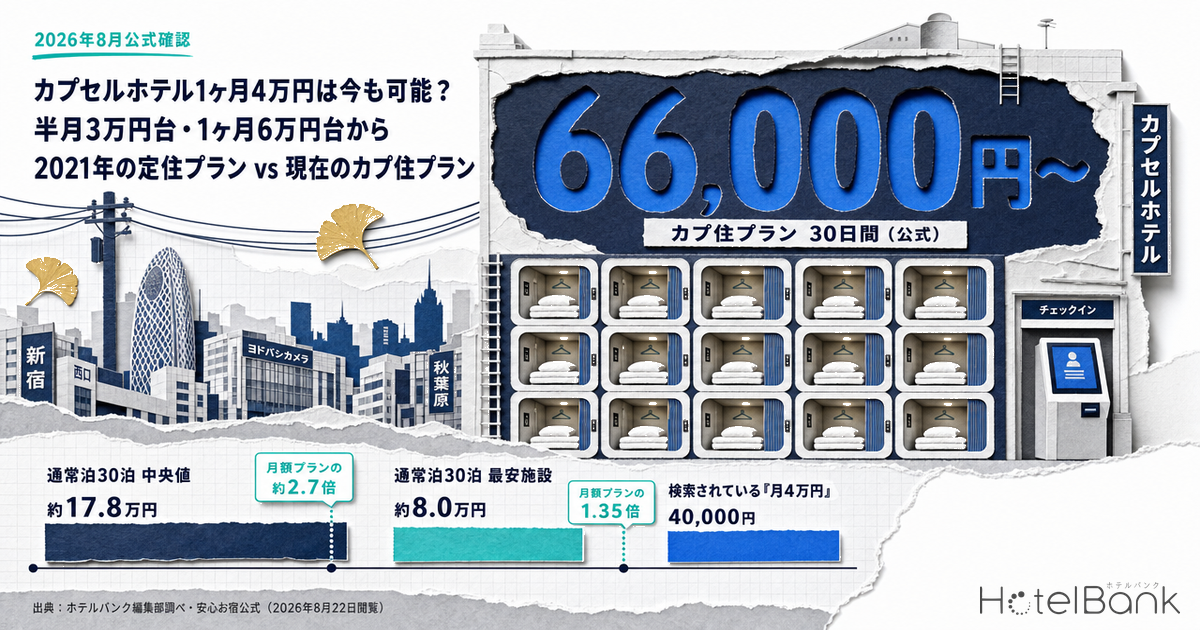
The short answer: “living in a capsule hotel for ¥40,000 a month” was a 2021 price. As of August 2026 the listed reality is from the ¥30,000s for half a month (15 days) and from the ¥60,000s for a full month (30 days). The ¥40,000 figure comes from the “Teiju Plan” (定住プラン, literally “settled-living plan”) that Anshin Oyado Luxury Capsule Hotel (豪華カプセルホテル 安心お宿) launched in 2021 — 30 days of unlimited use for ¥40,000. The same chain’s current plan has been renamed the “Kapuju Plan” (カプ住プラン, “capsule-living plan”) and runs from ¥33,000 per 15-day block (from ¥30,000 at some locations), or from ¥66,000 for two blocks covering 30 days (from ¥60,000 at those same locations). Book the ordinary nightly rate instead and stack 30 nights, and the median across Tokyo capsule hotels comes to about ¥178,000. Whether or not you get onto a monthly plan changes your monthly outlay by nearly a factor of three — that is the point of this article.
- — The “¥40,000 a month” people search for is a 2021 price. It comes from the Teiju Plan that Anshin Oyado announced in June 2021 — 30 days of unlimited use for ¥40,000.
- — The current price as of August 2026 is the Kapuju Plan: from ¥33,000 for 15 days (from ¥30,000 at Shinjuku Ogikubo) and from ¥66,000 for 30 days as two blocks (from ¥60,000 there).
- — Stack 30 nights without a monthly plan and the median is about ¥178,000 — measured across 38 capsule hotels in Tokyo, roughly 2.7 times the monthly plan.
- — Zero of the 38 properties come in under ¥40,000 for 30 nights; even the cheapest is about ¥80,000. A rate of ¥1,333 a night does not exist when you stack ordinary nightly bookings.
- — Weekends run 1.35 times higher (median about ¥4,900 Sunday–Thursday against about ¥6,600 on Friday and Saturday). Designing around weekends cuts ¥10,000–20,000 off a 30-night total.
Where “¥40,000 a month” comes from — the 2021 Teiju Plan and the 2026 Kapuju Plan
What people searching for “capsule hotel, one month, ¥40,000” are looking at is the price of the Teiju Plan that Anshin Oyado announced in June 2021, which HotelBank reported at the time. Thirty days of unlimited use cost ¥40,000 and 15 days cost ¥25,000 at three Tokyo locations (Shinjuku Ekimae, Akihabara Denkigai and Shimbashi Ekimae), with in-house meals, drinks, laundry machines, hot baths, Wi-Fi and coworking space all included in the fee.
Checking each location’s official rate page on 22 August 2026, the current long-stay plan is named the Kapuju Plan and carries the following terms.
| Item | 2021, at launch of the Teiju Plan | August 2026, current Kapuju Plan |
|---|---|---|
| Price for 30 days | ¥40,000 (three Tokyo locations, men) | From ¥66,000 (Shinjuku Ekimae, Akihabara Denkigai, Ginza Shiodome) / from ¥60,000 (Shinjuku Ogikubo) |
| Price for 15 days | ¥25,000 | From ¥33,000 / from ¥30,000 (one 15-day block is the base unit; 30 days is two blocks) |
| Locations covered | Four: Shinjuku Ekimae, Akihabara Denkigai, Shimbashi Ekimae and Nagoya Sakae | Four locations found listed on the official rate pages: Shinjuku Ekimae, Akihabara Denkigai, Ginza Shiodome and Shinjuku Ogikubo (Ginza Shiodome and Shinjuku Ogikubo are women-only) |
| What is included | Meals, drinks, laundry, hot baths, Wi-Fi, coworking | No deposit, no key money, no utility charges; meals, hot baths and Wi-Fi included (in-house service fees covered) |
| Conditions of offer | Available from 22 June | Limited period, limited number of units. Explicitly states that it may not be available depending on occupancy |
In other words, “¥40,000” is now closer to what half a month costs; a full month runs ¥60,000–66,000. Even so, set against the stacked nightly total covered below (a median of about ¥178,000), the monthly plan still lands at a little over a third of the price. There is no deposit, no key money and no utility bill, and hot baths, sauna, the morning curry and the late-night ramen are inside the fee — none of which applies to a rental apartment or a run of consecutive nights at a business hotel. That said, the plan is explicitly labelled limited-period and limited-inventory, so if you are moving in on this basis, checking the official site for an open block comes first.
What 30 stacked nightly bookings actually cost — 38 Tokyo properties measured
We totalled what you would pay booking one night at a time for 30 nights, across 38 capsule hotels in Tokyo. Capsule hotels assume single occupancy, so we took the lowest listed price for one guest (tax included) for each property on each date, averaged it over the 30 days from 1 to 30 September 2026, and multiplied by 30 (OTA listed prices as of 22 August 2026; N = 38 properties, 1,100 property-days).
| Band | Lowest listed price per night (average) | Total for 30 nights |
|---|---|---|
| Cheapest property | about ¥2,660 | about ¥80,000 |
| Bottom quarter (first quartile) | about ¥4,690 | about ¥141,000 |
| Median | about ¥5,920 | about ¥178,000 |
| Top quarter (third quartile) | about ¥6,680 | about ¥201,000 |
| For reference: Kapuju Plan (official, 30 days) | about ¥2,000–2,200 equivalent | ¥60,000–66,000 |
Not one of the 38 properties comes in at ¥40,000 for 30 nights, and even the cheapest runs about ¥80,000. A level of ¥1,333 a night (¥40,000 divided by 30) simply does not exist when you stack ordinary nightly bookings. If you are aiming at “around ¥40,000 a month”, the choice is between securing a block on a property that runs a monthly plan, or designing your life in half-month units.
The day of the week matters too. Splitting the same 38 properties’ lowest listed prices by day, the median from Sunday to Thursday is about ¥4,900 while Friday and Saturday run about ¥6,600 — weekends alone are 1.35 times higher (N = 1,100 property-days). If you are stringing together ordinary nights, going home to family or a friend’s place at weekends, or moving to a cheaper property just for those nights, takes ¥10,000–20,000 off the 30-night total.
How nights and nightly rate move the monthly bill — three cases and a lookup table
Everything above moves on simple multiplication: what you pay equals the nightly rate times the number of nights. Applying the quartiles above directly (cheapest about ¥2,660, first quartile about ¥4,690, median about ¥5,920, third quartile about ¥6,680) shows the band a month lands in when you string ordinary nights together.
| Case | When it applies | Nightly rate | Total for 30 nights |
|---|---|---|---|
| Optimistic | You pick cheap properties and can shift to dates with open inventory | about ¥2,660–4,690 | about ¥80,000–141,000 |
| Middle | You do not narrow the field much and stay 30 nights at typical levels | about ¥5,920 | about ¥178,000 |
| Pessimistic | You prioritise location, lean to pricier properties and keep the same one at weekends | about ¥6,680 | about ¥201,000 |
Cut the same rates by 15, 20, 25 and 30 nights and you get the lookup table below. Living in half-month units brings even the median level down to about ¥88,800 — the same order of magnitude as the Kapuju Plan’s 30-day price of ¥60,000–66,000.
| Nightly rate level | 15 nights | 20 nights | 25 nights | 30 nights |
|---|---|---|---|---|
| Cheapest property level (¥2,660) | ¥39,900 | ¥53,200 | ¥66,500 | ¥79,800 |
| First quartile (¥4,690) | ¥70,350 | ¥93,800 | ¥117,250 | ¥140,700 |
| Median (¥5,920) | ¥88,800 | ¥118,400 | ¥148,000 | ¥177,600 |
| Third quartile (¥6,680) | ¥100,200 | ¥133,600 | ¥167,000 | ¥200,400 |
| For reference: Kapuju Plan equivalent (about ¥2,000–2,200) | ¥30,000–33,000 | ¥40,000–44,000 | ¥50,000–55,000 | ¥60,000–66,000 |
This table only lays out the results of the multiplication; it builds in no discounts or negotiation. In practice three things move you one row down it: avoiding weekends, using consecutive-night plans, and securing a block on a monthly plan.
How to find capsule and sauna properties that run monthly plans
Monthly plans at capsule hotels and sauna-equipped properties often do not surface in ordinary searches on booking sites; they sit directly on the rate page of the official website. There are three ways to look.
- Search the official site’s “rates and plans” page for the words for long-term, monthly, consecutive-night and flat-rate. As with Anshin Oyado’s Kapuju Plan, these sit in a separate block from the nightly rate table, with prices in 15-day and 30-day units and notes about limited periods and limited inventory. If there is an FAQ entry along the lines of “do you have a plan for long stays”, the current price is often written there.
- On booking sites, search plan names and filters for consecutive nights and stays of seven nights or more. Even short of a full monthly rate, some properties offer plans in 7-night and 14-night units where the listed price per night falls below the standard rate. Combining 30 nights as 14 + 14 + 2 also blunts the weekend premium. For how many nights it takes before a consecutive-night discount starts to bite, Japan hotel long-stay discounts: 15% at 7 nights, 20% at 30 nights gives the measured figures night by night.
- Look at subscription-style and stay-focused specialist services. In central Tokyo, some properties now let you contract a capsule or dormitory bed on a monthly basis, with the monthly fee falling for each night you sleep elsewhere. If you are moving in to live, check first how each property handles pausing and restarting the monthly contract — that is what makes a pattern of going home at weekends workable. How monthly plans treat a room you leave empty for a weekend trip home (innippon, in Japanese) sorts this out along three conditions.
What every approach has in common is that monthly plans carry few units, so check availability on the official site before you commit. Anshin Oyado’s Kapuju Plan itself states that, inventory being limited, it may not be available depending on bookings.
Settle these before you move in — address, post and belongings
If you are making a capsule hotel your home, three things beyond cost need deciding.
- Residence registration and post. A hotel is not, as a rule, a place to register your address, and how long-term post is handled differs by property. Whether you can leave your residence registration at your family home, and what the filing deadline is if you move it, is covered in Hotel living: keep residence registration home, or file within 14 days.
- Somewhere to put your things. A capsule is a locker plus a bed, and even on a monthly plan one or two suitcases is the practical ceiling. Planning to leave seasonal clothes and documents in storage or at a family home makes renewing in 15-day and 30-day units far easier.
- Cleaning and maintenance hours. Hot baths and saunas are closed for cleaning for set hours late at night or during the day, and some properties require you to vacate the capsule during daytime hours. If you work mainly from where you sleep, checking the opening hours of the lounge or coworking space on the official site first will save you from having nowhere to be during the day. If a capsule turns out to be too cramped, Business hotels for long stays: 6 checks and ¥16,722 a night in Tokyo sets out the six-item checklist to run before choosing one.
Total costs, the comparison against renting, and the general caveats of hotel living are covered in Is hotel living cheaper than rent in Tokyo? Break-even at 24 nights, so we do not repeat them here.
Where to look next
For comparisons of specific properties, these articles go deeper (both in Japanese).
How monthly plans treat a room you leave empty for a weekend trip home — reading 2026 long-stay terms through pausing, room retention and restart charges (innippon, in Japanese)
Uses the three axes of whether you can pause, what holding the room costs and how restarting is charged to compare three properties: Ascott Marunouchi Tokyo (アスコット丸の内東京) in Otemachi, Citadines Central Shinjuku Tokyo (シタディーンセントラル新宿東京) five minutes on foot from Shinjuku Station, and the subscription-style unito CHIYODA, where the monthly fee falls for each night you sleep elsewhere (capsule and dormitory, single occupancy, equivalent to ¥3,000–4,000 a night). Aimed at readers weighing living centrally while going home at weekends.
Once a business trip runs past three nights, stop booking “hotels” — Top 5 apartment-style properties with a kitchen and washer-dryer (HotelPicks, in Japanese)
For readers who want the cooking and laundry a capsule cannot provide done inside the room, it compares five properties on consecutive-night price bands (¥24,000–84,000 for two guests in one room) and walking minutes from major stations: Tokyu Stay Hakata (東急ステイ博多), Tokyu Stay Sapporo Odori (東急ステイ札幌大通) and Tokyu Stay Shinjuku Eastside (東急ステイ新宿イーストサイド), all with a washer-dryer and mini-kitchen in every room, plus MIMARU Osaka Namba STATION (MIMARU大阪 難波STATION) and MIMARU Tokyo Ueno EAST (MIMARU東京 上野EAST) with rooms in the 40 m² class.
Frequently asked questions
Q. Can I live in a capsule hotel for ¥40,000 a month?
A. As of August 2026, no monthly plan at ¥40,000 a month could be found. The ¥40,000 figure is the price of the Teiju Plan (30 days of unlimited use) that Anshin Oyado announced in June 2021. The current Kapuju Plan runs from ¥66,000 for 30 days (from ¥60,000 at Shinjuku Ogikubo) and from ¥33,000 for the 15 days that make up half a month (from ¥30,000 there).
Q. What is the difference between the Teiju Plan and the Kapuju Plan?
A. The name, the price and the locations covered have changed. In 2021 it was ¥40,000 for 30 days and ¥25,000 for 15 days at three Tokyo locations plus Nagoya Sakae. In August 2026 the locations found listed on the official rate pages were Shinjuku Ekimae, Akihabara Denkigai, Ginza Shiodome and Shinjuku Ogikubo (the latter two women-only), with one 15-day block as the base unit and 30 days sold as two blocks.
Q. What does it cost to stay 30 nights without a monthly plan?
A. Totalling the lowest listed prices (one guest, tax included) for stays from 1 to 30 September 2026 across 38 capsule hotels in Tokyo gives a median of about ¥178,000. Even the cheapest property comes to about ¥80,000, and zero of the 38 came in under ¥40,000 for 30 nights.
Q. Do prices change by day of the week?
A. They do. Splitting the same 38 properties’ lowest listed prices by day, the median is about ¥4,900 from Sunday to Thursday against about ¥6,600 on Friday and Saturday — weekends alone are 1.35 times higher. Designing around weekends takes ¥10,000–20,000 off a 30-night total.
Q. How should I look for monthly plans?
A. Three ways. (1) Search the official site’s “rates and plans” page for the words for long-term, monthly, consecutive-night and flat-rate. (2) Search booking sites by plan name and filters for consecutive nights and stays of seven nights or more. (3) Look at subscription-style and stay-focused specialist services where the monthly fee falls for each night you sleep elsewhere. Because monthly plans carry few units, checking availability on the official site before you commit is the starting point.
Q. Can I register my residence at a capsule hotel?
A. A hotel is not, as a rule, a place to register your address, and how long-term post is handled differs by property. Whether to leave your residence registration at your family home or move it, and the filing deadline if you move it, is covered in our separate article on residence registration for hotel living.
Method and sources
■ Data sources
From publicly listed OTA price data (retrieved as of 22 August 2026), we aggregated the lowest listed price by stay date (one guest, tax included) for stays from 1 to 30 September 2026 across 38 capsule hotels in Tokyo. Prices and conditions for the monthly plan were confirmed by viewing the rate pages for each Anshin Oyado location on the official website on 22 August 2026. The 2021 conditions come from the HotelBank article dated 8 July 2021.
■ Calculation assumptions
The 30-night total is each property’s average rate over the period times 30 nights. Sold-out dates were excluded from the aggregation, leaving a valid base of 1,100 property-days. Days of the week were split into two groups, Sunday–Thursday and Friday–Saturday, and compared on medians. The per-night equivalent of the monthly plan is the official 30-day price (¥66,000 / ¥60,000) divided by 30. Each cell of the lookup table is the simple product of nightly rate and number of nights, with no discounts or negotiation built in.
■ Limitations and caveats
Listed prices are not amounts actually transacted, and they move with the timing of booking and with plan conditions. Because capsule hotels assume single occupancy, the basis differs from general hotel market aggregates built on two guests per room, and the two cannot be compared directly. The monthly plan is explicitly labelled limited-period and limited-inventory, and may not be offered depending on availability on the official site. Rates and conditions differ by location, so confirm the latest terms on the official site before applying.
- Monthly plan prices and conditions: rate and plan pages for each Anshin Oyado location on the official website (Shinjuku Ekimae, Akihabara Denkigai, Shimbashi Ekimae, Ginza Shiodome, Shinjuku Ogikubo and Nagoya Sakae), viewed on 22 August 2026, with tax-included amounts recorded as displayed. The 2021 conditions come from the HotelBank article dated 8 July 2021.
- Ordinary nightly prices: for 38 capsule hotels in Tokyo, the lowest listed price on each stay date (one guest, tax included) from 1 to 30 September 2026, aggregated from publicly listed OTA data as of 22 August 2026 (HotelBank Editorial Team analysis). 1,100 property-days after excluding sold-out dates. The 30-night total is each property’s average rate times 30.
- Because capsule hotels assume single occupancy, the basis differs from general hotel market aggregates built on two guests per room. Do not compare the figures in this article directly with two-guest market rates.
Related reading
- Business Hotels for Long Stays: 6 Checks and ¥16,722 a Night in Tokyo
- Japan Hotel Long-Stay Discounts: 15% at 7 Nights, 20% at 30 Nights
- 6 Downsides of Hotel Living in Japan: ¥502,000 per 30 Nights & Fixes
- APA Hotel Multi-Night Stays: Day Mix Saves 10%, Monthly Plan 29%
- Hotel Living for a New Job: 1 Month Max, ¥17,238 Median Night in Tokyo
- Hotel Living in Japan: 4 Room Criteria, Packing & Daily Routines