

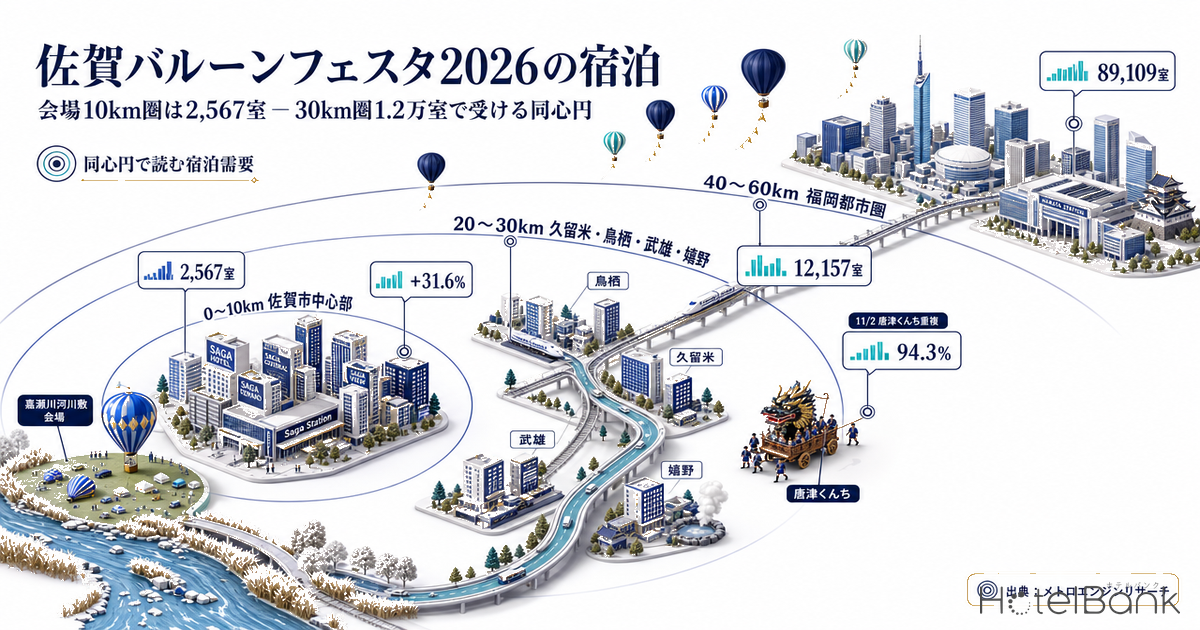
The 2026 Saga International Balloon Fiesta (2026佐賀インターナショナルバルーンフェスタ), one of Asia’s largest hot-air balloon competitions, runs for five days from Friday, October 30 to Tuesday, November 3 (a public holiday), centred on the Kasegawa riverbed in Saga City. The 2025 edition drew 838,000 visitors, and roughly 800,000 are expected again in 2026. A crowd of that size concentrated into five days is not something Saga City’s own room inventory can absorb on its own. This article measures the room count by distance band from the venue, the pricing record of last year’s event period, and the booking progress 78 days out at municipality-level granularity, to quantify how far the event’s lodging demand actually spreads.
- — Within 10km of the venue (the Kasegawa riverbed) there are 69 properties and 2,567 rooms. Adding the 20–30km band brings the cumulative total to 12,157 rooms, and the 60km ring — which includes the Fukuoka metropolitan area — reaches 89,109 rooms (N=2,351 properties, straight-line distance).
- — The event-period premium at the 2025 edition was +31.6% within 10km (¥17,400 → ¥22,900). It falls to +7.6% at 10–20km and converges to +1–3%, essentially normal-week levels, beyond 20km (same-property paired comparison, room-count weighted).
- — For the 2026 edition, at the LT90 cross-section 78 days before the event, Saga City’s estimated occupancy runs at 80.7–83.9% during the event (stay dates in October–November 2026, 46–48 properties / approx. 2,080 rooms) — more than 20pt above the normal-week range of 55–68%.
- — November 2 reads 94.3% and November 4 reads 91.3% (same basis), both overlapping with the Karatsu Kunchi festival. Together with the SanFair SAGA 2026 event the preceding week, late October through early November becomes effectively a continuous peak of just over two weeks.
- — New supply is concentrated in Tosu City, a transport junction, where 275 rooms returned to the market under refreshed brands over three years (mainly rebranding and renovation of existing buildings, not net-new construction). The conditions for Tosu to function as a second-tier catchment are falling into place.
Metric Definitions Used in This Article
- ADR (average daily rate): an estimated transacted rate (tax-exclusive equivalent) derived by applying category-specific adjustment coefficients to the lowest published plan rate each property lists on OTAs and similar channels (double occupancy, per-room rate, tax-inclusive). Cross-checked against property-level results disclosed by listed hotel REITs, the median error is approximately 7%. These are estimates and differ from each property’s actual transacted prices or accounting figures. Area-level ADR is the median across the properties covered (the level of a typical property in that area).
- Published price: the average selling price across all plans listed on OTAs and similar channels (double occupancy, per-room rate, tax-inclusive, from room-only through meal-inclusive plans). The daily and event-period premium analysis in this article is on this published-price basis.
- OCC (occupancy): sold rooms as a share of total rooms in the area (an estimate based on OTA sales inventory; consistency checks against monthly REIT disclosures confirm accuracy of roughly a few percentage points). Used only at the prefecture and municipality level.
- LT (lead time): days remaining until the check-in date. LT0 = same day.
- Data source: MetroEngines Research
800,000 Visitors in Five Days — Confirming the Event Outline from Official Sources
The schedule is worth pinning down from official sources first. According to the event’s official website, balloon competition at the 2026 edition runs for five days from Friday, October 30 to Tuesday, November 3 (a public holiday). Official practice flights are scheduled ahead of that on Wednesday, October 28 and Thursday, October 29, so the full programme including the awards ceremony spans October 28 to Wednesday, November 4. The venue is the Kasegawa riverbed in Saga City, as in previous years.
More than 100 balloons will take part. The 2025 edition drew 126 balloons from 20 countries and regions and recorded 838,000 visitors; roughly 800,000 are expected again in 2026. The important point is that those 800,000 do not translate into 800,000 units of lodging demand. Competition flights begin around 7 a.m., so day-trip attendance is common, and a same-day round trip from the Fukuoka metropolitan area is a realistic option. That is precisely why it is worth measuring, from actual data, how far out lodging demand actually reaches.
There is one more condition for 2026 that cannot be overlooked. Karatsu Kunchi (唐津くんち) in Karatsu City, Saga Prefecture — a UNESCO Intangible Cultural Heritage festival — runs as usual from Monday, November 2 to Wednesday, November 4, completely overlapping the second half of the Balloon Fiesta. As shown below, that overlap shows up clearly in the prefecture’s lodging supply-demand balance.
2,567 Rooms Within 10km — The Structure of Capacity by Distance Band
Taking the centre of the Kasegawa riverbed venue as the origin, we aggregated the properties tracked by MetroEngines Research whose operations can be confirmed on OTAs, by distance band. The results are shown in the table below.
Source: MetroEngines Research; compiled by the HotelBank Editorial Team
| Distance band | Properties | Rooms | Cumulative rooms | Main cities included |
|---|---|---|---|---|
| 0–10km | 69 | 2,567 | 2,567 | Central Saga City, Ogi City |
| 10–20km | 97 | 2,009 | 4,576 | Suburban Saga City, Okawa City, Yanagawa City |
| 20–30km | 250 | 7,581 | 12,157 | Kurume City, Tosu City, Takeo City, Ureshino City, Omuta City |
| 30–40km | 347 | 7,430 | 19,587 | Karatsu City, Ogori City, Chikushino City, etc. |
| 40–60km | 1,588 | 69,522 | 89,109 | Fukuoka City (Hakata Ward, Chuo Ward, etc.) |
Source: MetroEngines Research; compiled by the HotelBank Editorial Team (N=2,351 properties, straight-line distance from the venue centre coordinates)
Source: MetroEngines Research; compiled by the HotelBank Editorial Team
Within 10km of the venue — the walk-and-taxi radius centred on Saga Station — inventory stops at 69 properties and 2,567 rooms. Even at full occupancy with two guests per room, that accommodates on the order of 5,000 people, two orders of magnitude away from an 800,000 visitor count. Widening to 20km gives 4,576 rooms; counting all of Saga City gives 101 properties and 2,848 rooms.
The picture changes in the 20–30km band. This is where Kurume City (37 properties / 2,123 rooms), Tosu City (11 / 748), Omuta City (23 / 869), Takeo City (34 / 1,066) and Ureshino City (44 / 1,271) come in, adding 7,581 rooms at once for a cumulative 12,157. What distinguishes this band is not just the room count but its distribution along the transport spines — the JR Nagasaki and Kagoshima main lines and the Kyushu Expressway. Kurume and Tosu are both 26–30km from the venue in a straight line, roughly 30 minutes by rail.
Further out, the 40–60km band holds the Fukuoka metropolitan area’s 69,522 rooms. Hakata to Saga takes about 35 minutes by limited express. Cumulative rooms within 60km reach 89,109, and once that is in scope there is ample room to absorb an 800,000-visitor event in lodging terms. In other words, the lodging structure of this event is not one where Saga City absorbs everything; it is better understood as a set of concentric circles, with Saga City at the core, Kurume, Tosu, Takeo and Ureshino as the second tier, and the Fukuoka metropolitan area as the third. Counting capacity by distance band from the venue applies to large events generally — we have used the same method to measure the depth of accommodation supply around the venue of the 2027 International Horticultural Expo (GREEN×EXPO 2027).
Last Year’s Event Premium Was +31.6% — But Only Within 10km
So how far out does that concentric structure actually register in prices? We tested this against the 2025 edition (October 30 – November 3). Within each individual property, we compared published prices for the four event nights (October 30 – November 2) against published prices for the eight Friday and Saturday nights in the two weeks before and after, then weighted by room count. Because the comparison is property against itself, apparent differences caused by a changing property mix are eliminated.
Source: MetroEngines Research; compiled by the HotelBank Editorial Team
| Distance band | Normal-week published price | Event published price | Difference | Properties / rooms |
|---|---|---|---|---|
| 0–10km | ¥17,400 | ¥22,900 | +31.6% | 31 properties / 1,981 rooms |
| 10–20km | ¥22,300 | ¥24,000 | +7.6% | 48 properties / 1,278 rooms |
| 20–30km | ¥25,800 | ¥26,400 | +2.3% | 118 properties / 5,128 rooms |
| 30–40km | ¥21,600 | ¥22,200 | +2.7% | 141 properties / 4,886 rooms |
| 40–60km | ¥31,700 | ¥32,200 | +1.4% | 688 properties / 50,362 rooms |
Source: MetroEngines Research; compiled by the HotelBank Editorial Team (2025 edition actuals, same-property paired comparison, room-count weighted)
The result is unambiguous. The event premium rises sharply to +31.6% within 0–10km, drops to +7.6% at 10–20km, and beyond 20km converges to +1–3%, effectively indistinguishable from a normal week. Structurally, the premium decays by roughly three-quarters for each additional 10km.
Note that the normal-week baseline consists only of Fridays and Saturdays, whereas the event side spans Thursday to Sunday. Because the comparison is against a weekend-weighted baseline, the +31.6% figure should be read as a conservative estimate.
At the individual property level, even 200-room business hotels around Saga Station did not respond uniformly. Some pushed event published prices to 1.6 times their normal-week level, while others held close to normal-week levels throughout the event — so pricing behaviour varies even within the same distance band. Properties beyond 20km, meanwhile, sold through the event at essentially normal-week prices. The absence of a premium there does not indicate an absence of demand: ordinary non-event demand is the main driver in those bands, and event demand is absorbed by filling part of the existing inventory. The existence of this “fills without moving price” band is what materially relieves Saga City’s inventory constraint.
Source: MetroEngines Research; compiled by the HotelBank Editorial Team (October 13 – November 16, 2025; daily average published price within 10km of the venue)
Looking at the daily series for 2025, published prices within 10km climbed to ¥37,800 on Friday, October 31 as the event opened, stayed elevated through Saturday, November 1 (¥34,700) and Sunday, November 2 (¥32,300), then fell sharply to ¥23,000 on November 4, the day after the event closed. It is the classic event-demand waveform: prices return to normal the moment the event ends.
Where Things Stand 78 Days Out — Saga City Tracking in the 80s During the Event
Now to the current state of the 2026 edition. At the time of writing there are about 78 days to go and booking is still in progress. This is not a point at which definitive conclusions can be drawn, so we line up each date at the same lead time (LT90 = 90 days before check-in) and look at the relative gap against normal weeks.
Source: MetroEngines Research; compiled by the HotelBank Editorial Team (Saga City, 46–48 properties / approx. 2,080 rooms; estimated occupancy at LT90)
Lining up Saga City’s estimated occupancy at the fixed LT90 point, the normal-week level is 55–68% (stay dates in October–November 2026, 46–48 properties / approx. 2,080 rooms, LT90 cross-section): Monday, October 12 at 60.6%, Saturday, October 17 at 59.0%, Monday, November 9 at 55.9%. Against that, dates overlapping the event programme are distinctly higher. The official practice day of Thursday, October 29 reads 80.7%, the opening competition day of Friday, October 30 reads 82.5%, Saturday, October 31 reads 83.4% and Sunday, November 1 reads 83.9% (stay dates in October–November 2026, LT90 cross-section) — all above 80%. Ninety days out, the level already exceeds normal weeks by more than 20pt, a demand build-up consistent with the same event’s prior-year record. For how Saga Prefecture’s inventory absorption behaves outside event periods, our category-by-category look at booking progress in Saga Obon 2026: Ryokan Peak Aug 11, Not Aug 13; Aug 15 Down 6.5pt is also useful.
Two dates stand out in particular: Monday, November 2 at 94.3% and Wednesday, November 4 at 91.3% (both stay dates in November 2026, LT90 cross-section). November 2 is the fourth day of balloon competition and simultaneously the opening day of Karatsu Kunchi (the Yoiyama float parade). November 4 is the Balloon Fiesta’s awards-ceremony date and also coincides with Karatsu Kunchi’s closing-day festivities. These two days, with two major events running concurrently within the prefecture, are the most likely point at which Saga Prefecture’s lodging supply-demand balance tightens most. Conversely, Tuesday, November 3 (a public holiday) reads a relatively low 75.9% for an event date, which likely reflects the fact that a holiday makes day-trip attendance easier and that the following day is a working day.
One more point not to miss: the high readings the week before the event — Friday, October 23 at 81.2% and Saturday, October 24 at 87.7%. That weekend hosts the 36th National Industrial Education Fair, Saga (SanFair SAGA 2026), with SAGA Arena among its venues. Since SAGA Arena opened, Saga City has increasingly seen large events run back to back from late October into early November, so demand accumulates as an “autumn event season” rather than around a single event.
Saga City Rates Up 27% Year on Year — The Monthly View of the Uplift
Source: MetroEngines Research; compiled by the HotelBank Editorial Team (Saga City, N=32 properties; figures from August 2026 onward are estimates based on listing levels at the time of the survey)
Overlaying Saga City’s monthly estimated transacted ADR by year, the seasonal peak in October and November shows up for the third consecutive year. October 2026 is ¥13,600 and November 2026 is ¥14,000, up 26.9% and 27.0% respectively year on year. Both are more than 10% above October 2024’s ¥12,000. Note, however, that figures from August 2026 onward are estimated from published prices at the time of the survey and will shift with future sales conditions.
Neighbouring cities show the same uplift. Comparing estimated transacted ADR at municipality level between October 2025 and October 2026, Tosu City moves from ¥6,000 to ¥9,000 (+49.5%), Kurume City from ¥6,800 to ¥9,200 (+36.6%) and Hakata Ward in Fukuoka City from ¥14,100 to ¥17,800 (+26.5%) — double-digit growth across the board. Rates are rising in the second- and third-tier catchment cities too, so their positioning as “the cheap place to stay nearby” is relatively fading. How much further the third tier’s Fukuoka metropolitan room stock will grow is set out in Fukuoka Hotel Supply 2026-2028: ~1,000 Rooms/Year in Hakata & Tenjin.
Supply Concentrates in Tosu — New Capacity Stacking Up at the Transport Junction
The widening of capacity is happening on the supply side as well, not just in prices. Within the scope tracked by MetroEngines Research, new openings in Saga Prefecture by year total 9 properties / 226 rooms in 2024, 12 properties / 347 rooms in 2025, and 10 properties / 173 rooms in 2026 (on an OTA-listing-confirmed basis as of August).
| Property | Rooms | Location | Opened |
|---|---|---|---|
| ANA Holiday Inn Tosu (ANAホリデイ・イン鳥栖) | 126 | Tosu City | April 2026 |
| Nanairo Hotel (七彩ホテル) | 131 | Takeo City | July 2025 |
| Hotel Cross Base Tosu Ekimae (ホテル クロスベース鳥栖駅前) | 58 | Tosu City | September 2025 |
| HOTEL R9 The Yard Kanzaki | 41 | Kanzaki City | March 2025 |
| HOTEL R9 The Yard Saga Kashima | 40 | Kashima City | October 2025 |
| Comfort Inn Tosu (コンフォートイン鳥栖) | 91 | Tosu City | July 2024 |
| Karatsu Hotel (からつホテル) | 56 | Karatsu City | May 2024 |
Source: MetroEngines Research & Consulting (OTA-listing-confirmed basis, N=31 properties) / Note: because OTA listings appear several months before opening, counts for the most recent years may rise as further listings appear
What stands out is the concentration in Tosu City. Comfort Inn Tosu (91 rooms, July 2024, formerly Chisun Inn Tosu), Hotel Cross Base Tosu Ekimae (58 rooms, renovated October 2025) and ANA Holiday Inn Tosu (126 rooms, April 2026, formerly Hotel Viantos) together brought 275 rooms back to market under refreshed brands over three years. All are rebrandings and renovations of existing buildings rather than net-new construction, which is worth keeping in mind. Tosu sits about 29km from the venue at a transport junction — the branch point of the JR Kagoshima and Nagasaki main lines and the interchange of the Kyushu and Nagasaki expressways — with access to Saga, Fukuoka and Kurume alike. The conditions are falling into place for it to serve as the next band chosen once Saga City’s inventory tightens during the event.
On lodging taxes, neither Saga Prefecture nor Saga City had introduced one as of August 2026. Within the prefecture, Ureshino City raised its bathing tax effective October 1, 2025, taking overnight guests from ¥150 to ¥250 per person per night and day visitors from ¥50 to ¥100. Ureshino sits in the onsen belt within the 30km ring, and combining the Balloon Fiesta with a ryokan stay in Takeo or Ureshino is a realistic option. Given that this is a band where almost no event premium forms, there is considerable room for these properties to be chosen on their intrinsic merits as onsen ryokan.
Conclusion — Reading an Event Lodging Market as Concentric Circles
Lodging demand for the 2026 Saga International Balloon Fiesta has a concentric structure: a core within 10km of the venue (2,567 rooms), a second tier of Kurume, Tosu, Takeo and Ureshino in the 20–30km band (cumulative 12,157 rooms), and a third tier in the Fukuoka metropolitan area at 40–60km (cumulative 89,109 rooms). In last year’s actuals the price premium concentrated in the 10km ring at +31.6% and stayed at or below +3% beyond 20km. That indicates the second and third tiers have headroom to absorb demand with almost no movement in price.
For the 2026 edition, 78 days out, Saga City’s estimated occupancy is tracking in the 80s during the event (stay dates October 30 – November 3, 2026, LT90 cross-section), more than 20pt above normal weeks. Adding November 2 and November 4, which overlap Karatsu Kunchi, and October 23–25, which overlaps SanFair SAGA 2026 (October 24–25) the week before, Saga City in 2026 faces effectively a continuous peak of just over two weeks from late October into early November.
What is instructive for hotels is that this demand has a different character in each distance band. The 10km ring is a market where price moves, and staged pricing by lead time translates into revenue opportunity. Beyond 20km, properties are chosen less on price than on how well they solve access to the venue, so shuttles and early-morning transport guidance become the axis of differentiation. Even on the same day of the same event, the right move depends on location.
⚠ Note on forward-dated data: price and inventory data for October–November 2026 are estimates based on sales information published on OTAs and similar channels at the time of the survey, and will shift as check-in dates approach. Prices set high today may fall at the last minute, and equally may rise as inventory sells through. Estimated occupancy is likewise an estimate based on the sell-through of inventory offered on OTAs and differs from a property’s overall actual occupancy.
Related Reading
- Aomori’s First National Sports Games in 49 Years: Prices and Inventory
- Asian Para Games 2026: Aichi Weekdays Run 12pt Above the Next Week
- Nara Tokae 2026: 78.3% Estimated OCC 45 Days Out, 14.3pt Above After
- Kagoshima Summer Booking Curves: 23.2pt Gap by Type at 45 Days Out
- Saga Obon 2026: Ryokan Peak Aug 11, Not Aug 13; Aug 15 Down 6.5pt
- Obon T-7: Kyushu’s 31.7pt Gap — Fukuoka 73.0%, Kagoshima 41.3%
- Fukuoka Hotel Supply 2026-2028: ~1,000 Rooms/Year in Hakata & Tenjin
References and Sources
■ Official event information
- Saga International Balloon Fiesta, “Event Outline (2026)”
- Saga International Balloon Fiesta, “Dates for the 2026 Event” (March 11, 2026)
- Karatsu City Tourism Division, “Karatsu Kunchi — November 2, 3 and 4”
- 36th National Industrial Education Fair, Saga (SanFair SAGA 2026) official site
■ Press coverage
- Saga Shimbun, “[Breaking] Dates announced for the 2026 Saga International Balloon Fiesta — more than 100 balloons in the autumn sky”
- Saga Shimbun, “Ureshino to raise bathing tax: from ¥150 to ¥250 per night, ¥50 to ¥100 for day visitors” (February 18, 2025)
- Saga City, “Saga International Balloon Fiesta”
■ Data sources
Property and room counts by distance band, published prices, estimated transacted ADR and estimated occupancy are all aggregated by MetroEngines Research (coverage of approximately 27,000 properties and 1.26 million rooms in Japan). New openings are on an OTA-listing-confirmed basis from MetroEngines Research & Consulting (N=31 properties). Event dates, venue and scale were confirmed against the Saga International Balloon Fiesta official site and Saga Shimbun coverage; Karatsu Kunchi dates against the Karatsu City Tourism Division; and SanFair SAGA 2026 against its official site. Data as of August 13, 2026.
■ Calculation assumptions
Distance bands classify properties by straight-line distance from the main venue (Kasegawa riverbed, 33.2385°N / 130.2490°E), aggregating properties whose operations can be confirmed on OTAs (N=2,351 properties). The event premium compares, within each property, published prices for the four event nights of the 2025 edition (October 30 – November 2) against published prices for the eight Friday and Saturday nights in the two weeks before and after, weighted by room count. Booking progress is cut at the fixed LT90 (90 days before check-in) cross-section throughout and compared relatively against normal weeks (Saga City, 46–48 properties / approx. 2,080 rooms). Municipality-level rates are monthly series of estimated transacted ADR; Saga City is N=32 properties. Year-on-year figures compare October and November 2025 against the same months in 2026.
■ Limitations and caveats
Distances are straight-line and do not correspond to rail or road travel times. Prices and occupancy from October 2026 onward are estimates based on sales information published on OTAs and similar channels at the time of the survey, and will shift as check-in dates approach. Estimated occupancy is based on the sell-through of OTA-listed inventory and is defined differently from a property’s overall actual occupancy. Visitor figures are cumulative attendance announced by the organiser, not overnight-guest counts. New-opening data is on an OTA-listing-confirmed basis, so recent years may rise as further listings appear. The three new openings in Tosu City are rebrandings and renovations of existing buildings and are not net-new supply to the market. Data as of August 13, 2026.
■ Market data
- MetroEngines Research — estimated transacted ADR, published prices, estimated occupancy, booking curves, property and room counts (coverage of approximately 27,000 properties and 1.26 million rooms in Japan)
- MetroEngines Research & Consulting — new-opening data (OTA-listing-confirmed basis)