

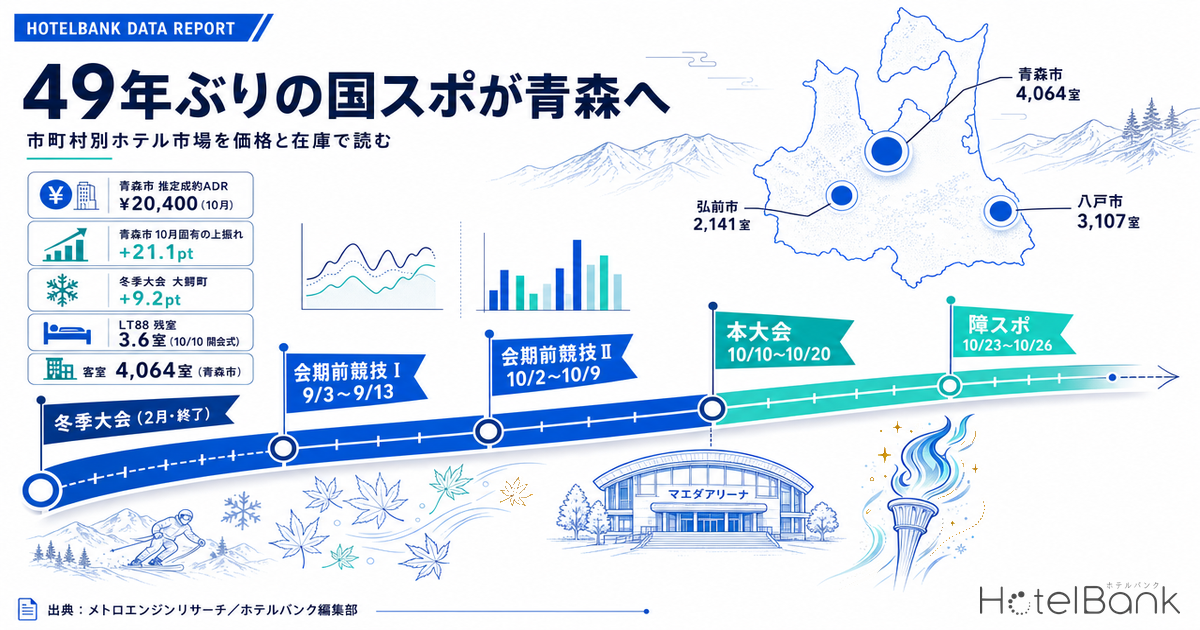
Aomori Prefecture will host the National Sports Games for the first time in 49 years. The Ao no Kirameki Aomori Kokusupo / Shosupo — whose main tournament runs for 11 days from October 10 to 20, 2026 — is a large-scale event staged across 22 municipalities inside the prefecture plus two out-of-prefecture venues, and for Aomori’s accommodation market these will be the 11 days with the strongest demand impact of the year. But October in Aomori is also the foliage season for Oirase Gorge, Hakkoda and Lake Towada. October price increases cannot simply be read as a games effect. This article uses municipality-level price data together with the observed results of the already-completed Winter Games to separate demand attributable to the games from everything else.
Metric Definitions Used in This Article
- ADR (average daily rate): An estimated settled rate (tax-exclusive equivalent) calculated by applying category-specific adjustment coefficients to each property’s lowest publicly listed plan level on OTAs and similar channels (two guests per room, per-room rate, tax-included). Cross-checked against property-level results disclosed by listed hotel REITs (91 properties, most recent 3 months), the median error is approximately 7%. These are estimates and differ from each property’s actual transacted prices or accounting figures. Area-level ADR is the median of the properties covered (the level of a typical property in that area).
- Listed price: The average price of all plans listed on OTAs and similar channels (two guests per room, per-room rate, tax-included, from room-only through meal-inclusive plans). This is a separate metric from estimated settled ADR.
- LT (lead time): Days remaining until the check-in date. LT0 = same day.
- Rooms remaining: The number of rooms present as sellable inventory on OTAs at each observation point (room basis).
- Data source: MetroEngines Research
- — The main tournament runs October 10-20, 2026, 11 days in all. Combined with Pre-Tournament Events I (Sep 3-13) and II (Oct 2-9) and the Para Games (Oct 23-26), demand does not peak at a single point but in three stages.
- — Room stock is concentrated in Aomori City 4,064 rooms, Hachinohe 3,107 rooms, Hirosaki 2,141 rooms. Even with venues dispersed across the prefecture, lodging demand flows not to the municipalities that have venues but to those that have rooms.
- — Taking the difference between the September and October year-on-year changes in listed price, Aomori City is the largest at +21.1pt. Hachinohe follows at +16.1pt and Hirosaki at +15.3pt, while Towada, the foliage market, stops at +9.4pt.
- — At the already-completed Winter Games in February, host municipalities recorded +7-9pt (Owani +9.2, Kazuno +8.0, Hachinohe +7.5), while non-host Aomori City came in at -5.1pt. The same framework holds in observed data.
- — At LT88, rooms remaining for October 10 stand at 3.6 rooms per observed property, roughly one-fifth of the 18.0 rooms for September 26. The opening-ceremony date being the tightest cannot be explained by foliage demand alone.
The Schedule Splits Into Three – and So Does the Demand Peak
According to the official games site, the schedule of the 80th National Sports Games is not a single continuous period. Pre-Tournament Events I run September 3-13, Pre-Tournament Events II run October 2-9, and the main tournament runs October 10-20: a three-stage structure. The grand opening ceremony is October 10 and the grand closing ceremony October 20. The 25th National Sports Games for Persons with Disabilities (Para Games) then follows for four days, October 23-26. Demonstration events are additionally scheduled intermittently from August 8 to October 4, meaning that for roughly two months from early September to late October, competition is taking place somewhere in the prefecture at all times.
From a lodging-demand standpoint, what matters is that this three-stage structure prevents demand from peaking at a single point. The pre-tournament events are limited in scale, centred on sport federations, competing athletes and their accompanying staff, whereas the main tournament period adds dignitaries, media and supporter groups attached to the grand opening ceremony, changing demand in both quality and volume. Indeed, in the booking-curve observations discussed below, the pace of inventory depletion during the September pre-tournament period and during the mid-October main tournament sits at completely different levels.
| Segment | Dates | Main content |
|---|---|---|
| Winter Games (completed) | January 31 – February 17, 2026 | Skating and ice hockey (Hachinohe, Misawa); skiing (Owani; Kazuno, Akita) |
| Demonstration events | August 8 – October 4, 2026 | Held intermittently |
| Pre-Tournament Events I | September 3 – 13, 2026 | Held by sport at sites across the prefecture |
| Pre-Tournament Events II | October 2 – 9, 2026 | Immediately before the main tournament |
| Main tournament | October 10 – 20, 2026 | Grand opening ceremony Oct 10, closing ceremony Oct 20 (Maeda Arena, New Aomori Prefectural Sports Park) |
| Para Games | October 23 – 26, 2026 | Aomori City, Hirosaki, Hachinohe, Mutsu and 12 municipalities in total |
Source: Compiled by the HotelBank Editorial Team from the official Ao no Kirameki Aomori Kokusupo / Shosupo site
Venues are dispersed widely across the prefecture: Aomori City, Hirosaki, Hachinohe, Kuroishi, Goshogawara, Towada, Misawa, Mutsu, Tsugaru, Hirakawa, Hiranai, Noheji, Shichinohe, Rokunohe, Tohoku Town, Rokkasho, Gonohe, Nanbu, Hashikami, Nishimeya and Fujisaki, among others. Two events are held outside the prefecture: swimming (diving) in Rifu, Miyagi, and equestrian in Hokuto, Yamanashi. Note that Kazuno in Akita was a venue for the Winter Games ski competition (jumping and Nordic combined) held together with Owani in February 2026, and is not a venue for the October main tournament. This point carries significant weight in the Winter Games analysis discussed below.
Circle size indicates the room-count scale of operating hotels and ryokan in each municipality. Source: MetroEngines Research; compiled by the HotelBank Editorial Team
Room Stock: 4,064 Rooms in Aomori City – Capacity Concentrates in Three Cities
Looking by municipality at the room stock of accommodation properties confirmed to be operating in Aomori Prefecture, Aomori City is the largest with 45 properties and 4,064 rooms, followed by Hachinohe with 42 properties and 3,107 rooms and Hirosaki with 31 properties and 2,141 rooms. These three cities alone account for most of the rooms among the prefecture’s main municipalities. Next come Towada with 1,225 rooms, Misawa with 863 and Mutsu with 760. Among the municipalities hosting competitions, capacity in the smaller ones is extremely limited: Goshogawara 372 rooms, Owani 309, Kuroishi 136, Hirakawa 106, Nishimeya 64 and Tohoku Town 38.
This structure means that lodging demand during the games flows not to the municipalities that have venues but to those that have rooms. Demand generated in small municipalities such as Kuroishi (badminton), Nishimeya (canoe) and Fujisaki (naginata) will in practice be absorbed by Hirosaki and Aomori City. Put the other way round, for hotels in the core cities that sit 30 to 60 minutes from a venue, the games bring demand even when no competition is held in their own area.
Ranking estimated settled ADR for October 2026 by municipality, Aomori City is the highest at ¥20,400. Below that come Kuroishi at ¥18,000, and among the main cities other than Kuroishi, Hirosaki ¥14,700, Towada ¥14,900, Misawa ¥13,300, Owani ¥12,700, Mutsu ¥12,000 and Hachinohe ¥11,900. What stands out is the scale of change from September to October: Aomori City is exceptional at +36.0%, followed by Hirosaki +24.3%, Hachinohe +21.9% and Towada +16.1%, while Misawa (-0.4%), Mutsu (-0.9%) and Owani (-5.4%) are flat to slightly negative.
| Municipality | Operating properties | Rooms | September 2026 Estimated settled ADR | October 2026 Estimated settled ADR | Sep to Oct |
|---|---|---|---|---|---|
| Aomori City | 45 | 4,064 | ¥14,975 | ¥20,359 | +36.0% |
| Hachinohe | 42 | 3,107 | ¥9,758 | ¥11,894 | +21.9% |
| Hirosaki | 31 | 2,141 | ¥11,813 | ¥14,684 | +24.3% |
| Towada | 24 | 1,225 | ¥12,796 | ¥14,858 | +16.1% |
| Misawa | 12 | 863 | ¥13,365 | ¥13,308 | -0.4% |
| Mutsu | 14 | 760 | ¥12,120 | ¥12,012 | -0.9% |
| Kuroishi | 10 | 136 | ¥16,813 | ¥18,040 | +7.3% |
| Owani | 10 | 309 | ¥13,386 | ¥12,663 | -5.4% |
Room and property counts are based on operating accommodation properties. The number of properties used to calculate estimated settled ADR for October 2026 is Aomori City 35, Hachinohe 29, Hirosaki 20, Towada 16, Misawa 9, Mutsu 8, Kuroishi 7, Owani 7. Source: MetroEngines Research; compiled by the HotelBank Editorial Team
Separating Foliage From the Games With a Difference Method
The size of the September-to-October increase is not in itself evidence of a games effect. Aomori’s premier foliage spots – Oirase Gorge, Hakkoda, Lake Towada and Tsutanuma – are at their best from mid to late October, so October running higher than September is a seasonal pattern that repeats every year. We therefore cancel out seasonality using the year-on-year comparison. Because the foliage exists equally in October 2025 and October 2026, the repeating seasonal factor is subtracted out of the year-on-year change.
One point about the handling of the data requires care, however. Estimated settled ADR is calculated on a different basis for months that have already ended than for months still ahead. The former is a value based on confirmed results; the latter is an estimate from listing conditions at the survey date. For a cross-year comparison such as October 2025 versus October 2026, we therefore use listed price (all-plan average), which is on the same basis in both years. Estimated settled ADR is used only for the comparison between September and October 2026, where the estimation basis is identical.
On a listed-price basis, Aomori City’s year-on-year change is +30.2% in September and +51.3% in October. The +21.1pt gap between the two is the October-specific uplift. Because September also contains pre-tournament events, part of the games effect is strictly speaking included on the September side, yet the October uplift – where the main tournament and the foliage season overlap – is still conspicuously large. Applying the same calculation to each municipality produces the following order.
| Municipality | September YoY | October YoY | October-specific uplift | Role in the games |
|---|---|---|---|---|
| Aomori City | +30.2% | +51.3% | +21.1pt | Main venue; grand opening and closing ceremonies |
| Hachinohe | +11.9% | +28.0% | +16.1pt | 7 sports + 2 Para sports |
| Hirosaki | +8.3% | +23.6% | +15.3pt | 6 sports + 2 Para sports |
| Towada | +27.8% | +37.2% | +9.4pt | 3 sports (foliage market) |
| Owani | +14.3% | +21.3% | +7.0pt | Onsen town near Hirosaki |
| Kuroishi | +7.4% | +12.4% | +5.0pt | Badminton venue |
| Misawa | +15.4% | +17.4% | +2.0pt | 4 sports + 3 Para sports |
| Mutsu | +3.1% | -1.5% | -4.5pt | 4 sports + 1 Para sport (Shimokita) |
Based on listed price (all-plan average, two guests per room, tax-included). Differences in year-on-year change are shown in points. Source: MetroEngines Research; compiled by the HotelBank Editorial Team
Source: MetroEngines Research; compiled by the HotelBank Editorial Team
What is interesting is that Towada, which should have the strongest foliage demand, stops at +9.4pt. Towada holds Oirase Gorge and Lake Towada, the largest foliage market in the prefecture, but that foliage demand existed in the same way in October of the previous year and is therefore cancelled out as a year-on-year difference. In other words, Towada’s +9.4pt can be read as indicating not foliage but additional demand specific to 2026. Aomori City’s +21.1pt, meanwhile, is more than double Towada’s, which means the demand concentration in the city holding the main venue and the grand ceremonies substantially exceeds that of the centre of the foliage market.
That Mutsu on the Shimokita Peninsula is the only negative reading (-4.5pt) reinforces this interpretation. Mutsu is a host municipality with four sports – rowing, sailing, fencing and basketball – plus the Para Games basketball venue, but it sits roughly two and a half hours by car from Aomori City, which makes combining a stay there with other venues impractical. Having a venue and attracting demand are two different things, and the constraint of geography shows up directly in the numbers.
Monthly listed price (all-plan average) for Aomori City. Source: MetroEngines Research; compiled by the HotelBank Editorial Team
What February’s Winter Games Left Behind – Host Municipalities +8pt, Non-Hosts -5pt
Everything analysed so far is an estimate of what is still to come. This edition of the games, however, has already produced an observed sample: the Winter Games. From January 31 to February 17, 2026, skating and ice hockey were held in Hachinohe and Misawa, and skiing in Owani and in Kazuno, Akita. Looking at the price record for that period gives an observed measure of the impact the National Sports Games have on a lodging market.
Because the Winter Games’ main dates were concentrated in February, we compare February’s year-on-year change with that of January, a month without the games. January’s year-on-year change corresponds to each municipality’s baseline for what would have happened without the games, and the gap versus February shows the uplift attributable to them.
Year-on-year change in listed price (all-plan average). Source: MetroEngines Research; compiled by the HotelBank Editorial Team
The result was clear. Owani, the venue for the alpine ski events, had fallen to -8.3% year-on-year in January yet recovered to +0.9% in February, a difference of +9.2pt. Kazuno in Akita, the venue for jumping and Nordic combined, went from -2.7% in January to +5.3% in February, or +8.0pt. Hachinohe, which held figure skating, speed skating and ice hockey, went from +7.7% in January to +15.1% in February, or +7.5pt. All three host municipalities landed within a +7 to +9pt range.
By contrast, Aomori City, which was not a Winter Games venue, went from -1.6% in January to -6.7% in February, a difference of -5.1pt, i.e. it actually worsened. Hirosaki, also a non-host, was essentially unchanged at -0.6pt. Misawa, the short-track venue, shows a small +1.5pt, most likely because that competition ran from January 31 to February 1 and straddled the month boundary, dispersing the effect into the January side as well (+6.9% year-on-year).
These observed values are an important yardstick for reading the October outlook. The Winter Games centred on four-day competitions with limited participation, whereas the October main tournament runs 11 days across dozens of sports, an entirely different order of magnitude. The question is how far a monthly uplift of around +8pt at the Winter Games expands at the main tournament. Aomori City’s +21.1pt in current listed prices is an explicable level given that difference in scale, but the possibility that listed prices are simply running ahead also remains. Where actual transactions land depends on how bookings come in over the next two and a half months.
Booking Curve – At LT88, Mid-October Rooms Remaining Are a Quarter of September’s
Demand takes shape in the pace of inventory depletion as well as in prices. We compared the booking curve for Aomori Prefecture as a whole by check-in date at the same lead time (LT88 = 88 days before check-in). Because the number of observed properties differs by check-in date, we normalise to rooms remaining per observed property rather than total rooms remaining.
Cross-section at LT88 (88 days before check-in). The number of observed properties ranges from 96 to 176 by check-in date. Source: MetroEngines Research; compiled by the HotelBank Editorial Team
Each Saturday in September carries 12.6 to 18.0 rooms remaining per observed property, and October 3, when Pre-Tournament Events II begin, is the loosest date in the period at 20.4 rooms. But October 10, when the main tournament begins, is at 3.6 rooms, October 17 at 4.8 rooms and October 24 during the Para Games at 4.0 rooms, a level one-third to one-fifth of September’s. Listed prices corresponding to the same cross-section also reach approximately ¥45,500 on October 10, ¥41,000 on October 17 and ¥39,700 on October 24, or 1.8 to 2.0 times the roughly ¥22,600 of September 26.
This is, however, only a mid-course reading at LT88 for check-in dates from October 10 onward. Roughly 70 days remain from this article’s survey date to October 10 and about 84 days to October 24, leaving open both the possibility that rooms remaining increase through added inventory or newly released plans and the possibility that depletion continues. In addition, mid to late October overlaps the foliage peak, so this tightness needs to be read as the sum of games demand and foliage demand. For how far inventory depletion differs between an event date and an ordinary weekend, 94.5% Sold 45 Days Out: Omagari Fireworks vs a Normal Akita Weekend makes the comparison using the same method.
Even so, the ordering – October 3, when Pre-Tournament Events II begin, being the loosest, and October 10, the grand opening ceremony, being the tightest – is hard to explain by foliage alone. If it were foliage demand, October 17 and 24 should show up more strongly than October 10. The fact that inventory is thinnest on the day of the opening ceremony suggests that non-leisure demand – games officials, supporters and media – is concentrated on October 10.
The Para Games and Out-of-Prefecture Venues – Room for Demand to Broaden
The Para Games of October 23-26 begin just three days after the main tournament ends on October 20. Venues span 12 municipalities: Aomori City (athletics, swimming, archery, table tennis), Hirosaki (flying disc, boccia), Hachinohe (football, foot softball), Misawa (bowling, deaf bowling, wheelchair basketball), Mutsu (basketball), Goshogawara, Tsugaru and Towada (volleyball divisions), Tohoku Town (softball), Shichinohe (blind tennis) and Oirase (blind baseball, fine ball).
Lodging demand for the Para Games has a characteristic that ordinary tournaments do not. In addition to the athletes, carers, sign-language interpreters and medical staff travel with them, so the number of companions per athlete tends to be higher. Demand also concentrates on accessible rooms, which gives properties that have them a scarcity value beyond price. The fact that the booking curve for October 24 has tightened to 4.0 rooms, essentially the same level as the main tournament period (October 17, 4.8 rooms), may reflect this structure. Demand during the Para Games should be positioned as a business opportunity on a par with the main tournament.
The out-of-prefecture venues are also worth noting. Swimming (diving) is held in Rifu, Miyagi, and equestrian in Hokuto, Yamanashi. Rifu’s listed price for October 2026 is ¥31,000 (6 properties covered), a substantial increase of 52.9% from ¥20,300 a year earlier. But Rifu is an event location that holds the Miyagi Prefectural Sports Park (Hitomebore Stadium Miyagi), and with the price observation set limited to 5 to 8 properties, this increase cannot be attributed to the diving events alone. Hokuto has a much larger base at 127 properties; its October 2026 listed price is ¥30,700, up 12.7% from ¥27,300 a year earlier. As a resort area on the southern foot of the Yatsugatake range it already has strong October foliage demand, and the equestrian events sit on top of that.
For hotels in Aomori Prefecture, the two out-of-prefecture venues are not direct competition. What deserves attention instead is where the demand that cannot be absorbed within Aomori Prefecture ends up going. Against Aomori City’s 4,064 rooms, demand during the main tournament – athletes, coaches, officials, media and supporters combined – will be considerable. Hirosaki (2,141 rooms), Kuroishi, Hirakawa and Owani within 60 minutes of Aomori City, and Towada and Misawa within 90 minutes, gain an opportunity to meet guest segments they do not normally reach. Whether the stay experience delivered here can be converted into return visits in later years is the real value of these 11 days.
Conclusion – Read the Map of Rooms, Not the Map of Venues
The National Sports Games, back after 49 years, bring three stages of demand to Aomori Prefecture’s accommodation market: Pre-Tournament Events I in early September, Pre-Tournament Events II in early October, and the main tournament of October 10-20 together with the Para Games of October 23-26. What the data shows is that this demand flows along the distribution of rooms, not the distribution of venues.
Taking the difference between the September and October year-on-year changes in listed price, Aomori City, which holds the main venue, is the largest at +21.1pt, followed by Hachinohe at +16.1pt and Hirosaki at +15.3pt. Towada, the centre of the foliage market, stops at +9.4pt, and geographically distant Mutsu sinks into negative territory at -4.5pt. Applying the same method to the already-completed Winter Games in February separates host municipalities (Owani +9.2pt, Kazuno +8.0pt, Hachinohe +7.5pt) clearly from non-host municipalities (Aomori City -5.1pt, Hirosaki -0.6pt), confirming that this analytical framework also holds in observed data.
On the booking curve, rooms remaining for October 10 at LT88 stand at 3.6 per observed property, one-fifth of the 18.0 rooms for September 26. The ordering in which the opening-ceremony date is the tightest cannot be explained by foliage demand alone. That said, roughly 70 days still remain from this article’s survey date to the main tournament, so this is no more than a mid-course reading. Additional inventory or last-minute price adjustments could still change where things finally land.
October 2026 in Aomori will be an unusual month in which the annual foliage demand overlaps with games that come once in 49 years. Demand reaches municipalities without venues, while a venue that is far away does not bring demand at all. What hotels should be reading is not the map of competition venues but the map of rooms – how many rooms sit how many minutes’ drive from each venue.
⚠ Note on data for future dates: The price and rooms-remaining data for September and October 2026 in this article are estimates based on sales information published on OTAs and similar channels as of the survey date (August 1, 2026), and will change as the check-in date approaches. Please note both that prices currently set high may fall through last-minute adjustments and that inventory that looks thin at present may increase as more is released. In addition, estimated settled ADR from July 2026 onward is an estimate from listing conditions at the survey date and is calculated on a different basis from figures for June 2026 and earlier, which are based on confirmed results. For this reason, cross-year year-on-year comparisons use listed price (all-plan average).
Further Reading
- North Tohoku’s 2,079 New Rooms: Which Segments Can Absorb the Supply
- 94.5% Sold 45 Days Out: Omagari Fireworks vs a Normal Akita Weekend
References and Sources
■ Official games information
- Ao no Kirameki Aomori Kokusupo / Shosupo official site (Aomori Prefecture) – schedule and grand opening/closing ceremony dates
- List of host municipalities, National Sports Games (same official site) – in-prefecture and out-of-prefecture venues (Rifu, Miyagi; Hokuto, Yamanashi)
- List of Para Games competition venues (same official site)
- Winter Games (same official site) – January 31 to February 17, 2026; Hachinohe, Owani and others
- Hachinohe Games, Winter Games (Hachinohe City Organising Committee)
- Ao no Kirameki Aomori Kokusupo Winter Games ski competition (Kazuno, Akita)
■ Data sources
Municipality-level estimated settled ADR, listed price and room stock are aggregated figures from MetroEngines Research (December 2024 to December 2026). The booking curve is an observation series covering 176 to 187 properties and 12,751 to 13,268 rooms in Aomori Prefecture, and the cross-section used in the text is at 88 days before check-in (LT88). The schedule, venues and competition dates follow the official Ao no Kirameki Aomori Kokusupo / Shosupo site.
■ Calculation assumptions
The games effect is extracted using a difference method. We take the year-on-year change for September and for October and treat the gap between them (in points) as the October-specific uplift, which offsets the foliage seasonality that repeats every year. The cross-year comparison uses listed price (all-plan average), which is calculated on the same basis in both years, and estimated settled ADR is used only for the comparison between September and October 2026, where the estimation basis is identical. In the Winter Games verification, the year-on-year change for January, a month without the games, serves as the baseline and the gap versus February is taken. Because the number of observed properties differs by check-in date, the booking curve is normalised to rooms remaining per observed property rather than total rooms remaining.
■ Limitations and caveats
September and October 2026 had not yet arrived as of the survey date (August 1, 2026), so both prices and rooms remaining are estimates from publicly listed sales information. Because September also contains Pre-Tournament Events I, the difference method absorbs part of the games effect into the September baseline, so the October-specific uplift should be interpreted as close to a lower bound rather than the full games effect. Mid to late October also overlaps the foliage peak, so the tightening of inventory is the sum of games demand and foliage demand. Note too that municipalities with few properties (Nishimeya, Tohoku Town, Hirakawa and the like) and the out-of-prefecture venue of Rifu have single-digit property counts, so a price revision at an individual property can easily move the aggregate figure.
■ Market data
- MetroEngines Research – municipality-level estimated settled ADR and listed price (December 2024 to December 2026), booking curve (176 to 187 properties and 12,751 to 13,268 rooms in Aomori Prefecture), room stock of operating properties