

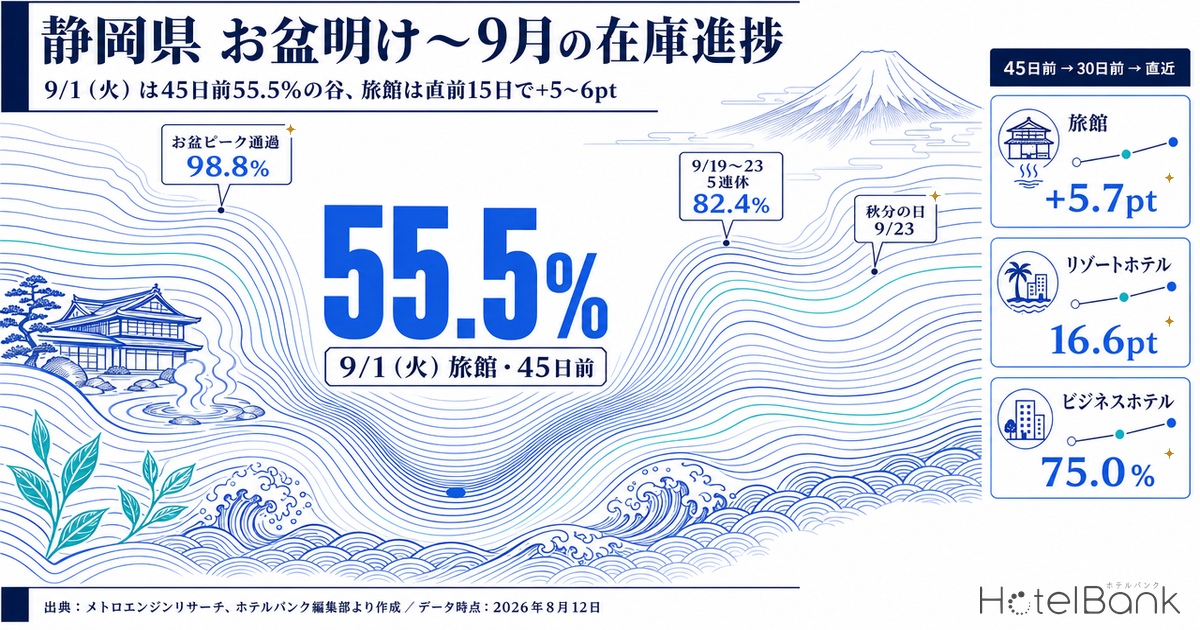
Accommodation demand in Shizuoka Prefecture has passed its Obon peak — 98.4% on Sunday, August 9 and 98.8% on Monday, August 10 (ryokan, estimated occupancy). The focus now is on what happens to inventory progress from here. Lined up against the same yardstick — the reading 45 days before each stay date — ryokan sit at 70.0% for Saturday, August 22 and 55.5% for Tuesday, September 1, a step down of 14.5 points. Business hotels fall 16.6 points from 88.2% on Saturday, August 22 to 71.6% on Saturday, September 12, dropping in stair-steps week by week. Sunday, September 20, by contrast, rises to an exceptional level at 82.4% for ryokan and 87.3% for resort hotels, with only the five-day run of holidays from September 19 to 23 standing out. This article examines inventory progress for ryokan, resort hotels and business hotels in Shizuoka Prefecture from August 22 to September 23, using observations within a 45-day lead time, and organises how to clear remaining rooms on the occupancy axis alone.
Scope: Shizuoka Prefecture (ryokan N=411–413 properties / resort hotels N=134–136 properties / business hotels N=211–213 properties; varies by stay date). Occupancy in this article is an estimate on an OTA-listed-inventory basis, and price metrics are not covered. Definitions appear at the end of the article. Data as of August 12, 2026.
- — 14.5pt On the same 45-days-out cross-section, ryokan in Shizuoka Prefecture fall from 70.0% on Saturday, August 22 to 55.5% on Tuesday, September 1, and 52.6% on Wednesday, September 23 is the lowest value in the period covered.
- — 16.6pt Saturdays at business hotels step down over four weeks, from 88.2% on August 22 to 71.6% on September 12, showing the fall-off of the summer holidays most clearly.
- — +5.7pt → +2.2pt Measured over the identical 15-day window from 45 days out to 30 days out, the ryokan pick-up is +5.7pt for August 22 against +2.2pt for September 5. Even on the same Saturday, the gain that can be expected close-in is less than half.
- — Thursday 75.0% / Sunday 81.9% On day-of-week averages of July 2026 actuals, the ryokan trough falls on Thursday and the business-hotel trough on Sunday: the position of the low within the week is almost inverted between property types.
- — 29.8pt The five-day run of holidays from September 19 to 23 cannot be treated as one block. On the 45-days-out cross-section, ryokan stand at 82.4% on Sunday, September 20 and 52.6% on Wednesday, September 23.
The Obon Peak Has Passed — Ryokan at 98.4% then 98.8% on August 9–10
First, the record already in the books. Daily estimated occupancy in Shizuoka Prefecture (OTA-listed-inventory basis) from August 1 to 12, 2026 puts ryokan at 95.8% on Saturday, August 8, 98.4% on Sunday, August 9, 98.8% on Monday, August 10 and 95.9% on Tuesday, August 11 (Mountain Day). Resort hotels record 96.2%, 98.3%, 98.9% and 96.7% over the same four days, and business hotels 97.9%, 94.5%, 95.6% and 91.9%. Mountain Day in 2026 falls on Tuesday, August 11, so the ordinary weekday of Monday, August 10 sits between the weekend of Saturday, August 8 and Sunday, August 9 and the holiday itself (Cabinet Office, “National Holidays”). Across all three property types, listed inventory was close to fully cleared over these four days.
Even on Wednesday, August 12, the day after Obon, levels remain high at 96.5% for ryokan, 96.8% for resort hotels and 92.5% for business hotels. Shizuoka’s peak has not so much “ended” as continued at a high level through the time of writing. For revenue management, the question narrows to a single point: where this high level breaks after August 22, and where it comes back.
August 22 to September 23, Lined Up Against the Same 45-Days-Out Yardstick
Progress cannot be compared when each stay date has a different number of days remaining. The chart below therefore lines up 11 stay dates on the same cross-section — the reading 45 days before the stay date. Ryokan fall from 70.0% on Saturday, August 22 to 55.5% on Tuesday, September 1, and 52.6% on Wednesday, September 23 (Autumnal Equinox Day) is the lowest value across the whole period. The highest, conversely, is 82.4% on Sunday, September 20, the middle day of the five-day run from Saturday, September 19 to Wednesday, September 23. Resort hotels take the same shape, with 62.3% on Tuesday, September 1 as the trough and 87.3% on Sunday, September 20 as the peak.
Source: Compiled by MetroEngines Research and the HotelBank Editorial Team
Business hotels have a different shape. Following Saturdays alone, they step down 16.6 points over four weeks: 88.2% on August 22 → 82.0% on August 29 → 73.1% on September 5 → 71.6% on September 12. Saturday, August 22 is the highest of the three property types at the 45-days-out point; by Saturday, September 12, the differences between types have all but disappeared, with ryokan at 64.9%, resort hotels at 71.6% and business hotels at 71.6%. As the embers of the summer holidays die down, business hotels in Shizuoka Prefecture can be read as being in the process of returning to ordinary, weekday-led demand.
Across these 11 stay dates, the number of properties observed at the 45-days-out point is 307–405 for ryokan, 128–135 for resort hotels and 188–207 for business hotels. Because the observed property count varies by stay date, it is safer to read the figures as an ordering between stay dates within the same column (45 days out) than as absolute levels.
The Shape of the Curve — On August 22, Ryokan Add +5.7pt in the Final 15 Days, Business Hotels +1.6pt
Next, the booking curve, following the same stay date along the time axis. For Saturday, August 22, moving from 45 days out to 30 days out to the latest reading (11 days remaining), ryokan progress 70.0% → 75.7% → 81.1% (+11.1pt versus 45 days out), resort hotels 75.2% → 82.3% → 87.8% (+12.6pt) and business hotels 88.2% → 89.8% → 92.0% (+3.8pt). Business hotels have already built up to 88.2% at the 45-days-out point, leaving little to add thereafter. The same stay date and the same observation window show that demand arrives in entirely different ways depending on the property type. The relationship whereby the higher the level at 45 days out, the smaller the close-in pick-up, is not unique to Shizuoka: the same shape can be seen in Tochigi’s booking curves by property type.
Source: Compiled by MetroEngines Research and the HotelBank Editorial Team
Because the number of days remaining at the latest reading differs by stay date, comparing pick-up figures side by side mixes in differences in the length of the observation window. Aligning them on the identical 15-day window from 45 days out to 30 days out, ryokan add +5.7pt on August 22, +6.2pt on August 25 and +5.0pt on August 29, against +2.8pt on September 1 and +2.2pt on September 5. Resort hotels add +7.1pt on August 22 and +6.1pt on August 29, then +3.9pt on September 1 and +5.0pt on September 5. Business hotels are thin across every stay date at +1.5 to +2.4pt. Late-August Saturdays build up in the close-in period, but once September arrives the amount accumulated over the same 15 days falls to less than half for ryokan.
| Stay date | Property type | 45 days out | 30 days out | Latest reading | 45 → 30 days out | 45 days out → latest |
|---|---|---|---|---|---|---|
| Aug 22 (Sat) | Ryokan | 70.0% | 75.7% | 81.1% (11 days left) | +5.7pt | +11.1pt |
| Aug 22 (Sat) | Resort | 75.2% | 82.3% | 87.8% (11 days left) | +7.1pt | +12.6pt |
| Aug 22 (Sat) | Business | 88.2% | 89.8% | 92.0% (11 days left) | +1.6pt | +3.8pt |
| Aug 25 (Tue) | Ryokan | 62.9% | 69.1% | 74.6% (14 days left) | +6.2pt | +11.7pt |
| Aug 29 (Sat) | Ryokan | 68.9% | 73.9% | 78.7% (18 days left) | +5.0pt | +9.8pt |
| Aug 29 (Sat) | Resort | 76.0% | 82.1% | 85.0% (18 days left) | +6.1pt | +9.0pt |
| Aug 29 (Sat) | Business | 82.0% | 84.2% | 87.7% (18 days left) | +2.2pt | +5.7pt |
| Sep 1 (Tue) | Ryokan | 55.5% | 58.3% | 61.4% (21 days left) | +2.8pt | +5.9pt |
| Sep 1 (Tue) | Resort | 62.3% | 66.2% | 68.3% (21 days left) | +3.9pt | +6.0pt |
| Sep 1 (Tue) | Business | 66.4% | 67.9% | 71.4% (21 days left) | +1.5pt | +5.0pt |
| Sep 5 (Sat) | Ryokan | 66.4% | 68.6% | 69.6% (25 days left) | +2.2pt | +3.2pt |
| Sep 5 (Sat) | Resort | 70.5% | 75.5% | 77.2% (25 days left) | +5.0pt | +6.7pt |
| Sep 5 (Sat) | Business | 73.1% | 75.3% | 76.3% (25 days left) | +2.2pt | +3.2pt |
| Sep 12 (Sat) | Ryokan | 64.9% | not yet reached | 69.2% (32 days left) | — | +4.3pt |
| Sep 12 (Sat) | Resort | 71.6% | not yet reached | 76.2% (32 days left) | — | +4.6pt |
| Sep 12 (Sat) | Business | 71.6% | not yet reached | 74.3% (32 days left) | — | +2.7pt |
Shizuoka Prefecture, estimated occupancy (OTA-listed-inventory basis). Observed property counts: the 45-days-out column covers 307–405 ryokan, 128–135 resort hotels and 188–207 business hotels; the 30-days-out column 355–393 ryokan, 127–134 resort hotels and 192–210 business hotels; and the latest-reading column 397–406 ryokan, 133–134 resort hotels and 208–210 business hotels. Source: Compiled by MetroEngines Research and the HotelBank Editorial Team
At the latest reading for Saturday, August 22, the estimated share of properties with no listed inventory confirmed was 40.8% for business hotels, 29.2% for ryokan and 25.0% for resort hotels. Business hotels were already at 43.1% in this state at the 45-days-out point, so progress has taken the form of demand concentrating on the properties that remain.
The Shape of the Week — Business Hotels 90.1% on Thursday, Ryokan 75.0% on Thursday
The trough on Tuesday, September 1 is not confined to this period. Averaging the daily actuals for the completed month of July 2026 by day of week, ryokan show 95.1% on Saturday, 90.2% on Sunday and 84.8% on Friday, against 75.0% on Thursday and 75.7% on Monday. Resort hotels likewise reach 95.8% on Saturday but 78.8% on Wednesday and 79.7% on Thursday. Business hotels are the reverse: the middle of the week is thick at 90.1% on Thursday, 89.6% on Wednesday and 88.4% on Tuesday, with Sunday the lowest at 81.9%. Saturday is the highest for all three property types (ryokan 95.1%, resort hotels 95.8%, business hotels 93.3%), but in Shizuoka Prefecture the position of the trough within the week is almost inverted between ryokan and resort hotels on one side and business hotels on the other. Where the business-hotel trough falls within the week differs by prefecture; the pattern in which Sunday and Monday form a twin trough is covered in detail in day-of-week occupancy at Saitama business hotels.
Day-of-week averages of daily actuals for July 2026 (only days with observation coverage of 90% or above, excluding Marine Day on July 20. n=2–5 days per day of week; observed property counts 334–412 ryokan, 124–136 resort hotels and 200–212 business hotels). Source: Compiled by MetroEngines Research and the HotelBank Editorial Team
This day-of-week structure is consistent with the ordering on the 45-days-out cross-section. Against 70.0% for Saturday, August 22 comes 62.9% for Tuesday, August 25; against 68.9% for Saturday, August 29 comes 55.5% for Tuesday, September 1 (ryokan in each case). Once September arrives, the gap between Saturday and Tuesday widens to 13.4 points. Over the five-day run from Saturday, September 19 to Wednesday, September 23, ryokan are high on the Sunday and Monday at 82.4% on Sunday, September 20 and 79.2% on Monday, September 21 (Respect for the Aged Day), then fall away sharply towards the back end of the run at 64.8% on Tuesday, September 22 (a designated public holiday) and 52.6% on Wednesday, September 23 (Autumnal Equinox Day). Even within a run of holidays, the final night — the one followed by a working day — has to be treated as a separate proposition.
For Revenue Managers Running Ryokan, Resort Hotels and Business Hotels in Shizuoka Prefecture — Implications and an Action Plan
1. Check your own curve against the market using just three points — 45 days out, 30 days out and the latest reading. In Shizuoka Prefecture, Saturday, August 22 runs 70.0% → 75.7% → 81.1% for ryokan and 88.2% → 89.8% → 92.0% for business hotels. Map your own booking position for the same stay date onto these three points and separate out whether the starting point at 45 days out is low against the market, or whether the close-in build-up is weak. A low starting point can be treated as a question of exposure and product design; a weak close-in build-up, as a question of how inventory is released.
2. Run late August and early September as different propositions, even on the same Saturday. The gain accumulated over the 15 days from 45 days out to 30 days out is +5.7pt for August 22 and +5.0pt for August 29 at ryokan, against +2.2pt for September 5. In late August, holding inventory back on the assumption of a close-in build-up is a defensible call; on early-September Saturdays, the same waiting game has not been producing the same accumulation. There is room to move on September Saturdays at an earlier stage.
3. The weekday trough sits in a different place depending on the property type. On day-of-week averages of July actuals, the ryokan trough is Thursday at 75.0% and Monday at 75.7%, while the business-hotel trough is Sunday at 81.9%. For ryokan and resort hotels the question is how to fill the middle of the week; for business hotels it is how to fill Sundays and the Saturdays left behind once the summer holidays have gone (September 12 is at 71.6% at 45 days out). The placement of the levers changes accordingly.
4. Treat the first and second halves of the September 19–23 run separately. On the 45-days-out cross-section, ryokan are high at 82.4% on Sunday, September 20 and 79.2% on Monday, September 21, while Wednesday, September 23 is the lowest across the whole period at 52.6%. Rather than applying one setting across the run as a single block of high demand, there is room to build the back end closer to the way a September weekday is handled.
| Time horizon | Action | Decision trigger (figures from this article) | Objective |
|---|---|---|---|
| Today to this week (week of Aug 22) | Decide whether to release the remaining allocation for Aug 22 (Sat) and Aug 25 (Tue) up front, as consecutive-night or two-guest-plus inventory | When your own progress for Aug 22 is clearly adrift from the market’s latest reading (ryokan 81.1% / resort 87.8% / business 92.0%) | Minimise unsold rooms over the remaining period while Obon levels still hold |
| Today to this week | At ryokan and resort hotels, design the three mid-week days including Aug 25 (Tue) as separate weekday products | When your own Thursday on July day-of-week averages sits below the market’s 75.0% for ryokan and 79.7% for resort hotels | Reduce weekend dependence and make the occupancy trough within the week shallower |
| Within two weeks (Aug 29–Sep 5) | Treat Sep 1 (Tue) as the top-priority date for action and bring forward the timing of close-in inventory release | The market’s Sep 1 is the lowest in the period covered at 55.5% at 45 days out (ryokan), with a 45-to-30-days-out gain of only +2.8pt | Secure guests at an early stage rather than relying on a close-in build-up |
| Within two weeks | Check that inventory for Sep 5 (Sat) has not been left on the same “wait” setting used in late August | The market’s Sep 5 shows +2.2pt for ryokan and +2.2pt for business hotels from 45 to 30 days out, a change in shape from +5.7pt and +1.6pt on Aug 22 | Avoid losing the post-summer Saturday by remaining dependent on close-in demand |
| Looking to next month (Sep 12–23) | Set inventory and conditions separately for Sep 19 (Sat)–21 (Mon) and Sep 22 (Tue)–23 (Wed) | On the 45-days-out cross-section, ryokan are at 82.4% on Sep 20 against 52.6% on Sep 23, a gap of 29.8pt | Capture demand in the first half of the run without carrying idle inventory on the back-end dates |
| Looking to next month | Put in place the steps to switch business hotels’ September Saturdays to weekday-style operation | Saturdays at 45 days out fall 16.6 points, from 88.2% on Aug 22 to 71.6% on Sep 12 | Shift the sales centre of gravity back to the weekday-led catchment on the assumption that summer demand falls away |
Source: Compiled by MetroEngines Research and the HotelBank Editorial Team
Summary — Three Yardsticks for Measuring Shizuoka Prefecture from August 22
First, where the steps fall. Lined up on the same 45-days-out cross-section, ryokan in Shizuoka Prefecture fall 14.5 points from 70.0% on Saturday, August 22 to 55.5% on Tuesday, September 1. Business hotels fall 16.6 points over four weeks, from 88.2% on August 22 to 71.6% on September 12. Post-Obon demand does not taper gently; it drops in steps from one stay date to the next.
Second, the size of the close-in build-up. Over the identical 15-day window from 45 days out to 30 days out, ryokan add +5.0 to +5.7pt on late-August Saturdays and +2.2pt in early September. Business hotels are thin at +1.5 to +2.4pt across every stay date. Even where bookings “come in late”, the margin that can be counted on differs completely by property type and by timing.
Third, the inversion across the week. On day-of-week averages of July 2026 actuals, the ryokan trough is Thursday at 75.0% and the business-hotel trough is Sunday at 81.9%. The five-day run from September 19 to 23 likewise shows a 29.8-point spread for ryokan, between 82.4% on Sunday, September 20 and 52.6% on Wednesday, September 23. Reading the shape of occupancy one day at a time, rather than grouping dates as “a run of holidays” or “the weekend”, is what pays off in Shizuoka Prefecture in September in particular.
About the Data
・Definition of estimated occupancy: OTA-listed-inventory-based occupancy = 100 − 100 × rooms still listed on OTAs ÷ total rooms. It is an estimate based on how inventory offered for sale on OTAs sells down, and differs in definition from actual room occupancy (it reads higher). This article refers to it as “estimated occupancy (OTA-listed-inventory basis)”. The scope is Shizuoka Prefecture, covering actuals for July and August 2026 and stay dates from August 22 to September 23, 2026.
・Booking curves: based on observations from 45 days before the stay date through to the most recent reading.
・Number of properties covered (N): 411–413 ryokan, 134–136 resort hotels and 211–213 business hotels in Shizuoka Prefecture (varies by stay date). The properties actually observed number 307–405 ryokan, 128–135 resort hotels and 188–207 business hotels in the 45-days-out column; 355–393 ryokan, 127–134 resort hotels and 192–210 business hotels in the 30-days-out column; and 397–406 ryokan, 133–134 resort hotels and 208–210 business hotels in the latest-reading column. Daily actuals for July 2026 cover 334–412 ryokan, 124–136 resort hotels and 200–212 business hotels; the day-of-week averages use only days with observation coverage of 90% or above and exclude Marine Day (July 20).
・The “estimated share of properties with no listed inventory confirmed” is an estimate of the share of properties for which listed inventory could not be confirmed on OTAs and similar channels.
・The arrangement of public holidays was confirmed against published data from the Cabinet Office, “National Holidays” (in 2026: August 11 Mountain Day, September 21 Respect for the Aged Day, September 22 a designated public holiday, September 23 Autumnal Equinox Day).
・Data as of August 12, 2026. Sales conditions and inventory change from day to day, so the figures in this article are a snapshot at the time of collection.
References and Sources
・Cabinet Office, “National Holidays” (国民の祝日について) https://www8.cao.go.jp/chosei/shukujitsu/gaiyou.html (holiday list data: syukujitsu.csv)
■ Data Sources
The occupancy and inventory metrics are OTA-listed-inventory data collected by MetroEngines Research and aggregated for Shizuoka Prefecture by property type (covering 411–413 ryokan, 134–136 resort hotels and 211–213 business hotels; varies by stay date). The arrangement of public holidays was confirmed against published data from the Cabinet Office, “National Holidays”.
■ Calculation Assumptions
Progress between stay dates is compared across three cross-sections — 45 days before the stay date, 30 days before, and the latest reading — and close-in pick-up is aligned on the identical 15-day window from 45 days out to 30 days out (the latest-reading column is not used for side-by-side comparison of pick-up, because the number of days remaining differs by stay date). The day-of-week averages for July 2026 cover only days with observation coverage of 90% or above, exclude Marine Day (July 20), and are calculated on n=2–5 days per day of week.
■ Limitations and Caveats
Estimated occupancy is on an OTA-listed-inventory basis and differs in definition from actual room occupancy (it reads higher). The number of properties observed varies by cross-section, and the 307 ryokan for Tuesday, September 1 in the 45-days-out column is the thinnest cross-section in the period covered. It is therefore safer to read the figures as an ordering between stay dates within the same column than as absolute levels. Price metrics are not covered in this article. The data is as of August 12, 2026, and sales conditions and inventory change from day to day.
Related Reading
- Shizuoka Ryokans: What “Full” Inns Name Differently (N=409)
- Tochigi Booking Curves by Type: Resort 81.1% at T-45, Only +2.6pt Left
- Mie August Booking Curves: Business Hotels Swing 25.5pt, Ryokan 9.7pt
- Oita Ryokan vs Resorts: 61.6% and 78.5% OCC 45 Days Out for Sep 12
- Nagano Late-Summer Booking Curve 2026: Ryokan -11.8pt at 45 Days Out
- Saitama Business Hotels: Sat 77.2% vs Sun 70.1%, Gap Widens to 11pt