

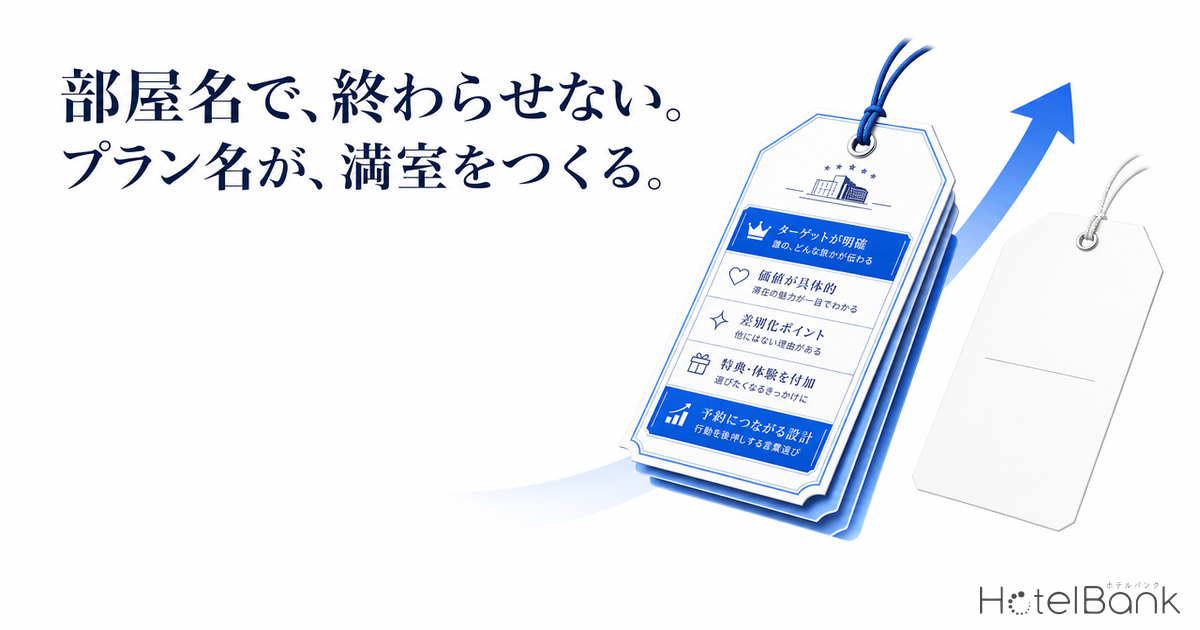
In Shizuoka’s ryokan market — centered on Izu and Atami — “always-full inns” and “good inns that just don’t quite break out” often sit side by side within the same hot-spring district. The bulk of that gap is determined by the property itself: location, facilities, pricing. That is the precondition. But if we set those upstream factors aside and look only at the “plan name” — the one line the inn writes to describe each room/meal package — do high-sell-through inns name things differently from low-sell-through inns? This article aggregates the publicly listed plan names of 409 ryokans across Shizuoka, then compares the top sell-through quartile against the bottom quartile to read the “naming habits” of each group through real examples. The conclusion, stated upfront: the differences are surprisingly small. But in exactly two places, they are unmistakable.
For context on the Atami ryokan market itself — supply count, room count, ADR trajectory — see our deep-dive analysis of Atami’s ryokan market as the necessary backdrop.
Metric Definitions Used in This Article
- Sell-Through Index (point-in-time): A relative indicator of each inn’s sales momentum, estimated from public sources. It is a single-observation value that fluctuates by season and day of week. Used not as an absolute level, but as a tool to read the “gap” between the top and bottom quartiles.
- Top Quartile / Bottom Quartile: Shizuoka ryokans were sorted by Sell-Through Index; the top quarter (102 properties) is the Top Quartile and the bottom quarter (102 properties) is the Bottom Quartile.
- Appeal Elements: The marketing-purpose words that make up a plan name, classified into roughly 95 categories. All plan names shown are anonymized versions of real public plan names and do not point to any specific booking site or inn.
- Scope: Shizuoka Prefecture, ryokan category — N=409 properties (Top 102 / Bottom 102). Data: MetroEngines Research and HotelBank Editorial Team.
- — The “surface” of plan names — character count, decoration, element count — is essentially identical between the Top and Bottom quartiles (avg. 40.7 vs. 43.7 characters; element counts 2.9 vs. 3.0). Naming skill is not a question of length or piling on more elements.
- — Where the gap is clear is the content of those elements. Top-quartile plan names spell out the meal in the title — “2-meal-included” appears in 29.1% vs. 13.3%, “buffet” in 10.2% vs. 0.7%, “kaiseki” in 23.8% vs. 18.7%. The guest already knows what arrives on the table just by reading the plan name.
- — The biggest upside sits in the Bottom Quartile’s “room-name / ingredient-name verbatim” plan titles (“Sea Bream Whole-Braised Plan,” “Standard Rate Plan,” etc.). The plan never says who it is for or what the night feels like. Closing this gap is not about adding decoration — it is about adding one word that describes a fact the inn already provides.
Method — Line-by-Line Comparison of Top-Quartile and Bottom-Quartile Plan Names
For 409 ryokans in Shizuoka, we collected every publicly listed plan name and broke each one down into roughly 95 appeal-element categories — location, target guest, perk, price, meal, and so on. We then sorted the universe by Sell-Through Index and pulled out the top 102 properties and the bottom 102 properties, then compared the naming style of the two groups one line at a time. The Sell-Through Index is a point-in-time estimate; what should be read here is not absolute level but the “gap” between the top and bottom quartiles. This is a comparison of distributions, not causation — a way to see “what names the full inns are putting up on the shelf.”
For the same methodology applied to a different market, see our companion piece that reads the plan names of full-quartile inns among Tokyo business hotels. Reading both side by side makes it more vivid how the “where naming matters” shifts when the business model changes.
Top-Quartile Examples — Dissecting “High Sell-Through” Plan Names
Let us first look at anonymized Top-Quartile plan names. What they share is that, within a single line of the name, “the content of the meal” and “the target guest / the kind of perk” sit together. True to Izu/Atami ryokan style, the dishes — seafood, wagyu beef, kaiseki — are named specifically; then in-room dining, a private-use bath, or a guest-segment call-out is layered on top.
[¥2,000 OFF per Person] <In-Room Dining> Ise-Ebi Lobster, Abalone, Wagyu Beef ◆ Isaribi Kaiseki Course
Beautifully Plated Premium Kaiseki + Premium Kuroge Wagyu — Detached Building, Open-Air Onsen-Bath Suite
[Private Bath Complimentary] Recommended for Families & Couples ☆ 1 Night with Breakfast Plan
In every case, the moment the guest reads the plan name, “I (who) eat (what) and stay (where)” comes into focus. It is not that more elements are stuffed in — each of those elements is allocated to a question the guest actually wants answered: the target audience, or the content of the meal.
The Numerical Gap — “Surface” Is Identical; What Differs Is How the Content Stacks
This is the core of the analysis. When we line up the Top and Bottom quartiles numerically, the “surface” of the names — character count, element count, decoration such as 【brackets】 — is almost indistinguishable. If anything, decoration is more common in the Bottom Quartile, which makes plain that “more flair, more bookings” is not the rule. The gap is in the content of the elements — above all, in whether the meal is named in the title or not.
| Plan-Name “Surface” | Top Quartile | Bottom Quartile | Gap |
|---|---|---|---|
| Avg. character count | 40.7 | 43.7 | Essentially same |
| Avg. element count per line | 2.9 | 3.0 | Same |
| Decoration (e.g. 【】) used | 79.5% | 90.7% | Higher in Bottom |
| 4+ elements “stacked” | 30.3% | 32.1% | Essentially same |
| Target guest explicitly named | 15.6% | 15.0% | Essentially same |
Source: MetroEngines Research, HotelBank Editorial Team (Shizuoka ryokans, Top 102 / Bottom 102)
So what does differ? When the elements are sliced by type, Top-Quartile plan names show a much stronger tendency to name the meal content specifically. The table below lists the elements the Top Quartile carried materially more often than the Bottom Quartile. “2-meal-included,” “buffet,” “kaiseki” — all words that let the dinner table come into view while still reading the plan name. Conversely, price-driven appeals (“discount”) were somewhat more common in the Bottom Quartile, hinting at a tendency to let the name lean entirely on cheapness.
| Element Carried in the Plan Name | Top Quartile | Bottom Quartile | Gap |
|---|---|---|---|
| Explicitly states “dinner + breakfast included” | 29.1% | 13.3% | +15.8 |
| Explicitly states “buffet / all-you-can-eat” | 10.2% | 0.7% | +9.5 |
| Explicitly states “kaiseki / kaiseki-style course” | 23.8% | 18.7% | +5.1 |
| Explicitly states “breakfast included” | 8.9% | 4.3% | +4.6 |
| Calls out “family / with-children” target | 5.9% | 3.7% | +2.2 |
Source: MetroEngines Research, HotelBank Editorial Team (Shizuoka ryokans, Top 102 / Bottom 102)
Chart: The “Content” Gap in Plan Names — Top vs. Bottom Quartile (share of inns writing the name that way)
Source: MetroEngines Research, HotelBank Editorial Team (Shizuoka ryokans, Top 102 / Bottom 102; index is a point-in-time estimate)
Bottom-Quartile Examples — The Upside Hidden in “Room-Name Verbatim” Titles
Bottom-Quartile plan names also carry good Izu-style raw material. The problem is that the line stops at an ingredient name or a rate category, and “who is this night for, what kind of stay is it” never makes it into language. This is not a verdict on the property’s underlying quality — it is that one last leg, the naming, has been left untouched. The upside is simply sitting there, unused.
“Sea Bream Whole-Braised Plan” / “Ise-Ebi Lobster Hot Pot Plan” / “One Whole Ise-Ebi Lobster per Person Plan”
“Standard Rate Plan” / “Chef’s Choice Big-Catch Plan” / “Dinner Yes, Breakfast No Plan”
“Sea Bream Whole-Braised Plan,” for instance, anchors itself to a fine ingredient — but the plan name has dropped whether it is a 2-meal plan, whether it is served in the room, who it is recommended for. “Standard Rate Plan” goes further: the name surfaces the back-office inventory bucket with zero meaning to the guest (what is included?). That is exactly where the Top Quartile’s habit — “add one more word that just states a fact” — has all its room to be applied.
How to Improve — From “Inventory Tag” to “Proposition to the Guest”
The principles distilled from how the Top Quartile writes are not difficult. Each one is satisfied just by adding a word that describes a fact the inn already provides.
- Name the meal content in the plan title. “2-meal-included,” “kaiseki,” “in-room dining,” and so on. The clearest gap between Top and Bottom Quartiles in Shizuoka ryokans was exactly this — meal specificity.
- Don’t stop at the ingredient name. “Sea Bream Whole-Braised” becomes “Dinner + Breakfast Included — Sea Bream Whole-Braised Kaiseki.” The hero ingredient only becomes a proposition when it sits next to who it’s for and how it is eaten.
- Name the target guest. “Family,” “couples,” “solo travel.” The Top Quartile is only marginally ahead here — but the Bottom Quartile has barely touched it, which is exactly why the upside is large.
- Replace “Standard Rate” with a proposition word. Don’t put the back-office bucket name on the shelf — describe in a word what the guest experiences at that rate.
Below are rewrites where “ingredient-verbatim / bucket-verbatim” titles found in the Bottom Quartile are reworked against those principles. These are illustrations of the principles only — in practice, the iron rule is that each inn must build the name strictly from elements it actually provides (don’t claim a meal style or a guest segment you don’t offer).
What This Article Can — and Cannot — Say
What this article has shown is a distributional fact within Shizuoka’s ryokan market: “this is how the plan names of the inns that are full are written.” It is not a causal claim that “naming a plan this way will sell it.” In fact, the “surface” of names — length, decoration, element count — barely differs between the Top and Bottom Quartiles, and the naming-craft gap across the market as a whole is small. The drivers of sell-through sit upstream: the property’s product, location, and price. The plan name is only the “last leg” downstream of all that.
This pattern — “the naming-craft gap is small; what works is how the content is spelled out” — is also observed broadly in our same-methodology analysis covering business hotels nationwide.
That said, the few differences we could measure are real. The Top Quartile names the meal content in the title, while the Bottom Quartile is still carrying a lot of “ingredient-verbatim / bucket-verbatim” titles. That is not a verdict — it is unworked upside. Move the name from inventory tag to a proposition for the guest, starting from adding one word that describes a fact the inn already provides — that is the most low-risk first step this article suggests you can take home.
This article describes the distribution of plan-name habits within the same area and category (Top vs. Bottom Sell-Through quartile) and does not establish a causal relationship between plan naming and sales performance (N=409, Top 102 / Bottom 102; the index is a point-in-time estimate). All plan names shown are anonymized versions of real public plan names and do not point to any specific booking site or inn.
Related Articles
- How Plan Names of “Full” Inns Differ for Tokyo Business Hotels
- How Plan Names of “Full” Inns Differ — Nationwide Business Hotels
- [April 2026] Atami Ryokan Market — 76 Properties, 2,508 Rooms, Structure and ADR Trajectory
- Buyout-Price Ceilings for Onsen Ryokans — ADR × OCC × 12% Cap Yield (Yugawara / Izu-Nagaoka / Minakami / Kusatsu)
- Top 30 Highest-Rated Sauna Inns Nationwide — When Urban Business Hotels Overtake Onsen Ryokans
References & Sources
- MetroEngines Research — Shizuoka ryokan plan-name appeal-element classification and Sell-Through Index (N=409 properties, Top 102 / Bottom 102, point-in-time estimate)
- HotelBank Editorial Team — Plan-name decomposition, anonymization, visualization