

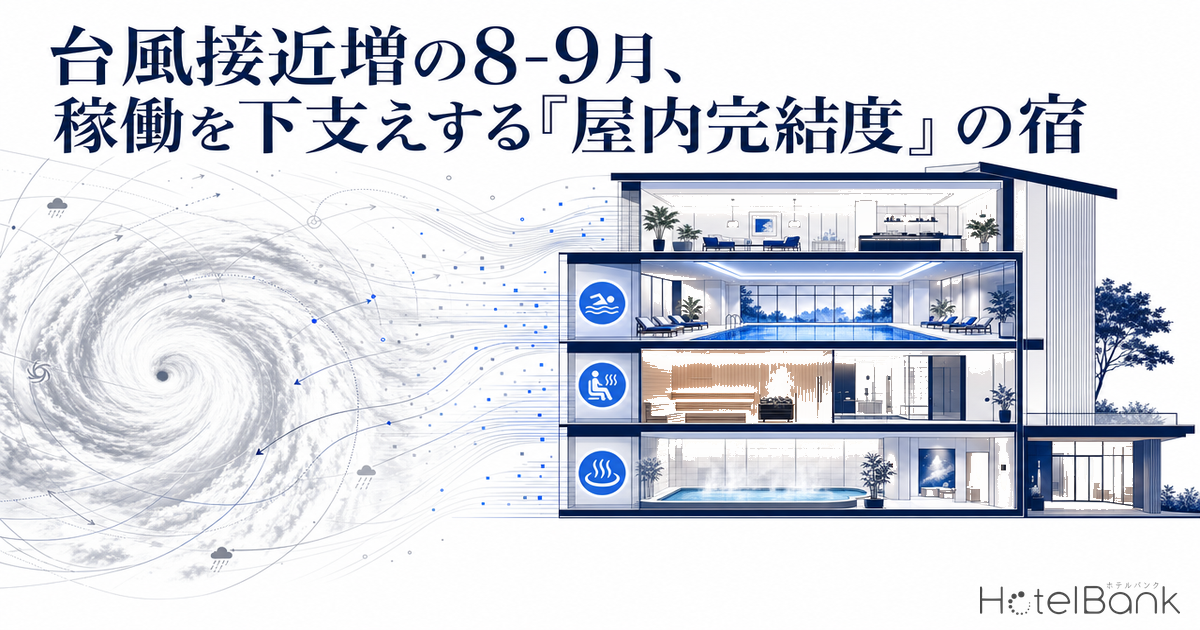
The Japan Weather Association (JWA) has projected that in 2026 the number of typhoons approaching the Japanese archipelago will be around average or above, centered on August, and that—against the backdrop of a shift toward El Niño conditions—caution will be needed in autumn against the approach of well-developed typhoons. During this period, which overlaps with the peak summer earning season, lodgings that depend on outdoor activities are more exposed to weather risk. By contrast, properties richly equipped with experiences that can be completed indoors—large communal baths, saunas, indoor pools—can more easily preserve their stay value even in bad weather. In this article, we read the occupancy-supporting effect of this “indoor completeness” through the lens of growth potential, using occupancy rates by property type and review tags.
Metric Definitions Used in This Article
- Room Occupancy Rate (OCC): Macro occupancy rates by property type and nationwide use the published figures from the Japan Tourism Agency’s “Overnight Travel Statistics Survey.” We compare across four categories: ryokan, resort hotels, business hotels, and city hotels.
- Review Mention Rate: The share of guest reviews—analyzed via NLP—that mention a specific in-house experience (bath-hopping, sauna, indoor pool, etc.). It represents “how frequently that experience is talked about,” not the rating score itself. Source: HotelBank Editorial Team research (NLP analysis).
- REIT Operating Metrics: The room occupancy, ADR, and RevPAR figures each REIT discloses monthly. These are actual performance figures for the entire portfolio.
- — In 2026, typhoon approaches are expected to increase in August, with “well-developed typhoons” to watch for in autumn. Properties with high indoor completeness, rather than outdoor-dependent ones, will underpin occupancy in this era of weather risk.
- — By property type, resorts surge in August to 88.1% occupancy and roughly ¥22,600 RevPAR, while business hotels stay stable year-round. In typhoon months, leisure demand is the most weather-sensitive.
- — Occupancy at the three listed hotel REITs sits at 80.1–84.9%, flat to slightly up year-on-year. ADR remains firm on added value—about ¥23,000 at Hoshino Resorts REIT (星野リゾート・リート) and about ¥21,400 at Japan Hotel REIT (ジャパン・ホテル・リート).
- — Read from reviews, indoor completeness centers on “bath-hopping, sauna, and indoor pool.” The sauna mention rate reaches as high as 55.6%, and a “reason to stay” that can be completed indoors becomes a differentiator.
The 2026 Typhoon Outlook — More Approaches in August, “Developed Typhoons” to Watch in Autumn
According to the typhoon outlook the Japan Weather Association published in May 2026, the number of typhoons approaching the Japanese archipelago is projected to be “around average or above, centered on August.” Furthermore, 2026 is seen as likely to shift into El Niño conditions by summer, and it has been noted that in autumn the typhoon genesis point may shift to the southeast, away from Japan, so that storms travel long distances over the sea and are more likely to approach in a well-developed state. In other words, this will be a year to prepare not only for the “number” of approaches but for the “strength” of each individual typhoon.
This forecast matters for lodging demand because August through September—the main battleground for typhoons—coincides with the season when leisure-oriented lodgings draw their heaviest annual demand. The period when weather most easily deteriorates aligns with the period when ryokan and resorts earn the most—and herein lies the significance of raising “indoor completeness,” the ability to preserve stay value even in bad weather. Properties with a deep set of experiences that do not depend on the outdoors can absorb the erosion of typhoon-hit leisure demand within their walls and turn it into occupancy support. For an examination of how far weather-resilient lodgings can stabilize occupancy, we verify the occupancy stability of indoor-complete properties in The Rainy El Niño Summer: Opportunities for Weather-Resilient Hotels.
Key point: In 2026, August typhoon approaches will be around average to above, and autumn calls for caution against developed typhoons. Because this period overlaps with the annual peak of leisure lodging, the depth of experiences that can be completed indoors is directly tied to occupancy stability.
Occupancy Structure by Property Type — Leisure Spikes in August, Business Stays Stable Year-Round
According to the Japan Tourism Agency’s “Overnight Travel Statistics Survey,” the room occupancy rate for 2025 (annual, preliminary figures) was 61.8% overall, and by property type: 38.4% for ryokan, 56.9% for resort hotels, 75.3% for business hotels, and 74.2% for city hotels. On an annual-average basis, urban types such as business and city hotels are high, while leisure types such as ryokan and resorts are relatively low. This is the flip side of the fact that leisure types have a strongly seasonal demand structure.
Looking at the swing across seasons makes this structure clearer. The chart below shows the standard pattern of monthly occupancy by property type, and ryokan and resorts jump sharply in August. Ryokan rise from the low-30% range of their weakest month to about 48% in August, and resorts concentrate to about 72%. Business and city hotels, by contrast, run in the 70–80% range throughout the year and do not spike in August either. In short, leisure-type lodgings concentrate demand into “the single point of August,” and the leverage this month’s weather exerts on annual revenue is large.
Source: Standard pattern of monthly occupancy by property type charted from the Japan Tourism Agency’s “Overnight Travel Statistics Survey.” Prepared by the HotelBank Editorial Team.
The actual weight of this August peak also shows in the monthly results of REITs with a strong resort-operating presence. Japan Hotel REIT Investment Corporation (8985) recorded room occupancy of 88.1%, ADR of about ¥25,700, and RevPAR of about ¥22,600 for August 2025—each the highest level of the year. August is the month when resorts can simultaneously achieve their highest rates and occupancy, and precisely because of this, a structure that can absorb weather risk indoors during this month holds great potential as a revenue backstop.
Occupancy Resilience by Property Type as Seen in Listed REITs
Placing the latest operating results of listed hotel REITs (May 2026, each company’s monthly disclosure) side by side reveals the differing character of occupancy driven by property-type mix. Invincible Investment Corporation (8963), centered on urban business hotels, posted 84.9% occupancy; Japan Hotel REIT Investment Corporation (8985), a resort-urban blend, posted 84.0%; and Hoshino Resorts REIT Investment Corporation (3287), mainly leisure/resort, posted 80.1%. All maintained flat-to-slightly-higher occupancy year-on-year, and underlying demand is firm regardless of property type.
Source: Prepared by the HotelBank Editorial Team from each REIT’s monthly operating data (May 2026).
What deserves attention here is that although leisure/resort-oriented lodgings do not reach the absolute occupancy levels of urban types, they achieve high added value in ADR and RevPAR. Hoshino Resorts REIT’s ADR is about ¥23,000 and Japan Hotel REIT’s is about ¥21,400, both above Invincible (about ¥15,200), which is centered on urban business hotels. Because a high-rate leisure stay contributes more revenue per night, the impact of a single typhoon-driven cancellation is also greater. That is exactly why whether a property can provide a “reason to stay” indoors even in bad weather becomes the key to not losing this high-rate demand.
Reading “Indoor Completeness” from Reviews — Bath-Hopping, Sauna, Indoor Pool
So what elements concretely make up the “indoor completeness” that keeps a stay enjoyable even in bad weather? The HotelBank Editorial Team analyzed guest reviews via NLP and tallied the properties with the highest mention rates over the most recent 24 months for three representative in-house experiences: bath-hopping (a wealth of multiple baths and bath types), sauna, and indoor pool. Each of these can fill the hours of a stay regardless of weather, allowing a property to propose ways to spend the day inside even on a day when a typhoon makes going out impossible.
Bath-Hopping and the Variety of Baths
Properties where guests can enjoy multiple baths and a diverse range of hot waters indoors can offer a “tour the building” experience even in the rain. The facilities with high mention rates are lined with large ryokan and hotels in hot-spring destinations.
| Rank | Facility | Location | Mention Rate | Reviews |
|---|---|---|---|---|
| 1 | Hotel Hana no Yu (ホテル華の湯) | Fukushima, Bandai-Atami | 6.3% | 886 |
| 2 | Daiichi Takimotokan (第一滝本館) | Hokkaido, Noboribetsu | 2.3% | 2,390 |
| 3 | Hotel Mahoroba (ホテルまほろば) | Hokkaido, Noboribetsu | 3.5% | 1,447 |
| 4 | Kur & Hotel Suruga Kenko Land (クア アンド ホテル 駿河健康ランド) | Shizuoka, Shimizu | 5.9% | 777 |
| 5 | Kurokawa Onsen Yukyo no Hibiki Yusai (黒川温泉 湯峡の響き 優彩) | Kumamoto, Kurokawa | 3.3% | 1,351 |
Source: HotelBank Editorial Team research (NLP analysis, most recent 24 months, top bath-hopping-tag mention rates; N = review count listed per facility).
Sauna
Against the backdrop of the recent “totonou” (getting into the zone) demand, the sauna has grown in presence as an element that raises stay value regardless of weather. By mention rate, at specialty facilities that put the sauna front and center more than 50% of reviews touch on the sauna, and even at urban business hotels it draws heavy mentions as a differentiator. It is precisely during typhoons, when outdoor leisure is difficult, that it functions as a refreshment experience completed indoors. The picture of urban business hotels overtaking hot-spring ryokan in review ratings is analyzed in detail in National Top 30 Hotels Renowned for Their Saunas.
Source: HotelBank Editorial Team research (NLP analysis, most recent 24 months, top sauna-tag mention rates).
Indoor Pool
The pool is a symbol of the leisure resort, but the outdoor pool is also the facility most easily affected by a typhoon. Many of the facilities with high mention rates here are equipped with indoor or heated pools, making a stay with children work regardless of weather. Large facilities in resort areas such as Okinawa, Beppu, and Shirahama line the list, and the depth of the pool experience supports stay satisfaction in bad weather.
| Rank | Facility | Location | Mention Rate | Reviews |
|---|---|---|---|---|
| 1 | Fusaki Beach Resort Hotel & Villas (フサキビーチリゾート ホテル&ヴィラズ) | Okinawa, Ishigaki Island | 39.3% | 1,425 |
| 2 | Southern Beach Hotel & Resort Okinawa (サザンビーチホテル&リゾート沖縄) | Okinawa, Itoman | 27.1% | 1,784 |
| 3 | Beppu Onsen Suginoi Hotel (別府温泉 杉乃井ホテル) | Oita, Beppu | 14.8% | 3,065 |
| 4 | Shirahama Koganoi Resort & Spa (白浜古賀の井リゾート&スパ) | Wakayama, Shirahama | 21.8% | 1,717 |
| 5 | Hotel Nikko Alivila (ホテル日航アリビラ) | Okinawa, Yomitan | 25.8% | 1,427 |
Source: HotelBank Editorial Team research (NLP analysis, most recent 24 months, top indoor-pool-tag mention rates).
The Distribution of Indoor-Complete Leaders
Plotting the lodgings that draw high mentions for this “indoor completeness” on a map, they spread nationwide—not only across the hot-spring and resort areas of western and southern Japan that are more exposed to typhoons, but all the way to the large hot-spring hotels of Tohoku and Hokkaido. What they share is that they bundle multiple in-house experiences: large communal baths, bath-hopping, saunas, indoor pools. Even when bad weather upsets a stay plan, the depth to build an entire day within the building leads to occupancy resilience.
Source: HotelBank Editorial Team research.
Growth Potential — Putting the “Reason to Stay” Indoors in an Era of Weather Risk
The 2026 typhoon outlook is two-tiered: more approaches in August and a tendency toward developed storms in autumn. For leisure-oriented lodgings, this period is the biggest earning season of the year, when weather risk and revenue opportunity peak at the same time. Herein lies an upside—regardless of property type—in deepening indoor-complete experiences.
Ryokan and resorts have room to capture the erosion of typhoon-hit leisure demand by clearly positioning existing in-house assets—bath-hopping, saunas, indoor pools—as “ways to enjoy the stay even in bad weather.” The higher a facility’s existing drawing power and rates, the greater the effect of this direction in protecting per-night revenue. Even at business and city hotels, moves to foreground saunas and large communal baths as differentiators hold the potential to add “weather-independent refreshment” as value to an urban stay.
Weather cannot be controlled, but the quality of the time spent indoors can be designed. It is precisely in the season when typhoon approaches increase that lodgings able to provide a stay that “satisfies even when you can’t go outside” will quietly underpin occupancy. Indoor completeness is a new axis of competition for lodgings in the era of weather risk, and its upside spreads across property types.
⚠ A note on the data: The occupancy rates by property type in this article are the published figures from the Japan Tourism Agency’s “Overnight Travel Statistics Survey,” and the seasonal pattern shows the standard monthly trend based on that same survey. The REIT operating metrics are the portfolio performance figures each company discloses monthly. Review mention rates are the frequency with which a specific experience is talked about, not the rating score itself. The typhoon outlook is a long-range forecast as of May 2026, and the actual course will vary.
Related Reading
- The Rainy El Niño Summer: Opportunities for Weather-Resilient Hotels — Verifying the Occupancy Stability of Indoor-Complete Properties
- National Top 30 Hotels Renowned for Their Saunas — The “Totonou” Era When Urban Business Hotels Overtake Hot-Spring Ryokan
- The Uneven Review Geography of Summer “Cold Baths, Saunas & Free-Flowing Cold Springs” 2026 — Where Bathing Differentiation Lifts Ratings on 35°C Scorching Days
- Will the 2026 Summer Bonus Flow to High-Rate Hot-Spring Ryokan? — ADR Analysis of Five Hot-Spring Destinations
References & Sources
- Japan Weather Association, Disaster-Prevention Report Vol.1 “The 2026 Typhoon Outlook” (May 2026)
- tenki.jp, “What Will 2026’s Typhoons Be Like? More Approaches in August, Watch for ‘Strong Typhoons’ in Autumn” (June 9, 2026)
- Japan Weather Association, Weather X, “2026 Typhoon Trends”
- Japan Tourism Agency, “Overnight Travel Statistics Survey (2025 annual, preliminary figures)”
- Japan Tourism Agency, “Overnight Travel Statistics Survey (July 2025 second preliminary, August first preliminary)”
- Each REIT’s monthly operating data (May 2026): Japan Hotel REIT Investment Corporation (8985), Hoshino Resorts REIT Investment Corporation (3287), Invincible Investment Corporation (8963)
- HotelBank Editorial Team research (NLP analysis) — tallying of in-house experience tags in guest reviews