
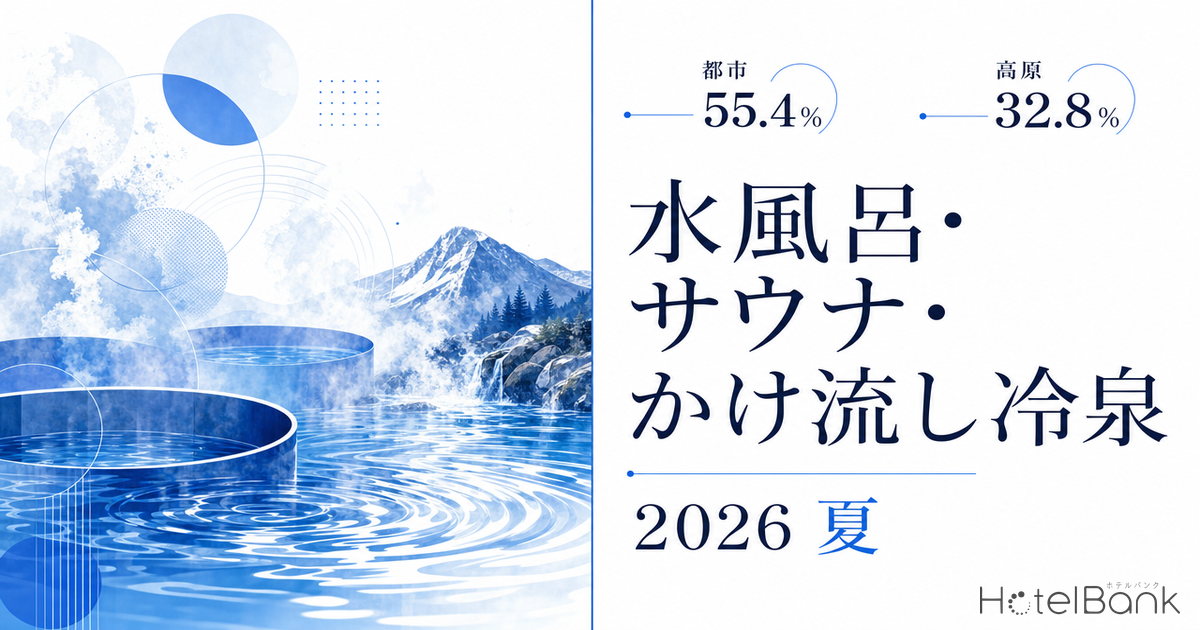
Summer 2026 is expected to bring “double high-pressure” extreme heat peaking from late July into early August, and the Japan Meteorological Agency (JMA) has newly introduced “extreme heat day (kokusho-bi)” as a forecast term for days with highs of 40°C or above. As days topping 35°C become routine, inns and hotels that differentiate on the guest bathing experience — “totonou (align/reset), cool down, wash off” — are gaining presence as a summer-demand differentiation axis in 2026. This report organizes review-mention distribution for four bathing tags extracted from guest reviews — Sauna & Cold Bath (bath_sauna), Water Quality (bath_water_quality), Open-Air Bath (bath_open_air), and Free-Flow Hot Spring (bath_kakenagashi) — split into two systems: the urban “totonou” cluster and the highland/onsen-town “cold-spring & famed-water” cluster.
Metric Definitions Used in This Article
- Mention pct: Share of a property’s total guest reviews that mention a given bathing tag (sauna / water quality / open-air / free-flow). Aggregated via NLP analysis.
- ADR (Average Daily Rate): Average listed price (2 guests / 1 room, tax included, all-plan average). Differs from actual booked prices.
- OCC (Occupancy): Share of sold rooms against total area rooms (estimate based on OTA inventory).
- Data sources: HotelBank Editorial Team (NLP analysis of about 2.5 million guest reviews, 24-month window) / MetroEngines Research (OTA public price data).
- — Summer 2026 will hit peak “double high-pressure” extreme heat, with the newly designated “extreme heat day (40°C+)” forecast term expected at 7-14 locations nationwide. Inns pitching “totonou, cool down, wash off” are emerging as a differentiation axis.
- — Bathing differentiation splits clearly between the “urban sauna” system and the “highland cold-spring & famed-water” system. Urban-type shows 13.95% sauna & cold-bath mention rate; ryokan-resort type shows 22.99% open-air and 20.79% sauna — both at high levels.
- — Free-flow hot springs cluster in Shizuoka, Yamanashi and Tochigi. Highland onsen towns at 800-1,500m elevation form a supply belt on the “cool down” axis, capturing summer demand within a 3-hour radius of the Tokyo metropolitan area.
- — Obon-week ADR (August 13-15) rises 1.4-1.7x for urban sauna hotels and 1.6-2.1x for highland inns. Supply tightness means top-rated properties often sell out within weeks of booking-window opening.
- — In areas where heat-day surges (Tokyo, Nagoya, Kyoto etc.) overlap only weakly with high-review bathing inns, demand capture headroom remains. Summer 2026 puts “totonou & cool down” at the center of the booking decision.
Summer bathing differentiation splits into “urban sauna” and “highland cold spring”
According to a 24-month NLP analysis (July 2024 – June 2026) of about 2.5 million guest reviews by the HotelBank Editorial Team, summer bathing keywords are clearly bifurcated. In cities, “sauna, cold bath, totonou” has risen as an independent support axis, while in onsen towns and highlands the core remains “water quality, open-air, free-flow spring”. Of the top-20 properties on the sauna tag, 18 (90%) concentrate in urban categories (business hotels, city hotels, capsules, bathhouse facilities); of the top-20 on the water-quality tag, 17 (85%) skew to ryokans and resort hotels.
The open-air-bath tag is even sharper: 15 of the top-16 properties are ryokans or resorts, with an average mention rate of 23.0%. Free-flow spring properties cluster in Shizuoka, Yamanashi and Tochigi. The top-20 accumulate about 546 mentions — fewer than other tags — but this reflects that “free-flow (kakenagashi)” is specialized ryokan vocabulary and the review base is limited. Under extreme heat, physical demand concentrates on properties equipped with “cold springs / cool-temperature spring, cold baths, outdoor cool-down benches”.
Source: HotelBank Editorial Team (NLP analysis, N=top 16-20 properties per tag, 24-month window)
Urban “totonou” axis — a coalition of capsules, business hotels and bathhouses
The national top on the sauna & cold-bath tag is Sauna & Capsule Hotel Paradise (サウナ&カプセルホテル パラダイス) in Chiba, where 158 of 285 reviews (mention rate 55.4%) reference the bathing experience. It is followed by 2. APA Hotel Stay Toyama (13.5%, N=104), 3. Premier Hotel-CABIN-Sapporo (7.6%, N=103), and 4. Shizuku, an all-private-sauna inn with Mt. Fuji views (富士山の見える全室個室サウナ付旅館しずく) in Yamanashi (29.0%, N=103). The top-20 properties accumulate about 1,715 total mentions. Geographically, they spread across 16 prefectures — led by 3 each in Hokkaido and Osaka — showing that “totonou” demand fans out across major cities, business hubs and tourism gateways.
In Tokyo, Do-C Ebisu (9.4%, N=77), Sauna & Capsule Hotel Hokuoh (24.0%, N=48), and Ueno Station Hostel Oriental 1 (5.5%, N=59) lead. In Osaka, Sauna & Capsule AMZA (12.7%, N=75), Yumoto “Hananoi” Super Hotel Osaka Natural Onsen (7.5%, N=72), and Capsule & Spa Grand Sauna Shinsaibashi (9.3%, N=68) form the core. The shared template is capsule / private cabin + large bath + sauna + cold bath + outdoor cool-down bench, which captures business, night-use and single-purpose sauna demand simultaneously. On extreme-heat days, the “instant recovery after outdoor work” use-case adds new demand, and the HotelBank Editorial Team’s tally of over 1,715 mentions signals a durable differentiation. Design-side inflection points in reviews include sauna-room temperature setup (90-100°C moderate-long vs 110°C+ high-short type), cold-bath water temperature (a 10-18°C range), and the outdoor cool-down space (benches and totonou chair counts). Room-side cooling performance also drives satisfaction sharply in extreme heat, as detailed in 40°C Heatwave Era “Room Temperature” Reviews — Cooling Drives Satisfaction & AC Capex Recovery 2026.
| Rank | Property | Prefecture | Category | Sauna mention % | N (mentions/total) |
|---|---|---|---|---|---|
| 1 | Sauna & Capsule Hotel Paradise | Chiba | Capsule | 55.44% | 158/285 |
| 2 | APA Hotel Stay Toyama | Toyama | City | 13.45% | 104/773 |
| 3 | Premier Hotel-CABIN-Sapporo | Hokkaido | Business | 7.61% | 103/1354 |
| 4 | Shizuku, all-private-sauna inn with Mt. Fuji views | Yamanashi | Ryokan | 29.01% | 103/355 |
| 5 | Nagoya B’s Hotel | Aichi | Business | 8.87% | 93/1048 |
| 6 | Ofuro Cafe Utatane | Saitama | Bathhouse | 20.04% | 91/454 |
| 7 | Hoshino Resorts OMO7 Asahikawa | Hokkaido | Resort | 12.57% | 90/716 |
| 8 | Hotel Global View Niigata | Niigata | Business | 3.91% | 82/2096 |
Source: HotelBank Editorial Team (NLP, bath_sauna tag, min_mentions=20)
Source: HotelBank Editorial Team (top sauna-tag properties in Tokyo & Osaka, 24-month window)
Highland & onsen-town “cold spring, famed water, open-air” axis — the ryokan and resort tradition
Of the top-20 on the water-quality tag, 17 are ryokans or resorts. The lead is Gifu’s Gero Onsen Suimeikan (下呂温泉 水明館) (14.7%, N=387), followed by Ureshino Onsen Hotel Kasuien (嬉野温泉 ホテル華翠苑) in Saga (23.4%, N=188) and Hotel Kusakabe Almeria in Gifu (12.1%, N=181). Top-20 mentions total about 2,682, exceeding the sauna tag (1,715). Region-wise, Gifu (2), Hokkaido (3), Saga (2), Gunma (2) and Wakayama (2) each field multiple properties, confirming that traditional onsen towns continue to earn support as “inns you can speak of by water quality”.
On the open-air-bath tag, the top three are Atami Tsukiuemon (Shizuoka, 34.3%, N=440), Minamisanriku Hotel Kanyo (Miyagi, 30.7%, N=376), and Asaya Hotel (Tochigi, 16.4%, N=370), directly connecting with the summer “outdoor cool-down x scenery” use-case. The top-16 average mention rate is 23.0%, the highest of the four tags, with Gunma’s Washin-no-yado Omori (和心の宿オーモリ) (43.4%, N=294) standing out. Located in Shima Onsen at around 800m elevation, where nighttime temperatures run 5-8°C below cities, the highland setting is a strong match for “summer outdoor cool-down”. The heat-wave trajectory of open-air-bath review mentions is explored in Open-Air Baths Rising in Reviews: Onsen Preference Grows in the Heat.
| Rank | Property | Prefecture | Category | Water-quality mention % | N (mentions/total) |
|---|---|---|---|---|---|
| 1 | Gero Onsen Suimeikan | Gifu | Ryokan | 14.65% | 387/2641 |
| 2 | Ureshino Onsen Hotel Kasuien | Saga | Resort | 23.35% | 188/805 |
| 3 | Hotel Kusakabe Almeria | Gifu | Resort | 12.07% | 181/1499 |
| 4 | Hotel Sakurai | Gunma | Ryokan | 10.05% | 156/1553 |
| 5 | Tamago-hada Bijin-no-yu Mishinen | Nara | Ryokan | 32.78% | 138/421 |
| 6 | Dai-ichi Takimotokan | Hokkaido | Ryokan | 6.31% | 135/2138 |
| 7 | TAOYA Kisoji | Nagano | Bathhouse | 20.34% | 131/644 |
| 8 | Heike-no-sho, Kanmu-Heishi Heritage Inn | Tochigi | Ryokan | 14.70% | 123/837 |
Source: HotelBank Editorial Team (NLP, bath_water_quality tag, min_mentions=100)
Source: HotelBank Editorial Team (national top open-air-tag properties, 24-month window)
National geography of “bathing-rated inns” — a twin belt of city and highland
Plotting the top properties across four tags on the map surfaces two belts. First is a Tokyo-Nagoya-Osaka-Fukuoka urban axis, a cluster of capsules, business hotels and bathhouses on the sauna and cold-bath tags. Second is a Hokkaido – Tohoku – North Kanto – Chubu / San’in – Kyushu onsen-town axis, a ryokan-and-resort belt where water-quality, open-air and free-flow tags concentrate. Where the heat-forecast areas (Kanto-Koshin, Kinki, Tokai, North Kyushu) overlap with high-rated bathing inns, the geometry supports capturing peak summer demand.
Source: HotelBank Editorial Team / MetroEngines Research
Free-flow (kakenagashi) clusters in Shizuoka, Yamanashi and Tochigi
The free-flow spring tag is specialized onsen-ryokan vocabulary and top-20 mentions total about 546, fewer than other tags, but regional concentration is sharp. Multi-property clusters include Shizuoka (5 inns: Izu, Ito, Atami), Yamanashi (3 inns, including Yumura), Tochigi (2 inns, Shiobara) and Gifu (2 inns, Gero area). The top three are Kobe Bay Sheraton Hotel & Towers (3.2%, N=49), Fukui Hotel (Hokkaido, 5.0%, N=43) and Yamagatakan (山県館) (Yamanashi, Yumura Onsen, 16.0%, N=42). Yamanashi’s Yumura Hotel B&B, an in-house-source free-flow natural-onsen inn (自家源泉かけ流し天然温泉の宿 湯村ホテルB&B) (8.9%, N=27) also performs well, and Yumura Onsen overall centers reviews on “kakenagashi”.
| Rank | Property | Prefecture | Kakenagashi mention % | N (mentions/total) |
|---|---|---|---|---|
| 1 | Kobe Bay Sheraton Hotel & Towers | Hyogo | 3.22% | 49/1520 |
| 2 | Fukui Hotel | Hokkaido | 4.99% | 43/861 |
| 3 | Yamagatakan | Yamanashi | 16.03% | 42/262 |
| 4 | Izu-Ito Onsen Daitokan | Shizuoka | 9.47% | 36/380 |
| 5 | Nishi-Izu Toi Onsen Musoan Biwa | Shizuoka | 11.07% | 33/298 |
| 6 | Hinoki-no-Yado Minakami Sanso | Gunma | 8.99% | 32/356 |
| 7 | Yumura Hotel B&B (in-house free-flow onsen) | Yamanashi | 8.85% | 27/305 |
| 8 | Atami Club Geihinkan | Shizuoka | 6.67% | 25/375 |
Source: HotelBank Editorial Team (NLP, bath_kakenagashi tag, min_mentions=15)
Summer 2026 peak demand — Obon-week ADR and supply
For the Obon peak from Saturday August 8 to Saturday August 15, 2026, listed ADRs at top-rated properties split cleanly between urban sauna and highland onsen ryokan. Urban capsule / sauna operators (Sauna & Capsule Hotel Hokuoh, Sauna & Capsule AMZA and so on) hold at ¥5,000-¥7,000 even in Obon week, while highland and onsen-town ryokans concentrate in the ¥80,000-¥160,000 range. Note that these are ADRs of top-rated properties, not area averages.
Source: MetroEngines Research (2026-08-08 to 08-15, top-30 review-rated properties, MetroEngines Research & Consulting)
Demand-capture headroom where heat-day areas and high-rated bathing inns overlap
Per JMA and Japan Weather Association forecasts, summer 2026 will see rising counts of 35°C+ heat days centered on Kanto-Koshin, Tokai, Kinki and North Kyushu. Overlaying heat-day zones with top water-quality and open-air-tag properties, Tochigi (Nikko, Nasu, Shiobara), Gunma (Kusatsu, Shima, Ikaho), Nagano (Shirahone, Tateshina, Yudanaka) and Yamanashi (Yumura) hold promising positions as “cool zones within a 2-3 hour reach of the cities”. Onsen towns at 800-1,500m elevation see nighttime temperatures drop to around 20°C in summer, boosting the perceived value of open-air bathing and outdoor cool-down.
On the urban side, sauna-primary stays (sa-shuku) are picking up new “instant recovery” demand on heat days. In HotelBank Editorial Team review tallies, Do-C Ebisu and Sauna & Capsule AMZA are drawing rising voices citing “reset a body worn out by outdoor work”, and occupancy stays firm on both weekdays and weekends in summer. Service-differentiation inflection points in reviews include sauna-room temperature design (90-100°C moderate-long vs 110°C+ high-short), cold-bath water temperatures (10-18°C range), and the outdoor cool-down space design (benches, totonou-chair counts). In extreme heat, in-room cooling performance also strongly drives satisfaction, and the structure is examined in 40°C Heatwave Era “Room Temperature” Reviews — Cooling Drives Satisfaction & AC Capex Recovery 2026.
Summary — two bathing systems redefine the summer inn-selection
With extreme heat expected in summer 2026, guest bathing evaluations split between the urban “totonou” axis and the highland / onsen-town “cold-spring & famed-water” axis. Of sauna top-20 properties, 18 are urban categories; of water-quality top-20, 17 are ryokans or resorts. Open-air bathing stands out at highland sites with an average mention rate of 23.0%. Free-flow springs cluster in Shizuoka, Yamanashi and Tochigi as region-specific strengths.
To capture peak summer demand, operators can clarify which “axis” their bathing experience anchors on, and communicate review-mentioned elements — cold-bath temperature, cool-down bench design, water-quality character, open-air view — explicitly in the booking funnel. Where heat-forecast zones overlap with high-rated bathing inns, summer upside potential runs highest.
Note on forward-dated ADRs: ADRs cited here are averages of OTA-listed prices as of late June 2026 and will move as check-in dates approach. Obon-week prices (August 8-15) may be repriced with future booking-pace changes.
Related Reading
References & Sources
Data sources
HotelBank Editorial Team review-NLP dataset (24-month window, about 2.5 million reviews, 79-tag classification) and MetroEngines Research (OTA listed-price aggregation, August 2026, N=30 properties). JMA, Japan Weather Association and Weathernews summer 2026 forecasts feed into the demand-side assumptions.
Model assumptions
Bathing mention pct is the share of guest reviews containing the four tags (bath_sauna / bath_water_quality / bath_open_air / bath_kakenagashi). ADRs are 2 guests / 1 room, tax-included, all-plan averages, compared between Obon week (Aug 13-15) and normal period (late July / September). The aggregation region centers on “3-hour reach of the Tokyo metropolitan area”, including North Kanto, Koshin-etsu and Tokai.
Limits & caveats
Mention rates here are relative signals built on voluntary guest reviews, not objective measures of bathing-facility quality (properties with few reviews carry small-N sampling bias). ADRs are averages of OTA public inventory and do not include actual booked prices, direct-sale prices, or group rates. Heat-day forecasts are probabilistic outputs from weather models; regional and period gaps with realized outcomes are possible.
Market data & weather references
- HotelBank Editorial Team — NLP analysis of about 2.5 million guest reviews, 79-tag classification (24-month window)
- MetroEngines Research — OTA public price data (August 2026, N=30 properties)
- Japan Weather Association: “Will Summer 2026 Be Hot? Extreme Heat Forecast and When It Starts” (updated April 2026)
- Weathernews: “Summer 2026 Outlook — Double High-Pressure Extreme Heat, Peak from Late July” (June 2026)
- Japan Weather Association tenki.jp: “2026 Heat Outlook: 40°C+ ‘Extreme Heat Days’ Expected at 7-14 Locations Nationwide” (March 2026)
- Japan Weather Association: “‘Extreme Heat Day’ Becomes a JMA Forecast Term for Summer 2026”
- Time Out Tokyo: “9 Notable Sauna & Bathhouse Facilities Opening in 2026”