

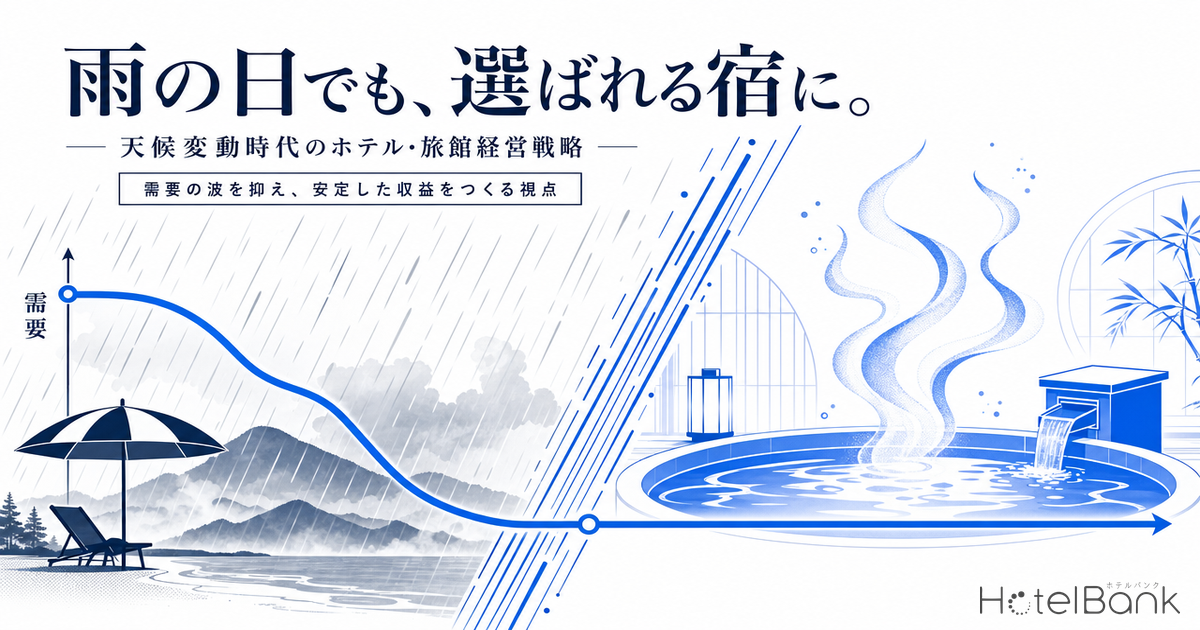
On May 12, 2026, the Japan Meteorological Agency (JMA) released its El Niño monitoring bulletin stating that an El Niño event was highly likely (90% probability) to develop by summer. The follow-up bulletin on June 10 upgraded this to a definitive outlook: “El Niño conditions appear to have developed since spring 2026 and are expected to continue through autumn (100%).” During an El Niño summer, the Pacific High weakens its westward push, the rainy season tends to last longer, and northern Japan in particular sees heavier rainfall and reduced sunshine. Typhoons tend to form farther to the southeast and travel longer paths over open sea, often making landfall with greater intensity.
The greater the weather volatility in summer, the more asymmetric the demand becomes between “outdoor-dependent products” and “indoor-completable products.” In this report, we use MetroEngines Research’s estimated occupancy rates (OCC) and booking curves to quantitatively compare demand stability between outdoor-dependent properties (beach, mountain-resort activities = resort segment) and indoor-completable properties (onsen, large communal baths, in-property facilities = ryokan segment), interpreting weather resilience as a demand-side growth opportunity.
Metric Definitions Used in This Article
- OCC (Occupancy Rate): Share of sold rooms relative to total rooms in the area (estimate based on OTA listed inventory). In this article, only prefecture x category macro aggregates are used; individual-hotel occupancy is not addressed.
- OCC Coefficient of Variation (CV): Daily dispersion of estimated OCC within a month (standard deviation / mean x 100). Smaller values mean smaller day-to-day demand swings and greater stability.
- Booking Curve: Trajectory of OTA remaining inventory in the run-up to check-in date. Lead Time (LT) = days until check-in. LT0 = day of arrival.
- ADR (Average Daily Rate): Average of listed prices on OTAs and other public channels (2 guests/1 room, per-room rate, tax-inclusive, averaged across all plans). Differs from actual transaction prices.
- Data Sources: MetroEngines Research. Weather outlook from JMA “El Nino Monitoring Bulletin.”
- – In June 2026, JMA confirmed El Niño conditions (100% probability). Increased rainfall and more typhoons are expected to widen summer weather volatility.
- – Comparing 7 prefectures by estimated OCC, indoor-centric properties (ryokan / onsen) show ~32% smaller daily demand swings than outdoor-dependent resorts (CV 3.22% vs 4.74%, May 7-31, 2026).
- – Average occupancy is roughly identical: 98.8% for resorts vs 99.1% for ryokan. The difference lies not in “how full” but in “day-to-day volatility and the floor on bad days.”
- – Booking curves for indoor-centric properties build up smoothly and steadily from LT90 to LT45, making demand easier to read and improving revenue-planning precision.
- – Weather resilience is not a defensive trait — it is a growth opportunity. Combining rainy-day indoor-plan messaging with tiered pricing can convert stable demand into revenue expansion.
An El Niño summer brings amplified weather volatility
According to commentary from JMA and the Japan Weather Association, when an El Niño event develops in summer, the Pacific High weakens, which tends to delay the end of the rainy season and increases the likelihood of concentrated heavy rainfall in July at the tail end of tsuyu. The Sea-of-Japan side of western Japan tends to see higher rainfall, and northern Japan is particularly prone to heavier rain and reduced sunshine. In 2026, however, climate change adds another layer, and extremely hot days are simultaneously forecast — so the textbook “El Niño = cool summer” framing no longer captures the compound nature of this year’s weather.
What matters for hotel operators is not whether average temperatures run hot or cool, but rather that “the swing in day-to-day weather widens.” When sunny weekends and weekends washed out by typhoons or stalled fronts alternate, lodging demand premised on outdoor activities swings sharply from one day to the next. By contrast, properties where the guest experience completes indoors, even in the rain, see steadier demand. In other words, weather volatility structurally tilts as a relative tailwind for indoor-centric hotels. Weather-driven demand shifts remain a topic through autumn as well, with changes in booking behavior in September and October.
Source: JMA “El Nino Monitoring Bulletin” (May 12 and June 10, 2026 releases), compiled by HotelBank Editorial Team
Indoor-centric properties have smaller occupancy swings — a 7-prefecture comparison
To test the hypothesis, we used MetroEngines Research’s estimated OCC to compare the “resort” category (as the outdoor-dependent proxy) with the “ryokan (indoor-completable properties with onsen / large communal bath)” category (as the indoor-centric proxy) within the same prefecture. The metric is the coefficient of variation (CV) of daily estimated OCC within the month. The goal is not to measure how high average occupancy is, but rather how much daily demand swings. We selected 7 prefectures with strong leisure demand that are exposed to weather, with the observation period set to May 7 and after, when estimated OCC stabilizes.
The results were clear. In all 7 prefectures, the OCC coefficient of variation for the ryokan category came in below the resort category. On average, against resorts’ CV of 4.74%, ryokan registered 3.22% — making indoor-centric demand swings roughly 32% smaller. Notably, average occupancy itself was virtually identical: resorts at 98.8% vs ryokan at 99.1% (both estimates, May 7-31, 2026, prefecture x category aggregates). The difference shows up not in “how full they get” but in “how much they swing day to day.” Furthermore, occupancy on the weakest demand day (the monthly minimum OCC) was 65.8% for resorts vs 88.7% for ryokan in Chiba, and 82.1% for resorts vs 89.0% for ryokan in Nagano — indoor-centric properties consistently hold a higher floor. The essence of resilience — demand not collapsing on bad-weather days — shows up here.
Source: MetroEngines Research, compiled by HotelBank Editorial Team (May 7-31, 2026; daily coefficient of variation of estimated OCC)
| Prefecture | Resort CV (outdoor-dependent) | Ryokan CV (indoor-centric) | Min OCC Resort / Ryokan |
|---|---|---|---|
| Okinawa | 2.00% | 1.43% | 89.9% / 92.7% |
| Hokkaido | 4.82% | 3.86% | 75.7% / 81.0% |
| Nagano | 3.59% | 2.40% | 82.1% / 89.0% |
| Shizuoka | 4.58% | 3.70% | 77.3% / 81.9% |
| Kanagawa | 6.65% | 5.31% | 67.1% / 74.3% |
| Chiba | 6.93% | 2.42% | 65.8% / 88.7% |
| Hyogo | 4.61% | 3.40% | 78.1% / 84.0% |
| 7-prefecture average | 4.74% | 3.22% | ~32% volatility reduction |
* Smaller CV (coefficient of variation) indicates smaller daily demand swings. Average OCC is essentially the same — resorts 98.8% vs ryokan 99.1% — and the gap appears in “stability of fill-up.”
Even in the early booking curve, indoor-centric demand is easier to read
Beyond occupancy stability, the “readability” of demand also shows up in the booking curve. Looking at the average booking curve for August 2026 check-ins (which include Obon), resort properties (outdoor-dependent) ramp from already-high occupancy of 73-74% at LT90, but subsequent buildup is more vulnerable to weather and last-minute booking decisions. Ryokan (indoor-centric, with onsen and large communal baths), on the other hand, start at slightly lower occupancy at LT90, but build gradually and steadily from LT90 toward LT45. Because high-confidence bookings — repeat-night stays, anniversary trips — stack early, the front half of the lead-time curve is smooth, making demand easier to forecast.
The chart below overlays average lead-time occupancy (estimated) for Okinawa resorts vs Nagano and Shizuoka ryokan. Outdoor-dependent properties show high early levels but late-stage movement that is hard to read depending on weather, while indoor-centric properties build gradually and steadily. Properties where the experience completes even in the rain are less exposed to last-minute cancellations or hesitation triggered by bad weather, and their booking curves are less likely to break. In an El Niño summer with wider weather volatility, this translates into greater potential to improve the precision of revenue planning.
Source: MetroEngines Research, compiled by HotelBank Editorial Team (Average booking curve for August 2026 check-ins, LT90-LT45)
“Satisfying even in the rain” experiences underpin the ratings
The stability of indoor-centric properties is also backed by guest sentiment. NLP analysis of guest reviews compiled by the HotelBank Editorial Team shows that mentions of indoor-experience elements remain at high levels. Across nationwide reviews over the most recent 3 months (N = 297,400), mentions of onsen ran at 12.8% (+1.1 percentage points YoY), suggesting heightened interest in onsen and large communal baths that can be enjoyed even on rainy days.
At the property level, hotels where the in-property bathing experience anchors guest evaluations are conspicuous. Aggregating reviews for onsen ryokan in Nagano, mentions of open-air baths (rotenburo) reach 24.2% at the top property (N = 272), mentions of bath-water quality (sensitsu) reach 20.9% (N = 133), and mentions of in-property pools reach 10.8% (N = 120). Voices such as “I could spend the whole day in the property without worrying about the weather” or “Precisely because it was raining, the onsen was even better” underpin satisfaction on bad-weather days. Experience value that completes without relying on outdoor scenery or activities is the wellspring of resilience to weather volatility.
Source: HotelBank Editorial Team analysis (NLP analysis; mention rate at top property per tag, Nagano onsen ryokan)
Reframing weather resilience as a “growth opportunity”
The data so far highlight the strength of indoor-centric properties — “demand that is less swayed by weather.” What matters is to treat this not as a defensive trait but as a growth opportunity. In stretches like an El Niño summer with wide weather swings, outdoor-dependent products see demand wobble, and reservations are relatively more likely to concentrate at properties where the experience completes indoors. Hotels that have already demonstrated stable occupancy can combine tiered pricing with rainy-day indoor-plan messaging to open up further revenue upside.
Concretely, the upside has several directions. First, foregrounding “experiences that complete even in the rain.” Indoor-completable assets — onsen, large communal baths, saunas, in-property lounges, indoor pools — are already highly rated. Putting these front-and-center during periods of heightened weather anxiety creates the potential to capture demand shifting from outdoor plans. Second, exploiting the readability of the booking curve: by using early-bird discounts for high-confidence early-stage bookings and dynamic last-minute pricing for the back half of the lead time, there is room to lift the average daily rate. Even outdoor-dependent properties have headroom to lift the demand floor by enriching indoor content for rainy days.
For summer 2026, an El Niño-driven scenario of heavier rainfall and more typhoons is becoming a reality. Weather is a variable operators cannot control, but the demand-side resilience that responds to it can be strengthened through product design and pricing strategy. The “small swing” demonstrated by indoor-centric properties is a solid starting point for turning an uncertain summer into a revenue opportunity.
Summary
JMA’s El Niño scenario of heavier rainfall and more typhoons has asymmetric impacts on lodging demand. Comparing 7 prefectures using MetroEngines Research’s estimated OCC, indoor-centric properties (ryokan / onsen) show daily demand swings roughly 32% smaller than outdoor-dependent properties (resorts) at virtually the same average occupancy, with a consistently higher occupancy floor on bad-weather days. Their booking curves also build gradually from the front half, making demand easier to read. Reviews give high marks to onsen, open-air baths, and bath-water quality — indoor experiences that underpin resilience to weather volatility. A summer with wide weather swings is a good window for hotels with this kind of stable demand to expand revenue opportunities by sharpening pricing and indoor-experience messaging.
Note on forward-dated booking curves and OCC: The booking curve for August 2026 check-ins in this article is an estimate based on OTA listed inventory at the time of analysis, and will continue to shift as check-in dates approach. The back half of the lead time (under LT45) is still under observation; please note that figures may change with future bookings and inventory additions. Estimated OCC is an estimate based on OTA listed inventory and differs in nature from official figures such as the Japan Tourism Agency’s “Accommodation Travel Statistics Survey.”
References & Sources
- Data sources: MetroEngines Research estimated occupancy rates (daily OCC estimated from OTA-listed inventory), booking curves (OTA remaining-inventory trajectories by lead time), and NLP analysis of guest reviews (N = 297,400 nationwide over the most recent 3 months). Weather outlook from JMA “El Niño Monitoring Bulletin.”
- Analytical assumptions: “Resort” as the outdoor-dependent proxy and “ryokan (onsen / large communal baths)” as the indoor-completable proxy, compared within the same prefecture. Stability metric is the within-month coefficient of variation of daily estimated OCC (CV = standard deviation / mean x 100). Sample: 7 prefectures with deep leisure demand; observation period: May 7-31, 2026, when estimated OCC stabilizes. Booking curve uses category-average for August 2026 check-ins.
- Limitations & caveats: Estimated OCC is an estimate based on OTA listed inventory and differs in nature from official actuals such as the Japan Tourism Agency’s “Accommodation Travel Statistics Survey.” Only prefecture x category macro aggregates are used; individual-property occupancy is not addressed. The August 2026 booking curve is still under observation for LT under 45 and will continue to move. CV depends on the mix of properties within the category and includes area-specific effects.
- JMA “El Nino Monitoring Bulletin” (May 12 and June 10, 2026 releases)
- JMA “Mechanism by which El Nino affects Japan’s weather”
- Japan Weather Association tenki.jp “High likelihood of El Nino developing by this summer” (May 12, 2026)
- Japan Weather Association tenki.jp “What does the El Nino event mean for Japan; possible typhoon implications” (June 13, 2026)
- MetroEngines Research — OTA public price data, estimated occupancy (OCC), booking curves
- HotelBank Editorial Team analysis (NLP analysis of guest reviews)