

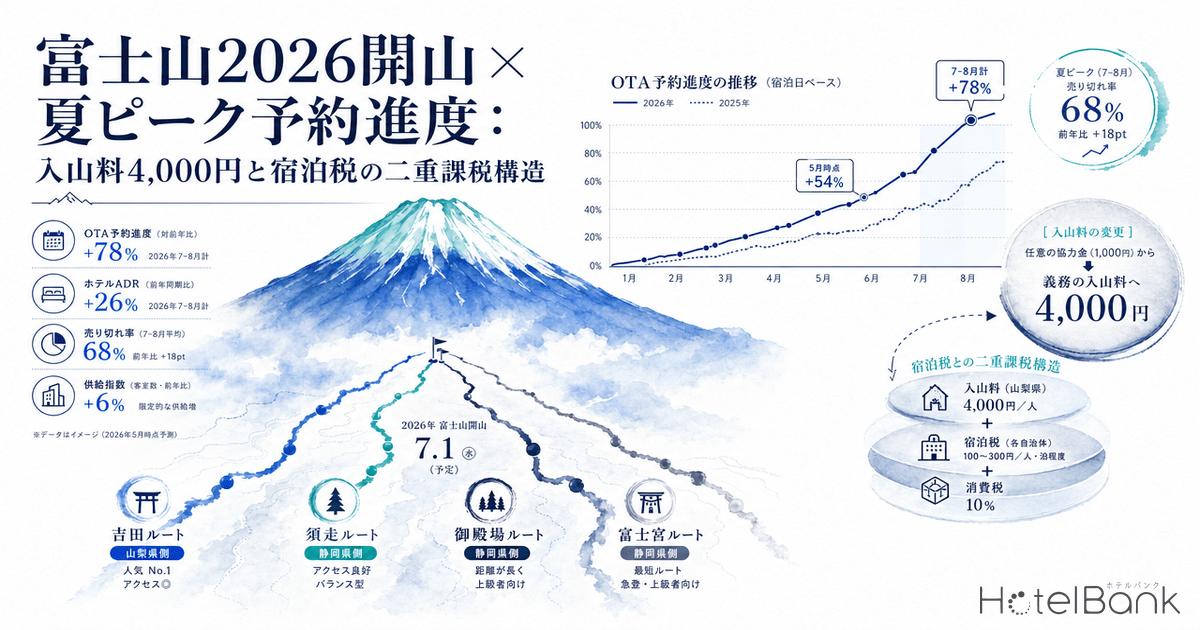
On July 10, 2026, Mt. Fuji will officially open for the climbing season. From this season—the second year of full-scale operation—a uniform ¥4,000 climbing fee will apply to all four routes (Yoshida, Subashiri, Gotemba, and Fujinomiya). In addition, Fujikawaguchiko Town and Fujiyoshida City are advancing the introduction of a lodging tax within the same fiscal year. As a result, climbers and overnight visitors will effectively face a “climbing fee + lodging tax” double-tax structure. This article examines the booking pace and sell-out rate during the opening period (July 1 – September 10, 2026), as well as the structural changes since before the climbing fee was introduced (2024), based on publicly available pricing data for 456 properties in the Fuji Five Lakes, Gotemba, and Fujinomiya area tracked by MetroEngines Research (メトロエンジンリサーチ).
Metric Definitions Used in This Article
- ADR (Average Daily Rate): The average of publicly listed selling prices on OTAs and similar platforms. This differs from actual transaction prices (tends to be 25–30% higher than the transaction-based ADR average; high-priced unsold plans tend to remain on OTAs, structurally pushing the average of public prices above transaction prices). Per-room rate for double occupancy (tax included), averaged across all plans (including room-only and meal-inclusive plans).
- Sell-out rate: The share of plans that had stopped accepting OTA reservations as of the survey time. This differs from the overall room occupancy rate of a property.
- Target area: Eight municipalities — Fujikawaguchiko Town, Yamanakako Village, Oshino Village, and Narusawa Village (Yamanashi Prefecture); Gotemba City, Oyama Town, and Fujinomiya City (Shizuoka Prefecture); and Fujiyoshida City.
- Data source: MetroEngines Research (as of late April 2026).
Overview of 2026 Mt. Fuji Climbing Regulations: Uniform ¥4,000 Across 4 Routes Becomes the Norm
Starting from the 2025 season, the climbing fee system was formally introduced on the Yoshida Route (Yamanashi side). From the 2026 season, this will be expanded to the three Shizuoka-side routes (Subashiri, Gotemba, and Fujinomiya), completing a uniform ¥4,000 collection system across all four routes. Compared with the “voluntary ¥1,000 conservation cooperation fee” through 2024, this represents a structural shift to roughly four times the burden.
The main regulatory provisions include: an opening period starting July 10 (for the Yoshida, Subashiri, Fujinomiya, and Gotemba routes, as well as the summit crater area); the closure of 5th-station gates from 14:00 to 03:00 the following day, with passage during this window restricted to climbers with mountain hut reservations; and a 4,000-person daily cap on the Yoshida Route, excluding mountain hut overnight guests. Mountain hut reservations have effectively become a prerequisite, and demand for pre/post-stays at hotels and inns in the foothill area is intensifying as climbers seek to avoid “bullet climbs” (overnight ascents without sleep).
| Route | Prefecture | 2024 | 2025 | 2026 (Planned) |
|---|---|---|---|---|
| Yoshida Route | Yamanashi | ¥2,000 (prefectural ordinance) | ¥4,000 (mandatory) | ¥4,000 (mandatory) |
| Subashiri Route | Shizuoka | ¥1,000 (voluntary) | ¥1,000 (voluntary) | ¥4,000 (mandatory) |
| Gotemba Route | Shizuoka | ¥1,000 (voluntary) | ¥1,000 (voluntary) | ¥4,000 (mandatory) |
| Fujinomiya Route | Shizuoka | ¥1,000 (voluntary) | ¥1,000 (voluntary) | ¥4,000 (mandatory) |
Source: Compiled by HotelBank Editorial Team from materials released by Yamanashi and Shizuoka Prefectures
Supply Structure of 456 Properties in the Target Area: Fujikawaguchiko Town Holds an Overwhelming Share
456 properties with 10,798 rooms are operating in the Fuji Five Lakes, Gotemba, and Fujinomiya area, which absorbs pre/post-stay demand from climbers, within the scope tracked by MetroEngines Research. By municipality, Fujikawaguchiko Town holds the largest share at 202 properties and 4,441 rooms, followed by Yamanakako Village with 142 properties and 1,966 rooms, and Gotemba City with 24 properties and 1,646 rooms.
What is particularly noteworthy is that while Fujikawaguchiko Town and Yamanakako Village together account for 75% of all hotels and inns in the area, Gotemba City and Oyama Town (which host Fuji Speedway and the Subashiri trailhead) have fewer properties but a larger average size (Gotemba City averages 69 rooms per property, Oyama Town 43 rooms), functioning as a base for absorbing group and tour demand. Fujinomiya City, the gateway to the Fujinomiya Route, is limited to 22 properties and 833 rooms, indicating that the lodging supply on the southern side of Mt. Fuji is relatively thin.
Source: Compiled by HotelBank Editorial Team based on MetroEngines Research (N=456 properties, 10,798 rooms, as of April 2026)
Looking at the grade distribution, the budget tier (small inns and minshuku averaging about 20 rooms per property) accounts for 190 properties—more than half of the area total. However, Fujikawaguchiko Town has a concentration of 21 lakeside luxury resorts with 1,113 rooms, resulting in an extremely wide price range. Yamanakako Village also has a strong upper-tier presence (38 properties, 795 rooms) and 5 luxury properties with 141 rooms, making both areas typical resort portfolios where small inns and high-end resorts coexist. Niseko, Okinawa, and Karuizawa are similar mixed high-end / small-inn resort areas; their summer ADR and booking pace are analyzed in detail in our article Summer Resort 3-Region Comparison 2026 — Niseko, Okinawa, Karuizawa: ADR, Booking Pace, and FX Sensitivity.
Booking Pace During the Opening Period (July–September 2026): Clear Differences in Sell-Out Rates Across 3 Sub-Periods
Aggregating OTA public price data as of late April 2026, when the opening period (July 1 – September 10) is split into three sub-periods—”opening day (July 10–12),” “summer peak (August 8–17),” and “just before closing (September 1–10)”—clear differences emerge in ADR and sell-out rate.
| Sub-Period | Properties | Avg. ADR | Sell-Out Rate | Plan Count |
|---|---|---|---|---|
| A: Opening Day (Jul 10–12) | 204 | ¥50,200 | 14.9% | 36,984 |
| B: Summer Peak (Aug 8–17, Obon) | 174 | ¥61,500 | 14.1% | 97,828 |
| C: Just Before Closing (Sep 1–10) | 152 | ¥50,600 | 20.4% | 105,309 |
Source: Compiled by HotelBank Editorial Team based on MetroEngines Research (as of late April 2026)
The summer peak ADR (Sub-Period B) of ¥61,500 is +22% higher than just after the opening (A) and +22% higher than just before closing (C). What is particularly interesting is that the sell-out rate just before closing in early September stands at 20.4%—the highest of all periods, exceeding even the Obon peak (14.1%). This is likely driven by the weekday-heavy day-of-week composition in September, combined with climbers aiming for the final phase of the climbing season securing pre/post-stays alongside mountain hut reservations early. The relatively low sell-out rate during the August Obon period (14.1%) suggests that high-end properties may be suppressing last-minute demand through price elasticity, or that there is still ample booking capacity four months out. With Silver Week (September 19–23)—the first 5-day stretch in 11 years—coming in late September, readers analyzing the demand structure just before the closing period may also find our article Silver Week 2026 May Booking Pace and 9-Day Holiday Scenario Analysis useful.
Source: Compiled by HotelBank Editorial Team based on MetroEngines Research
Daily Booking Pace During Opening Week: Two-Stage Peak on Friday and Saturday
Looking at daily data for the week surrounding opening day (July 10, 2026, Friday), Saturday, July 11 records the highest weekly ADR at ¥55,000, while weekdays trend in the ¥46,000–¥48,000 range. The sell-out rate also peaks at 17.0% on Saturday, July 11, the highest of the week, confirming that bookings concentrate on the weekend immediately following the opening. This is because the typical climber behavior pattern (arrive at the foothills Friday night → summit Saturday → descend and return home Sunday) overlaps with general weekend tourism demand.
Source: Compiled by HotelBank Editorial Team based on MetroEngines Research (Jul 8–15, 2026, N=191–202 properties)
2024–2026 July–August ADR Trends: Structural Changes Before and After Climbing Fee Introduction
Comparing summer ADR trends in the Fuji Five Lakes, Gotemba, and Fujinomiya area (July 15 – August 20 same-condition comparison) across three years: in 2024, when the climbing fee was still a voluntary ¥1,000, July averaged ¥47,900 and August ¥51,800. In 2025, when the ¥4,000 fee was formally introduced on the Yoshida Route, July rose to ¥49,100 (+2.4%) and August to ¥54,600 (+5.5%). In 2026, when the ¥4,000 fee will be fully implemented across all four routes, current public prices show July at ¥50,200 (+2.4%) and August at ¥61,500 (+12.7%)—with an especially large jump in August.
Source: Compiled by HotelBank Editorial Team based on MetroEngines Research (same period, same area comparison)
Three factors can be identified for the +18.9% YoY (vs. 2024) growth in August 2026 ADR. First, accommodation operators may be reflecting the increased total spending burden on climbers (driven by the mandatory ¥4,000 climbing fee) into their pricing. Second, the mandatory mountain hut reservation system has increased demand for guaranteed pre/post-stays, improving early-booking conversion rates. Third, an overall rising rate trend driven by a higher share of inbound foreign visitors. However, ADR represents the average of public prices only, and actual transaction prices may come in lower due to last-minute discounting—this caveat should be kept in mind.
→ Summer 2026 5 Major Resort Areas — ADR, Sell-Out Rate, and YoY Comparative Analysis
August Peak by Municipality: Narusawa Village and Fujiyoshida City Lead on ADR; Fujinomiya City Sits at a Discount
Comparing August peak (Aug 8–17, 2026) ADR by municipality reveals a sharp price gap within the area. Narusawa Village leads at ¥133,600—the highest in the area—reflecting the fact that the property mix consists of a small number of luxury resorts pitching Mt. Fuji views (Narusawa Village has 8 properties). Next come Fujiyoshida City at ¥83,400, Oyama Town at ¥70,900, Fujikawaguchiko Town at ¥68,900, and Yamanakako Village at ¥68,100. By contrast, Fujinomiya City sits at ¥22,200—roughly one-third to one-sixth of the others—reflecting the thin lodging supply on the southern side of Mt. Fuji.
| Municipality | Properties | August Peak ADR | Sell-Out Rate | Main Trailhead |
|---|---|---|---|---|
| Narusawa Village | 10 | ¥133,600 | 9.8% | Yoshida / Lake Shoji area |
| Fujiyoshida City | 41 | ¥83,400 | 17.7% | Yoshida Route |
| Oyama Town | 6 | ¥70,900 | 25.9% | Subashiri Route |
| Fujikawaguchiko Town | 212 | ¥68,900 | 16.5% | Yoshida Route |
| Yamanakako Village | 119 | ¥68,100 | 8.8% | Subashiri Route |
| Oshino Village | 7 | ¥60,500 | 0.0% | Yoshida / Oshino |
| Gotemba City | 25 | ¥55,200 | 15.4% | Gotemba Route |
| Fujinomiya City | 20 | ¥22,200 | 4.4% | Fujinomiya Route |
Source: Compiled by HotelBank Editorial Team based on MetroEngines Research
In terms of sell-out rate, Oyama Town (gateway to the Subashiri Route) leads at 25.9%—the fastest booking pace. This is likely because the target period (Aug 8–17) overlaps with F1-related events at Fuji Speedway, and with only 6 properties in the town, the area cannot fully absorb pre/post-stay demand from mountain hut reservation holders. Conversely, Yamanakako Village lags at 8.8%, indicating that ample booking capacity remains.
Map of Major Lodging Clusters
The geographic distribution of major accommodations (30+ rooms) in the area covering the Fuji Five Lakes and the 5th stations of each climbing route is mapped below. Marker size reflects room count; color is unified in MetroEngines blue. Visually, large hotels are concentrated along the southern shore of Lake Kawaguchi (Funatsu district) and the northern shore of Lake Yamanaka (Hirano district).
Source: Compiled by HotelBank Editorial Team based on MetroEngines Research (major properties with 30+ rooms, N=70)
Climbing Fee + Lodging Tax Double-Tax Structure: Overlap in Fujikawaguchiko Town and Fujiyoshida City
This is the essential argument of this article. In January 2026, Fujikawaguchiko Town’s Lodging Tax Study Committee submitted an introduction recommendation to the mayor, with the goal of implementing the system within fiscal 2026. Fujiyoshida City likewise established a Lodging Tax Study Council in October 2025 and deliberated a draft proposal at its 4th council meeting in January 2026. Specific tax rates are still being finalized in both municipalities, but based on the precedents of Kyoto City and Fukuoka City, ¥200–¥500 per person per night is expected. For a quantitative reference on the short-term ADR impact of a lodging tax, see Kyoto’s New Lodging Tax: One Month In, Kyoto ADR Pushed +18.6% YoY.
Assuming the typical climber behavior pattern (1 night pre-stay → climb → 1 night post-stay for recovery), the additional burden per climber works out as follows.
| Cost Item | 2024 | 2025 | 2026 (Estimated) |
|---|---|---|---|
| Climbing Fee (Yoshida) | ¥2,000 | ¥4,000 | ¥4,000 |
| Climbing Fee (Subashiri / Gotemba / Fujinomiya) | ¥1,000 (voluntary) | ¥1,000 (voluntary) | ¥4,000 |
| Lodging Tax × 2 nights pre/post (assumed ¥300/night) | ¥0 | ¥0 | ¥600 |
| Total (Yoshida Route) | ¥2,000 | ¥4,000 | ¥4,600 |
Source: Compiled by HotelBank Editorial Team based on Yamanashi and Shizuoka Prefecture announcements and the Fujikawaguchiko Town Lodging Tax Study Committee report (January 2026)
The absolute amount of the lodging tax—about ¥600 per person—is relatively small. However, compared to 2024 (¥2,000) before the climbing fee was introduced, 2026 represents 2.3 times the burden. What stands out is that these collected funds are used for the “same purpose”—climbing trail maintenance and tourism infrastructure development. From a climber’s perspective, a structure has emerged whereby they are taxed twice: once as a climbing fee while walking the trail, and once as a lodging tax while staying at the foothills. Beyond the standalone lodging tax discussion, this overlap with the climbing fee calls for marketing design that explicitly accounts for the dual-tax structure.
Implications for Lodging Operators’ Revenue Management
Three practical implications for lodging operators emerge from this data. First, the high 20.4% sell-out rate in early September shows that climbers’ “just-before-closing” demand is shifting into early bookings—suggesting room to capture revenue through staged price increases on September weekday plans, rather than selling them out early. Second, the fact that the 17.0% sell-out rate on Saturday, July 11 marks the weekly peak immediately after opening suggests that aggressive early pricing is effective for the Friday–Saturday opening week. Third, Fujinomiya City’s ADR level (¥22,200)—one-third to one-sixth of the others—diverges sharply, and given the thin lodging supply on the southern side of Mt. Fuji, differentiated plans for Fujinomiya Route climbers (e.g., pre/post-stay + climbing guide bundles) offer upside potential.
With the climbing fee fixed at ¥4,000 in total, climbers will find it easier to plan budget allocation in advance—”how much to spend on what.” For lodging operators, this means a higher level of price transparency and an environment in which choices are increasingly made on the basis of total expenditure. Packaging the entire climbing experience—pre/post-stays + meals + early-morning shuttle—represents a real business opportunity.
Conclusion
The 2026 Mt. Fuji season marks an inflection point as the uniform ¥4,000 climbing fee on all routes and the introduction of lodging taxes complete a double-tax structure. Public-price data on the 456 properties tracked by MetroEngines Research show that the summer peak (August) ADR is up +18.9% versus 2024—a substantial gain—and that the early-September sell-out rate of 20.4% is the highest of the entire opening period. Within the structure where Fujikawaguchiko Town and Yamanakako Village together account for 75% of supply, price levels and sell-out rates differ widely by municipality, and demand absorption capacity also varies clearly by climbing route.
From a climber’s perspective, the additional burden of ¥4,000 climbing fee + lodging tax (assumed ¥600 for 2 nights) = ¥4,600 represents 2.3 times the 2024 level. For lodging operators, a realistic strategy is to package the entire climbing experience while keeping this increased burden in mind, and capture upside in an environment of rising price transparency. Going forward, we will be watching the progression of sell-out rates beyond the August peak, the formal implementation timing of the lodging tax, and booking trends on September weekdays.
Note on ADR for Future Dates: The ADR figures in this article represent the average of selling prices publicly listed on OTAs as of late April 2026, and will fluctuate as check-in dates approach. Currently high prices may decline through last-minute discounting, while popular properties may see public prices rise as fewer additional plans are released. Please verify the latest information on climbing fees and lodging taxes via each municipality’s official website.
Related Reading
- Shizuoka’s “31 Hidden Openings” 2026 — Mt. Fuji’s ¥4,000 Mandatory Climbing Fee and the Structural Shift in Summer Foothill Hotels
- Summer 2026 5 Major Resort Areas — ADR, Sell-Out Rate, and YoY Comparative Analysis
- National Average ADR Hits Record ¥32,340 (May 2026) — Decomposing the “+19% in 3 Years” Driven by Inflation and Labor-Cost Pass-Through
- Will Junglia Okinawa’s Opening Shift the Northern Market to “Year-Round”? Verified Across 6 Areas via ADR and Sell-Out Rate
- May 2026 Inbound Booking Trends: Western and Southeast Asian Visitors Lift Regional ADR
- Silver Week 2026, the First in 11 Years — Will the 9-Day Holiday Reignite Autumn Resort Demand?
- Lake Suwa Fireworks 2026: How August 15 Obon Peak Demand and Booking Changes Affect the Lodging Market
- Kyoto’s New Lodging Tax: One Month In, Kyoto ADR Pushed +18.6% YoY, Price Tier Shifting to High-Class
- Summer Resort 3-Region Comparison 2026 — Niseko, Okinawa, Karuizawa: ADR, Booking Pace, and FX Sensitivity
- Silver Week 2026, the First in 11 Years: May Booking Pace and 9-Day Holiday Scenario Analysis
- [Interview] “HOTEL SEION FUJI” — A One-Group-Per-Day Retreat in the Forest of Lake Yamanaka with Mt. Fuji Views