

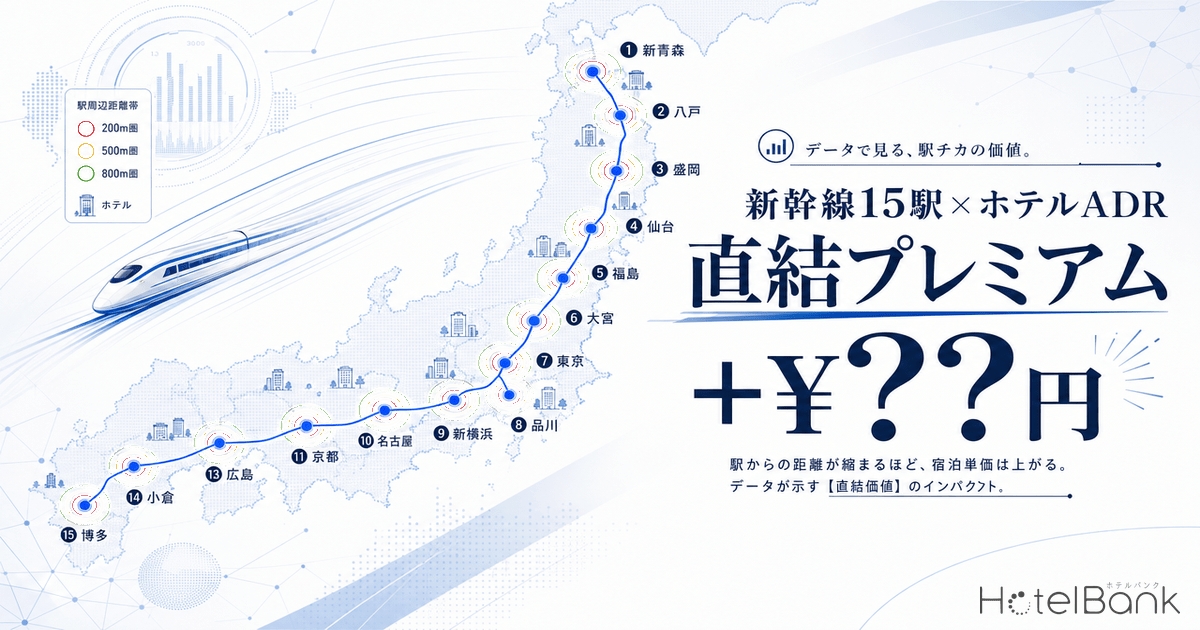
When traveling by Shinkansen on business, the recurring dilemma is whether to book a station-adjacent hotel or walk a few minutes to a cheaper one. This article examines 15 major stations across the Tokaido, Sanyo, Tohoku, Joetsu, Hokuriku, and Kyushu Shinkansen lines, segmenting the OTA-published prices of nearby hotels into three distance bands: 200m (station-adjacent), 500m (about 5 minutes’ walk), and 800m (about 10 minutes’ walk). We test whether the “direct-access premium” really exists, broken down by station and grade. Our universe is 799 hotels confirmed operating within an 800m radius of these 15 stations from MetroEngines Research’s tracking, of which 470 had usable May–June weekday (Mon–Thu) price data.
Metric Definitions Used in This Article
- Distance bands: Haversine distance from station coordinates. 200m (station-adjacent / directly connected), 500m (~5 min walk), 800m (~10 min walk).
- ADR (Average Daily Rate): Average of OTA-published rack rates. This differs from actual transacted prices (the published average tends to run +25–30% higher than the booked ADR, because higher-priced unsold plans linger on OTAs). Per-room rate (tax-inclusive) for 2-person, 1-room occupancy, averaged across all plans (room-only through meal-included).
- Analysis period: Weekdays (Mon–Thu) from May 1 to June 30, 2026. Weekends and holidays excluded.
- Direct-access premium: The yen-difference and percentage difference between the median ADR of hotels within 200m and the median ADR of hotels in the 800m band (i.e., outside the 5–10 minute walking ring).
- Data source: MetroEngines Research
Pick the Station-Adjacent Hotel, or Tolerate a 10-Minute Walk?
Two opposing forces shape the choice of hotel for Shinkansen business travel. One is the efficiency logic of “minimize travel time,” which steers travelers toward the Granvia and Station Hotel brands. The other is the cost logic of “keep the expense down,” which favors business hotels a few hundred meters away. The yen difference between the two directly affects corporate per-diem rules and personal wallets.
To preview the conclusion: in the Tokyo metropolitan area (Tokyo, Shinagawa, Shin-Yokohama), the median ADR within 200m runs +110.7% above the 800m band — a sizable premium. By contrast, in Tohoku and Hokuriku (Sendai, Niigata, Kanazawa, Tsuruga), the relationship inverts to -13.2%. In regional cities, budget business hotels cluster around the station rotary, while higher-rate boutique inns and city hotels tend to sit a bit further out — so “farther from the station = cheaper” is not a universal rule.
Methodology
Centered on each station’s structural midpoint, we used the Haversine distance to define three bands: 200m, 500m, and 800m radii. These thresholds match how Shinkansen business travelers physically experience proximity.
| Distance band | Walk time (approx.) | Locational character |
|---|---|---|
| 200m | Within 2 min | Station-adjacent / station-building / can reach without getting wet |
| 500m | About 5 min | Around the station rotary / within a short walk of major bus terminals |
| 800m | About 10 min | Central shopping district / practical limit when rolling a suitcase |
Distance band definitions: HotelBank Editorial Team
For each band, we extracted matching hotels and computed the average of weekday (Mon–Thu) published room rates from May 1 to June 30, 2026 at the hotel level, then took the median ADR per band. Weekends and holidays were excluded due to their different demand structure. We use the median rather than the mean to avoid being pulled by a single luxury outlier. Sample sizes are noted as N= in each cell.
Shin-Aomori was excluded because virtually no operating hotels fall within an 800m radius (the station sits well away from the city center). For Tsuruga and Shin-Kobe, the 200m sample is zero or negligible, so analysis there centers on the 500m and 800m comparison.
Mapping Hotels and Prices Around the 15 Stations
We start with a bird’s-eye view of the hotel distribution around each station. On the map, marker color indicates the distance band, and marker size indicates room count. Click a marker to see the hotel name, grade, and median May–June weekday ADR.
Source: MetroEngines Research, prepared by HotelBank Editorial Team (Red = 200m, Yellow = 500m, Green = 800m, marker size = room count)
The dropdown at the top of the map switches between target stations. The default view is around Tokyo Station, but switching to Niigata or Kanazawa instantly shows how budget business hotels cluster directly outside the station. Tokyo Station, by contrast, has only one hotel within 200m (The Tokyo Station Hotel), with the 500m band dominated by luxury properties in Marunouchi and Yaesu — a structurally distinct profile.
Per-Station ADR Comparison: Median Prices at 200m / 500m / 800m
Comparing the median ADR by distance band across the 15 stations, each station reveals a completely different price structure.
Source: MetroEngines Research, prepared by HotelBank Editorial Team
Tokyo Station and Shinagawa Station have very few hotels within 200m (one each), and those single properties — The Tokyo Station Hotel and Strings Hotel Tokyo InterContinental — are luxury-class, pushing the 200m median above ¥100,000. This reflects the structural reality of the metropolitan terminals: land prices are so high that anything below luxury is uneconomic.
By contrast, regional core stations such as Niigata, Kanazawa, and Sendai are densely surrounded within 200m by national chain business hotels — Toyoko Inn, Super Hotel, Via Inn. The 200m median ADR around Niigata Station hovers around ¥14,800, less than a quarter of the same band in the metropolitan area.
| Station | 200m band median ADR |
500m band median ADR |
800m band median ADR |
Direct-access premium |
|---|---|---|---|---|
| Tokyo Metropolitan |
¥129,024 N=1 |
¥81,682 N=10 |
¥33,960 N=19 |
+¥95,064 +279.9% |
| Shinagawa Metropolitan |
¥100,068 N=1 |
¥21,166 N=2 |
¥25,300 N=6 |
+¥74,768 +295.5% |
| Shin-Yokohama Metropolitan |
¥30,892 N=2 |
¥16,586 N=10 |
— | — |
| Nagoya Tokai |
¥24,240 N=4 |
¥15,786 N=27 |
¥17,356 N=16 |
+¥6,884 +39.7% |
| Kyoto Kinki |
¥26,360 N=3 |
¥23,698 N=34 |
¥25,494 N=61 |
+¥866 +3.4% |
| Shin-Osaka Kinki |
¥28,538 N=2 |
¥15,518 N=15 |
¥12,912 N=13 |
+¥15,626 +121.0% |
| Shin-Kobe Kinki |
— | ¥31,433 N=3 |
¥15,278 N=6 |
— |
| Okayama Chugoku |
¥19,570 N=2 |
¥12,496 N=14 |
¥15,395 N=9 |
+¥4,175 +27.1% |
| Hiroshima Chugoku |
¥43,694 N=1 |
¥13,378 N=15 |
¥12,060 N=11 |
+¥31,634 +262.3% |
| Hakata Kyushu |
¥26,996 N=4 |
¥18,949 N=35 |
¥20,361 N=30 |
+¥6,635 +32.6% |
| Sendai Tohoku |
¥36,440 N=1 |
¥13,264 N=19 |
¥15,842 N=24 |
+¥20,598 +130.0% |
| Niigata Shinetsu |
¥14,785 N=4 |
¥11,858 N=18 |
¥15,926 N=5 |
−¥1,141 -7.2% |
| Kanazawa Hokuriku |
¥16,687 N=4 |
¥15,795 N=21 |
¥24,795 N=12 |
−¥8,108 -32.7% |
| Tsuruga Hokuriku |
— | ¥15,485 N=5 |
¥25,061 N=1 |
— |
| Shin-Aomori Tohoku |
— | — | — | — |
Source: MetroEngines Research, prepared by HotelBank Editorial Team (May–June 2026 weekday Mon–Thu OTA published price averages, N = sample size per cell)
Direct-Access Premium Ranking: 200m vs 800m by Station
Ranking the 15 stations by the median ADR difference (yen and percentage) between the 200m and 800m bands reveals a clear split between metropolitan terminals and regional cities.
Source: MetroEngines Research, prepared by HotelBank Editorial Team
Tokyo Station tops the list at +¥95,100 (+279.9%), Shinagawa is second at +¥74,800 (+295.5%), and Hiroshima is third at +¥31,600 (+262.3%) — the two metropolitan terminals dominate the top spots. Hiroshima’s #3 ranking is somewhat unexpected; it reflects the fact that Hotel Granvia Hiroshima alone elevates the 200m median, while the abundant budget hotels in the 500m band (Hiroshima Station-mae Green Hotel, Toyoko Inn family, APA Hotel family) drag the median down.
The bottom of the ranking is what stands out. Niigata and Kanazawa show negative direct-access premiums — meaning hotels within 200m are actually cheaper than those in the 800m band. Around Niigata Station, budget chains such as Toyoko Inn and Comfort Hotel cluster directly outside the station, while the 800m ring picks up mid-sized properties like Niigata Keihin Hotel and the Furumachi district. Kanazawa shows the same pattern: the east exit (Kenrokuen exit) is dominated by business hotels, but extending to 800m brings in long-established and tourist-oriented higher-grade hotels on both the east and west sides. For a deeper look at the Hokuriku Shinkansen corridor including Kanazawa and Tsuruga, see our Hokuriku Shinkansen Tsuruga extension – year 3 ADR analysis of Fukui, Tsuruga, Komatsu, and Kanazawa.
| Rank | Station | 200m median | 800m median | Yen diff | % diff |
|---|---|---|---|---|---|
| 1 | Tokyo | ¥129,024 | ¥33,960 | +¥95,064 | +279.9% |
| 2 | Shinagawa | ¥100,068 | ¥25,300 | +¥74,768 | +295.5% |
| 3 | Hiroshima | ¥43,694 | ¥12,060 | +¥31,634 | +262.3% |
| 4 | Sendai | ¥36,440 | ¥15,842 | +¥20,598 | +130.0% |
| 5 | Shin-Osaka | ¥28,538 | ¥12,912 | +¥15,626 | +121.0% |
| 6 | Nagoya | ¥24,240 | ¥17,356 | +¥6,884 | +39.7% |
| 7 | Hakata | ¥26,996 | ¥20,361 | +¥6,635 | +32.6% |
| 8 | Okayama | ¥19,570 | ¥15,395 | +¥4,175 | +27.1% |
| 9 | Kyoto | ¥26,360 | ¥25,494 | +¥866 | +3.4% |
| 10 | Niigata | ¥14,785 | ¥15,926 | −¥1,141 | -7.2% |
| 11 | Kanazawa | ¥16,687 | ¥24,795 | −¥8,108 | -32.7% |
Source: MetroEngines Research, prepared by HotelBank Editorial Team (stations with zero samples in either the 200m or 800m band are excluded)
Reading the Structural Gap Between Metropolitan and Regional
Aggregating the per-station data into regional groups makes the divergence even sharper.
Source: MetroEngines Research, prepared by HotelBank Editorial Team
The metropolitan area (Tokyo, Shinagawa, Shin-Yokohama) posts a 200m-band median ADR of ¥67,600, towering over every other region. As noted earlier, this reflects the structural reality that land directly adjacent to metropolitan terminals tolerates only luxury-class economics — making it not a practical option for business travelers. For a sense of where Tokyo, Osaka, and Kyoto’s high-end ADRs sit on a global yardstick, see our USD-converted analysis in Tokyo, Osaka, Kyoto ADRs vs. NY, Paris, London. Once the radius widens to 500m, however, the metropolitan median falls to a more realistic ¥29,900, and the 800m band sits at ¥32,100. In other words, for a metropolitan business traveler willing to give up direct-access in exchange for “within 5 minutes’ walk,” the actual cost gap is not dramatic.
The Tokai/Kinki bloc shows a milder 200m-vs-800m gap of +32.5%, with Kyoto being the only station where a 200m-band luxury property (Hotel Granvia Kyoto) lifts the median. Chugoku/Kyushu sits in the middle at +70.0%, reflecting the presence of station-adjacent high-grade hotels at Hiroshima and Hakata stations.
And in Tohoku/Hokuriku, the relationship inverts at -13.2%. This is the result of station-front redevelopment in regional cities producing a supply structure dominated by business hotels — showing that the metropolitan rule of thumb “station-adjacent = expensive” does not apply at every Shinkansen-served station. In these regions, capping per-diems by yen amount may be more rational than capping by walking distance.
Implications for Travelers and Hotel Operators
From the traveler’s perspective, the findings can be summarized in three points.
First, if you want to stay in a station-adjacent hotel at Tokyo Station or Shinagawa Station, the practical choice set is essentially one luxury property. If a unit price above ¥100,000 is unacceptable, the realistic move is to widen the search to 500m. Within that 5-minute walking radius, multiple upper- and high-grade options open up across Yaesu, Marunouchi, and Takanawa.
Second, in regional cities (Niigata, Kanazawa, Sendai, Tsuruga), budget business hotels are abundant within 200m, so there is no need to walk 800m. Indeed, in some cases the 800m radius brings higher prices, so importing the metropolitan reflex of “walk farther to save” may actually cost more.
Third, mid-sized cities (Nagoya, Hiroshima, Hakata, Kyoto) offer practical options within 200m, and far more once the 500m band is included. Securing a station-adjacent upper-grade room around ¥20,000 is a reasonable price band for business travelers. For where the weekday ADRs of these major cities currently stand, see our Tokyo, Nagoya, Osaka, Fukuoka weekday ADR analysis, which examines the recovery of business demand alongside pricing.
From the hotel operator’s perspective, this serves as a benchmark for how much premium a station-adjacent hotel can command over those located beyond a 5-minute walk. The data confirms that the direct-access premium is robust in the metropolitan area, while regional cities — facing oversupply directly outside the station — tend to fall into per-unit price competition. How much locational scarcity translates into pricing power is closely tied to competitor supply density.
Conclusion: The Value of “Station-Adjacent” Varies Sharply by Region
Through analysis of 799 hotels around 15 Shinkansen-served stations and 470 weekday May–June price points, we have shown that the “direct-access premium” is by no means uniform across Japan. It is robust at metropolitan terminals but reverses at some regional cities — driven by hotel supply density and grade composition around each station.
Business travelers using Shinkansen + hotel packages are likely to make better cost-performance choices by not transplanting the metropolitan-rooted assumption that “station-adjacent equals convenient but expensive” to regional cities. Conversely, those committed to station-adjacent stays in the metropolitan area should remember that simply easing the constraint to “within 5 minutes’ walk” dramatically expands the option set and narrows the cost gap.
⚠ Note on future-dated ADRs: The ADRs in this article are averages of OTA-published prices at the time of survey, and they shift as the check-in date approaches. Prices currently set high may be discounted closer to arrival, while shrinking unsold inventory can also leave only the higher-priced plans on the shelf. Both directions of revision are possible.
Related Reading
- Hokuriku Shinkansen Tsuruga Extension Year 3: Fukui, Tsuruga, Komatsu, and Kanazawa 4-City ADR Comparison and Courtyard Fukui Price Trajectory
- Weekday ADR Deep-Dive of Tokyo, Nagoya, Osaka, and Fukuoka: Visualizing the Recovery of Business Demand
- The Reality of Business Hotel Price Surges — National ADR Analysis and the 10 Most Cost-Effective Prefectures for Business Trips
- Hotel Prices Move on Cruise Call Days — Verifying ADR Premiums in Yokohama, Kobe, and Naha
- Tokyu Stay × Mercure Hiroshima as a Dual-Brand Strategy — A New Opening Format for Mid-Sized Cities
- [March 2026 Update] Tokyo 23 Wards Business Hotel Deep-Dive: Area-by-Area Supply Expansion and Supply-Demand Balance
- Golden Week 2026 Hotel Price YoY Analysis Across 6 Major Cities: Decoding the Drivers Behind Kyoto +20% and Tokyo +17%
- Verifying the Impact of Kyoto’s Lodging Tax Reform — Daily Tracking of ADR Movements at Sub-¥10,000 Hotels
- Are Japan’s Hotels Cheap by Global Standards? Tokyo, Osaka, and Kyoto ADRs in USD vs. NY, Paris, and London
- How School-Trip Bookings Form a Rate Floor for Mid-Tier Hotels: Spring 2026 Weekday ADR Comparison Across 6 Cities
External references: Japan Tourism Agency / Japan National Tourism Organization (JNTO)