


As of November 20, 2026, the answer that primary sources support is this: of the two Atami properties, one is under contract to be sold and the other has changed its brand.Nippon Hotel & Residential Investment Corporation (3472; formerly Ooedo Onsen Reit Investment Corporation) disclosed on November 4, 2026 that it had signed a sale agreement for its property Ooedo Onsen Monogatari Premium Atami (大江戸温泉物語Premium あたみ; Sakimicho, Atami; 76 rooms) at a planned sale price of ¥3.05 billion. The scheduled transfer date is December 11, and the buyer is a single domestic operating company (undisclosed). At the time of writing, the handover has not yet taken place. The other property, the former Ooedo Onsen Monogatari Hotel Suiyotei (大江戸温泉物語 ホテル水葉亭; Izusan, Atami), reopened on July 18, 2026 as TAOYA Atami (TAOYA熱海) under the operation of GENSEN HOLDINGS. That, however, was a change of brand: as of November 20, 2026, no disclosure or announcement of a transfer of ownership or a sale of this property can be found.
• ADR (average daily rate) = an estimated settled rate (tax-excluded equivalent), calculated by applying segment-specific adjustment factors to the lowest-plan price each property publishes on OTAs (per room, two guests per room, tax included). Checked against the property-level results disclosed by listed hotel REITs (91 properties, most recent 3 months), the median error is about 7%. These are estimates and differ from each property’s actual settled prices and accounting figures.
• ADR at the area level (prefecture / city) is the median of the estimated settled rates of the properties covered (the level of a typical property in the area).
• Where listed prices are cited, they are per-room rates for two guests per room (tax included).
• OCC (occupancy) = the share of rooms sold out of the total rooms in the area (an estimate based on OTA sales inventory).
• Source: MetroEngines Research (continuous tracking of OTA public prices for about 168,000 properties in Japan, of which about 27,000 have confirmed occupancy data)
This article answers a frequently searched question — “Was Ooedo Onsen Monogatari in Atami sold?” — using only the investment corporation’s timely disclosures and the operator’s announcements. For the history and brand structure of the chain as a whole, see“What Is Ooedo Onsen Monogatari”; for an overview of the investment corporation’s 16 hotels, seeour analysis of Nippon Hotel & Residential Investment Corporation. Here we focus on the two Atami properties.
- — Ooedo Onsen Monogatari Premium Atami (76 rooms) went under a sale agreement on November 4, 2026 at¥3.05 billion, with handover scheduled for December 11. The buyer is a single domestic operating company (undisclosed); for now, the sale is “decided” rather than completed.
- — The former Hotel Suiyotei was rebranded on July 18, 2026 asTAOYA Atami. This was a brand change by the operator; as of November 20, 2026, no disclosure or announcement of a transfer of ownership can be found.
- — The planned sale price is below the ¥3.5 billion appraisal value by12.9%, but above both the ¥3,000.9 million acquisition price and the ¥2,478 million book value, with an expected gain on sale of ¥491 million.
- — Against the appraisal’s net cash flow of about ¥180 million, the yield on the planned sale price isabout 5.9%(appraisal cap rate: 5.1%). Moving net cash flow by ±10% gives a range of 5.3–6.5%.
- — The estimated settled ADR of ryokan in Atami City averaged about ¥25,300 in January–October 2026, up+6.6%year on year (N=73 properties in October 2026).
Direct Answer — Who Owns, Operates and Brands the Two Atami Properties Today
First, the two properties side by side. Two properties in Atami carried the Ooedo Onsen Monogatari name: Premium Atami, in the town center south of Atami Station, and the former Hotel Suiyotei, on the coast at Izusan northeast of the station. Their names are similar, but their ownership structures are completely different. The former has been held by a listed REIT since September 2016; the latter does not appear on that investment corporation’s property list.
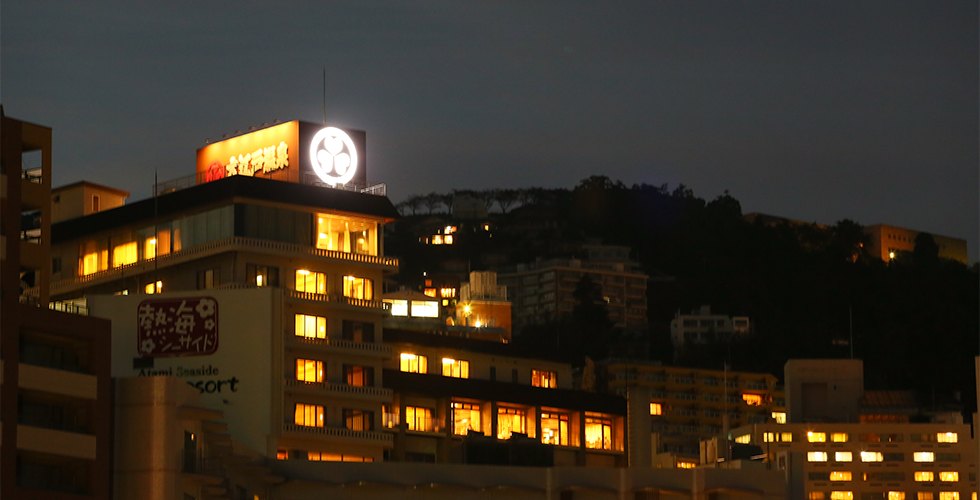
| Item | Ooedo Onsen Monogatari Premium Atami | TAOYA Atami (formerly Ooedo Onsen Monogatari Hotel Suiyotei) |
|---|---|---|
| Location | Sakimicho, Atami, Shizuoka | 190-1 Izusan, Atami, Shizuoka |
| Ownership (as of November 20, 2026) | Nippon Hotel & Residential Investment Corporation. To be transferred on December 11 to a single domestic operating company (undisclosed) | No public information on the owner was found within the scope of our research (not a property of that investment corporation) |
| Lease / operation | Lessee: GENSEN HOLDINGS Co., Ltd. The lease will be terminated with the transfer | GENSEN HOLDINGS Co., Ltd. |
| Brand | Ooedo Onsen Monogatari Premium (renamed from Ooedo Onsen Monogatari Atami in July 2024). No brand has been announced for after the transfer | Rebranded as TAOYA Atami on July 18, 2026 |
| Is it a “sale”? | Yes (sale agreement signed, before handover) | No disclosure of a transfer can be found as of November 20, 2026 |
Source: Compiled by HotelBank Editorial Team from Nippon Hotel & Residential Investment Corporation timely disclosure (November 4, 2026) and GENSEN HOLDINGS announcement (July 21, 2026)
In other words, the statement “Ooedo Onsen Monogatari in Atami has been sold” is expected to become true for Premium Atami upon the December 11 handover, but there is no basis for it in the case of TAOYA Atami. The two stories are likely being mixed up in searches because the opening of TAOYA Atami — when the Ooedo Onsen Monogatari sign seemed to disappear from Atami — and the disclosure of the Premium Atami sale came about four months apart.
Timeline — From the 2016 Acquisition to the Planned Transfer in December 2026
Below are Premium Atami’s ten years alongside events at the investment corporation. Note that even after the investment corporation’s sponsor and name changed, the Atami property remained in the portfolio as an “Ooedo Onsen facility” and only became a candidate for asset replacement in 2026.
| Date | Event |
|---|---|
| September 2016 | Ooedo Onsen Reit Investment Corporation acquires Ooedo Onsen Monogatari Atami (acquisition price ¥3,000.9 million; 76 rooms; built February 1959) |
| December 24, 2021 | Sale of Nagasaki Hotel Seifu (長崎ホテル清風) disclosed (planned sale price ¥1.64 billion) |
| November 15, 2022 | Sale of Kamoshikaso (かもしか荘) and Kinosaki (きのさき) disclosed (buyer: the then-operator’s group) |
| December 19, 2023 | Following a change in the asset manager’s major shareholder, its trade name changes to APA Investment Advisors Co., Ltd. |
| February 27, 2024 | The investment corporation’s name changes to Nippon Hotel & Residential Investment Corporation |
| July 22, 2024 | Reopens after renovation as Ooedo Onsen Monogatari Premium Atami |
| July 4, 2025 | Sale of Kimitsu no Mori (君津の森) and Kounkaku (幸雲閣) disclosed (the Atami property not included) |
| July 18, 2026 | The former Hotel Suiyotei reopens under the TAOYA Atami brand (the 14th TAOYA property and the first in Shizuoka Prefecture) |
| November 4, 2026 | Sale of Premium Atami and termination of its lease disclosed; sale agreement signed the same day (planned sale price ¥3.05 billion) |
| December 11, 2026 (scheduled) | Scheduled transfer date of Premium Atami |
Source: Compiled by HotelBank Editorial Team from Nippon Hotel & Residential Investment Corporation (formerly Ooedo Onsen Reit Investment Corporation) timely disclosures and portfolio list (as of February 25, 2026), GENSEN HOLDINGS announcements and Travel Watch
Because more than one month separates signing and handover, this contract counts as a “forward commitment, etc.” for disclosure purposes. It provides that if either party materially breaches its obligations, the other may claim a penalty equal to 20% of the planned sale price. With contractual procedures still outstanding until handover, it is more accurate to say the sale has been “decided” than that it has been “completed.”
How Do a “Sale,” a “Rebrand” and a “Change of Operator” Differ?
In news about hot-spring ryokan “being sold off,” three layers are easily confused: ownership, operation and brand. In a ryokan held by a listed REIT, the investment corporation that owns the land and building (ownership), the company that leases and runs it (lease / operation), and the sign guests see (brand) are each separate entities. What it means depends entirely on which layer has moved.

| Layer | What happens when it moves | Status at the two Atami properties |
|---|---|---|
| Ownership(sale / transfer) | The owner of the real estate changes. For a REIT, subject to timely disclosure | Premium Atami: transfer scheduled for December 11 / TAOYA Atami: no disclosure or announcement found |
| Lease / operation(change of operator) | The company running the business changes. The owner may stay the same | Premium Atami: the lease between the investment corporation and GENSEN HOLDINGS will be terminated; operation after the transfer not disclosed |
| Brand(rebrand) | The sign and concept change. Ownership and operation often stay the same | TAOYA Atami: the same operator renovated it and switched it from Ooedo Onsen Monogatari to TAOYA |
Source: Compiled by HotelBank Editorial Team from each company’s disclosures and announcements
Both the GENSEN HOLDINGS announcement of TAOYA Atami’s opening and the Travel Watch report describe the renovation and the rebrand, but neither mentions a change of owner or a sale of the property. Reading the disappearance of the sign as a “sale” mistakes a change in the brand layer for a change in the ownership layer. Premium Atami, conversely, is a case in which the ownership and lease layers move at the same time, and what will happen to its sign (brand) has not yet been announced.
Premium Atami’s Acquisition Price, Appraisal Value and Planned Sale Price
Next, the price relationships investors care about most. The acquisition price was ¥3,000.9 million (September 2016), the book value as of the scheduled transfer date is ¥2,478 million, and the appraisal value as of May 31, 2026 is ¥3.5 billion. The planned sale price of ¥3.05 billion is 12.9% below the appraisal value but above the book value. After holding the property for about ten years, the investment corporation is letting it go at a level just above its acquisition price.
Source: Compiled by HotelBank Editorial Team from Nippon Hotel & Residential Investment Corporation, “Notice Concerning Transfer of Domestic Real Estate and Termination of Lease (Ooedo Onsen Monogatari Premium Atami)” (November 4, 2026) and portfolio list (as of February 25, 2026). Unit: ¥ million, excluding consumption tax
Per room, the acquisition price works out to about ¥39.49 million, the planned sale price about ¥40.13 million and the appraisal value about ¥46.05 million. Compared with about ¥30.22 million per room for the nine Ooedo Onsen facilities held by the investment corporation (total acquisition price ¥29,225.37 million, 967 rooms), Premium Atami’s per-room acquisition cost was on the high side, reflecting its town-center location near the station. Across the properties held by listed hotel REITs, ryokan carry the highest per-room acquisition prices by asset type, at up to about ¥49.6 million per room.
| Item | Amount | Per room (76 rooms) |
|---|---|---|
| Acquisition price (September 2016) | ¥3,000mn | approx. ¥39.49mn |
| Book value (as of scheduled transfer date, calculated) | ¥2,478mn | approx. ¥32.61mn |
| Appraisal value (as of May 31, 2026) | ¥3,500mn | approx. ¥46.05mn |
| Planned sale price | ¥3,050mn | approx. ¥40.13mn |
| Gain/loss on sale (expected, for reference) | +¥491mn | — |
| Annual rent (fixed rent, annualized) | ¥125mn | — |
| Appraisal cap rate / discount rate / terminal cap rate | 5.1% / 4.9% / 5.2% | — |
Source: Compiled by HotelBank Editorial Team from Nippon Hotel & Residential Investment Corporation timely disclosure (November 4, 2026) and portfolio list. Per-room figures calculated by the editorial team
Under the direct capitalization method in the appraisal report, net operating income is assessed at about ¥202.8 million and net cash flow after capital expenditure at about ¥180 million. Divided by the planned sale price, these give about 6.6% on an NOI basis and about 5.9% on an NCF basis — meaning the deal is priced at a higher yield than the appraisal’s 5.1% cap rate. From the buyer’s side, it is a deal that can be acquired at a yield above the appraisal. According to the disclosure, the investment corporation approached multiple potential buyers and decided after weighing together that this was the highest price offered, that it exceeded book value and would allow a gain on sale to be booked, and the future spending burden of continuing to hold the property.
Table 6 shows how sensitive this yield is to the income assumptions, using three scenarios based on the figures from the appraisal’s direct capitalization method. The base case uses the appraisal’s income; the pessimistic and optimistic cases lower or raise NOI and NCF by the same 10%. All are simple calculations based on assumptions. The NCF yield on the planned sale price is 5.3% (pessimistic), 5.9% (base) and 6.5% (optimistic) — above the appraisal’s 5.1% cap rate even in the pessimistic case.
| Scenario | Net cash flow (NCF) | Yield on NOI basis | Yield on NCF basis | Value capitalized at 5.1% cap rate |
|---|---|---|---|---|
| Pessimistic (NCF −10%) | ¥162mn | 6.0% | 5.3% | ¥3,176mn |
| Base (per appraisal) | ¥180mn | 6.6% | 5.9% | ¥3,529mn |
| Optimistic (NCF +10%) | ¥198mn | 7.3% | 6.5% | ¥3,882mn |
Source: HotelBank Editorial Team estimates based on the appraisal (NOI approx. ¥202.8 million, NCF approx. ¥180 million, cap rate 5.1%) in Nippon Hotel & Residential Investment Corporation, “Notice Concerning Transfer of Domestic Real Estate and Termination of Lease” (November 4, 2026). Pessimistic / optimistic cases assume NOI and NCF move by the same ±10%
Table 7 lists values with NCF and yield varied at the same time. Capitalizing the appraisal NCF at 5.1% gives ¥3,529 million, and at 5.9% ¥3,051 million — the latter almost exactly the planned sale price. In other words, the price corresponds to keeping NCF unchanged and adding about 0.8 percentage points to the yield. Even if NCF came in 10% lower, the calculation balances with the planned sale price at a yield of around 5.3%. The repair burden expected for a 67-year-old building may be showing up in the price as this added yield.
| NCF \ Yield | 4.8% | 5.1% | 5.5% | 5.9% | 6.3% |
|---|---|---|---|---|---|
| ¥162mn (−10%) | ¥3,375mn | ¥3,176mn | ¥2,945mn | ¥2,746mn | ¥2,571mn |
| ¥171mn (−5%) | ¥3,562mn | ¥3,353mn | ¥3,109mn | ¥2,898mn | ¥2,714mn |
| ¥180mn (appraisal) | ¥3,750mn | ¥3,529mn | ¥3,273mn | ¥3,051mn | ¥2,857mn |
| ¥189mn (+5%) | ¥3,938mn | ¥3,706mn | ¥3,436mn | ¥3,203mn | ¥3,000mn |
| ¥198mn (+10%) | ¥4,125mn | ¥3,882mn | ¥3,600mn | ¥3,356mn | ¥3,143mn |
Source: HotelBank Editorial Team estimates based on the appraisal in Nippon Hotel & Residential Investment Corporation timely disclosure (November 4, 2026). Value = NCF ÷ yield (simple calculation); does not match the appraisal value, which also uses the DCF method. Shaded cells are the base case in the columns for the appraisal’s 5.1% cap rate and the 5.9% implied by the planned sale price
Two reasons were given for the sale: lowering the share of Ooedo Onsen facilities (by acquisition price) from 42.4% to 39.7%, and the fact that, at more than 67 years since construction, it is the oldest property in the portfolio, with rising capital expenditure and repair costs expected. The appraisal’s cost-approach value is ¥1.43 billion, with the land accounting for 65.3%. It is worth reading this alongside the building-age discussion: the property’s value is weighted toward the land rather than the building.
Compared With the Investment Corporation’s Past Sales
Since its days as Ooedo Onsen Reit Investment Corporation, the investment corporation has been selling hot-spring ryokan in stages. Lining up the disclosed planned sale prices and book values, the Atami deal is the largest of the six.
Source: Compiled by HotelBank Editorial Team from each “Notice Concerning Transfer of Domestic Real Estate” by Nippon Hotel & Residential Investment Corporation (formerly Ooedo Onsen Reit Investment Corporation). Unit: ¥ million. Book value for Nagasaki Hotel Seifu is the expected amount as of December 31, 2021; for Kamoshikaso and Kinosaki, as of May 31, 2022; for the others, the calculated value as of the scheduled transfer date
| Disclosure date | Property | Planned sale price | Buyer |
|---|---|---|---|
| December 24, 2021 | Nagasaki Hotel Seifu | ¥1,640mn | Undisclosed |
| November 15, 2022 | Kamoshikaso | ¥1,260mn | Ooedo Onsen Monogatari Hotels & Resorts (interested party, etc.) |
| November 15, 2022 | Kinosaki | ¥2,517mn | Ooedo Onsen Monogatari Hotels & Resorts (interested party, etc.) |
| July 4, 2025 | Kimitsu no Mori | ¥847mn | Undisclosed |
| July 4, 2025 | Kounkaku | ¥1,050mn | Undisclosed |
| November 4, 2026 | Premium Atami | ¥3,050mn | One domestic operating company (undisclosed) |
Source: Same as above
One difference that stands out against past disclosures is how they describe operations after the sale. The 2021 disclosure for Nagasaki Hotel Seifu included the sentence “It will continue to operate as an Ooedo Onsen Monogatari facility after this transfer.” The Atami disclosure, by contrast, is titled “Transfer and Termination of Lease”; it states clearly that the lease with GENSEN HOLDINGS will be terminated, but does not say which company will operate the property under which brand after the transfer. It also notes that the buyer is a domestic operating company and that consent to disclose its name was not obtained. For the post-transfer operating structure, we will have to wait for a new announcement.
In MetroEngines Research data as of the November 15, 2026 aggregation, Premium Atami’s room rates were observed listed for stay dates through January 2027. This does not, however, indicate the operating structure after the transfer. Anyone considering a stay should check the latest information through the property’s official channels.
Location of the Two Properties
The two properties are only about 1.5 km apart in a straight line, but their locations differ in character. Premium Atami is in Sakimicho, in the town center down to the south of Atami Station, and the operator has promoted it as a “town-center onsen inn.” TAOYA Atami sits on the coast at Izusan, northeast of the station, overlooking Sagami Bay, and features an infinity open-air bath.
Source: Compiled from MetroEngines Research and HotelBank Editorial Team
Estimated Settled ADR of Atami Ryokan and Listed Prices at the Two Properties
How is the Atami ryokan market itself moving? According to MetroEngines Research data, the estimated settled ADR of ryokan in Atami City (area median, tax-excluded equivalent) averaged about ¥25,300 in January–October 2026, 6.6% above the roughly ¥23,700 of the same period a year earlier. By month, January rose 24.1% year on year, March 14.8% and September 10.5%, while June–August ran 2.5–3.0% below, roughly flat to slightly down. The latest month, October, was ¥24,300, up 4.3% year on year (N=73 properties).
Source: Compiled from MetroEngines Research and HotelBank Editorial Team (Atami City, ryokan, area median of estimated settled ADR; N=73 properties in October 2026). November and December 2026 are estimates based on listed price levels at the time of the survey
For the individual properties, we look at listed prices (all-plan average, two guests per room, tax included). Premium Atami’s listed price in October 2026 was about ¥53,700, up 6.8% from about ¥50,300 a year earlier. The median listed price of ryokan in Atami City in the same month was about ¥54,600, placing Premium Atami in a price band close to the area’s standard level.
TAOYA Atami (former Hotel Suiyotei) had no observed listings during its renovation in February–June 2026, and its listed price in October after the rebrand was about ¥68,200, versus about ¥42,400 in October of the previous year as Suiyotei. TAOYA, however, uses an all-inclusive system that includes alcohol at dinner and lounge drinks in the room rate, so what the rate covers differs from before. It is better read not as a simple rate increase but as a shift in price band accompanying a change in product design.
Source: Compiled from MetroEngines Research and HotelBank Editorial Team. Listed price = monthly average of the all-plan average (two guests per room, per room, tax included). TAOYA Atami’s January 2026 is not shown because it was observed on only 7 days. November 2026 onward reflects listed price levels at the time of the survey
Points for Investors and Operators to Watch
To sum up, the moves at the two Atami properties are separate stories: a change of ownership and a change of brand. With that in mind, here are the points investors and operators should each check.
First, whether the handover is completed on December 11 as scheduled. This is a forward-commitment contract, and on completion the investment corporation is likely to report the settlement. Only once the handover is confirmed can it be written that the property “has been sold.”
Second, the operating structure after the transfer. The termination of the lease has been disclosed, but it has not been announced whether the new owner will operate the property itself, entrust it to another operator, or keep the brand. How a 76-room onsen ryokan in central Atami is run will be information of great interest to surrounding ryokan as well.
Third, how the investment corporation uses the proceeds. The ¥491 million gain on sale is to be allocated in full to distributions for the fiscal period ending May 2027, and the forecast distribution per unit for that period was revised up to ¥3,000 (+50.0% from the previous forecast). The remaining funds, excluding the gain, are to go toward acquiring new properties; the supplementary materials anticipate acquiring trust beneficiary interests in domestic real estate during December 2026 (acquisition not yet decided). On November 9, the investment corporation also disclosed that it had obtained preferential negotiation rights for six properties operated by sponsor APA Group, including EN HOTEL Fujisawa, though it is not obliged to acquire them.
Fourth, price levels in the Atami ryokan market. Estimated settled ADR in January–October 2026 averaged +6.6% year on year, holding firm. While market rates are rising, even older large ryokan have more options to lift their price band through renovation or a brand change. TAOYA Atami is a useful example of the same operator switching the concept of an existing building.
Frequently Asked Questions
Q. Was Ooedo Onsen Monogatari in Atami sold?
A. For Ooedo Onsen Monogatari Premium Atami, its owner, Nippon Hotel & Residential Investment Corporation, signed a sale agreement on November 4, 2026, and the transfer is scheduled for December 11. As of November 20, 2026, the handover has not yet taken place. For the former Hotel Suiyotei (now TAOYA Atami), no disclosure of a sale can be found as of the same date.
Q. What is Premium Atami’s sale price, and who is the buyer?
A. The planned sale price is ¥3.05 billion (excluding consumption tax). The buyer is a single domestic operating company, undisclosed because consent to disclose was not obtained. The disclosure states that it has no capital, personnel or business relationships with the investment corporation or the asset manager.
Q. Did it become TAOYA Atami because it was sold?
A. The conversion to TAOYA Atami is a rebrand by the operator, GENSEN HOLDINGS. The company’s announcement and press reports describe the renovation and rebrand and do not mention any transfer of ownership.
Q. Can I still stay at Premium Atami after December 11?
A. The investment corporation’s disclosure says nothing about operations after the transfer. As of the November 15, 2026 aggregation, room rates were observed listed for stay dates through January 2027, but please check the latest operating information through the property’s official channels.
⚠ Note on ADR for future dates:ADR and listed prices from November 2026 onward in this article are estimates based on sales prices published on OTAs at the time of the survey, and will change as check-in dates approach. Please note that prices currently set high may fall with last-minute discounts.
Summary
The answer to whether Ooedo Onsen Monogatari in Atami was “sold” depends on the property. Premium Atami is set to be transferred to a domestic operating company for ¥3.05 billion, with handover scheduled for December 11. The sale price is 12.9% below the appraisal value but above both the acquisition price and the book value, and the investment corporation will allocate the gain to distributions. The former Hotel Suiyotei switched its sign and product to become TAOYA Atami, but as of November 20, 2026, no disclosure or announcement indicating a transfer of ownership can be found. Separating which layer moved — ownership, operation or brand — is the first step to reading hot-spring ryokan deal news correctly.
Related Articles
- Ooedo Onsen Monogatari: 270K Reviews, TAOYA at 1.57x Prefecture ADR
- Nippon Hotel & Residential REIT: 51% of 1,991 Rooms Added Since 2024
- Odaiba Oedo Onsen Closed in 2021: 74 Inns Today, 4 Brands & Rates
Further Reading
- Hotel REIT Appraisals Hit 1.25x Cost: Cap Rates Across 298 Assets
- Nasu-Hakone 4-Hotel Trust Sale (194 Rooms): Decoding a ¥4.5bn Gain
- Ryokan M&A: 3 Deal Structures, License Succession, ¥17.64M NOI Loss
- Shizuoka & Atami Oct Long Weekend: Ryokan Sat 83.1% vs Holiday 61.5%
- Shizuoka’s 67 New 2026 Hotels: 1,089 Rooms, 64% One-Room Villas
References & Sources
■ Data sources
Deal terms, appraisal, book value and past sales are from the timely disclosures and portfolio list of Nippon Hotel & Residential Investment Corporation (formerly Ooedo Onsen Reit Investment Corporation); the TAOYA Atami rebrand is from GENSEN HOLDINGS announcements and press reports. The estimated settled ADR of ryokan in Atami City (N=73 properties in October 2026) and the listed prices of the two properties are MetroEngines Research aggregations (aggregated November 15, 2026).
■ Calculation assumptions
Per-room amounts are each amount divided by 76 rooms. Yields are simple calculations dividing the NOI (approx. ¥202.8 million) and NCF (approx. ¥180 million) from the appraisal’s direct capitalization method by the planned sale price of ¥3.05 billion; the scenarios assume both move by the same ±10%, and the two-way sensitivity combines NCF ±10% with yields of 4.8–6.3%.
■ Limitations and caveats
As of November 20, 2026, the transfer is scheduled and before handover, and may change depending on contract terms. The yield estimates are based on the appraisal’s assumed income and differ from the actual rent (fixed rent of ¥125 million annualized) and from income under the buyer’s operating plan. Estimated settled ADR is an estimate obtained by applying segment-specific adjustment factors to OTA public prices and differs from actual settled prices and accounting figures.
■ Timely disclosures & IR materials
- Nippon Hotel & Residential Investment Corporation, “Notice Concerning Transfer of Domestic Real Estate and Termination of Lease (Ooedo Onsen Monogatari Premium Atami)” (November 4, 2026) (Japanese)
- Same, “Supplementary Materials on the Press Releases Announced November 4, 2026” (November 4, 2026) (Japanese)
- Same, “Notice Concerning Revision of Forecasts of Operating Conditions and Distributions for the Fiscal Periods Ending November 2026 and May 2027” (November 4, 2026) (Japanese)
- Same, “Notice Concerning Acquisition of Preferential Negotiation Rights” (November 9, 2026) (Japanese)
- Same, “Portfolio List (as of February 25, 2026)” (Japanese)
- Same, “Notice Concerning Transfer of Domestic Real Estate (Ooedo Onsen Monogatari Kimitsu no Mori, Ooedo Onsen Monogatari Kounkaku)” (July 4, 2025) (Japanese)
- Ooedo Onsen Reit Investment Corporation, “Notice Concerning Change of Trade Name of the Investment Corporation, Partial Amendment to the Articles of Incorporation, Election of Officers and Appointment of Accounting Auditor” (January 22, 2024) (Japanese)
- Same, “Notice Concerning Transfer of Domestic Real Estate (Ooedo Onsen Monogatari Kamoshikaso, Ooedo Onsen Monogatari Kinosaki)” (November 15, 2022) (Japanese)
- Same, “Notice Concerning Transfer of Domestic Real Estate (Ooedo Onsen Monogatari Nagasaki Hotel Seifu)” (December 24, 2021) (Japanese)
■ Operator announcements & press reports
- GENSEN HOLDINGS, “TAOYA Atami” rebrand opening on Saturday, July 18, 2026 (PR TIMES, July 21, 2026) (Japanese)
- Travel Watch, article on the rebrand of Ooedo Onsen Monogatari Hotel Suiyotei as TAOYA Atami (May 13, 2026) (Japanese)
- Press release on the July 22 reopening of Ooedo Onsen Monogatari Premium Atami after renovation (July 2024) (Japanese)
■ Market data
- MetroEngines Research — Estimated settled ADR of ryokan in Atami City (N=73 properties in October 2026) and listed prices of the two properties (July 2025 – January 2027, aggregated November 15, 2026)