

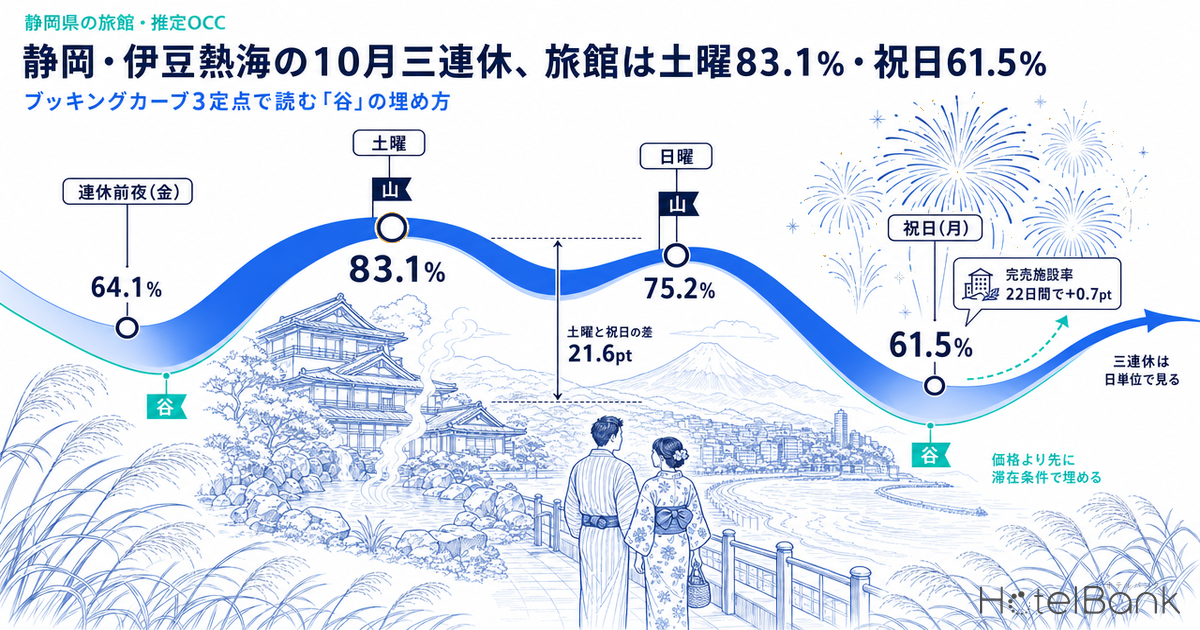
We tracked the booking curves of ryokan and resort hotels in Shizuoka Prefecture for Japan’s October 2026 three-day weekend (Sat Oct 10, Sun Oct 11 and Mon Oct 12, Sports Day) from 45 days before each stay date up to the latest observation, and the long weekend turns out to be “Saturday and everything else.” For ryokan, estimated OCC (based on published online inventory) for Saturday, October 10 reached 83.1% at the latest observation, and the sold-out property share has built up to 36.2%. The final day, Monday, October 12 (holiday), stands at just 61.5% — 21.6 points below Saturday. Its sold-out property share moved from 13.5% at 45 days out to 14.2% at the latest reading, a gain of only 0.7 points over 22 days. Friday, October 9, the night before the long weekend, is at 64.1%, on the same “trough” side as the final day. This article measures the depth of these troughs at three checkpoints — 45 days out, 30 days out and the latest observation — and turns the findings into a practical playbook for filling them over the remaining three to four weeks without leaning too heavily on price.
About the data in this article — Coverage: ryokan in Shizuoka Prefecture, N=317–318 properties (about 8,600 rooms), and resort hotels, N=112–113 properties (about 6,250 rooms). The price metric used throughout is settled ADR (an estimated transacted rate level derived from online distribution data, tax-excluded equivalent); occupancy is an estimate based on published online inventory. Definitions for both appear at the end of the article. Data as of September 17, 2026.
- — Oct 10 (Sat) 83.1% / Oct 12 (Mon, holiday) 61.5% Shizuoka ryokan show a 21.6-point gap inside a single long weekend. Read the holiday day by day, not as one block (latest observation, N=317–318 properties).
- — Last-week pickup: Saturday +3.8pt, holiday +2.3pt Looking at speed rather than level separates the days that will fill on their own from the days that have stalled.
- — Saturday-to-holiday drop: ryokan 21.6pt, resort hotels 11.3pt Within the same area, the shape of the fill differs by roughly a factor of two. Benchmark against the curve of your own property type.
- — October is a rate trough (Oct 2025 approx. ¥16,900 → Nov approx. ¥19,700) Easing Saturday rates would run against how the market is absorbing inventory. Put non-price measures first for the two trough days.
A Saturday-Led Long Weekend — Booking Curves from 45 Days Out to the Latest Observation
Start with the ryokan curves. The chart below follows each stay date day by day from 45 days out to the latest observation (23 days out for Oct 9, 24 for Oct 10, 25 for Oct 11 and 26 for Oct 12). The four lines already start at very different heights, and the gaps between them barely narrow over the 45 days.
Source: MetroEngines Research; compiled by the HotelBank Editorial Team
Saturday, October 10 started from an already high 72.2% at 45 days out and reached 83.1% at the latest observation. Its pickup since 45 days out, +10.9 points, is the largest of the four days. Monday, October 12 (holiday), by contrast, moved from 54.3% to 61.5%, a gain of only +7.2 points. Friday, October 9, the night before the long weekend, went from 55.1% to 64.1% (+9.0 points). Viewed as a single “three-day weekend,” demand looks concentrated — but what is actually filling runs only through the middle day (Oct 11). The final day and the night before are absorbing inventory at close to a weekday pace.
The contrast sharpens when you look at pickup over the last week (observations from Sep 9 to Sep 16). Saturday, October 10 gained +3.8 points and Sunday, October 11 +3.2 points, while Monday, October 12 (holiday) gained +2.3 points and Friday, October 9 +2.2 points. Even with three to four weeks remaining, the two trough days are building at only about 60% of the pace of the two peak days. The plain reading of the curves is that, if nothing is done, the current gap will not close.
Comparing against the following, ordinary weekend at the same number of days remaining makes the position clearer. At 32 days out, Sunday, October 11 stood at 72.0%, 3.4 points above the ordinary Sunday of October 18 (68.6%); at 31 days out, Saturday, October 10 stood at 79.3%, 5.3 points above the ordinary Saturday of October 17 (74.0%). Monday, October 12 (holiday), however, was at 59.5% at 32 days out — 9.1 points below an ordinary Sunday (October 18 at 68.6%). A public holiday that is pacing behind an ordinary Sunday: this is the part of the long weekend most worth working on.
The same Shizuoka ryokan and resort hotel cohorts showed a similar shape during the September Silver Week holidays, with demand concentrating in the first half of the break and the latter half left behind. This October long weekend repeats that shape on different dates.
| Stay date | 45 days out | 30 days out | Latest | Change vs 45 days out | Sold-out property share (latest) |
|---|---|---|---|---|---|
| Ryokan (N=317–318 properties, about 8,600 rooms) | |||||
| Oct 9 (Fri) | 55.1% | 61.9% | 64.1% | +9.0pt | 9.1% |
| Oct 10 (Sat) | 72.2% | 80.2% | 83.1% | +10.9pt | 36.2% |
| Oct 11 (Sun) | 66.1% | 73.4% | 75.2% | +9.1pt | 22.0% |
| Oct 12 (Mon, holiday) | 54.3% | 60.2% | 61.5% | +7.2pt | 14.2% |
| Oct 13 (Tue) | 50.9% | 58.6% | 59.2% | +8.3pt | 20.8% |
| Resort hotels (N=112–113 properties, about 6,250 rooms) | |||||
| Oct 9 (Fri) | 63.3% | 69.9% | 72.6% | +9.3pt | 6.2% |
| Oct 10 (Sat) | 75.2% | 82.3% | 83.5% | +8.3pt | 31.2% |
| Oct 11 (Sun) | 68.1% | 75.2% | 77.6% | +9.5pt | 13.4% |
| Oct 12 (Mon, holiday) | 65.2% | 71.2% | 72.2% | +7.0pt | 8.0% |
| Oct 13 (Tue) | 59.9% | 66.3% | 67.1% | +7.2pt | 7.1% |
Estimated OCC (based on published online inventory). Latest = observation at 23 days out for Oct 9, 24 for Oct 10, 25 for Oct 11, 26 for Oct 12 and 27 for Oct 13. Source: MetroEngines Research; compiled by the HotelBank Editorial Team
Deep Troughs for Ryokan, Shallow for Resorts — The Long Weekend Takes a Different Shape by Property Type
Even within Shizuoka Prefecture, ryokan and resort hotels show clearly different long-weekend shapes. Saturday levels are almost identical (ryokan 83.1%, resorts 83.5%), but on the final day, Monday, October 12 (holiday), ryokan are at 61.5% against 72.2% for resorts — a 10.7-point gap. Measured as the drop from Saturday to the holiday, ryokan fall 21.6 points and resorts 11.3 points. Ryokan demand is roughly twice as concentrated on the weekend peak.
Source: MetroEngines Research; compiled by the HotelBank Editorial Team
The sold-out property share moves in sharply contrasting ways, too. For ryokan, Saturday, October 10 built from 19.5% at 45 days out to 36.2% at the latest observation (+16.7 points): more than one in three properties now show no published inventory. Monday, October 12 (holiday), however, went only from 13.5% to 14.2% (+0.7 points) — growth in sold-out properties has all but stopped over 22 days. In other words, the expectation that “a holiday will fill last” is not supported, at least by current sales. Resort hotels are even lower on October 12 at 8.0%; with a deeper pool of inventory, reasonably priced one-night options are likely to remain on the market until the very end.
The pattern of “only the holiday itself failing to build” is not unique to Shizuoka. Applying the same three-checkpoint method to Hokkaido’s October long weekend showed the same arrangement: the peak on Saturday and the trough on the holiday itself. Regardless of area, it is more practical to assume that the internal gaps of a long weekend open up day by day.
On the demand-event side, according to Atami City’s official information, the Atami Marine Fireworks Festival (熱海海上花火大会) will be held on Monday, October 12 (holiday) and Sunday, October 25 (20:20–20:40, over Atami Bay). The Cabinet Office’s list of national holidays confirms that October 12, 2026 is Sports Day. So there is a draw on the final night, yet room absorption is not capturing the benefit. Given the 20:00-hour timing of the fireworks, two guest flows both work: guests staying Sunday, October 11 who stay on until the evening of the next day to watch, and guests who stay the night of Monday, October 12 (holiday) and head home the next morning. The former translates into a late check-out offer; the latter into a proposal along the lines of “one holiday night, with a relaxed departure since the next day is a weekday.” Both are areas where inventory can be moved without touching price.
For putting stay conditions and reasons to stay into words, how well-filled ryokan in Shizuoka and Izu-Atami name their plans offers useful clues. The same inventory moves differently depending on whether the plan spells out what it promises.
October Is Also a Rate Trough — The Seasonal Shape of Settled ADR
We also need a map of the price side. Overlaying years of settled ADR for Shizuoka ryokan shows that October sits in the annual “rate trough.” The settled figure for October 2025 was approx. ¥16,900 (N=426 properties), the second-lowest level of the year after June (approx. ¥16,000, N=457 properties). The following November came in at approx. ¥19,700 (N=423 properties), 16.1% higher, and December at approx. ¥22,300 (N=419 properties). October falls just before the peak of the autumn-foliage season; it is the month in which the rate climb has to wait until November.
Source: MetroEngines Research; compiled by the HotelBank Editorial Team
Comparing settled 2026 figures year on year, Shizuoka ryokan came in at approx. ¥16,700 in July (N=457 properties), −4.4% YoY, and approx. ¥21,500 in August (N=463 properties), −4.0%. Resort hotels fell further: approx. ¥16,300 in July (N=151 properties), −8.9%, and approx. ¥22,500 in August (N=150 properties), −9.6%. With summer rates having landed below the prior year, easing prices unconditionally in the October trough month risks compounding the decline.
Settled ADR for October 2026 is approx. ¥17,000 for ryokan (N=442 properties) and approx. ¥17,100 for resort hotels (N=147 properties). These are not settled figures, however, but estimates based on sales to date, and they will shift depending on the remaining three to four weeks of sales. A straight comparison with the prior year’s settled figure should wait until the month closes. What matters is the shape rather than the level: “a monthly rate at the annual trough, yet Saturday absorption above 83%” is the actual picture in Shizuoka and Izu-Atami right now. A low monthly average rate and selling one particular day at an accessible price can be treated as separate decisions.
For Revenue Managers of Ryokan and Resorts in Shizuoka (Izu and Atami) — Implications and Action Plan
(1) Overlay your own curve on the market’s three checkpoints. Market ryokan are progressing as follows: Saturday, October 10 went 72.2% at 45 days out → 80.2% at 30 days out → 83.1% at the latest observation, and Monday, October 12 (holiday) went 54.3% → 60.2% → 61.5%. Line up your own booking pace for the same dates at the same three points. If your Saturday is below the market while your holiday is in line with it, read it as a “missed Saturday sales” pattern; if the reverse, your holiday pricing is working. As long as you evaluate the long weekend as a single block, this difference stays invisible.
(2) The days to fill narrow down to two: Oct 12 and Oct 9. For ryokan, Monday, October 12 (holiday) is at 61.5% and Friday, October 9 at 64.1%, both about 20 points below Saturday. Their pickup over the last week, +2.3 points and +2.2 points respectively, is also clearly slower than Saturday’s +3.8 points. This supports steering measures toward the “inventory that isn’t moving” rather than toward the absolute volume of remaining rooms.
(3) Protect Saturday; attack the troughs with non-price measures. The sold-out property share for Saturday, October 10 has reached 36.2%, so options for Saturday are thinning across the market. At the same time, October is the month in which settled ADR hits its annual trough. Easing Saturday rates would run counter to how the market is absorbing inventory. For the two trough days, there is still room to differentiate on stay conditions (multi-night stays, check-out times, added local experiences) before moving price significantly.
(4) Treat the day after the long weekend (Tue Oct 13) separately. Ryokan on Tuesday, October 13 are at 59.2% at the latest observation, almost level with October 12. That points to a certain volume of “stay on the last night of the long weekend and head home Tuesday” demand, and room to design the October 12 → 13 two-night stay as a single product. Conversely, if you try to sell out October 13 as a standalone weekday, your competition becomes all weekday inventory across Shizuoka Prefecture.
| Time horizon | Measure | Decision trigger | Aim |
|---|---|---|---|
| Today to this week (about 25 days left) |
Package Oct 11 (Sun) + Oct 12 (Mon, holiday) as a single two-night product and lead with the value of the second night (late check-out, use of the property until the evening) | If your Oct 12 pace is below the market’s 61.5% for ryokan (72.2% for resorts) | Move holiday inventory without cutting rates |
| Today to this week | Limit remaining Oct 10 (Sat) rooms to one-night-only allotments and review minimum-length-of-stay restrictions | If the market’s Saturday sold-out property share has reached 36.2% (31.2% for resorts) and you still have Saturday inventory | Secure visibility on a day when options are thinning |
| Within one week (about 18 days left) |
Promote Oct 9 (Fri) as “the night before the long weekend” and bundle it with remaining Saturday allotments in a Fri–Sat two-night product | If your Oct 9 pace is below the market’s 64.1% for ryokan (72.6% for resorts) and your last-week pickup falls short of the market’s +2.2pt | Take the trough Friday out of standalone sale |
| Within one week | Build around the local event on the night of Oct 12 (Mon, holiday) — the Atami Marine Fireworks Festival, 20:20–20:40 — and spell out dinner-time options, transfers and viewing access in the plan description | If the market’s Oct 12 sold-out property share remains at 14.2% (only +0.7pt from 13.5% at 45 days out) | Make the reason to stay on the holiday night explicit |
| 7–10 days out | Limit price adjustments to Oct 12 and Oct 9, and decide in advance that holding Oct 10 (Sat) rates is the baseline | If the market’s Saturday holds at 83.1% (83.5% for resorts) and your own Saturday is at or above that level | Keep trough adjustments from spilling over to the peak |
| Looking to next month | Lock in the November rate-change calendar first. Treat October as the trough and November as the ramp-up, and do not carry the long-weekend results straight into November weekend settings | Because Shizuoka ryokan showed a step from approx. ¥16,900 in October to approx. ¥19,700 in November (+16.1%) last year | Avoid carrying trough-month settings into a busy month |
Source: MetroEngines Research; compiled by the HotelBank Editorial Team
Summary: Read a Long Weekend Not as Three Days but as “Two Peaks and Two Troughs”
The Shizuoka data yields three reusable yardsticks.
First, don’t read a long weekend as a block. Oct 10 (Sat) is at 83.1% and Oct 11 (Sun) at 75.2%, against 61.5% for Oct 12 (Mon, holiday) and 64.1% for Oct 9 (Fri). Treat the long weekend as a single demand period and the 21.6-point internal gap disappears into the average. Simply lining up the curves day by day automatically narrows down the days that need work.
Second, look at the “speed” of pickup. Looking not only at level (where you are now) but also at pickup since 45 days out (+7.2 to +10.9pt for ryokan) and pickup over the last week (+2.2 to +3.8pt) distinguishes the days that will fill on their own from the days that have stalled. The fact that the Oct 12 sold-out property share moved only +0.7 points in 22 days cannot be picked up by looking at level alone.
Third, translate the depth of your property type’s troughs into your own position. Against a 21.6-point Saturday-to-holiday drop for ryokan, resort hotels drop 11.3 points. Because the shape of the fill differs even within the same area, the benchmark needs to be the curve for your own property type. And given that October is the month of the annual rate trough, it is reasonable to prioritize designing stay conditions and reasons to stay ahead of price when filling the trough days.
About the Data
| Definition of estimated OCC | Occupancy based on published online inventory = 100 − 100 × rooms remaining on OTAs ÷ total rooms. Coverage is a fixed cohort of properties that list at least 30% of their total rooms on OTAs (the same set of properties for each stay date; the N= in this article is that property count). It is an estimate based on how inventory sold on OTAs is being absorbed and is defined differently from actual room occupancy (rooms not listed are counted on the absorbed side, so it tends to read high). |
| Booking curve | Based on observations from 45 days before the stay date up to the latest reading. |
| Definition of settled ADR | An estimated transacted rate level (tax-excluded equivalent) derived from online distribution data (lowest-plan level × property-type coefficient, ensembled across multiple channels). Past months are settled figures; current and future months are estimates based on sales to date. Median error of 6.6% against published operating results. |
| Coverage | Booking curves = Shizuoka Prefecture ryokan N=317–318 properties, about 8,600 rooms; resort hotels N=112–113 properties, about 6,250 rooms (based on listings on major booking sites; fixed cohort per stay date). Settled ADR = Shizuoka Prefecture ryokan N=381–475 properties, resort hotels N=128–151 properties (varies by month; shown alongside each figure). Sold-out property share = share of properties with no published inventory visible on OTAs and similar channels (estimate). |
| Data date | Data as of September 17, 2026. Because sales and inventory change daily, the figures in this article are a snapshot as of the time of retrieval. |
Source: MetroEngines Research; compiled by the HotelBank Editorial Team
Frequently Asked Questions
Q. Which day of the October 2026 long weekend is least booked in Shizuoka Prefecture?
A. For ryokan, it is Monday, October 12 (Sports Day). Estimated OCC at the latest observation is 61.5%, 21.6 points below Saturday, October 10 at 83.1%. The sold-out property share has moved only from 13.5% at 45 days out to 14.2% at the latest reading — just +0.7 points over 22 days.
Q. Won’t the holiday itself fill up closer to the date?
A. Current sales do not support that expectation. Pickup over the last week was +2.3 points for October 12 and +2.2 points for Friday, October 9, clearly slower than the +3.8 points for Saturday, October 10. Even with three to four weeks remaining, the two trough days are building at only about 60% of the pace of the two peak days.
Q. Does the long weekend look different for ryokan and resort hotels?
A. Saturday levels are almost identical (ryokan 83.1%, resort hotels 83.5%), but on the final day, October 12, ryokan are at 61.5% against 72.2% for resort hotels, a 10.7-point gap. The Saturday-to-holiday drop is 21.6 points for ryokan and 11.3 points for resort hotels, meaning ryokan demand is roughly twice as concentrated on the weekend.
Q. Should the trough days be filled with rate cuts?
A. There is a case for putting non-price measures first. October is a rate-trough month: settled ADR for Shizuoka ryokan was approx. ¥16,900 in October 2025 and approx. ¥19,700 in November (+16.1%). Meanwhile, the sold-out property share for Saturday, October 10 has reached 36.2%, so easing Saturday rates would run counter to how the market is absorbing inventory. The consistent approach is to limit price adjustments to October 12 and October 9 and hold Saturday as the baseline.
Q. How far ahead is the long weekend compared with an ordinary weekend?
A. Aligned on days remaining, at 32 days out Sunday, October 11 was at 72.0%, 3.4 points above the ordinary Sunday of October 18 (68.6%), and at 31 days out Saturday, October 10 was at 79.3%, 5.3 points above the ordinary Saturday of October 17 (74.0%). Monday, October 12 (holiday), by contrast, was at 59.5% at 32 days out, 9.1 points below an ordinary Sunday.
References and Sources
■ Data sources
Daily observations of published inventory and published rates on major booking sites (compiled by MetroEngines Research). Booking curves use fixed per-stay-date cohorts of Shizuoka Prefecture ryokan, N=317–318 properties (about 8,600 rooms), and resort hotels, N=112–113 properties (about 6,250 rooms). Settled ADR is a monthly aggregate of Shizuoka Prefecture ryokan, N=381–475 properties, and resort hotels, N=128–151 properties. Holiday and local event dates are from Cabinet Office and Atami City publications.
■ Calculation assumptions
Estimated OCC = 100 − 100 × published rooms remaining ÷ total rooms. Coverage is a fixed cohort of properties that list at least 30% of their total rooms. The three checkpoints are 45 days before the stay date, 30 days before, and the latest observation (23 days out for Oct 9, 24 for Oct 10, 25 for Oct 11 and 26 for Oct 12). Comparisons with the ordinary weekend were made with days remaining aligned at 31–32 days. Settled ADR is an ensemble across multiple channels of the lowest-plan level multiplied by a property-type coefficient, tax-excluded equivalent.
■ Limitations and caveats
These are estimates based on published inventory and are defined differently from actual room occupancy (rooms not listed are counted on the absorbed side, so the figures tend to read high). The sold-out property share is the share of properties with no published inventory visible and does not mean the property is fully booked. Settled ADR from September 2026 onward is not settled and will change with sales over the remaining period. All figures are a snapshot as of September 17, 2026.
・Cabinet Office, “National Holidays” (国民の祝日について) https://www8.cao.go.jp/chosei/shukujitsu/gaiyou.html
・Atami City, “Atami Marine Fireworks Festival schedule” (熱海海上花火大会日程について) https://www.city.atami.lg.jp/event/1009037/1014753.html
・Atami City Tourism Association, Atami News, “Atami Marine Fireworks Festival” (熱海海上花火大会) https://www.ataminews.gr.jp/event/8/