

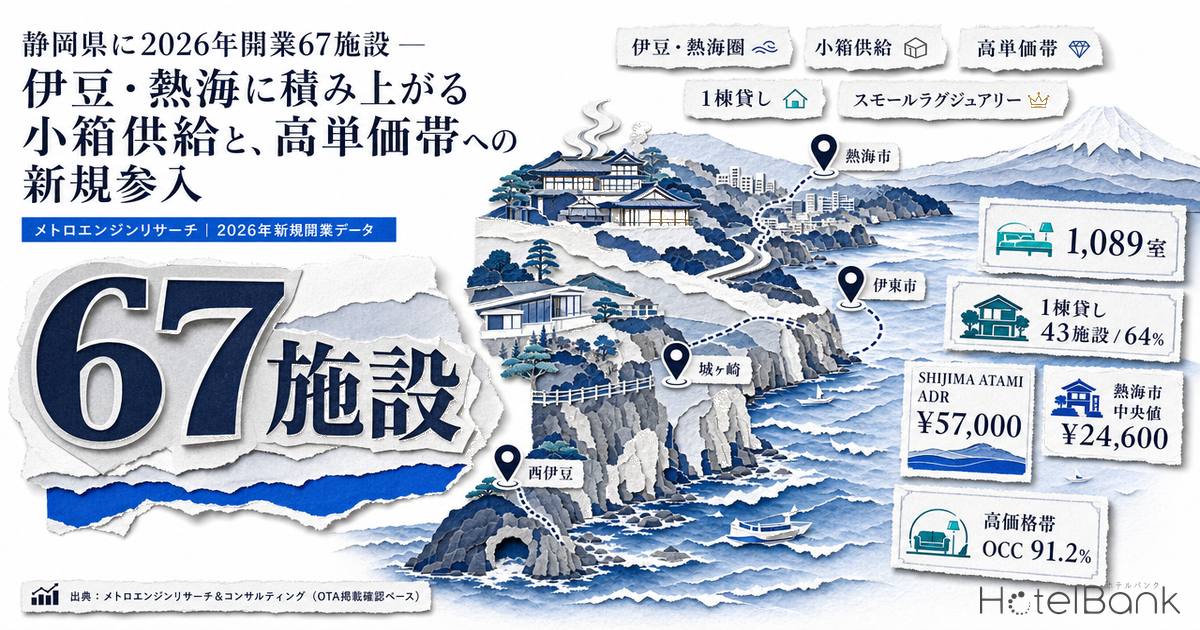
Within the scope tracked by MetroEngines Research, 1,113 newly opened lodging properties were confirmed listed on OTAs and similar channels across Japan in 2026. Of these, 67 are in Shizuoka — a national top-tier figure, trailing only Hokkaido (109 properties) and Okinawa (72 properties) and on par with Tokyo. Open up the breakdown, however, and the picture is nothing like a wave of large hotel openings. Of the 67 properties, 43 are single-room whole-house rentals, while just two properties account for 48% of all new rooms. This article breaks Shizuoka’s new supply down along three axes — municipality, room count, and price band — to map where the small-format supply piling up across Izu and Atami, and the high-end entries layered on top of it, sit within the existing price hierarchy.
Metric Definitions Used in This Article
- ADR (average daily rate): an estimated settled rate (tax-exclusive equivalent) derived by applying a property-type correction coefficient to the lowest published plan level each property lists on OTAs (two guests per room, per-room rate, tax-inclusive). Cross-checked against property-level results disclosed by listed hotel REITs (91 properties, most recent three months), the median error is approximately 7%. These are estimates and differ from each property’s actual transacted prices and accounting figures. Area-level ADR is the median across the covered properties (the level of a typical property in that area).
- Listed price: the average price across all plans listed on OTAs (two guests per room, per-room rate, tax-inclusive). Includes everything from room-only to meal-inclusive plans.
- OCC (occupancy rate): the share of sold rooms against total rooms in the area (an estimate based on OTA sales inventory). Used only in prefecture-level macro aggregates.
- Newly opened property: a property listed on a major OTA whose opening (establishment) date is confirmed as falling in 2026. Ryokan, minshuku, and simple lodging houses not listed on OTAs are excluded; this is not a complete census.
- Data source: MetroEngines Research
- — 67 properties, 1,089 rooms — the property count ranks near the top nationally, but relative to existing stock it is 4.7% by property count against just 2.3% by room count. What is growing is the number of properties, not the volume of rooms.
- — 43 properties (64%) have a single room — the whole-house rental format. Vacation rentals alone account for 41 properties, as second-home stock around Izu-Kogen and Jogasaki comes to market as lodging.
- — 48% of new rooms sit in two properties (284 rooms in Hamamatsu Naka Ward and 239 rooms in Atami). The map of property counts and the map of room counts draw entirely different pictures.
- — The 13 properties with 10 or more rooms mix ground-up builds, rebuilds, and rebrands, so only some represent a net addition. The 64 rooms in Nishi-Izu and 67 rooms in Izu-Kogen are conversions of existing properties.
- — Every new property lands in a band above its area median. The 26-room Atami property (estimated settled ADR approximately ¥57,000) sits at roughly 2.3x the area median — a move that thickens the top tier.
Shizuoka: 67 Properties and 1,089 Rooms — Top-Tier by Count, Just 2.3% of Stock by Rooms
Start with the overall picture. Of the roughly 27,000 domestic properties MetroEngines Research tracks (properties confirmed in operation, about 1.26 million rooms), 1,113 were confirmed as opening in 2026, averaging 29 rooms each. Shizuoka accounts for 67 of them, totalling 1,089 rooms.
By count alone that ranks fourth nationally, but the impression changes once scale enters the frame. Shizuoka has 1,437 lodging properties confirmed in operation, holding 47,250 rooms. New openings equal 4.7% on a property-count basis but only 2.3% on a room-count basis. Nationally, 1,113 openings against 27,249 properties works out to 4.1%, so Shizuoka’s property-count ratio runs slightly ahead. What is happening in Shizuoka, in other words, is less a flood of rooms than a fine-grained increase in the number of properties.
Average room count bears this out. Shizuoka’s 67 new properties average 16.3 rooms, with a median of 1. That is small even against the national average of 29 rooms, and less than half the 32.9 rooms per property that the prefecture’s existing stock averages.
| Metric | Shizuoka | Nationwide |
|---|---|---|
| 2026 newly opened properties | 67 properties | 1,113 properties |
| Total rooms in new openings | 1,089 rooms | — |
| Average rooms per property | 16.3 rooms (median 1) | 29 rooms |
| Existing stock confirmed in operation | 1,437 properties / 47,250 rooms | 27,249 properties / 1,267,378 rooms |
| New / existing (property basis) | 4.7% | 4.1% |
| New / existing (room basis) | 2.3% | — |
Source: MetroEngines Research & Consulting (OTA-listing-confirmed basis, N=67 properties / Shizuoka existing N=1,437 properties)
79% of Properties Sit in the Izu–Atami Zone — Yet Two Properties Hold Half the Rooms
Broken out by municipality, the concentration is unmistakable. Grouping Atami, Ito, Izu City, Shimoda, Higashiizu, Minamiizu, Kawazu, Izunokuni, Nishiizu, Matsuzaki, and Kannami as the Izu Peninsula / Atami zone, 53 of the 67 properties (79%) and 655 rooms (60%) fall inside it. Ito leads on property count with 23; Atami leads on rooms with 407.
At the same time, a handful of mid- to large-scale properties drive the room-count rankings. Just two properties — 284 rooms in Hamamatsu Naka Ward and 239 rooms in Atami — supply 523 rooms, or 48% of all new rooms in the prefecture. That the distribution of properties and the distribution of rooms trace entirely separate maps is the defining feature of Shizuoka in 2026.
The new-opening tallies in this article are on an OTA-listing-confirmed basis. OTA listings often begin several months before opening, and a fair number appear only after opening, so properties opening from the second half of 2026 onward may push these property and room counts higher as further listings appear. Read the figures as a lower bound confirmable at the present time.
Source: MetroEngines Research & Consulting (OTA-listing-confirmed basis, N=67 properties)
Plotted on a map, small circles run in a band down the east coast of the Izu Peninsula (around Atami, Ajiro, Izu-Kogen, and Jogasaki), overlaid by a few large circles in central Atami. The Nishi-Izu and Minami-Izu side is only sparsely dotted, and in the western prefecture a single point in front of Hamamatsu Station stands out.
Source: MetroEngines Research & Consulting (OTA-listing-confirmed basis, N=67 properties)
| Municipality | New properties | New rooms | Existing stock | New ratio (properties) | New ratio (rooms) | ADR |
|---|---|---|---|---|---|---|
| Atami | 16 | 407 | 135 / 4,839 rooms | 11.9% | 8.4% | ¥24,600 |
| Hamamatsu Naka Ward | 1 | 284 | 32 / 4,122 rooms | 3.1% | 6.9% | ¥7,300 |
| Ito | 23 | 120 | 298 / 4,825 rooms | 7.7% | 2.5% | ¥20,700 |
| Gotemba | 4 | 98 | 25 / 1,736 rooms | 16.0% | 5.6% | ¥9,000 |
| Izu City | 3 | 90 | 93 / 1,855 rooms | 3.2% | 4.9% | ¥22,000 |
| Fujinomiya | 2 | 43 | 23 / 875 rooms | 8.7% | 4.9% | ¥8,200 |
| Izunokuni | 2 | 21 | 46 / 1,266 rooms | 4.3% | 1.7% | ¥17,500 |
| Shimoda | 3 | 11 | 133 / 2,009 rooms | 2.3% | 0.5% | ¥15,100 |
| Numazu | 4 | 4 | 58 / 2,383 rooms | 6.9% | 0.2% | ¥8,600 |
| Higashiizu | 2 | 2 | 75 / 1,867 rooms | 2.7% | 0.1% | ¥20,900 |
* ADR is the average of monthly estimated settled ADR over the most recent 12 months (August 2025–July 2026). Covered property counts vary by month — for example 99–106 in Atami, 120–127 in Ito, 58–65 in Izu City, 46–55 in Shimoda, and 33–35 in Hamamatsu Naka Ward. “Existing stock” is the current count of properties confirmed in operation, including the new openings.
Source: MetroEngines Research & Consulting (OTA-listing-confirmed basis)
What “Small-Format Supply” Actually Looks Like — 64% Are Single-Room, 41 Are Vacation Rentals
Cut Shizuoka’s 2026 openings by room-count band and the structure comes into focus. Single-room properties (whole-house rentals and vacation rentals) number 43, or 64% of the total, and the 2–9 room band adds 11 properties, or 16%. Those two bands alone make up 54 properties (81%) — yet they contribute only 43 and 55 rooms respectively.
Category breakdown leads to the same conclusion. The 67 properties comprise 41 vacation rentals, 6 resort hotels, 6 ryokan, 3 guesthouses, 2 business hotels, one each of cottage, farm-stay, minshuku, and pension, and 5 unclassified. Vacation rentals are also the largest category nationally among 2026 openings at 522 properties, but Shizuoka’s share runs higher still. The pattern reads as second-home stock around Izu-Kogen and Jogasaki coming to market largely as-is in whole-house rental form. This spread of the whole-house format is not confined to Shizuoka: vacation rentals took 45% of Japan’s 2026 new openings (247 villas), which analyses the concentration in Okinawa, Izu, and Yamanashi.
This dovetails with a shift on the demand side. Small groups, pet owners, and multi-generational travellers all book on a whole-property basis — demand a single room in a large hotel cannot absorb. A whole-house rental may count as one room, but its rate per booking party can equal several rooms’ worth, so inflation in property counts does not translate directly into pressure on room supply.
Source: MetroEngines Research & Consulting (OTA-listing-confirmed basis, N=67 properties)
Mid- to Large-Scale Openings Cluster in Atami — Three Types: New Build, Rebuild, and Rebrand
The room count is driven by the 13 properties with 10 or more rooms. This is an entirely different market from whole-house rentals, and the form the openings take is far from uniform. The group filed under “opened in 2026” mixes ground-up construction on vacant land, rebuilds on the site of a former property, and rebrands (conversions) of existing buildings. We verified the representative properties individually.
| Property | Location | Rooms | Opening date (as we record it) | Type | Form of opening (only where confirmable in public information) |
|---|---|---|---|---|---|
| Toyoko Inn Hamamatsu Sta. South Exit (東横INN浜松駅南口) | Hamamatsu Naka Ward | 284 rooms | 2026-04-25 | Business hotel | New build (3 min. walk from Hamamatsu Sta. south exit) |
| La Vista Atami Terrace (ラビスタ熱海テラス) | Atami | 239 rooms | 2026-03-31 | Resort hotel | New build (facing Atami Sun Beach, three buildings) |
| Hotel Kanraku Premier Fujisan Shin-Gotemba IC Route 246 (ほてる寛楽プレミア富士山・新御殿場インター・国道246) | Gotemba | 90 rooms | 2026-05-05 | Business hotel | — |
| Village Atami (ヴィラージュ熱海) | Atami | 82 rooms | 2026-08-01 | Resort hotel | Rebuild (site of the former Tamanoi Honkan) |
| Wanwan Paradise Izu-Kogen (わんわんパラダイス 伊豆高原) | Ito | 67 rooms | — | Resort hotel | Renewal (April 2026, dedicated to dog-friendly stays) |
| Ooedo Onsen Monogatari Wanwan Resort Nishi-Izu (大江戸温泉物語わんわんリゾート 西伊豆) | Izu City | 64 rooms | 2026-03-01 | Resort hotel | Rebrand (formerly Toi Marine Hotel) |
| VoyStay Fuji HOTEL | Fujinomiya | 42 rooms | 2026-05-01 | Resort hotel | — |
| SHIJIMA ATAMI | Atami | 26 rooms | 2026-08-01 | Ryokan | New build (small luxury) |
| Nishi-Izu Meguri (西伊豆 巡り) | Izu City | 25 rooms | 2026-07-01 | — | — |
| Atami New Mimatsu (熱海ニュー美松) | Atami | 20 rooms | 2026-03-15 | Ryokan | — |
* Room counts and type are per the registration information we hold. Form of opening is stated only where confirmable in each operator’s public materials or press coverage; where it could not be confirmed, the cell reads “—”. Opening dates are on the listing-start basis we record and may not match publicly announced opening dates.
Source: MetroEngines Research & Consulting / operators’ public materials and press coverage
The form of the opening changes how its supply impact should be read. The 64 rooms in Izu City, for instance, are a rebrand of the existing Ooedo Onsen Monogatari Toi Marine Hotel, reopened on 1 March 2026 as a dog-only property (per the operator’s announcement). The 67 rooms in Ito were likewise renewed as a dog-friendly hotel in April 2026. In neither case were rooms newly added to the stock; existing stock re-entered the market with a changed use.
The 82 rooms in Atami are likewise a resort hotel built on the site of the long-established Tamanoi Honkan ryokan, which Sumitomo Realty’s Villa Fontaine announced as grand-opening on 1 August 2026. It comprises 82 rooms across eight types, all with balconies, plus hot springs, a sauna, and a rooftop terrace. The 239 rooms facing Atami Sun Beach, by contrast, are new construction across three buildings that grand-opened on 31 March 2026 — a genuine net addition of rooms.
In the western prefecture, 284 rooms opened on 25 April 2026 three minutes’ walk from the south exit of Hamamatsu Station. The mix centres on 128 single and 91 economy double rooms, and the opening marked the milestone of the operating brand passing 80,000 rooms in total. This is supply serving Hamamatsu’s business and event demand — something wholly separate from the leisure demand of Izu and Atami.
Where the New High-End Entry Sits Within the Existing Price Hierarchy
Here lies the most notable change in Shizuoka in 2026. On 1 August 2026, SHIJIMA ATAMI — a 26-room small-luxury property overlooking Sagami Bay in Momoyama-cho, Atami — held its pre-opening. It is operated by the Ainet Group, which announced the opening to coincide with the company’s 65th anniversary. The room mix comprises 6 Shijima Suites and 2 Tatami Suites (all 100 sq m), plus 6 Deluxe Twins, 7 Premier Kings, and 5 Deluxe Sauna rooms (all 50 sq m). Every room has an open-air bath, including semi-open-air types, and the property adds a dining room built on local ingredients and a rooftop lounge facing Sagami Bay.
Where this property sits in the price hierarchy is worth pinning down with our estimated settled ADR. As of August 2026, SHIJIMA ATAMI’s estimated settled ADR is approximately ¥57,000. With the Atami area median (estimated settled ADR) that month at approximately ¥24,500, that is roughly 2.3x the standard level for the area. On a listed-price basis, its all-plan average runs about ¥158,500 and even its lowest plan level about ¥93,300 — a band well above Atami’s average listed price of approximately ¥62,200.
Atami’s high-end band has until now been carried by a small number of long-established luxury ryokan and luxury resorts. Adding 26 rooms specified with open-air baths throughout and 100 sq m suites thickens the area’s ceiling band. At 26 rooms, the scale is just 0.5% of the area’s total room count (4,839 rooms). One more option at the very top of the price hierarchy, generating almost no supply pressure — that is how this entry should be positioned. Comparable moves are observable in other resort destinations: the high-end supply piling up in Hakone this autumn and winter examines where 126 rooms of high-end supply land within that area’s price hierarchy.
Source: MetroEngines Research & Consulting
Even within Atami, new openings do not share one price band. The 82 rooms on the former Tamanoi Honkan site show an estimated settled ADR of approximately ¥30,600 as of August 2026, and the 239 rooms facing Atami Sun Beach approximately ¥26,000 — both slightly above the Atami median of approximately ¥24,500. The 284 rooms at Hamamatsu Station’s south exit, meanwhile, sit at approximately ¥9,400, above the Hamamatsu Naka Ward median (approximately ¥7,300 on a trailing 12-month average). New supply is entering above the existing median in every area — a common thread. On how rates climb after opening, when new hotel rates actually ramp up traces the ramp-up trajectories of 91 properties that opened in 2025.
Room to Absorb — Occupancy by Price Band Shows the Top Is the Tight End
Finally, consider how the demand side absorbs this supply. Aggregating estimated occupancy on an OTA-listed-inventory basis by category for Shizuoka in July 2026, the all-property average is 84.9% (covering 1,127 properties and 45,208 rooms). By category, business hotels reached 87.7% and city hotels 86.8%, against 80.5% for ryokan and 84.2% for resort hotels.
The high-price band is what stands out. Properties listed at ¥100,000 or more per night (16 properties, 151 rooms) reached 91.2%, and the deluxe segment (4 properties, 218 rooms) 93.2% — both above the prefecture average. The small number of covered properties means these should be read with a margin, but in Shizuoka it is the upper end of the price hierarchy where inventory is relatively thin, and the natural reading is that supply on the order of 26 or 82 rooms entering there has somewhere to land.
| Category | Properties covered | Total rooms | Estimated OCC | Avg. listed price |
|---|---|---|---|---|
| All properties | 1,127 | 45,208 rooms | 84.9% | ¥25,227 |
| Business hotel | 212 | 22,355 rooms | 87.7% | ¥12,638 |
| City hotel | 29 | 3,480 rooms | 86.8% | ¥24,237 |
| Resort hotel | 124 | 7,268 rooms | 84.2% | ¥36,553 |
| Ryokan | 334 | 8,650 rooms | 80.5% | ¥32,732 |
| Deluxe | 4 | 218 rooms | 93.2% | ¥65,239 |
| High-price band (listed price ¥100,000+) | 16 | 151 rooms | 91.2% | ¥131,834 |
* Aggregate for Shizuoka, July 2026 (31 days). Estimates based on the depletion of inventory sold on OTAs; they differ from each property’s actual overall occupancy. Note that the deluxe and high-price bands cover few properties and therefore swing widely.
Source: MetroEngines Research & Consulting
The trajectory of rates themselves also points to upside. Atami’s estimated settled ADR ran above the prior year from the start of 2026: approximately ¥27,200 in January, +22.4% against the same month a year earlier (approximately ¥22,200), and approximately ¥25,900 in February, +18.0% year on year (approximately ¥22,000). June, the annual trough, came in slightly below the prior year at approximately ¥19,400 versus approximately ¥20,300, but listed prices point to a recovery toward approximately ¥28,900 in December. Ito is moving differently from Atami, with July 2026 at approximately ¥17,400, −14.1% against the same month a year earlier (approximately ¥20,300).
Ito has the most openings in the prefecture at 23 properties, but the great majority are single-room whole-house rentals, and the room-basis new ratio against its existing 4,825 rooms is only 2.5%. Softening rates are hard to explain by added supply alone. Closer to reality is to start from the premise that whole-house rentals and established ryokan differ in both product and guest base, leaving room to build rates separately within each band.
⚠ Note on ADR for future dates: ADR figures for September 2026 onward in this article are estimates based on prices listed on OTAs at the time of research, and will shift as new plans are added and prices adjusted closer to the check-in date. Present levels will not necessarily become settled levels.
Absorption Depends on Band Depth — What the Same 26 Rooms Weigh in Each Band
The estimated occupancy in the previous section is defined as the share of sold rooms against total rooms in the area. Rearranging that definition gives estimated rooms sold = total rooms × estimated OCC , which lets us see in room terms how much the denominator grows when new supply arrives, without introducing any further assumptions. Everything below is a unit conversion using only the room counts and estimated occupancy figures already stated in this article; none of it forecasts a rise or fall in demand.
| Cross-section | High-price band (listed price ¥100,000+) | Deluxe |
|---|---|---|
| Total rooms in band | 151 rooms | 218 rooms |
| Estimated OCC (current) | 91.2% | 93.2% |
| Estimated rooms sold (current) | 137.7 rooms | 203.2 rooms |
| Total rooms after adding 26 | 177 rooms | 244 rooms |
| Estimated OCC if demand is unchanged | 77.8% | 83.3% |
| Difference vs. current | −13.4pt | −9.9pt |
| Rooms sold needed to hold current estimated OCC | 161.4 rooms | 227.4 rooms |
| Additional rooms required | +23.7 rooms (+17.2%) | +24.2 rooms (+11.9%) |
Source: MetroEngines Research & Consulting (unit conversion based on July 2026 aggregates)
Because the high-price band holds only 151 rooms, 26 rooms lift its total by 17.2%. If demand is unchanged, estimated OCC falls from 91.2% to 77.8%; holding the original level would require an additional 23.7 rooms sold per night (+17.2%) across the band. “There is room to land in the top band” and “the top band is thin” are two sides of the same fact — worth keeping in mind that a single property’s entry is large enough to move supply and demand within the band.
| Band (total rooms, estimated OCC) | 26 rooms Atami, 26 rooms | 64 rooms Nishi-Izu, 64 rooms | 82 rooms Atami, 82 rooms | 239 rooms Atami, 239 rooms | 284 rooms Hamamatsu, 284 rooms |
|---|---|---|---|---|---|
| High-price band (listed price ¥100,000+) 151 rooms, 91.2% | 77.8% −13.4pt | 64.1% −27.1pt | 59.1% −32.1pt | 35.3% −55.9pt | 31.7% −59.5pt |
| Deluxe 218 rooms, 93.2% | 83.3% −9.9pt | 72.0% −21.2pt | 67.7% −25.5pt | 44.5% −48.7pt | 40.5% −52.7pt |
| City hotel 3,480 rooms, 86.8% | 86.2% −0.6pt | 85.2% −1.6pt | 84.8% −2.0pt | 81.2% −5.6pt | 80.3% −6.5pt |
| Resort hotel 7,268 rooms, 84.2% | 83.9% −0.3pt | 83.5% −0.7pt | 83.3% −0.9pt | 81.5% −2.7pt | 81.0% −3.2pt |
| Ryokan 8,650 rooms, 80.5% | 80.3% −0.2pt | 79.9% −0.6pt | 79.7% −0.8pt | 78.3% −2.2pt | 77.9% −2.6pt |
Source: MetroEngines Research & Consulting (rows = total rooms and estimated occupancy by category as stated in this article; columns = room counts of the 2026 openings stated in this article)
* The column room counts are the actual room counts of 2026 openings mentioned in this article, laid out as reference points; they do not imply that those properties belong to the band in question. Each cell is the arithmetic value for the case where the denominator grows by that many rooms and rooms sold stay unchanged.
The same 26 rooms move the high-price band by −13.4pt but the ryokan band by only −0.2pt — two orders of magnitude apart in impact. Conversely, Hamamatsu’s 284 rooms enter a deep band serving business demand, so despite being the largest opening in the prefecture by room count, their weight within the band is small. Supply impact is set not by the absolute number of rooms but by their ratio to the depth of the band they enter — which is precisely why “67 properties” should never be read as a single number.
Conclusion — Read It as Capacity Band by Band, Not as Oversupply
Shizuoka’s new supply in 2026 comes down to four points.
| Counts diverge from rooms | 67 properties opened but they hold 1,089 rooms. Against existing stock that is 4.7% by property count and only 2.3% by room count. |
| Concentration in small formats | 43 properties (64%) are single-room whole-house rentals, with 41 in the vacation rental category alone. The bulk is second-home stock around Izu-Kogen and Jogasaki converted to lodging. |
| A mixed mid- to large-scale group | 48% of new rooms sit in two properties. The 13 properties with 10 or more rooms mix new builds, rebuilds, and rebrands, so the net addition is smaller than the headline figure. |
| Entry into the top band | Every new property enters a price band above its area median. Estimated OCC rises with the price band, so the top band has capacity to absorb them. |
What is happening in Shizuoka, and above all across the Izu–Atami zone, is not a flood of rooms but a layering of price tiers and product formats. Whole-house rentals take small-group and whole-property demand, small luxury takes the top band, and the station-front business hotel takes business-travel demand in the western prefecture. Within the same “67 properties,” the competitive relationship facing an incumbent differs completely from band to band.
The practical implication for incumbents is to redefine the competitive set starting from which band your own property actually competes in. That Ito gained 23 whole-house rentals does not necessarily mean more direct competition for a 20-room ryokan. The larger revenue opportunity lies in how to reflect product strengths — rooms with open-air baths, the quality of the dining — in pricing aimed at the top band, where estimated OCC has reached the 90% range.
Related reading
- Hakone’s 126-Room Luxury Supply: Listed +30.9%, Settled ADR +5.7%
- Vacation Rentals Take 45% of Japan’s 2026 New Hotel Openings (247 Villas)
- Shizuoka Ryokans: What “Full” Inns Name Differently (N=409)
- New Hotel ADR Ramp-Up: 91 Japan Openings Split Into 4 Pricing Types
- Vacation Rentals Lead Japan’s 2026 Hotel Supply — 48.2% of 758 New Openings
- Construction +41% & Labor Crunch Erase Japan’s 2027-2029 Hotel Supply
References and Sources
■ Data sources
Newly opened properties are those confirmed listed on a major OTA whose opening (establishment) date could be established as falling in 2026 (1,113 properties nationwide / 67 properties and 1,089 rooms in Shizuoka). New property and room counts by municipality, existing stock property and room counts, estimated settled ADR, and estimated occupancy and average listed price by category are all aggregated by MetroEngines Research & Consulting. Individual opening dates and room counts are per the registration information we hold, and the form of each opening is stated only where confirmable in operators’ public materials or press coverage.
■ Calculation assumptions
The new-to-existing ratio is new openings (properties or rooms) divided by properties (or rooms) currently confirmed in operation. Municipality-level ADR is the average of monthly estimated settled ADR over the most recent 12 months (August 2025–July 2026), with covered property counts varying by month. Estimated occupancy by category is the July 2026 aggregate (31 days). The tables in “Absorption Depends on Band Depth” are unit conversions from the metric definition stated in this article (estimated occupancy = sold rooms against total rooms), rearranged as estimated rooms sold = total rooms × estimated OCC; the row and column figures use only the room counts and estimated occupancy stated in this article. They do not forecast changes in demand or future occupancy.
■ Limitations and caveats
Ryokan, minshuku, and simple lodging houses not listed on OTAs are excluded from the tallies; this is not a complete census. OTA listings often begin several months before opening, so listing-confirmed opening dates may not match publicly announced ones. Estimated settled ADR and estimated occupancy are both estimates and differ from each property’s actual transacted prices, accounting figures, and overall actual occupancy. The deluxe segment (4 properties, 218 rooms) and the high-price band (16 properties, 151 rooms) cover few properties and swing widely month to month. Estimated occupancy is a snapshot as of the time of writing and may edge slightly higher later as observations accumulate. ADR from September 2026 onward is an estimate on a listing-snapshot basis.
■ Market data
- MetroEngines Research & Consulting — new-opening property data (OTA-listing-confirmed basis, 2026 N=1,113 properties / Shizuoka N=67 properties), estimated settled ADR, and estimated occupancy (OCC)
■ Operators’ public materials and press coverage
- SHIJIMA ATAMI official site
- Pre-opening of SHIJIMA ATAMI, the Ainet Group’s small-luxury hotel, on a hilltop overlooking Sagami Bay, 1 August 2026 (Ainet Service Co., Ltd., PR TIMES, 3 August 2026)
- [Atami, Shizuoka] 26-room hotel SHIJIMA ATAMI holds pre-opening (STRAIGHT PRESS, 6 August 2026)
- Sumitomo Realty’s resort hotel series Village Atami grand-opens 1 August (Sumitomo Realty Villa Fontaine, PR TIMES)
- La Vista Atami Terrace to open facing Atami Sun Beach in March 2026 (Atami Keizai Shimbun)
- Ooedo Onsen Monogatari Wanwan Resort Nishi-Izu opens 1 March 2026 (GENSEN HOLDINGS, PR TIMES)
- Ooedo Onsen Monogatari Wanwan Resort Nishi-Izu rebrand-opens in March (Travel Watch)
- Wanwan Paradise Izu-Kogen renewal information (Iconia Hospitality official)
- Bookings open for the new Toyoko Inn Hamamatsu Sta. South Exit (Toyoko Inn official)
- Toyoko Inn Hamamatsu Sta. South Exit opens with 284 rooms, 3 minutes’ walk from the station (Travel Watch)