

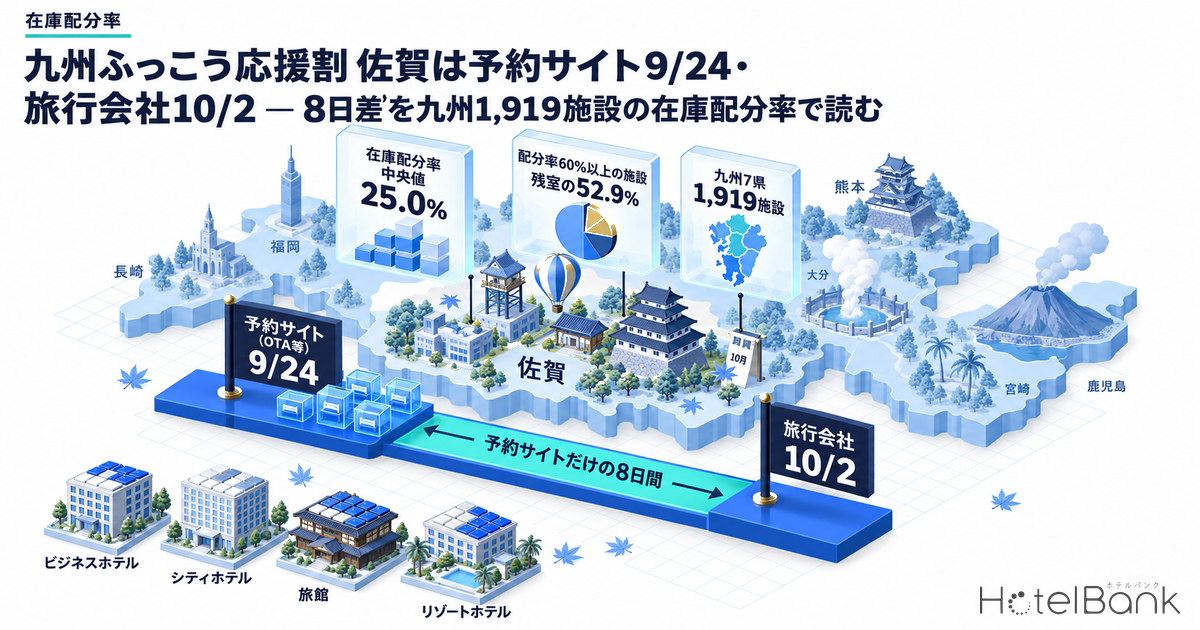
Under the Kyushu Fukko Ouenwari recovery travel subsidy (九州ふっこう応援割, covering stays from October 1 to December 25), Saga prefecture has set different start dates for each sales channel. Booking sites (OTAs, etc.) begin selling on September 24 (Thu) and travel agencies on October 2 (Fri), so for the eight days in between, only booking sites will be selling discounted products. How many rooms a property can offer at the discount during those eight days is largely determined by what share of its total rooms it normally places on OTAs and similar sites — its inventory allocation ratio. In this article, we tallied the allocation ratio for the October 10 (Sat) stay date across 1,919 properties and 139,326 total rooms in Kyushu’s seven prefectures, and estimated the “rooms available to sell” during the head-start period for each allocation band. The median was 25.0%. Properties with an allocation ratio of 60% or more account for only 22.0% of properties by count, yet they held 52.9% of the rooms still available on OTAs for the October 10 stay date.
Metric Definitions Used in This Article
- Inventory allocation ratio (share of inventory allocated to OTAs, etc.): The maximum number of sellable rooms simultaneously observable on major booking sites during the observation period ÷ the property’s total room count (%). Calculated on a room basis; the number of rate plans is not used. It is a proxy indicator showing the lower bound of the room volume assigned to online sales channels. For properties where sales progressed before the stay date, inventory had already declined at the time of observation, so the figure understates the actual allocation. Observations more than 45 days before the stay date may include the state before listing allotments were loaded and may not reflect booking progress (1,919 properties covered; observation coverage 89.9%).
- Remaining rooms on OTAs, etc.: The number of sellable rooms remaining on major booking sites (room basis). The latest observation in this article is September 10, 2026 (LT30 for the October 10 stay date). Zero remaining rooms is a reversible state that includes not only sell-outs but also temporary sales suspensions by the property.
- LT (lead time): Days until the stay date. LT0 = same day.
- Scope: 1,919 properties with 139,326 total rooms (based on major booking site listings) among business hotels, city hotels, ryokan, and resort hotels in the seven prefectures of Fukuoka, Saga, Nagasaki, Kumamoto, Oita, Miyazaki, and Kagoshima, with sufficient observations for the October 10 stay date.
- Data source: MetroEngines Research (program details and schedules from primary sources: the Japan Tourism Agency, each prefecture, and news reports)
Key Takeaways
— In Saga, booking sites (OTAs, etc.) start on September 24 and travel agencies on October 2, an eight-day gap between channels. In Kumamoto, all three channels — direct booking, travel agencies, and OTAs — start together at 10:00 on September 15, while in Nagasaki some OTAs are set to go first, targeting the third week of September (as of September 11, 2026).
— The median inventory allocation ratio across 1,919 Kyushu properties is 25.0%. 54.9% are below 30%, 23.1% are at 30–60%, and 22.0% are at 60% or more. By property type, the ratio rises in the order of city hotels 12.7%, business hotels 20.6%, resort hotels 26.7%, and ryokan 33.3%.
— Saga’s median is 25.6% (N=138). Allocation design differs sharply between business hotels at 11.6% (N=45) and ryokan at 33.3% (N=79).
— Properties with an allocation ratio of 60% or more make up 22.0% of properties and 15.9% of total rooms, but hold 52.9% of the 16,846 rooms remaining on OTAs for the October 10 stay date. Discounted inventory available during the booking-site head-start period tends to concentrate in this band.
— Converted per 100 total rooms, the rough number of rooms placed on OTAs is about 10 in the below-30% band, about 43 in the 30–60% band, and about 78 in the 60%-or-more band. The “rooms available to sell” can be adjusted operationally — for example, by raising the allocation only during the head-start period and pulling it back when travel agency sales begin.
Start Dates by Channel — An 8-Day Gap in Saga, All Three Channels at Once in Kumamoto
First, we confirm the start dates by channel from primary sources. The Japan Tourism Agency’s prefecture-by-prefecture information on the Kyushu Fukko Ouenwari (updated September 11, 2026) lists Saga as “online booking sites 9/24, travel agencies 10/2,” Nagasaki as “third week of September,” Kumamoto as “9/15,” and Oita as “late September,” while Fukuoka, Miyazaki, and Kagoshima have not yet announced dates. According to Travel Watch (September 11), which reported on Saga’s announcement, participating businesses will be listed on a dedicated website scheduled to go live around 17:00 on September 18.
Kumamoto’s announcement (Kumamoto Prefecture website, updated September 11) sets the sales start at 10:00 a.m. on September 15 (Tue), and the notice on the prefecture’s official tourism site “Motto, Mootto! Kumamotto” explains that “businesses will begin selling in turn as their preparations are completed.” Travel Watch (September 11) reported three sales channels: direct booking with properties by phone or web, travel agencies, and OTAs. Nagasaki states on its prefectural page (updated September 8) that it is preparing to start sales early on some OTAs, targeting the third week of September, and that details for both travel agency bookings and direct bookings with properties are still being arranged (direct bookings are expected to be eligible).
| Prefecture | Booking sites (OTAs, etc.) | Travel agencies | Direct booking with property | Discount rate |
|---|---|---|---|---|
| Kumamoto | From 9/15 (Tue) 10:00 | From 9/15 (Tue) 10:00 | Eligible (per reports). Businesses start in turn as they are ready | 60% |
| Saga | From 9/24 (Thu) | From 10/2 (Fri) | Not stated in published information (check with the prefecture) | 50% |
| Nagasaki | Some sites first, targeting the 3rd week of September | Being arranged | Being arranged (expected to be eligible) | 50% |
| Oita | Late September (channel breakdown not announced as of 9/11) | 50% | ||
| Fukuoka, Miyazaki, Kagoshima | Not announced (as of 9/11) | Fukuoka, Miyazaki 50% / Kagoshima 60% | ||
Source: Compiled by HotelBank Editorial Team from the Japan Tourism Agency’s Kyushu Fukko Ouenwari prefecture information (updated September 11, 2026), materials published by Kumamoto and Nagasaki prefectures, and Travel Watch (September 11, 2026). Caps are common to all prefectures: ¥20,000 for a one-night stay alone or with transport, ¥30,000 for two or more nights with transport, and ¥35,000 for touring-type trips (per trip, per person)
Laying out the start dates by channel as sales windows leading up to the October 10 (Sat) stay date gives the chart below. In Saga, booking sites move first, and travel agencies join only on October 2. For the October 1 stay date, travel agency sales begin after the stay date itself, so discounted products for that night are limited to booking sites. In Kumamoto, by contrast, all three channels start together, and differences between channels are small.
Source: Compiled by HotelBank Editorial Team from the Japan Tourism Agency’s Kyushu Fukko Ouenwari prefecture information (updated September 11, 2026), materials published by Kumamoto and Nagasaki prefectures, and Travel Watch (September 11, 2026). Nagasaki’s “third week of September” is shown in light shading as a range of September 14–20, and Oita’s “late September” as September 21–30
The relationship between the length of each prefecture’s sales window and remaining inventory before sales begin was covered in Kyushu Subsidy Start Dates: Kumamoto 9/15, Saga 9/24, Fukuoka TBD. This article goes a step further and looks at how much inventory properties place in the channel that goes first (booking sites). Note also that Kumamoto states that “travel products already booked are not eligible,” meaning the discount will not be applied retroactively to existing reservations — a premise for handling inquiries at each channel.
What Share of Total Rooms Do Kyushu Properties Place on OTAs? — Median 25.0%
We tallied the inventory allocation ratio of 1,919 properties in the seven prefectures for the October 10 (Sat) stay date. The Kyushu-wide median is 25.0%, with a wide spread: first quartile 9.1% and third quartile 55.6%. By band, 54.9% are below 30%, 23.1% are at 30–60%, and 22.0% are at 60% or more. Keep in mind that October 10 is the first day of a three-day weekend, a date on which the allocation ratio tends to come out low. Our nationwide measurement across 12,941 properties in Median 39.2% of Rooms Online — Allocation Across 12,941 Hotels also observed lower allocation ratios on holiday-weekend Saturdays than on ordinary weekdays, so the figures here are best read as the lower bound of allotments.
By prefecture, the highest median is Kumamoto at 32.1% (N=333), followed by Oita 28.6% (N=400), Saga 25.6% (N=138), and Kagoshima 25.6% (N=270). Fukuoka was 20.0% (N=405), Nagasaki 22.4% (N=232), and Miyazaki 16.5% (N=141). That said, in every prefecture the below-30% band accounts for around half of properties, and the 60%-or-more band for around 20%. The divergence in allocation design among properties within the same prefecture is larger than the differences between prefectures.
Source: Compiled by HotelBank Editorial Team from MetroEngines Research. October 10 stay date, observations through September 10, 2026. 1,919 properties / 139,326 rooms (based on major booking site listings; business, city, ryokan, and resort). As this chart shows the distribution of allocation ratios, the population is not filtered by the size of the property’s public OTA allotment
Allocation Splits by Property Type — Saga: Business Hotels 11.6%, Ryokan 33.3%
Differences by property type are sharper than differences by prefecture. Across Kyushu, city hotels have the lowest median at 12.7% (N=138), rising through business hotels at 20.6% (N=842) and resort hotels at 26.7% (N=167) to ryokan at 33.3% (N=772). City hotels have substantial sales channels such as banquets, corporate contracts, and travel agency groups, so the inventory simultaneously visible on booking sites is only a fraction of their total rooms. Many ryokan are small and find it hard to maintain their own sales networks, so they tend to be designed to entrust a larger share of inventory to booking sites.
In Saga, this gap widens further. The business hotel median is 11.6% (N=45), a 21.7-point gap from ryokan at 33.3% (N=79). This suggests that what moves on booking sites during Saga’s head-start period will mainly be ryokan inventory. Business hotels, on the other hand, are likely to include many properties with relatively large allotments for corporate, group, and travel agency business — a structure in which the discount is likely to take effect once travel agency sales begin on October 2.
| Prefecture | All | Business | City | Ryokan | Resort | Total rooms |
|---|---|---|---|---|---|---|
| Fukuoka | 20.0% (405) | 19.0% (295) | 13.0% (35) | 30.0% (61) | 28.9% (14) | 50,219 rooms |
| Saga | 25.6% (138) | 11.6% (45) | 6.7% (7)* | 33.3% (79) | 22.6% (7)* | 6,930 rooms |
| Nagasaki | 22.4% (232) | 16.3% (112) | 15.8% (24) | 36.4% (61) | 35.9% (35) | 17,129 rooms |
| Kumamoto | 32.1% (333) | 27.8% (99) | 21.2% (17) | 37.5% (198) | 42.4% (19) | 18,596 rooms |
| Oita | 28.6% (400) | 18.2% (81) | 5.3% (14) | 36.4% (269) | 27.4% (36) | 16,760 rooms |
| Miyazaki | 16.5% (141) | 16.5% (77) | 5.2% (18) | 28.6% (31) | 15.0% (15) | 11,170 rooms |
| Kagoshima | 25.6% (270) | 27.8% (133) | 13.7% (23) | 27.3% (73) | 20.0% (41) | 18,522 rooms |
| Kyushu (7 prefectures) | 25.0% (1,919) | 20.6% (842) | 12.7% (138) | 33.3% (772) | 26.7% (167) | 139,326 rooms |
Source: Compiled by HotelBank Editorial Team from MetroEngines Research. Median inventory allocation ratio (number of properties in parentheses). October 10 stay date, observations through September 10, 2026, based on major booking site listings. * Reference value only, as fewer than 10 properties
Rooms Available to Sell at a Discount During the Head Start — 52.9% of Remaining Rooms in the 60%+ Band
During a period when only booking sites are selling, the ceiling on rooms that can be sold at a discount is the inventory a property has placed on booking sites at that point. We therefore compared, by allocation band, the share of properties, total rooms, rooms placed on OTAs, and remaining rooms for the October 10 stay date (observed September 10). The weight of each band by property count differs completely from its weight by inventory.
The below-30% band accounts for 54.9% of properties and 64.9% of total rooms, but only 25.2% of rooms placed on OTAs and 20.2% of remaining rooms. Conversely, the 60%-or-more band, at 22.0% of properties and 15.9% of total rooms, holds 43.8% of rooms placed on OTAs and 52.9% of remaining rooms. In other words, the inventory travelers can book at a discount while booking sites have the head start tends to concentrate in properties with high allocation ratios — particularly small to mid-sized ryokan and business hotels.
Source: Compiled by HotelBank Editorial Team from MetroEngines Research. October 10 stay date; remaining rooms observed September 10, 2026 (LT30). 1,919 properties / 139,326 rooms (based on major booking site listings). Rooms placed on OTAs is the sum of each property’s maximum observed inventory (1,919 properties, 38,219 rooms in total); remaining rooms total 16,846
Translated into per-property benchmarks, the band medians are 53 total rooms and a 10.3% allocation ratio for the below-30% band (median rooms placed on OTAs: 4), 23 rooms and 42.9% for the 30–60% band (median: 9), and 19 rooms and 78.3% for the 60%-or-more band (median: 16.5). Converted per 100 total rooms, the rough number of rooms on booking sites is about 10, about 43, and about 78, respectively. During a period when only booking sites go first — such as Saga’s eight days — these levels can be taken as the ceiling on rooms available at a discount.
| Allocation band | Properties (share) | Median total rooms | Median allocation ratio | Per 100 rooms (approx.) | Remaining OTA rooms, 10/10 stay | Remaining rooms in Saga |
|---|---|---|---|---|---|---|
| Below 30% | 1,053 (54.9%) | 53 rooms | 10.3% | ~10 rooms | 3,408 rooms (20.2%) | 130 rooms (77 properties) |
| 30–60% | 444 (23.1%) | 23 rooms | 42.9% | ~43 rooms | 4,531 rooms (26.9%) | 186 rooms (32 properties) |
| 60% or more | 422 (22.0%) | 19 rooms | 78.3% | ~78 rooms | 8,907 rooms (52.9%) | 368 rooms (29 properties) |
| Total | 1,919 | — | 25.0% | — | 16,846 rooms | 684 rooms (138 properties) |
Source: Compiled by HotelBank Editorial Team from MetroEngines Research. October 10 stay date; remaining rooms observed September 10, 2026 (LT30), based on major booking site listings. “Per 100 rooms (approx.)” applies each band’s median allocation ratio to 100 total rooms
Narrowing down to Saga, of the 684 rooms remaining on OTAs for the October 10 stay date, 368 (53.8%) are at the 29 properties with an allocation ratio of 60% or more. The 77 properties in the below-30% band have only 130 rooms remaining, and 66.2% of properties in this band already showed zero remaining rooms on OTAs. Many properties that appear to have low allocation ratios are also properties that had already sold through their booking-site allotment at the time of observation. Whether the discounted inventory on booking sites during the head-start period can be increased depends on how these properties reshuffle inventory earmarked for other channels.
Remaining Inventory at Properties with Public Allotments of 30%+ — Around 60% Remains in Kagoshima, Nagasaki, and Saga
How much booking-site allotment remains differs by prefecture. To exclude the influence of properties with small public allotments, we narrowed the population to 866 properties (48,858 total rooms) whose public OTA allotment is 30% or more of total rooms, and compared by prefecture how much inventory remains now relative to the maximum observed inventory (median), along with the share of properties showing zero remaining rooms on OTAs.
The median share of maximum observed inventory still remaining is high in Kagoshima at 62.7% (N=121), Nagasaki at 56.8% (N=99), and Saga at 55.0% (N=61), followed by Miyazaki at 44.4% (N=53) and Fukuoka at 40.6% (N=160). Kumamoto is at 28.6% (N=176) and Oita at 22.4% (N=196); in these two prefectures, booking-site allotments had already moved considerably before sales started. In Saga, a little over half of the allotment remains, so the prefecture looks set to reach September 24 with relatively thick inventory that can be put on sale at a discount during the eight-day head start.
Source: Compiled by HotelBank Editorial Team from MetroEngines Research. Only properties whose public OTA allotment is 30% or more of total rooms. October 10 stay date, observed September 10, 2026 (LT30). 866 properties / 48,858 rooms (based on major booking site listings). Of the 1,919 properties, 1,053 with public allotments below 30% are excluded
However, the October 10 stay date is 30 days ahead of the September 10 observation, and remaining inventory will change with future bookings and inventory adjustments by properties. Zero remaining rooms on OTAs includes not only sell-outs but also cases where the property has temporarily stopped selling. Since some properties may pause and swap out existing booking-site inventory while preparing subsidy-eligible plans, these figures should be read as a snapshot of “how things look on booking sites.”
Options for Operators — How to Design Allocation for the Head-Start Period
A program in which start dates differ by channel is also, for properties, an opportunity to reshuffle inventory allocation over time. Properties that entrust much of their inventory to booking sites and those with strong travel agency or direct sales each have moves they can make. Here we organize the options from the perspective of sales and reservations managers and site controller operators.
1. Raise the allocation only during the booking-site head start. In Saga, for the eight days from September 24 to October 1, discounted products are sold only through booking sites. A property at the median of the below-30% band (53 total rooms, about 5 rooms at a 10.3% allocation ratio) would have about 16 rooms if it raised its allocation to 30% for this period only. Adding booking-site allotment only for dates where travel agency and corporate allotments have slack makes it easier to capture demand during the head start.
2. Pull the allocation back when travel agency sales begin. Saga’s travel agencies start selling on October 2. It is worth arranging in advance to return the booking-site allotment added during the head start to travel agency and wholesale allotments around this date. Scheduling date-specific inventory changes in the site controller keeps the workload of switching over down. For travel agency purchasing staff, too, how much allotment is secured as of October 2 is a premise of their sales plans.
3. Confirm with each prefecture whether direct sales are eligible. Direct booking has been reported as eligible in Kumamoto, while Saga’s published information does not mention how direct bookings are treated, and Nagasaki says it plans to include them but is still arranging details (all as of September 11). Whether your own website and phone reservations can be made eligible for the discount changes how much inventory you should move during the head start. It is advisable to confirm with each prefecture’s program office before participating businesses are announced (scheduled for September 18 in Saga).
4. Spread discounted inventory into later stay dates as well. In some prefectures, booking-site allotments for early-October Saturdays have already moved considerably before sales begin. Meanwhile, the subsidy covers stays through December 25. Rather than concentrating discounted allotments in early October, placing them more heavily from late October through December is another option. The price step at the December 25 cutoff is estimated in Kyushu Subsidy Ends Dec 25: Dec 26 Net Cost Jumps 2.3-2.7x.
5. Prepare for inquiries at each channel. Kumamoto states that travel products already booked are not eligible. As inquiries about how existing reservations are handled may increase after sales begin, aligning guidance wording for each channel in advance can reduce the burden on front-line staff. Please also see Inventory Allocation First: 4 Routes to Cut OTA Fees, which organizes the relationship between inventory allocation and commissions from a normal-times perspective.
Summary
Saga’s Kyushu Fukko Ouenwari start dates are offset by eight days: booking sites (OTAs, etc.) on September 24 and travel agencies on October 2. The ceiling on rooms that can be offered at a discount during these eight days is set by the inventory each property places on booking sites — that is, its inventory allocation ratio. The median allocation ratio across 1,919 properties in Kyushu’s seven prefectures is 25.0%, ranging by property type from 12.7% for city hotels to 33.3% for ryokan, and the gap is even wider in Saga, at 11.6% for business hotels versus 33.3% for ryokan.
Weighted by inventory, properties with an allocation ratio of 60% or more are only 22.0% by count but hold 52.9% of the rooms remaining on OTAs for the October 10 stay date. Discounted inventory during the booking-site head start tends to concentrate in small to mid-sized properties with high allocation ratios. At the same time, properties with low allocation ratios also have operational room to add booking-site allotment only during the head start and pull it back when travel agency sales begin. Whether properties can use the offset in channel start dates as an opportunity to reshuffle where inventory sits over time looks likely to shape sales from autumn through year-end.
Note on inventory data for future dates: The figures for the October 10 stay date in this article are a snapshot based on observations of major booking sites through September 10, 2026 (30 days before the stay date), and will change as the stay date approaches due to booking progress and inventory additions or sales suspensions by properties. Program schedules and eligible channels reflect information published as of September 11, 2026, and may change with future announcements by each prefecture.
Related Articles
- Kyushu Subsidy Start Dates: Kumamoto 9/15, Saga 9/24, Fukuoka TBD
- Kyushu Subsidy Pre-Launch: Kumamoto Oct Saturdays at 72-80% Occupancy
- Median 39.2% of Rooms Online — Allocation Across 12,941 Hotels
- Kyushu Subsidy: Kumamoto & Kagoshima Hold 34.9% of Oct Unsold Rooms
- Kyushu Recovery Subsidy Set: 60%/50% Split, ¥20,000 Cap Hits Top 10%
- Kyushu Fukko Ouenwari: 60% Off in Kumamoto, Kagoshima, ¥20,000 Cap
- Kyushu Subsidy Ends Dec 25: Dec 26 Net Cost Jumps 2.3-2.7x
- Inventory Allocation First: 4 Routes to Cut OTA Fees, ¥95,200/Room
References and Sources
- Japan Tourism Agency, “Kyushu Fukko Ouenwari” prefecture information (updated September 11, 2026)
- Kumamoto Prefecture, “About the Kumamoto Fukko Ouenwari” (updated September 11, 2026)
- Kumamoto Prefecture official tourism site “Motto, Mootto! Kumamotto” — “Sales of the Kumamoto Fukko Ouenwari Begin”
- Nagasaki Prefecture, “About the Kyushu Fukko Ouenwari” (updated September 8, 2026)
- Travel Watch, “Saga Prefecture’s travel support ‘Kyushu Fukko Ouenwari Saga Campaign’ opens for booking September 24; participating businesses to be announced on the 18th” (September 11, 2026)
- Travel Watch, “Kumamoto Prefecture’s Kyushu Fukko Ouenwari” (September 11, 2026)
- TRAICY, “Saga Prefecture to begin selling ‘Kyushu Fukko Ouenwari’ from September 24” (September 11, 2026)
- MetroEngines Research — inventory observations for the October 10 stay date at 1,919 properties with 139,326 total rooms in Kyushu’s seven prefectures (based on major booking site listings, through September 10, 2026)