

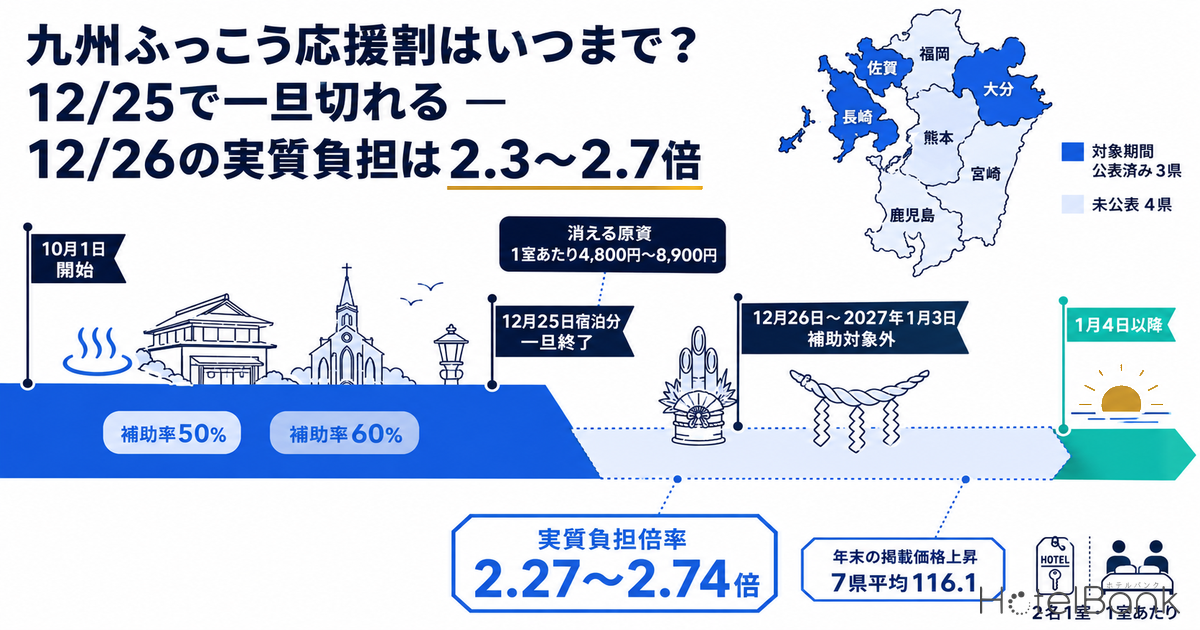
The Kyushu Recovery Subsidy (九州ふっこう応援割) begins with stays from October 1, 2026. That much is settled and common to all seven prefectures. What is not common is the answer to “until when.” As of September 8, only three prefectures — Oita, Nagasaki and Saga — have published their eligible period, and all three set the same end date: stays through December 25. The national subsidy grant guidelines, in turn, exclude the period from the following day through January 3, 2027. December therefore contains two different things inside one month: 25 days that carry subsidy funding, and 6 days that do not.
This article is about that step inside a single December, and nothing else. We apply each prefecture’s subsidy rate to the estimated settled ADR across the seven Kyushu prefectures, show in yen how much a guest’s out-of-pocket payment changes between December 25 and December 26, and then layer on the year-end rise in listed prices to see, prefecture by prefecture, how many times higher the net burden becomes. We do not address the nationwide nine-day holiday debate or year-end price formation itself.
Metric Definitions Used in This Article
- ADR (average daily rate): an estimated settled rate (tax-excluded equivalent) calculated by applying a property-type correction coefficient to the lowest published plan rate each property lists on OTAs (double occupancy, per room, tax included). Cross-checked against property-level results disclosed by listed hotel REITs (91 properties, most recent 3 months), the median error is approximately 7%. These are estimates and differ from each property’s actual transacted rates and accounting figures. Area-level ADR is the median of the covered properties (the level of a typical property in that area).
- Listed price: the per-room rate at double occupancy (tax included). In this article it is used only to read the relative day-to-day shape (as an index); levels themselves are discussed using estimated settled ADR.
- OCC (occupancy): the share of sold rooms against total rooms in the area (an estimate based on OTA sales inventory). Here it is used only as a lead-time progression for a specific check-in date at prefecture level.
- Net payment: the guest’s burden after applying each prefecture’s subsidy rate to the estimated settled ADR. Because the subsidy is applied per person per night, figures are converted back to a per-room basis at double occupancy.
- Data source: MetroEngines Research
- — The subsidy stops, for now, with stays on December 25. The three prefectures that have published their eligible period — Oita, Nagasaki and Saga — all name the same end date; the remaining four had not published one as of September 8, 2026.
- — The funding that disappears from December 26 is ¥4,800 to ¥8,900 per room (estimated settled ADR for December 2026, N=1,955 properties). Oita has the largest step, Miyazaki the smallest.
- — The multiple on a guest’s net burden runs 2.27x to 2.74x. The loss of the subsidy (2.00x in 50% prefectures, 2.50x in 60% prefectures) compounds with the year-end rise in listed prices (seven-prefecture average index of 116.1).
- — The nine days from December 26 to January 3, when the subsidy does not apply, coincide exactly with the highest nine consecutive days of listed prices in Kyushu across December and January.
- — Treat December as two separate inventories: through the 25th, and from the 26th. Even if the scheme is extended, funding returns not on December 26 but from January 4.
December 25 is a national framework boundary, not a prefectural budget decision
When Oita, Nagasaki and Saga each set December 25 as their end date, it initially looked like a prefecture-specific matter of “the budget only stretches that far.” But according to reporting on the explanation given at Kumamoto Prefectural Assembly’s 5th Economy and Environment Standing Committee (held September 3, 2026), the national subsidy grant guidelines cover stays through the end of February 2027 at the longest, with December 26, 2026 through January 3, 2027 carved out. The three prefectures’ December 25 lands exactly on the day before that excluded window.
If that reading is correct, then for the four prefectures that have not published an eligible period — Fukuoka, Kumamoto, Miyazaki and Kagoshima — the odds of the subsidy applying between December 26 and January 3 are low. What can still move at a prefecture’s discretion is limited to two things: whether the budget runs out before December 25, and whether the scheme is extended from January 4 onward. The nine days over the New Year period are likely outside prefectural discretion altogether. That said, this exclusion is not stated on the Japan Tourism Agency’s dedicated page or on Oita Prefecture’s official page; as of September 8 it rests on reporting and on assembly testimony.
What matters for sales planning is that this boundary is not something “we cannot know until it is decided” but something that has most likely already been decided. Waiting for prefectural announcements leaves too little time to prepare inventory before December 25 and inventory from December 26 as separate things.
| Prefecture | Subsidy rate | Eligible period (as of Sep 8) | Booking start | Source confirmed |
|---|---|---|---|---|
| Fukuoka | 50% | Not published | Not published | — |
| Saga | 50% | Stays Oct 1 – Dec 25 | Not published | Saga Shimbun (related budget of ¥233.69mn submitted to the September regular assembly session) |
| Nagasaki | 50% | Stays Oct 1 – Dec 25 | Online booking sites in the week of Sep 14 | Travel Watch |
| Kumamoto | 60% | Not published (national framework explained at prefectural assembly) | Not published | Prefectural assembly, 5th Economy and Environment Standing Committee (Sep 3) |
| Oita | 50% | Stays Oct 1 – Dec 25 | Late September (planned) | Oita Prefecture official page (updated Sep 3) |
| Miyazaki | 50% | Not published | Not published | — |
| Kagoshima | 60% | Not published | Not published (reported to be considering its own preceding measure in mid-September) | — |
Source: Japan Tourism Agency “Kyushu Recovery Subsidy” dedicated page, prefectural official announcements and press reports; compiled by the HotelBank Editorial Team (as of September 8, 2026)
The discount cap is common to all seven prefectures: ¥20,000 per person per night for accommodation-only products and for one-night travel products including transport, ¥30,000 for travel products including transport with two or more nights, and ¥35,000 for multi-destination itineraries staying in two or more prefectures.
The funding that disappears on December 26 is ¥4,800 to ¥8,900 per room
So how large is this step in yen? We applied each prefecture’s subsidy rate to MetroEngines Research’s estimated settled ADR for December 2026 (seven Kyushu prefectures, N=1,955 properties) and lined up the guest’s net payment through December 25 against the payment from December 26.
Source: MetroEngines Research; compiled by the HotelBank Editorial Team
| Prefecture | Dec estimated settled ADR | Subsidy rate | Net payment through Dec 25 | Payment from Dec 26 | Step | N |
|---|---|---|---|---|---|---|
| Oita | ¥17,709 | 50% | ¥8,854 | ¥17,709 | ¥8,854 | 402 |
| Saga | ¥15,907 | 50% | ¥7,954 | ¥15,907 | ¥7,954 | 137 |
| Kumamoto | ¥13,225 | 60% | ¥5,290 | ¥13,225 | ¥7,935 | 346 |
| Fukuoka | ¥14,179 | 50% | ¥7,090 | ¥14,179 | ¥7,090 | 437 |
| Kagoshima | ¥9,992 | 60% | ¥3,997 | ¥9,992 | ¥5,995 | 283 |
| Nagasaki | ¥11,058 | 50% | ¥5,529 | ¥11,058 | ¥5,529 | 208 |
| Miyazaki | ¥9,532 | 50% | ¥4,766 | ¥9,532 | ¥4,766 | 142 |
Source: MetroEngines Research; compiled by the HotelBank Editorial Team (December 2026, estimated settled ADR, N=1,955 properties)
The largest step is Oita’s, at roughly ¥8,900. Its subsidy rate is a standard 50%, but because its December estimated settled ADR of about ¥17,700 is the highest of the seven prefectures, the absolute amount of funding that disappears is also the largest. Saga follows at about ¥8,000 and Kumamoto at about ¥7,900. Kumamoto, despite its 60% subsidy rate, ends up marginally below Saga in absolute step size. Because a high subsidy rate and a high rate level work in opposite directions here, judging from the rate alone — “Kumamoto will be hit hardest” — misreads the picture.
Seen as a multiple from the guest’s side, however, the two 60% prefectures stand out. Against the net payment through December 25, the payment from December 26 is 2.00x in the five 50% prefectures, but 2.50x in Kumamoto and Kagoshima. The thicker the funding received, the larger the felt difference when it is removed.
Note that the ¥20,000 per person per night discount cap barely operates in this price band. The cap only binds where the per-room rate (double occupancy) exceeds ¥80,000 in a 50% prefecture or ¥66,700 in a 60% prefecture, and every one of the seven prefectural medians sits below a quarter of that level. How to think about the price bands where the cap does bite is covered in our article from when the scheme was confirmed.
The nine days without the subsidy are also the nine days with the highest listed prices
The step does not end there. December 26 to January 3 falls on the peak of year-end and New Year demand, and listed prices themselves rise regardless of whether a subsidy applies. Indexing daily listed prices across the seven Kyushu prefectures (double occupancy, tax included) against the December 1–25 average as 100 makes the shape unmistakable.
Source: MetroEngines Research; compiled by the HotelBank Editorial Team (seven Kyushu prefectures, daily listed prices indexed to the Dec 1–25 average = 100)
The seven-prefecture average index is 100 by definition for December 1–25, 116.1 across the nine days from December 26 to January 3 that are excluded from the subsidy, and 97.9 for January 4–31. There are Friday and Saturday spikes in early December as well (126.5 on December 12, for example), but the year-end period is the only stretch where nine consecutive days all sit above 110. In effect, the scheme carves out the most expensive continuous band in Kyushu across December and January and places its funding on the relatively cheaper days on either side.
Multiply the two together and you get the answer to a simple question: how many times more does a guest pay on Saturday, December 26 than on Friday, December 25? Multiplying the period ratio of listed prices (Dec 26–31 average ÷ Dec 1–25 average) by the effect of losing the subsidy (1 ÷ (1 − subsidy rate)) gives the following net burden multiples.
Source: MetroEngines Research; compiled by the HotelBank Editorial Team
The largest is Kagoshima at 2.74x, followed by Kumamoto at 2.71x. These two prefectures have the smallest year-end increases in listed prices of the seven (1.095x and 1.083x respectively), yet because the subsidy rate they lose is 10pt higher, their combined multiple is the largest. Miyazaki is the smallest at 2.27x. Nagasaki has the steepest listed-price increase of the seven at 1.309x, which combined with its 50% rate produces the third-largest step at 2.62x.
The implication for readers is straightforward. Inventory from December 26 onward has to sell through one of the highest price bands of the year in Kyushu on its own, without the tailwind of a subsidy. Inventory through December 25, by contrast, can hold its rate flat and still cut a guest’s net burden to half or 40% of it. Within the same December sit two stretches whose selling difficulty is entirely different.
Design December as two layers
From here the discussion turns to sales design. The starting point is to stop treating December as a single month and to build it instead as two layers with different characteristics.
Layer 1: December 1–25 (the 25 days that carry funding)
In this stretch a guest’s net burden is 40–50% of the estimated settled ADR. The need to chase demand with discounts falls relatively, and there is room to design the period as one that can be sold while holding rates. Actual observations across the seven Kyushu prefectures in October and November show Saturday inventory drawing down faster after the subsidy was announced. Taking Saturday, October 17 in Kumamoto as an example, occupancy at 90 days’ lead time was 77.6% (as of September 2026, for check-in on October 17, 2026; an estimate based on OTA listed inventory, N=506 properties and 21,188 rooms), building to 83.2% at 41 days’ lead time (same basis). If demand of the same character carries into the first half of December, releasing inventory into discounting early may narrow the opportunity.
Layer 2: December 26–31 (the six days without funding)
This stretch sits outside the scheme, and its prices are naturally high. What decides the outcome here is not the subsidy but the value of the stay itself. The year-end period skews toward multi-night stays, and guests choose on the design of the whole stay — dining, how time is spent on property, on-site spending — more than on the room alone. Because the same material used for Layer 1 will not land as well here, there is a practical case for presenting plans differently.
This two-layer structure carries a further implication for operators with properties in more than one prefecture. Because Kumamoto and Kagoshima sit 10pt above the other five, the way net burden falls in Layer 1 differs between them (40% versus 50% of estimated settled ADR). How rate gaps narrow across a prefectural border is covered in our comparison of Kurokawa Onsen and Yufuin.
If an extension comes, funding returns from January 4
Nagasaki has set its eligible period as October 1 to December 25 while stating that it may extend into January 2027 or later depending on how sales progress. Given that the national framework is designed to reach stays through February 28, 2027 at the longest (check-out March 1), the extension branch is worth planning for realistically. That said, it depends on each prefecture’s budget execution and recovery status, and as of September 8 no prefecture can speak definitively about an extension.
If an extension does come, the subsidy returns not on December 26 but from January 4, because the year-end exclusion sits on the national framework side. And what kind of price band does January 4 onward represent? On the seven-prefecture average listed-price index it is 97.9 — slightly below the December 1–25 level. By prefecture, the January 4–31 average against the December 1–25 average is 0.920x in Fukuoka, 0.960x in Nagasaki, 0.972x in Kumamoto, 0.979x in Oita and 0.984x in Kagoshima, below par in five prefectures (Saga is 1.007x and Miyazaki 1.030x).
In other words, under an extension scenario the subsidy would land in the period when Kyushu demand is at its calmest. The natural way to prepare is to assume that a stretch appears in January where the same design thinking as Layer 1 can be reused directly. If no extension comes, December 25 is the end of the scheme and selling reverts to normal from there. Either way, the work of splitting inventory at the December 25 boundary is not wasted.
How the second half of December is filling cannot yet be discussed in numbers
We have covered prices and the scheme, but the question “is the second half of December actually filling up?” cannot be answered as of September 8. Booking curves for the seven Kyushu prefectures currently carry values only from 90 days’ lead time inward, and no observation points yet exist for check-in dates from December 12 onward. Kumamoto’s Saturday, December 5 has only two observation points, at 90 and 89 days’ lead time, standing at 63.0% occupancy (as of September 2026, for check-in on December 5, 2026; an estimate based on OTA listed inventory), and everything from December 12 is empty.
This article therefore makes no claim whatsoever about pickup or sell-out tendencies for the second half of December. The only measured figures used as reference are those for October and November. How demand from December 26 actually accumulates is something we intend to revisit once observation points fill in from November. This carries forward, unchanged, the reservation we placed on the December picture when we examined November and December booking pace: December could not yet be read.
Summary
On the question of “until when,” as of September 8 three prefectures — Oita, Nagasaki and Saga — have published stays through December 25, and the remaining four have published nothing. But the national subsidy grant guidelines are reported to exclude December 26, 2026 through January 3, 2027, and the three prefectures’ December 25 aligns with that boundary. What moves at prefectural discretion is early termination on budget exhaustion and extension from January 4 onward — most likely not the nine days over the New Year themselves.
Converted into yen, the funding a guest loses at that boundary runs from ¥4,800 per room (Miyazaki) to ¥8,900 (Oita). As a multiple it is 2.00x in the five 50% prefectures and 2.50x in Kumamoto and Kagoshima at 60%. Layer on the year-end rise in listed prices and the net burden on December 26 reaches 2.27x (Miyazaki) to 2.74x (Kagoshima) of December 25. The nine days without the subsidy overlap exactly with the nine days of highest listed prices in Kyushu across December and January.
December’s sales design therefore starts by separating the period through the 25th — where funding lifts demand — from the period from the 26th, where the value of the stay has to sell itself. If an extension comes, the same design can be reused from January 4; if it does not, December 25 is the end point. Either way, the preparation of splitting inventory into two layers, without waiting for prefectural announcements, can begin now.
⚠ Note on ADR for future dates: The estimated settled ADR and listed prices for December 2026 and January 2027 in this article are estimates based on selling prices published on OTAs at the time of research (early September 2026). They shift as check-in approaches through the addition of new plans and price adjustments, and current levels will not necessarily be realized as they stand. Eligible periods, booking start dates and whether the scheme is extended also change with each prefecture’s announcements. Please confirm the latest information on each prefecture’s official page when making operational decisions.
Related Reading
- Kyushu Recovery Subsidy Set: 60%/50% Split, ¥20,000 Cap Hits Top 10%
- Kyushu Subsidy: 10pt Border Step Cuts Kurokawa-Yufuin Gap to ¥665
- Kyushu Subsidy: Kumamoto & Kagoshima Hold 34.9% of Oct Unsold Rooms
- Kyushu Fukko Ouenwari: 60% Off in Kumamoto, Kagoshima, ¥20,000 Cap
- Year-End 2026-27 Room Rates Are Already Visible: December Forward ADR vs Prior-Year Actuals
References and Sources
■ Data sources
Estimated settled ADR and listed prices are estimates calculated by MetroEngines Research from OTA published prices (retrieved early September 2026; double occupancy, per room). The December 2026 figures for the seven Kyushu prefectures cover 1,955 properties, and daily listed prices cover 3,628 properties across the seven prefectures. Eligible periods, discount rates and discount caps for the scheme are from the Japan Tourism Agency and from prefectural official announcements and press reports (as of September 8, 2026).
■ Calculation assumptions
Net payment = estimated settled ADR × (1 − prefectural subsidy rate). Because the subsidy is applied per person per night, figures are converted to a per-room basis at double occupancy for display. The discount cap (¥20,000 for accommodation only) does not operate at any of the seven prefectural medians and is therefore not incorporated into the calculation. Net burden multiple = period ratio of listed prices (Dec 26–31 average ÷ Dec 1–25 average) × 1 ÷ (1 − subsidy rate). The listed-price index takes the December 1–25 average as 100.
■ Limitations and caveats
ADR and listed prices for future dates are estimates based on selling prices at the time of retrieval and shift as check-in approaches. The exclusion of December 26, 2026 through January 3, 2027 from the subsidy rests on press reports and on the explanation given at a prefectural assembly; it is not stated on the Japan Tourism Agency’s or the prefectures’ official pages. Because no lead-time inventory observation points exist for check-in dates from December 12, 2026, no claim is made about pickup or sell-out tendencies for the second half of December.
- Japan Tourism Agency, “Kyushu Recovery Subsidy” dedicated page (primary source for eligible period, discount rate and discount cap)
- Oita Prefecture, “Kyushu Recovery Subsidy” (updated September 3, 2026)
- Travel Watch, “Oita Prefecture’s Kyushu Recovery Subsidy runs through the end of December; bookings start in late September, with early termination if the budget cap is reached” (September 2, 2026)
- TRAICY, “Nagasaki Prefecture to start selling the Kyushu Recovery Subsidy around the week of September 14” (September 8, 2026)
- Saga Shimbun, “Saga Prefecture also joins the Kyushu Recovery Subsidy from October 1, covering stays within the prefecture”
- Travel Voice, “Japan Tourism Agency to launch the Kyushu Recovery Subsidy in October, discounting travel and accommodation by 50%, with 60% in Kumamoto and Kagoshima” (August 28, 2026)
- JTB, “Handling of the Kyushu Recovery Subsidy”
- Information reported as the explanation given at Kumamoto Prefectural Assembly’s 5th Economy and Environment Standing Committee (held September 3, 2026) regarding the eligible period under the national subsidy grant guidelines and the exclusion of the year-end and New Year period (December 26, 2026 – January 3, 2027)
- MetroEngines Research — estimated settled ADR for the seven Kyushu prefectures (December 2026, N=1,955 properties), daily listed prices (December 2026 – January 2027, 3,628 properties across the seven prefectures), booking curves and occupancy (OTA listed inventory basis, estimated)