

On 23 July 2026 Japan’s Ministry of Land, Infrastructure, Transport and Tourism (MLIT) held the designation ceremony for the third round of National Cycle Routes, adding six new routes. It was the third designation since the scheme was created, the first in five years, and the largest number designated at one time. Japan now has 12 National Cycle Routes, with a combined length of more than 3,700 km.
Draw a route and more people ride it. But cycle touring always ends the day somewhere — riders have to sleep. This article quantifies, for the municipalities along each of the 12 routes, how deep the accommodation stock runs and where autumn room rates sit, using MetroEngines Research data. It also maps how many properties lie within a 5 km radius of the rest hubs along each route, to locate where the capacity to absorb riders still has room to grow.
Metric Definitions Used in This Article
- ADR (average daily rate): An estimated settled rate (tax-exclusive equivalent) calculated by applying property-type correction coefficients to the lowest publicly listed plan level each property posts on OTAs and similar channels (double occupancy, per-room rate, tax included). Cross-checked against property-level actuals disclosed by listed hotel REITs, the median error is approximately 7%. These are estimates and differ from each property’s actual transacted prices or accounting figures. Municipal ADR is the median across the properties covered — the level of a typical property in that area.
- Room stock: The total number of guest rooms at properties located in the municipality that are in operation and were confirmed listed on OTAs and similar channels at some point during September–November 2026.
- Data source: MetroEngines Research. MetroEngines Research tracks approximately 168,000 properties across Japan, of which approximately 27,000 properties and 1.26 million rooms confirmed active on OTAs form the analysis universe. Ryokan, minshuku and simple lodgings not listed on OTAs are excluded, so this is not a complete census.
- — 12 routes, over 3,700 km in total The third designation round on 23 July 2026 added six routes, bringing the National Cycle Routes to 12. The designation criteria include accommodation roughly every 60 km, placing lodging at the centre of the scheme itself.
- — 515 properties and 29,454 rooms across 18 representative municipalities Route-side room stock splits into regional-hub cities such as Iwaki (56 properties, 3,708 rooms, approx. ¥9,100) and tourism-led towns such as Nanao (17 properties, 850 rooms, approx. ¥16,800).
- — November’s rate index of 112.8 is the annual high Across 11 route-side municipalities, the monthly ADR index (annual average = 100) peaks in November, above August’s 108.1 despite the Obon holiday. The peak cycling season and the peak rate season coincide.
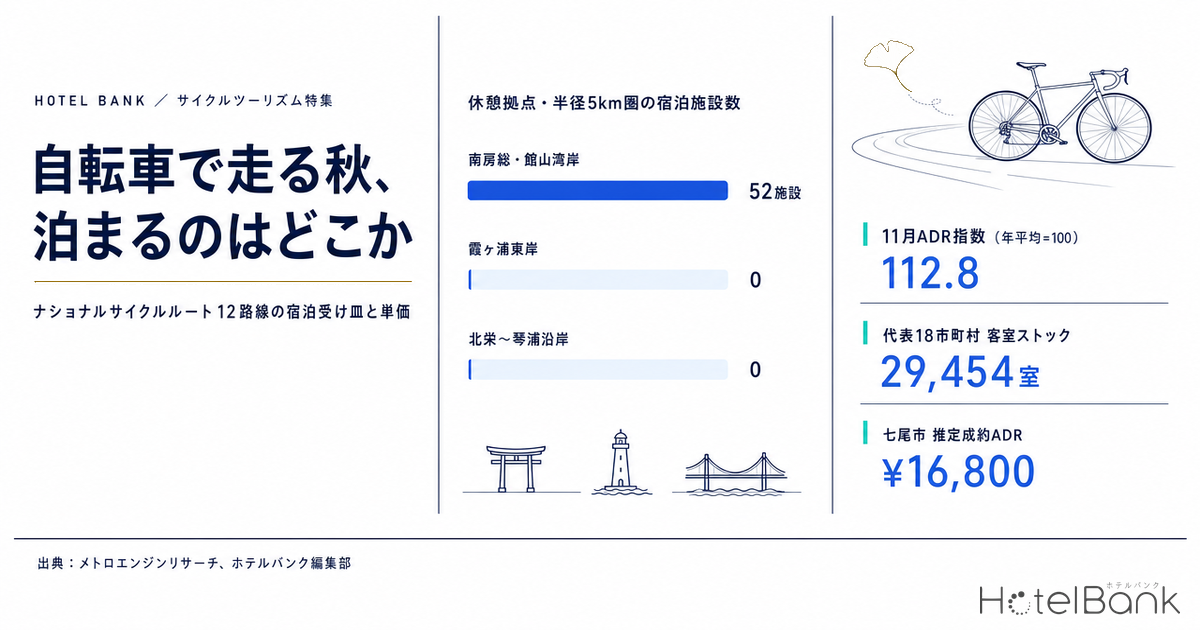
- — Within 5 km, counts range from zero to 52 properties Of 15 rest hubs, the eastern shore of Lake Kasumigaura and the Hokuei–Kotoura coast have zero properties within 5 km. Widen to 15 km, however, and both show 22–34 — a gap that operational design can close.
- — The nearest upside is re-framing facilities that already exist The properties ranking highest on four review-based convenience indicators are business and city hotels close to stations. There is ample room to re-present amenities built for business travellers in the language of cycle touring.
Twelve National Cycle Routes — the scheme builds lodging into its criteria
The National Cycle Route scheme was created in September 2019 under Japan’s Act on Promoting the Use of Bicycles. Its aim is regional revitalisation through cycle tourism, achieved by having the national government designate cycling routes that represent Japan and can stand comparison with any in the world. The first round in 2019 designated three routes — Tsukuba Kasumigaura Rin Rin Road, Biwaichi and the Shimanami Kaido. The second round in 2021 added three more — Tokapuchi 400, the Pacific Coast Cycling Road and the Toyama Bay Coastal Cycling Course. The third round in July 2026 added six.
What deserves attention here is that the designation criteria themselves explicitly embed the lodging and rest environment. Alongside cycling lanes marked with chevron arrows and directional signage, MLIT’s criteria call for cycle stations (rest hubs) roughly every 20 km, cyclist-friendly accommodation roughly every 60 km, emergency support arrangements, information provided in at least two languages including Japanese and English, and a route length of 100 km or more in principle. In other words, the scheme evaluates not only the riding environment but the hosting environment. Route designation means that, for the properties along it, a visible demand-generating infrastructure arrives with the national government’s endorsement attached.
| Route | Prefecture | Length (km) | Designated | Representative municipality | Properties | Rooms | ADR (Oct) | N |
|---|---|---|---|---|---|---|---|---|
| Tokapuchi 400 | Hokkaido | 403 | 2nd round (2021) | Obihiro | 29 | 2,921 | ¥11,100 | 30 |
| Fukushima Hamadori Cycle Route | Fukushima | 179 | 3rd round (2026) | Iwaki | 56 | 3,708 | ¥9,100 | 66 |
| Tsukuba Kasumigaura Rin Rin Road | Ibaraki | 176 | 1st round (2019) | Tsuchiura | 14 | 1,045 | ¥8,700 | 20 |
| Tsukuba | 26 | 2,035 | ¥10,900 | 26 | ||||
| Pacific Coast Cycling Road | Chiba to Wakayama | 1,487 | 2nd round (2021) | Tateyama | 33 | 689 | ¥15,500 | 23 |
| Fuji-ichi | Yamanashi and Shizuoka | 163 | 3rd round (2026) | Fujinomiya | 16 | 761 | ¥9,900 | 11 |
| Yukiguni Uonuma Golden Cycle Route | Niigata | 193 | 3rd round (2026) | Minamiuonuma | 37 | 866 | ¥12,400 | 20 |
| Toyama Bay Coastal Cycling Course | Toyama | 102 | 2nd round (2021) | Toyama | 49 | 5,091 | ¥11,300 | 45 |
| Himi | 22 | 386 | ¥12,900 | 11 | ||||
| Ishikawa Satoyama Satoumi Cycling Route | Ishikawa | 517 | 3rd round (2026) | Nanao | 17 | 850 | ¥16,800 | 13 |
| Biwaichi | Shiga | 193 | 1st round (2019) | Otsu | 42 | 2,251 | ¥14,800 | 29 |
| Hikone | 18 | 1,256 | ¥11,200 | 19 | ||||
| Nagahama | 19 | 675 | ¥12,800 | 20 | ||||
| Takashima | 19 | 412 | ¥8,700 | 7 | ||||
| Tottori Uminami Road | Tottori | 152 | 3rd round (2026) | Yonago | 38 | 2,850 | ¥10,200 | 40 |
| Tottori | 25 | 1,785 | ¥11,000 | 27 | ||||
| Shimanami Kaido Cycling Road | Hiroshima and Ehime | 70 | 1st round (2019) | Imabari | 27 | 1,078 | ¥9,400 | 30 |
| Onomichi | 28 | 795 | ¥15,000 | 24 | ||||
| Amaichi | Kumamoto | 152 | 3rd round (2026) | Excluded from the rate tabulation in this article given the impact of the 2026 Kumamoto Earthquake | ||||
Property and room counts cover properties in operation and confirmed listed on OTAs and similar channels during September–November 2026. ADR is the estimated settled ADR for October 2026 (rounded to the nearest ¥100); N is the number of properties used in that calculation. The 18 representative municipalities total 515 properties and 29,454 rooms.
Source: MetroEngines Research; compiled by the HotelBank Editorial Team
Depth of room stock versus rate band — every route has a different profile
The chart below maps the 18 representative municipalities by room stock (horizontal axis) against estimated settled ADR for October 2026 (vertical axis). Circle size represents the number of properties.
Source: MetroEngines Research; compiled by the HotelBank Editorial Team
The first thing that catches the eye is Iwaki, sitting at the lower right. Anchoring the southern end of the Fukushima Hamadori Cycle Route (179 km), the city holds 56 properties and 3,708 rooms — among the largest room stocks along any of the routes — while its estimated settled ADR for October is approximately ¥9,100 (N=66), among the lowest of the 18 municipalities. Accommodation stock built up to serve business demand in an industrial city can be repurposed as-is to absorb cycling demand. The same applies to Toyama (49 properties, 5,091 rooms, approx. ¥11,300, N=45) and Yonago (38 properties, 2,850 rooms, approx. ¥10,200, N=40). Routes whose hubs coincide with regional core cities start out strong on volume.
By contrast, the upper left is occupied by tourism-led municipalities such as Nanao (17 properties, 850 rooms, approx. ¥16,800, N=13), Tateyama (33 properties, 689 rooms, approx. ¥15,500, N=23) and Onomichi (28 properties, 795 rooms, approx. ¥15,000, N=24). Property and room counts are modest but the rate band is high. These markets absorb demand through price rather than volume, which suits the segment of cycle tourists who invest in both their equipment and their stay.
Biwaichi (193 km) circles the lake, so four municipalities line up along it. Otsu is the deepest at 42 properties and 2,251 rooms with an ADR of approximately ¥14,800 (N=29), followed by Hikone at 18 properties and 1,256 rooms (approx. ¥11,200, N=19), Nagahama at 19 properties and 675 rooms (approx. ¥12,800, N=20) and Takashima at 19 properties and 412 rooms (approx. ¥8,700, N=7). Moving clockwise, room stock thins and rates fall. For riders who complete the loop in a single day this makes no difference, but for those touring the lake over two nights it means the western shore offers noticeably fewer options than the eastern shore. This is a stretch where the room to deepen capacity is plainly visible.
Autumn is the rate peak — November is the annual high across 11 route-side municipalities
That autumn is the peak season for cycling is often said from experience; the accommodation rate data supports it. Taking estimated settled ADR on a 2025 actuals basis, month by month, for 11 representative route-side municipalities (Otsu, Hikone, Nagahama, Takashima, Imabari, Matsuyama, Tsukuba, Tsuchiura, Toyama, Yonago and Tottori), and averaging each city’s index with its own annual average set to 100, produces the following.
Source: MetroEngines Research; compiled by the HotelBank Editorial Team
November, at 112.8, is the annual high, above August (108.1) despite the Obon holiday. October also exceeds the annual average at 102.4. The troughs are June (92.2), February (93.4) and July (94.5). In structural terms, the accommodation markets along these routes command higher rates in late autumn than during the summer holidays. Autumn foliage demand, comfortable weather and a concentration of academic conferences and events all contribute, but the fact that peak cycling season aligns neatly with the rate peak carries an important implication for the properties along these routes.
Municipality by municipality, November was the highest month of the year in Matsuyama, Tsukuba and Toyama, while Hikone peaked in October. Himi, on the other hand, peaks in winter on the back of cold-season yellowtail demand, so the pattern is not uniformly autumnal. Even so, the composite index shows autumn as a clear rate peak. How many riding-friendly options can be made available in that season will shape the revenue opportunity along each route.
Where lodging runs thin — counting properties within 5 km of each rest hub
Even when a route has enough accommodation overall, what matters to the rider is whether there is somewhere to sleep near today’s finish point. We therefore selected 15 representative rest hubs and midpoints across the routes and counted the accommodation properties within a 5 km and a 15 km radius of each, limited to properties in operation and confirmed listed on OTAs and similar channels during September–November 2026.
Source: MetroEngines Research; compiled by the HotelBank Editorial Team
Source: MetroEngines Research; compiled by the HotelBank Editorial Team
| Route | Rest hub / midpoint | Within 5 km | Within 15 km |
|---|---|---|---|
| Tsukuba Kasumigaura Rin Rin Road | Eastern shore of Lake Kasumigaura (Namegata–Kasumigaura) | 0 | 22 |
| Tottori Uminami Road | Hokuei–Kotoura coast | 0 | 34 |
| Fuji-ichi | Asagiri Kogen | 1 | 62 |
| Yukiguni Uonuma GCR | Uonuma / Koide area | 3 | 23 |
| Tokapuchi 400 | Kamishihoro town centre | 3 | 4 |
| Tsukuba Kasumigaura Rin Rin Road | Mt. Tsukuba foothills, midpoint of the former Tsukuba Railway line | 6 | 73 |
| Fukushima Hamadori | Naraha–Hirono | 6 | 15 |
| Shimanami Kaido | Innoshima / Ohama area | 7 | 133 |
| Biwaichi | Kohoku lakeshore (northern Nagahama) | 8 | 56 |
| Biwaichi | Takashima, near Shirahige Shrine | 12 | 52 |
| Pacific Coast Cycling Road | Choshi, near the Byobugaura cliffs | 16 | 34 |
| Ishikawa Satoyama Satoumi | Nanao, near Wakura Onsen | 17 | 46 |
| Shimanami Kaido | Omishima, near Tatara Shimanami Park | 19 | 70 |
| Toyama Bay Coastal | Amaharashi Coast | 19 | 65 |
| Pacific Coast Cycling Road | Minamiboso / Tateyama Bay shore | 52 | 222 |
Figures are property counts. Only properties in operation and confirmed listed on OTAs and similar channels during September–November 2026 are included. The hub locations were selected by the editorial team as representative rest hubs and midpoints along each route and do not correspond to the locations of official cycle stations.
Source: MetroEngines Research; compiled by the HotelBank Editorial Team
The results divide sharply. The Minamiboso / Tateyama Bay shore on the Pacific Coast Cycling Road has 52 properties within 5 km alone, and 222 within 15 km. Next come the Amaharashi Coast on the Toyama Bay route with 19, Omishima on the Shimanami Kaido with 19, Nanao / Wakura Onsen on the Ishikawa Satoyama Satoumi route with 17, and Choshi on the Pacific Coast Cycling Road with 16. Along these stretches, riders barely need to shape their itinerary around where they can sleep.
At the other end, the eastern shore of Lake Kasumigaura (Tsukuba Kasumigaura Rin Rin Road) and the Hokuei–Kotoura coast (Tottori Uminami Road) have zero properties within 5 km, Asagiri Kogen (Fuji-ichi) has one, and Uonuma / Koide (Yukiguni Uonuma Golden Cycle Route) and Kamishihoro town centre (Tokapuchi 400) have three each. Widen the radius to 15 km, however, and a degree of capacity appears: 22 properties on the eastern Kasumigaura shore, 34 around Hokuei–Kotoura and 62 around Asagiri Kogen. These stretches, in other words, are not places without accommodation; they pose a design question about how to bridge the last 10 km to the room.
That gap points directly to where the upside sits. Along stretches that are thin within 5 km, operational measures alone — shuttle pick-ups, luggage forwarding, tie-ups with railway stations and roadside rest areas — can capture new demand. On the Shimanami Kaido, luggage transfer services linking properties with rail-transport hubs have already become established and have widened the range of feasible itineraries. Comparable arrangements could work on other routes that hold a reasonable stock within 15 km. Stretches such as Kamishihoro town centre, with only four properties even within 15 km, arguably offer the largest capture opportunity per existing property.
Everyday convenience is what counts on a cycle tour — read through review proxy indicators
What matters when a cycle tourist picks a place to stay is everyday convenience rather than luxury. Can sweaty kit be washed? Can tomorrow morning’s ride food be bought nearby? Can the bike be stored safely? Guest review analysis tags, however, include no category specific to cycling, so we use four tags as proxy indicators: ease of parking, shopping convenience (proximity to convenience stores and supermarkets), laundry facilities, and consecutive or extended stays. Ease of parking properly refers to cars, but we reference it as an indicator of generous site layouts and circulation that makes bringing gear inside easier. These are proxies only, and do not directly measure whether a property stores bike bags or provides bike racks.
Across 19 route-side municipalities, we extracted properties ranking highly on all four indicators, and list below those whose operation could be confirmed on their official websites.
| Property (route / municipality) | Reviews | Mentions across the four indicators (mention rate) | Cycle-touring features confirmed on the official website |
|---|---|---|---|
| Comfort Hotel Hikone (コンフォートホテル彦根) Biwaichi / Hikone | 704 | Ease of parking 48 (6.82%) / consecutive and extended stays 14 (1.99%) / shopping convenience 7 (0.99%) / laundry 4 (0.57%) | Bike stands stated on the official website |
| Green Hill Hotel Onomichi (グリーンヒルホテル尾道) Shimanami Kaido / Onomichi | 717 | Ease of parking 26 (3.63%) / consecutive and extended stays 21 (2.93%) / shopping convenience 16 (2.23%) / laundry 3 (0.42%) | 92 rooms; bike racks installed inside the building |
| Richmond Hotel Obihiro Ekimae (リッチモンドホテル帯広駅前) Tokapuchi 400 / Obihiro | 587 | Ease of parking 39 (6.64%) / consecutive and extended stays 13 (2.21%) / laundry 6 (1.02%) / shopping convenience 4 (0.68%) | 209 rooms; on-site coin laundry |
| Hotel Sunroute Hikone (ホテルサンルート彦根) Biwaichi / Hikone | 409 | Ease of parking 35 (8.56%) / shopping convenience 11 (2.69%) / laundry 5 (1.22%) / consecutive and extended stays 5 (1.22%) | 73 rooms; free rental bicycles |
| Route Inn Grantia Himi Wakura no Yado (ルートイングランティア氷見 和蔵の宿) Toyama Bay Coastal / Himi | 276 | Ease of parking 25 (9.06%) / consecutive and extended stays 10 (3.62%) / shopping convenience 9 (3.26%) / laundry 3 (1.09%) | Coin laundry and dryers, plus an on-site natural hot spring |
| Onomichi Royal Hotel (尾道ロイヤルホテル) Shimanami Kaido / Onomichi | 319 | Ease of parking 15 (4.7%) / shopping convenience 9 (2.82%) / consecutive and extended stays 5 (1.57%) / laundry 4 (1.25%) | 47 rooms; registered as a local cyclist-friendly property |
Tabulated from guest reviews over the most recent 24 months. Mention rate is the share of each property’s total reviews in which the tag appears; it is not a rating score. Operating status confirmed on each property’s official website (as of July 2026).
Source: HotelBank Editorial Team research (NLP analysis of guest reviews)
Laid out side by side, every property near the top is a business or city hotel close to a station. In Hikone, two properties rank highly on all four indicators, with ease-of-parking mention rates of 6.8% and 8.6%. Onomichi likewise places several properties near the top, one of which has bike racks inside the building. The Himi property combines a coin laundry and dryers with an on-site natural hot spring, which suits cycle touring in terms of post-ride recovery.
That said, properties praised for this kind of everyday convenience were not designed with cyclists in mind. Most of these amenities were built up to serve the extended-stay needs of business travellers. That is precisely why there is upside. Simply restating existing amenities in the language of cycle touring — spelling out circulation that allows a bike to be brought into the room, tool loans, and stay proposals timed around how long laundry takes to dry — can reach a new segment.
Some properties along these routes were designed for cycle touring from the outset. One, inside a mixed-use complex converted from a shipping warehouse in Onomichi, lets guests check in while wheeling their bike, provides cycle hangers in the rooms and a maintenance space with tool loans in the shared areas. It also offers free road and cross bike rentals for guests and accepts bicycles shipped ahead from home. Purpose-built properties of this kind remain limited on every route, and that scarcity is itself a measure of the room to grow.
Connecting autumn demand with inbound travel
The National Cycle Route scheme includes information provision in at least two languages, Japanese and English, among its designation criteria — evidence that inbound visitors were in view from the outset of the scheme’s design. The Shimanami Kaido became known to cyclists overseas because the riding environment, the information provision and the response of the properties hosting riders all came together. The six routes designated in the third round can set out along a path that has already been mapped.
The connection points are clear. First, autumn is when rates along these routes stand highest in the year (a composite index of 112.8 in November), so the conditions are in place to add new demand while holding rates. Second, because cycle touring involves consecutive nights and touring itineraries, revenue can be grown through length of stay rather than the single-night rate alone. Third, the thinner the accommodation within 5 km, the more readily the added value of operational services such as shuttles and luggage transfers can be priced in.
Municipalities such as Iwaki on the Fukushima Hamadori Cycle Route — holding 3,708 rooms built up on business demand while sitting in a low rate band — have considerable room to layer autumn cycling demand on top. Conversely, in municipalities such as Nanao and Onomichi, where rates are high and rooms are limited, the effective move is to design itineraries that extend the catchment out to a 15 km radius. The right play differs by route, but in every case it is within reach through re-framing existing stock and refining operations.
One note: Amaichi (152 km) in Kumamoto, designated in the third round, has been excluded from the rate and room stock tabulations in this article because it lies within the impact zone of the 2026 Kumamoto Earthquake, which struck on 28 July 2026. Where properties are suspending operations or halting reservations, it is not appropriate to discuss capacity on the basis of normal-period listing data.
Summary
The third designation round on 23 July 2026 brought Japan’s National Cycle Routes to 12. The scheme sets out rest hubs roughly every 20 km and accommodation roughly every 60 km among its criteria, positioning route-side properties as a structural component of the framework itself.
Across the 18 representative municipalities, room stock totals 515 properties and 29,454 rooms. The profile differs sharply by route, splitting between routes holding deep business-oriented stock in regional core cities such as Iwaki, Toyama and Yonago, and tourism-led routes in higher rate bands such as Nanao, Tateyama and Onomichi. Autumn is when rates along these routes stand highest in the year, with the November composite index of 112.8 exceeding the Obon period.
Measured within 5 km of the rest hubs, counts range from 52 properties at the Minamiboso / Tateyama Bay shore down to zero on the eastern shore of Lake Kasumigaura and the Hokuei–Kotoura coast. Even the thin stretches show a degree of capacity once the radius widens to 15 km, which reads as room that operational design can fill. The properties ranking highest on the review proxy indicators are business and city hotels close to stations, which makes re-presenting existing everyday convenience in the language of cycle touring the nearest available upside.
Related reading
- Japan Intra-Prefecture ADR Gaps Reach 5.2x: 368 Municipalities Ranked
- Japan’s Top 30 Garden Hotels for Autumn Foliage — Review Analysis
- Gunma Hotel Market 2026: Four ADR Tiers and a ¥5,700 Upper-Mid Gap
A note on ADR for future dates: The September–November 2026 ADR figures in this article are estimates calculated from selling prices publicly listed on OTAs and similar channels at the time of research, and will move as the check-in date approaches. Current levels may not be realised as they stand. Monthly 2025 figures are estimates on an actuals basis.
References and Sources
■ Scheme and designation information
- MLIT, “GOOD CYCLE JAPAN — National Cycle Routes” (list of designated routes and designation criteria)
- MLIT, “National Cycle Route Review Committee”
- Six routes including Fuji-ichi designated in the third round of National Cycle Routes (Cycle Sports, July 2026)
- Six new National Cycle Routes — third-round designation announced (cyclowired, July 2026)
■ Data sources
Municipal estimated settled ADR and room stock are from MetroEngines Research monthly tabulations (September 2024 – November 2026). Property and room counts cover properties located in the municipality, in operation, and confirmed listed on OTAs and similar channels at some point during September–November 2026. The four convenience indicators come from NLP analysis of guest reviews over the most recent 24 months. Scheme and designation information is from MLIT public materials.
■ Calculation assumptions
ADR is an estimated settled rate (tax-exclusive equivalent) derived by applying property-type correction coefficients to each property’s lowest publicly listed plan level (double occupancy, per room, tax included), with the municipal figure taken as the median across the properties covered. The monthly index is a simple average of each city’s 2025 actuals-based index with its own annual average set to 100. The 5 km and 15 km radii are straight-line distances centred on rest hubs and midpoints selected by the editorial team. The October 2026 ADR is a forward estimate based on future-date prices as at the time of research.
■ Limitations and caveats
The analysis is limited to properties listed on OTAs and similar channels and does not include unlisted ryokan, minshuku or simple lodgings, so it is not a complete census. The four review-based convenience indicators are proxies rather than direct measures of cycle-touring amenities, and mention rates are not rating scores. The rest hubs do not correspond to the locations of official cycle stations. Amaichi in Kumamoto is excluded from the rate and room stock tabulations because it lies within the impact zone of the 2026 Kumamoto Earthquake. ADR for future dates will move as the check-in date approaches.
■ Market data
- MetroEngines Research — municipal estimated settled ADR and room stock (September 2024 – November 2026)
- HotelBank Editorial Team research — convenience tag tabulation via NLP analysis of guest reviews (most recent 24 months)
■ Confirmation of operating status (as of July 2026)
- Comfort Hotel Hikone official website
- Hotel Sunroute Hikone official website
- Green Hill Hotel Onomichi official website
- Richmond Hotel Obihiro Ekimae official website
- Route Inn Grantia Himi Wakura no Yado official website
- Onomichi Royal Hotel official website
- ONOMICHI U2 / HOTEL CYCLE official website
- Onomichi City, “Shimanami Cycle Tour Lodgings”
■ Disaster-related