

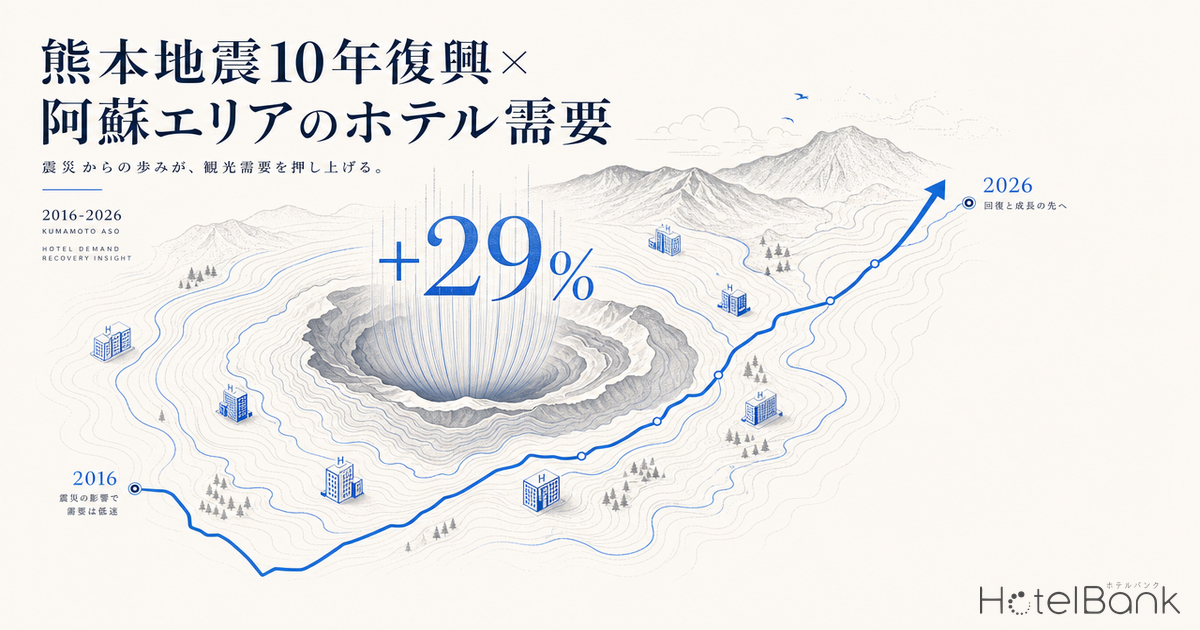
April 2026 marks 10 years since the Kumamoto Earthquake. Tourism in the Aso area has steadily recovered from its post-quake slump, and qualitative changes are emerging in the hotel market. This article combines MetroEngines Research’s OTA public-price data with guest reviews and public information on recovery efforts to verify Aso’s demand structure and its linkage with central Kumamoto City (where TSMC-related demand is concentrated).
Metric Definitions Used in This Article
- ADR (Average Daily Rate): Average of public selling prices listed on OTAs and similar channels. Differs from actual transacted prices. Per-room rate for double occupancy (tax included), averaged across all plan types (room-only through dining-included).
- Analysis Coverage Area: 20km radius from the center of the Aso caldera (32.945N, 131.105E). Includes Aso City, Minamiaso Village, Takamori Town, Ubuyama Village, Oguni Town, and Minamioguni Town.
- Data Source: MetroEngines Research. Covers 134 properties in the Aso area and 173 properties in central Kumamoto City with confirmed OTA operation.
Recovery 10-Year Milestone — Tourist Numbers Back to 73% of Pre-Quake Level
On April 14 and 16, 2016, Kumamoto Prefecture was struck by earthquakes registering a maximum seismic intensity of 7. Tourist arrivals in the Aso region nearly halved from approximately 15 million in the pre-quake year to roughly 8.5 million in 2016. However, according to the Ministry of Land, Infrastructure, Transport and Tourism’s Kyushu Regional Development Bureau, tourist numbers recovered to approximately 11 million by 2024 — about 73% of pre-quake levels.
Recovery milestones are also clear. For road infrastructure, the Tawarayama Tunnel route opened in 2019, National Route 57 and the northern restoration road in 2020, and the New Aso Bridge in March 2021. For rail, JR Hohi Main Line resumed full operation in 2020 and Minamiaso Railway in 2023. In December 2023, the Aso Shrine Romon Gate was fully restored after about seven and a half years. In December 2024, the former Hotel Aso no Tsukasa underwent a major rebranding to open as Kamenoi Hotel Aso Park Resort (209 rooms).
Source: MLIT Kyushu Regional Development Bureau and Aso Kumamoto Airport IR materials, compiled by HotelBank Editorial Team
Aso Supply Structure — 27 Luxury Properties with 377 Rooms of Onsen Inns at the Core
Within the 20km radius of the Aso caldera tracked by MetroEngines Research, analysis of 134 properties and approximately 2,563 rooms with confirmed operation shows the following supply composition by grade. The luxury tier of 27 properties (377 rooms) is heavily concentrated in traditional hot-spring destinations such as Kurokawa Onsen, Oda Onsen, and Jigoku Onsen, with an average of just 14 rooms per property — a clear small-scale profile. In contrast, the upper tier comprises 23 properties with 698 rooms, averaging 30 rooms each, reflecting a more mid-scale profile typified by conventional tourist hotels in Aso Uchinomaki Onsen and around Aso Takamori.
Source: MetroEngines Research, compiled by HotelBank Editorial Team (N=134 properties)
Particularly noteworthy are the 4 new openings totaling 128 rooms in 2016 and the 4 openings totaling 78 rooms in 2021. The 128 rooms supplied immediately after the quake in 2016 likely reflect properties whose construction was already underway pre-quake opening on schedule. The 2021 new supply, delivered amid the COVID-19 trough, reflects investment decisions made in anticipation of recovery demand.
Aso ADR Surges in 2026 — Double-Digit YoY Growth in the Most Recent Three Months
Through 2025, Aso area ADR ran in the ¥53,000-¥58,000 range. The pattern shifts clearly from the start of 2026. From March onward, ADR has exceeded the prior-year month, reaching ¥61,800 in May (+11.2% YoY) and ¥59,900 in June (+12.3% YoY) — double-digit growth.
Source: MetroEngines Research, compiled by HotelBank Editorial Team (monthly aggregates of 74-75 Aso properties and 89-91 central Kumamoto City properties)
The divergence from central Kumamoto City is notable. In central Kumamoto City — where TSMC-related demand has been the subject of debate — ADR has held a stable ¥19,000-¥23,000 range from 2025 into 2026, with May and June 2026 posting modest YoY gains of +4.7% and +6.7%. By contrast, Aso shows double-digit growth, indicating that the two areas are not synchronized and are driven by separate demand factors. We analyzed this dynamic in detail in TSMC Arrival and Kumamoto Hotel ADR: Data-Based Reality Check vs Expectations.
Aso x Central Kumamoto ADR Regression — Moderate Correlation (r=0.568, R²=0.32)
Regression analysis of monthly ADR across the 18 months from January 2025 through June 2026 yields a Pearson correlation coefficient of 0.568 and coefficient of determination R²=0.323. While the two areas do correlate to a degree, only about 32% of Aso’s ADR variation is explained by central Kumamoto City’s movements. The remaining roughly 68% is attributable to Aso-specific demand drivers (onsen tourism, recovery-related events, inbound visitors, etc.).
Source: MetroEngines Research, compiled by HotelBank Editorial Team (N=18 months, January 2025 – June 2026)
The regression equation is “Aso ADR = ¥33,400 + 1.119 x Central Kumamoto ADR,” indicating that a ¥1,000 rise in central Kumamoto City ADR is associated with an average ¥1,100 rise in Aso ADR. However, as the low R² shows, it is difficult to argue that TSMC-related corporate demand is spilling over to Aso. Aso is more accurately viewed as functioning as an independent leisure-tourism market.
Hotel Distribution Map of the Aso Caldera
Plotting Aso’s 35 major properties on a map reveals three clusters. In the north, Kurokawa Onsen (Oguni Town / Minamioguni Town) is packed with small-scale, high-rate luxury ryokan. In the central-west, Aso Uchinomaki Onsen gathers mid-scale upper-tier hot-spring hotels. The southern Minamiaso Village / Takamori Town area features a more dispersed mix of property types, including post-recovery new openings. An example of a distinctive new opening in southern Aso is the gallery-style accommodation profiled in Stay-in Gallery “Minamiaso Ringa-tei LOG HOUSE” Opens in South Aso.
Source: MetroEngines Research, compiled by HotelBank Editorial Team (marker size = room count, color = grade) / Map tiles: CartoDB
Review Data Shows Tourism Brand Recovery — Review Volume at 41% of 2019 Peak
Annual aggregation of guest reviews across 15 major Aso properties shows: 1,813 reviews in the pre-quake year 2015, rising sharply to 2,317 in the quake year 2016 and 3,230 in 2017 (driven by existing properties resuming operations and the rebound in reviews). Reviews peaked at 6,840 in 2019, then plunged during COVID-19 to 3,821 in 2020 and 1,993 in 2021. From 2023 onward they have turned upward again, reaching 2,827 in 2025 — about 41% of the 2019 peak.
Source: Guest reviews aggregated by MetroEngines Research (15 major Aso properties, 2015-2026), compiled by HotelBank Editorial Team
HotelBank Editorial Team’s aggregation of travel purpose over the most recent 24 months (N=1,759) found that 99.1% of Aso guests were traveling for leisure. The TSMC-related corporate business demand discussed in central Kumamoto City has barely spilled over to Aso. Aso continues to function as a pure leisure market anchored by hot springs and tourism.
International Routes Return to Aso Kumamoto Airport — Record Passenger Numbers in Recovery Year 10
A symbol of the recovery is the surge at Aso Kumamoto Airport. Passenger volume, which stood at approximately 2.98 million in fiscal 2016, hit an all-time high of about 3.70 million in fiscal 2024. International passengers reached 476,000 — a 105.3% year-on-year increase. The new Kumamoto-Busan route launched in December 2024, and Kumamoto-Kaohsiung resumed in February 2025. With 40 weekly international scheduled flights now operating, inbound demand from Taiwan, South Korea, and Hong Kong is supporting Aso’s tourism brand recovery. For the impact of Korean visitors on Kyushu ADR, see How Korean Long Weekends Move Kyushu ADR: Verifying the Normalization of Inbound Travel.
2026 10-Year Anniversary Events Boost April-May Demand
From April through May 2026, a series of events commemorating the 10th anniversary of the Kumamoto Earthquake will roll out across Aso and Kumamoto. On April 11, “Kumamoto Recovery Hisho-sai 2026” at the Kumamoto Castle Ninomaru Plaza will feature a Blue Impulse aerial demonstration. On April 18, a thousand-drone show “ONE KUMAMOTO no Wa 2026” is scheduled in Mashiki Town. In the Aso area, the “Minamiaso Kurokawa Walk 2026” is planned at the former Choyo Seibu Elementary School site on April 25-26.
The impact of these commemorative events is clearly reflected in MetroEngines Research’s April-June 2026 ADR data. Aso area April ADR was ¥59,000 (+6.3% YoY), May ¥61,800 (+11.2%), and June ¥59,900 (+12.3%). May’s ¥61,800 in particular exceeds 2025’s highest monthly value of ¥58,900, indicating that demand tied to the 10-year recovery milestone is materializing.
Conclusion — TSMC x Aso Tourism: A Hybrid Scenario of Coexisting Demand Drivers
The conclusion that emerges from this analysis is that Kumamoto Prefecture’s hotel demand cannot be explained by a single economic factor (TSMC-related). Instead, two geographically and demand-segment-distinct markets coexist. Central Kumamoto City is anchored by corporate business demand and occupancy growth tied to semiconductor cluster formation, delivering stable single-digit ADR growth. Aso, on the other hand, is driven by 10-year recovery anniversary demand and inbound tourism demand from restored international routes, producing double-digit ADR growth in 2026.
The 0.568 correlation between the two areas reflects shared exposure to macro factors (yen weakness, inflation, inbound trends, etc.), but the R²=0.32 indicates that 70% of Aso’s ADR variation comes from its own factors. For investors and operators, the earnings outlook for Kumamoto Prefecture hotels needs to be assessed along two separate axes: “Central Kumamoto = corporate demand x occupancy” and “Aso = leisure demand x rate.”
Reaching the 10-year recovery milestone in April 2026, Aso sits at both the destination of a long tourism-brand recovery story and the starting point of a new phase. With supply-side reinvestment exemplified by the Kamenoi Hotel Aso Park Resort rebranding, expanded international air routes, and 10-year anniversary events all converging in 2026, this year is highly likely to be a turning point for the Aso hotel market.
Note on future-date ADR: ADRs in this article are the average of public selling prices on OTAs at the time of research and will change as check-in approaches. Prices currently set high may decline through last-minute markdowns.
Related Reading
- TSMC Arrival and Kumamoto Hotel ADR: Data-Based Reality Check vs Expectations
- Wakura Onsen x Noto Recovery Hotel Investment Update — Hokuriku’s Two-Track Story: Tsuruga Surges, Noto Rebuilds
- 16 Months After the Noto Peninsula Earthquake: Wakura Onsen and Wajima Recovery Phase and 2026 Summer Booking Trends
- Hotel Investment in the 80% Nankai Trough Era — Disaster Risk x ADR x Risk-Adjusted Yield Analysis of 10 Pacific Coast Destinations
- How Korean Long Weekends Move Kyushu ADR: Verifying the Normalization of Inbound Travel
- Stay-in Gallery “Minamiaso Ringa-tei LOG HOUSE” Opens in South Aso
References and Sources
- Kumamoto Prefecture “10 Years Since the Kumamoto Earthquake — Carrying Memory and Lessons into the Future” Official Page
- Aso Shrine “Restoration Journey” (Romon Gate reconstruction completed December 2023)
- Kyodo News press release “Hotel Aso no Tsukasa Rebrands to Kamenoi Hotel Aso Park Resort on 12/25” (November 12, 2024)
- Minamiaso info “10 Years After the Kumamoto Earthquake — Special Exhibition + Minamiaso Kurokawa Walk 2026”
- “ONE KUMAMOTO no Wa 2026” Kumamoto Earthquake Recovery 10-Year Commemorative Project
- Kumamoto City Tourist Guide “Blue Impulse Aerial Display — Kumamoto Earthquake 10-Year Related Event”
- Aso Kumamoto Airport Official Site (International passengers: 476,000 in FY2024, +105.3% YoY)
- MONEY PLUS “Tourism Resumes After 3.5 Years: What Is Happening at Mount Aso and Kumamoto Now” (tourist number trends)
- HotelBank “TSMC Arrival and Kumamoto Hotel ADR” (preceding article for linkage analysis)
- MetroEngines Research — OTA public-price data for 134 Aso area properties and 173 central Kumamoto City properties, plus guest reviews (15 major properties, N=33,000+)