


HOTEL AZ, the business hotel brand operated by Amaze Co., Ltd. (株式会社アメイズ), headquartered in Oita City, opened three properties in 2026 — Kagawa Kanonji, Kagawa Miki and Okayama Bizen — and has three more lined up for 2027: Shimane Yasugi, Miyazaki Saito and Kagawa Mitoyo. All three 2027 properties whose pre-opening listings MetroEngines Research could confirm have 158 rooms each, for a total of 474 rooms. The development model is to build hotels of almost identical room count and specification, over and over, on the outskirts of cities with populations in the tens of thousands or near expressway interchanges.
This article lists the six properties and then sets out, for each one, the size of its 158 rooms relative to the room stock within a 5 km radius, the resident population and workforce within a 3 km radius, the estimated settled ADR of the host municipality, and a calculation of the ADR required to make a standard 158-room property work. We then summarize the key takeaways for landowners, local governments and financial institutions holding land suitable for limited-service hotels in regional cities.
• ADR (average daily rate) = estimated settled rate (tax-excluded equivalent), calculated by applying a segment-specific adjustment factor to the lowest publicly listed plan on OTAs (per room, 2 guests per room, tax included). Checked against property-level results disclosed by listed hotel REITs (91 properties, most recent 3 months), the median error is about 7%. These are estimates and differ from each property’s actual settled rates and accounting figures.
• ADR at the area level (prefecture / municipality) is the median of the estimated settled rates of the properties covered (the level of a typical property in the area).
• Where listed prices are mentioned, they are per-room rates for 2 guests per room (tax included).
• OCC (occupancy) = share of rooms sold out of total rooms in the area (estimate based on OTA inventory).
• Source: MetroEngines Research (continuously tracks OTA public prices for about 168,000 properties in Japan, of which about 27,000 are confirmed operating)
- — 2027: 3 hotels, 474 rooms: Shimane Yasugi (planned January 2027), Miyazaki Saito (planned May 2027) and Kagawa Mitoyo, 158 rooms each. Between 2025 and 2027, ten properties of 157–158 rooms line up.
- — Suburban roadside model repeating a standard 158-room format: The annual securities report positions the 158-room type as a “new series” and states a policy of expanding into the Chugoku and Shikoku regions. New properties are, in principle, company-owned or leased land and building shells.
- — 54.3–89.8% of rooms within 5 km are accounted for by the 158 rooms at 5 of the 6 sites (listed stock as of November 19, 2026). At Kanonji, the share is 16.5%, joining an existing cluster.
- — Host-municipality estimated settled ADR in the ¥5,000–¥9,000 range (October 2026, excluding Bizen City, which has few observed properties), roughly 60–80% of the rate level of the prefectural capitals.
- — Required ADR of about ¥5,500 vs. actual of about ¥5,800: Calculation assumes ¥10M per room, OCC (assumed) 80%, GOP margin 50% and GOP yield 8%. At a project cost of ¥12M per room, the required ADR rises to ¥6,600.
The six properties — three in 2026, three in 2027, all with 157–158 rooms
We begin with the basic facts on the six properties. Opening dates for the three 2026 properties can be confirmed from operator announcements and local news reports, but the certainty of timing for the three 2027 properties varies. For Shimane Yasugi, the operator’s press release announcing the Okayama Bizen opening states “Shimane Yasugi scheduled to open next January”; Miyazaki Saito is listed in booking information as “scheduled to open May 2027” (address: 1233-5 Tonodono, Saito City). For Kagawa Mitoyo, we could not confirm an opening date from primary sources, so we treat it only as scheduled for 2027 per our new-opening data.
| Property | Location | Rooms | Opening / planned | Basis for timing |
|---|---|---|---|---|
| HOTEL AZ Kagawa Kanonji | Kanonji City, Kagawa | 158 rooms | Opened January 18, 2026 | Local news (KSB Setonaikai Broadcasting) |
| HOTEL AZ Kagawa Miki | Miki Town, Kagawa | 158 rooms | Opened March 2026 | Reported by local news (same as above) as opening in March |
| HOTEL AZ Okayama Bizen | Bizen City, Okayama | 157 rooms | Opened October 15, 2026 | Operator press release |
| HOTEL AZ Shimane Yasugi | Yasugi City, Shimane | 158 rooms | Planned January 2027 | Operator press release |
| HOTEL AZ Miyazaki Saito | Saito City, Miyazaki | 158 rooms | Planned May 2027 | Booking information listing |
| HOTEL AZ Kagawa Mitoyo | Mitoyo City, Kagawa | 158 rooms | Planned 2027 | Our new-opening data |
The fact that room counts are consistently 157–158 is the core of this model. According to our new-opening data (100+ rooms, based on confirmed OTA listings), HOTEL AZ also opened four 157–158-room properties in Ehime, Kochi and Okayama in 2025, so ten properties of the same size line up over the three years from 2025 to 2027. In rooms per year, that is 631 rooms in 2025, 473 in 2026 and 474 in 2027 — a steady pace of three to four properties a year.
*OTA listings appear a few months before opening, so the 2027 figure may increase as more listings appear
The development model — repeating a “158-room type” along suburban roadsides
Why 158 rooms in small regional cities? The operator’s annual securities report (fiscal year ended November 2025) explains the thinking clearly. The company positions its properties as “suburban roadside business hotels,” designates the 158-room type as a “new series,” and states a policy of expanding into the Chugoku and Shikoku regions. Sites are chosen mainly along arterial roads on the outskirts of cities or near small and mid-sized stations connected to city centers; by choosing locations with few competitors, the company avoids excessive competition and keeps land costs down.
According to the same report, the company had 91 hotels as of November 30, 2025 (88 directly operated, 3 franchised), of which 68 are in Kyushu. New openings are, “in principle, company-owned properties or properties where the land and building shell are leased,” so arrangements where the landowner provides the land and building shell and the operator leases them are among the options. Net sales for the fiscal year were ¥19.56 billion, up from ¥18.03 billion the previous year. As of September 2026 the company had 93 hotels, and the Okayama Bizen property opening in October was its 94th (press release).
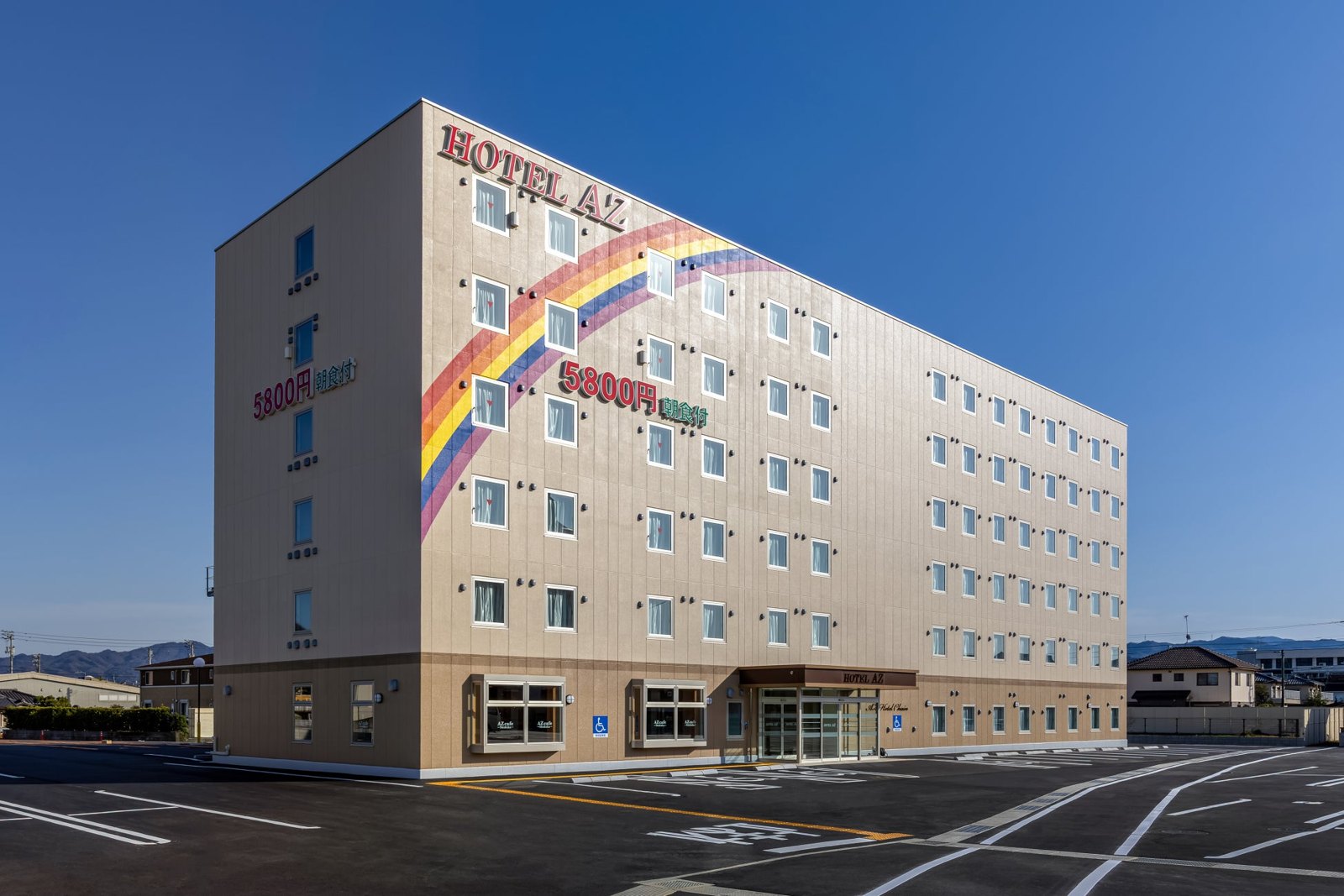
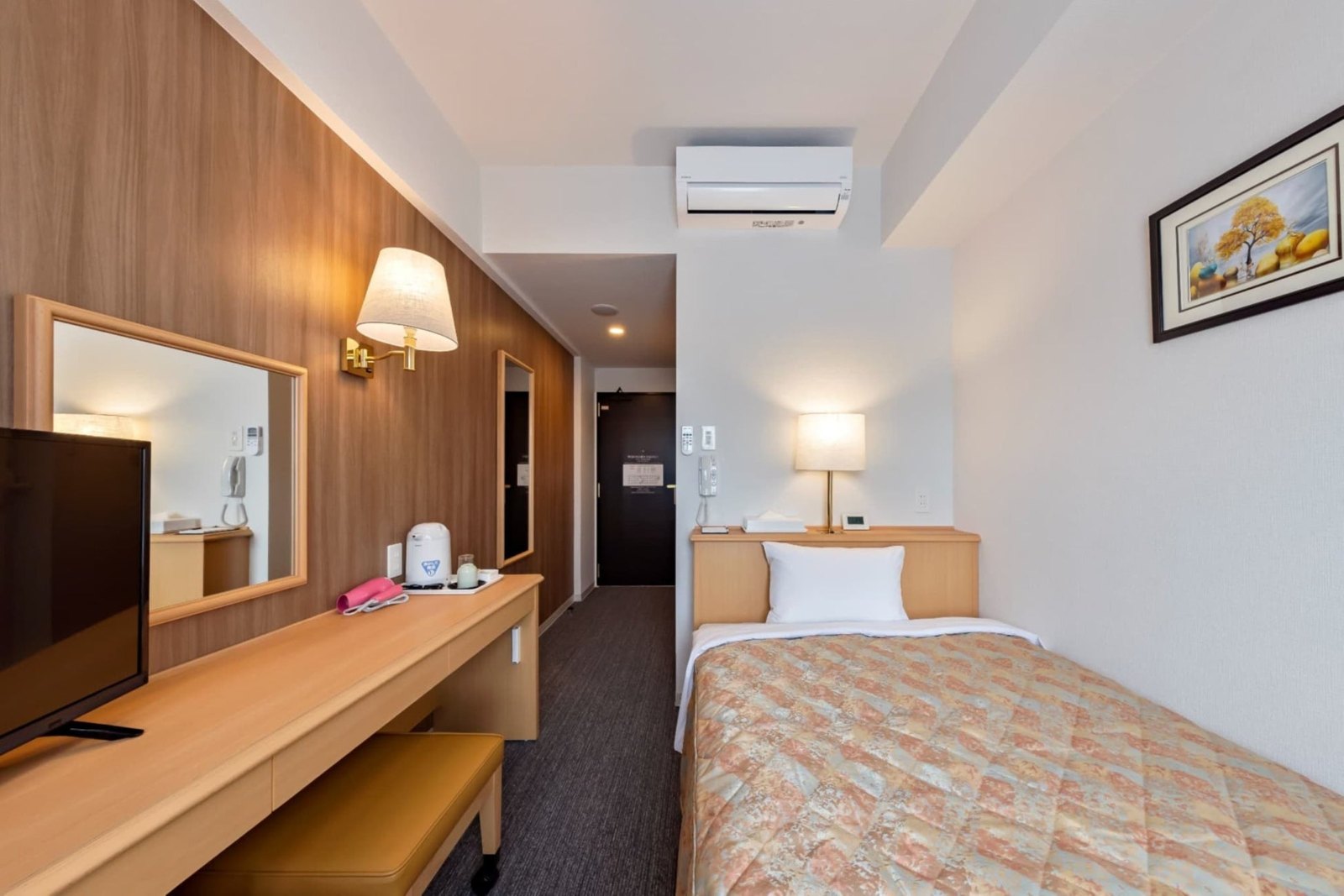
The standard specification can be read from the Okayama Bizen announcement. The property has 157 rooms — 114 singles, 40 twins and 3 family rooms — with 132 free surface parking spaces and a free breakfast buffet included in every plan. Rates are “the same price 365 days a year,” including the New Year holidays and long weekends, with singles from ¥6,380 per night including tax (¥5,800 excluding tax). The design targets drivers on suburban roadsides, and by including parking and breakfast in the rate, it captures a wide range of demand — business trips, construction work and family travel — at a single price.
Location analysis — land prices and zoning at the six sites, and the catchment population at Yasugi
Plotted on a map, the six properties stretch from the Seto Inland Sea to San’in and southern Kyushu: Kanonji, Mitoyo and Miki in Kagawa, Bizen in Okayama, Yasugi in Shimane and Saito in Miyazaki. None is a prefectural capital; what they have in common is that they are in cities and towns roughly 20 minutes to an hour by car from a prefectural capital or a regional core city.
The nearest official land price points range from ¥27,200 to ¥59,300 per ㎡ for commercial land and ¥7,770 to ¥15,600 for residential land. Year-on-year changes are all between −1.1% and ±0.0% — land without significant price movement. At both Yasugi and Kanonji, the point about 200–240 m away is commercial land in a quasi-industrial zone, consistent with roadside land use along arterial roads. The nearest points for Miki, Mitoyo and Bizen are classified as “other” for zoning — suburban points away from town centers. Securing a site large enough for 158 rooms and more than 100 surface parking spaces along a road where land prices are stable — this is where the site-selection logic shows.
The map below shows the resident population within a 3 km radius of the Yasugi property, scheduled to open in January 2027, on a 250 m mesh. The estimated 2025 population within the radius is 12,851, and projections show a 23.9% decline by 2040 compared with 2020. Densely populated mesh cells cluster around JR Yasugi Station, and the property is located east of the station (about a 15-minute walk).
Room stock within 5 km — at many sites the 158 rooms make up the majority of rooms in the area
How big are 158 rooms in a regional market? We aggregated the listed stock (10+ rooms, excluding leisure/love hotels) within a 5 km radius of each property and calculated the property’s own share of rooms. At Kanonji, the property accounts for only 16.5% of 960 rooms at 17 properties in the radius, but at the other five sites the share is 54.3–89.8%, with the 158 rooms making up the majority. Yasugi accounts for 158 of 176 rooms at 2 properties, Mitoyo 158 of 208 rooms at 4 properties, and Miki 158 of 222 rooms at 4 properties.
These high shares illustrate what happens when a large limited-service hotel is placed on a regional roadside. In markets where existing lodging is mostly small ryokan and business hotels, adding 158 rooms with parking and breakfast creates a venue that can capture locally the stays that may previously have gone to core cities outside the municipality — long stays for construction and business trips, groups, and weekend family trips. In markets like Kanonji, where several business hotels already cluster, the property joins the existing cluster, as its 16.5% share indicates. Where the Kanonji and Miki properties sit within all 2026 openings in Kagawa Prefecture is analyzed in detail in Kagawa Hotel Openings 2026: Only 316 of 686 Rooms Are Net New (Kanonji and Miki).
Catchment — resident population and workforce within 3 km
Next, we compare resident population (2025 estimate) and the number of workers within a 3 km radius of each property. Resident population is largest at Kanonji (30,840) and Miki (29,684), and smallest at Bizen (10,098). Looking at workers, however, 7,552 people work within the Bizen radius, giving a worker-to-resident ratio of about 0.75 — the highest of the six. The small resident base is offset by the large number of people working in the area, suggesting a market where business-trip and construction demand linked to factories and business establishments can become the backbone of lodging demand.
At Yasugi too, workers number 9,378, more than 70% of the resident population of 12,851, indicating a cluster of business establishments. Mitoyo has the fewest workers of the six at 5,532, but on a 5 km basis its catchment adjoins that of Kanonji, positioning the two properties to capture demand across the western Kagawa (Seisan) region as a whole. Note that worker counts here are the 2021 Economic Census town/block-level figures apportioned by radius, and in rural areas they tend to understate actual numbers depending on how business-establishment locations are treated.
| Property | Resident population (2025) | Change by 2040 (vs. 2020) | Workers | Of which office-type share |
|---|---|---|---|---|
| Kanonji | 30,840 | −19.6% | 16,094 | 6.0% |
| Miki | 29,684 | −12.0% | 11,563 | 3.9% |
| Bizen | 10,098 | −18.8% | 7,552 | 1.7% |
| Yasugi | 12,851 | −23.9% | 9,378 | 5.4% |
| Saito | 14,097 | −23.9% | 7,416 | 4.4% |
| Mitoyo | 15,975 | −19.9% | 5,532 | 6.8% |
Estimated settled ADR in host municipalities — ¥5,000–¥9,000 range in small cities
What level are lodging rates in the host municipalities? We compared the estimated settled ADR for October 2026 (median of covered properties in the municipality) with the prefectural capital of the same prefecture. Yasugi City is about ¥9,000 (about ¥8,700 a year earlier, N=8), roughly 60% of Matsue City’s about ¥15,000 (about ¥12,500 a year earlier, N=55). Saito City is about ¥5,100 (about ¥4,500, N=4) versus Miyazaki City’s about ¥8,900 (about ¥7,700, N=59); Mitoyo City is about ¥5,600 (about ¥7,600, N=5) and Kanonji City about ¥6,400 (about ¥6,800, N=12), both below Takamatsu City’s about ¥8,100 (about ¥8,000, N=74).
However, Yasugi, Saito, Mitoyo and Kanonji each have 12 or fewer observed properties, so their medians swing easily with property turnover or a price change at a single property. Rather than year-on-year changes, it is more appropriate to read them as a level — “roughly 60–80% of the prefectural capital’s rate band.” Yasugi is home to the Adachi Museum of Art and Sagi-no-yu Onsen, and the city median includes hot-spring ryokan rates — worth keeping in mind when comparing with other cities in the prefecture. The structure of price bands across San’in as a whole, including Matsue and Yonago, is examined in San’in Hotel Whitespace: 19 of 155 Sold Out at GW, Gap at ¥12k–20k.
| Municipality | Oct 2026 | Oct 2025 | Properties (N) | Note |
|---|---|---|---|---|
| Yasugi City (Shimane) | ¥9,023 | ¥8,742 | 8 | Few observed properties; volatile |
| Matsue City (Shimane) | ¥14,990 | ¥12,502 | 55 | |
| Saito City (Miyazaki) | ¥5,094 | ¥4,494 | 4 | Few observed properties; volatile |
| Miyazaki City (Miyazaki) | ¥8,887 | ¥7,744 | 59 | |
| Mitoyo City (Kagawa) | ¥5,588 | ¥7,588 | 5 | Few observed properties; volatile |
| Kanonji City (Kagawa) | ¥6,389 | ¥6,779 | 12 | Few observed properties; volatile |
| Miki Town (Kagawa) | ¥6,168 | ¥6,686 | 2 | Few observed properties; reference only |
| Takamatsu City (Kagawa) | ¥8,130 | ¥8,039 | 74 | |
| Bizen City (Okayama) | ¥20,659 | ¥9,627 | 3 | Few observed properties; reference only |
Required ADR for a standard 158-room hotel — about ¥5,500 at ¥10M per room and OCC (assumed) 80%
So what rate is needed to make a 158-room limited-service hotel work in a regional city? We back-calculated the ADR required to secure a given GOP yield on total project cost (building and equipment, excluding land) under the following assumptions.
- 158 rooms, open 365 days
- Project cost per room: ¥8M, ¥10M, ¥12M, ¥15M (4 cases)
- GOP margin 50% (a modeling assumption reflecting an operation that provides free breakfast)
- Target GOP yield (GOP ÷ total project cost) 8%; OCC (occupancy) in 3 cases: 70%, 80%, 85%
- Required ADR = total project cost × 8% ÷ (GOP margin × OCC × 365 days × 158 rooms)
On construction cost levels, MLIT’s Building Construction Starts statistics show 2025 costs for hotels and ryokan of ¥2.405M per tsubo for steel-frame construction and ¥2.174M per tsubo for the all-structure average, up sharply from ¥1.38M in 2022. The ¥10M–¥12M per room cases can be considered the central assumption for building a suburban standard-specification hotel at current construction costs.
| Project cost per room | Total project cost (158 rooms) | OCC (assumed) 70% | OCC (assumed) 80% | OCC (assumed) 85% |
|---|---|---|---|---|
| ¥8M | ¥1.26B | ¥5,000 | ¥4,400 | ¥4,100 |
| ¥10M | ¥1.58B | ¥6,300 | ¥5,500 | ¥5,200 |
| ¥12M | ¥1.90B | ¥7,500 | ¥6,600 | ¥6,200 |
| ¥15M | ¥2.37B | ¥9,400 | ¥8,200 | ¥7,700 |
Comparing this calculation with actual rates reveals the strength of the model. The estimated settled ADR of the six 157–158-room properties opened in 2025–2026 (two in Ehime, Kochi, Okayama Tsuyama, Kagawa Kanonji and Kagawa Miki) stayed within a median range of about ¥5,800–¥5,900 from April through October 2026, and was about ¥5,800 in October. This level, nearly identical to the published single rate of ¥5,800 excluding tax, barely moves from month to month. The “same price 365 days a year” operation is reflected directly in the rate figures.
Against the required ADR of about ¥5,500 at ¥10M per room and OCC (assumed) 80%, the actual figure of about ¥5,800 sits above it. Given that host-municipality estimated settled ADRs are in the ¥5,000–¥9,000 range (excluding Bizen City, which has few observed properties), this reads as a model that does not aim for rates above the municipal median, but instead fixes a “price that will reliably be chosen” within the municipality’s rate band and builds the business on high occupancy. At a project cost of ¥12M per room, the required ADR rises to ¥6,600 (OCC (assumed) 80%), so controlling construction costs through standardized design is the linchpin of profitability. For how far the required ADR rises if construction costs exceed plans, see also Hotel Build Cost Overruns of 1.5x Lift Required ADR to ¥18,836.
*The calculations are simplified estimates based on general assumptions and do not represent the actual project costs, occupancy or financial results of any HOTEL AZ property. Actual investment decisions require a detailed feasibility study. ADRs in this article are estimates (median error about 7% when checked against REIT-disclosed results).
Implications for landowners, local governments and financial institutions
In summary, HOTEL AZ’s regional expansion can be read as a model that identifies “locations where, even in a city of a few tens of thousands of people, enough bundled demand can be gathered to fill 158 rooms,” and repeats the same design to keep construction costs and operating effort down. From the perspective of those holding land, the following three points offer starting points for evaluation.
First, site conditions. Is there land large enough for 158 rooms plus more than 100 surface parking spaces, along a road a few minutes’ drive from an interchange or arterial road? The nearest official land price points for the six sites are at stable levels of roughly ¥8,000 to just under ¥60,000 per ㎡, and suburban roadside sites where large surface parking lots are easy to secure have been chosen. Second, the composition of catchment demand. Even with a resident population of only about 10,000, sites like Bizen and Yasugi with many people working in the area have room to capture business-trip and construction stays. Looking at the number of workers within a 3 km radius together with nearby industrial parks and planned large public works makes it easier to gauge demand.
Third, the approach to rates. Even if the host municipality’s estimated settled ADR is only about 60–80% of the prefectural capital’s, the calculation shows the business can be built on a fixed rate of just under ¥6,000 if construction costs are kept to around ¥10M per room. For financial institutions, where the landowner provides the land and building shell, it is useful to look at this required ADR alongside the municipality’s rate band as material for evaluating lending premised on rental income. The rate trends after the three openings starting with Yasugi in January 2027 deserve continued attention as a gauge of the viability of standardized limited-service hotels in regional cities.
Frequently asked questions
Q. Where is HOTEL AZ opening in 2027?
A. The properties whose pre-opening listings MetroEngines Research could confirm are three: Shimane Yasugi, Miyazaki Saito and Kagawa Mitoyo (158 rooms each, 474 rooms in total). Yasugi is scheduled to open in January 2027 according to the operator’s press release, and Saito in May 2027 according to booking information listings. Opening dates are subject to change.
Q. Why 158 rooms?
A. The operator’s annual securities report positions the 158-room type as a “new series” of suburban roadside business hotels and states it will be used for expansion into the Chugoku and Shikoku regions. A key feature is that repeating the same size and specification allows design and operations to be standardized.
Q. Can it be profitable even in small regional cities?
A. In this article’s simplified calculation, the required ADR to secure an 8% GOP yield at a project cost of ¥10M per room, OCC (assumed) 80% and GOP margin 50% was about ¥5,500. The median estimated settled ADR of the six recent openings was about ¥5,800, above that level. Actual results vary by property depending on project cost and occupancy.
Related reading
- What is Hotel AZ? ¥6,380 Flat-Rate Kyushu Chain, 3.74 Reviews (2026)
- Kagawa Hotel Openings 2026: Only 316 of 686 Rooms Are Net New
- San’in Hotel Whitespace: 19 of 155 Sold Out at GW, Gap at ¥12k–20k
- Miyazaki Hotel Investment Map 2026: Takachiho ¥19.4k, Miyazaki +14.8%
- Nobeoka, Hyuga, Miyakonojo: ADR ¥5,903-6,408, Only 2 Above ¥10k
- Hotel Build Cost Overruns of 1.5x Lift Required ADR to ¥18,836
- 61% of 2026 Hotel Openings Fall Outside Urbanization Promotion Areas
- Japan Hotel Openings Oct 2026–Mar 2027: 14 Hotels, 2,283 Rooms
References and sources
■ Data sources
MetroEngines Research new-opening data (100+ rooms, based on confirmed OTA listings); room stock within a 5 km radius of each property (10+ rooms, excluding leisure/love hotels, as of November 19, 2026); estimated settled ADR by municipality (median of covered properties, October 2026 and a year earlier). Resident population from National Land Numerical Information future population projections by 250 m mesh; worker counts from the 2021 Economic Census for Business Activity town/block-level figures apportioned to a 3 km radius; land prices from the nearest official land price points (2025).
■ Calculation assumptions
158 rooms, open 365 days; project cost per room in 4 cases from ¥8M to ¥15M (excluding land acquisition costs and ground rent); GOP margin 50%; target GOP yield (GOP ÷ total project cost) 8%; OCC (assumed) in 3 cases: 70, 80, 85%. Required ADR = total project cost × 8% ÷ (GOP margin × OCC × 365 days × 158 rooms).
■ Limitations and caveats
ADRs are estimates derived from OTA public prices, not each property’s actual settled rates or accounting figures. Yasugi, Saito, Mitoyo, Kanonji, Miki and Bizen each have 12 or fewer observed properties, so medians are volatile. 2027 opening timing is planned, based on operator announcements and listings, and subject to change. OTA listings appear a few months before opening, so the number of 2027 properties may increase. Required ADR is a simplified calculation and does not represent any property’s project cost or financial results.
■ Market data
- MetroEngines Research & Consulting — New-opening data (based on confirmed OTA listings), room stock within a 5 km radius (as of November 19, 2026), estimated settled ADR by municipality and by property
■ Operator disclosures and news reports
- Amaze Co., Ltd., announcement of the opening of “HOTEL AZ Okayama Bizen” (PR TIMES, September 15, 2026)
- Amaze Co., Ltd. Annual Securities Report (fiscal year ended November 2025)
- KSB Setonaikai Broadcasting, report on the opening of “HOTEL AZ Kagawa Kanonji” (December 23, 2025)
- Miyazaki Saito planned opening timing and address: booking information listings (checked November 2026)
■ Government statistics and public data
- MLIT Real Estate Information Library — Official Land Prices (2025)
- MLIT National Land Numerical Information — Future population projections by 250 m mesh
- MIC/METI “Economic Census for Business Activity” (2021)
- MLIT “Building Construction Starts Statistics”
■ Industry sources