


Within a 1km radius of Tottori Station, 24 lodging facilities with 2,658 rooms are currently operating (as of November 2026), and the four properties with 727 rooms that opened in 2024 or later account for 27% of that total. Even as supply has piled up, the estimated settled ADR for Tottori City landed at roughly ¥9,000 in October 2026, up 12.9% year on year, and 17 of the 18 existing properties in the radius beat their prior-year level for the same month. This article layers, in turn, the composition of station-front supply, current rates and estimated occupancy, the working and resident population, flood-risk zoning and land prices, and closes by estimating the ADR required to build a new 100-room business hotel.
• ADR (average daily rate) = an estimated settled rate (tax-exclusive equivalent), calculated by applying segment-specific adjustment factors to the lowest-plan level each property publishes on OTAs (per-room rate for two guests, tax included). Benchmarked against property-level results disclosed by listed hotel REITs (91 properties, most recent three months), the median error is about 7%. These are estimates and differ from each property’s actual settled prices and accounting figures.
• Area-level ADR (prefecture / municipality) is the median of the estimated settled rates of the properties covered (the level of a typical property in the area).
• Where listed prices are mentioned, they are per-room rates for two guests (tax included).
• OCC (occupancy) = the share of rooms sold out of total rooms in the area (an estimate based on OTA sales inventory).
• Source: MetroEngines Research (continuous tracking of OTA public prices for approx. 168,000 properties in Japan, of which approx. 27,000 are confirmed operating)
The room stock in this article covers lodging facilities with 10 or more rooms (excluding love hotels) within a 1,000m radius of Tottori Station. “Operating” means properties whose selling prices were confirmed on major booking sites in the last three months (September–November 2026) (as of November 15, 2026; compiled by MetroEngines Research).
Let us start with the conclusions. First, 83% of rooms within 1km of the station are in business hotels, and every opening of the past two years falls into the same segment. Second, although rates were below the prior year in the first half of 2026, they have exceeded the prior year for three consecutive months since August, and newer properties sit in higher price bands. Third, as preconditions of the location, 96.1% of operating rooms lie inside the flood inundation zone (maximum assumed scale) of the Sendai and Fukuro rivers, and station-front official land prices stopped falling in 2026. Taken together, an ADR in the ¥11,000s — the upper tier within the radius — is the benchmark for a new build to pencil out, which also explains why openings that reuse existing buildings are being chosen.
- — 24 properties, 2,658 rooms: lodging facilities operating within 1km of Tottori Station (as of November 2026). The four properties with 727 rooms that opened in 2024 or later are all business hotels and make up 27% of operating rooms.
- — +12.9%: Tottori City’s estimated settled ADR in October 2026 was ¥8,984 (N=36), up 12.9% YoY. It has topped the prior year for three straight months since August, and 17 of 18 existing properties in the radius beat last year.
- — 89.0%: estimated occupancy of business hotels in Tottori Prefecture in October 2026 (based on OTA-listed inventory, 25 properties). The slower the month, the larger the pickup in the final 7 days.
- — 96.1%: share of operating rooms located inside the flood inundation zone (maximum assumed scale). All fall in the 0.5m-to-under-3.0m depth class, and station-front official land prices turned flat in 2026.
- — Approx. ¥11,500: ADR required to build a new 100-room business hotel and achieve a 7% GOP yield (70% annual occupancy, 2025 construction costs). That is 1.45× the radius business-hotel median of about ¥7,900.
Supply Trend — From 1,991 Rooms in 2017 to 2,572 at End-2025, With the Increase Concentrated Since 2024
First, the volume of supply. Stacking up properties with a confirmed opening year as of each year-end, the room stock within 1km of Tottori Station grew from 22 properties and 1,991 rooms in 2017 to 25 properties and 2,572 rooms at end-2025 — up 29.2% over eight years. The growth was not even, however. After 150 rooms were added in 2019, the stock stayed almost flat at 2,141–2,153 rooms through 2023, then rose by 245 rooms in 2024 and by a net 174 rooms in 2025, so more than 70% of the increase came in the last two years.
In 2026, Hotel Livemax Tottori GRANDE (ホテルリブマックス鳥取GRANDE, 158 rooms) opened at the end of May, and Smile Hotel Premium Tottori (スマイルホテルプレミアム鳥取, 119 rooms) began operating between late October and early November. That said, according to press reports the former opened in the building of the former Bird Stay Hotel, so in terms of building stock it is closer to a replacement. Current scale is therefore best captured by “operating” properties whose sales were confirmed in the last three months: 24 properties and 2,658 rooms.
Broken down by decade of opening, the 2020s account for the most operating rooms with 5 properties and 739 rooms, followed by the 1980s (3 properties, 452 rooms) and the 2010s (4 properties, 440 rooms). There are also 9 properties with 1,131 rooms that opened in the 1970s–1990s, so buildings more than 30 years old sit alongside buildings less than two years old in the same station-front area. By size, 9 properties with 101–200 rooms hold 1,226 rooms and 4 properties with 201+ rooms hold 887 rooms — properties with more than 100 rooms carry about 80% of the room count.
The 4 Properties / 727 Rooms Opened Since 2024 — All Business Hotels, 170–660m From the Station
Next, the breakdown of the increase. All four properties opened in 2024 or later are business hotels, located within roughly 170–660m of the station in straight-line distance. Toyoko Inn Tottori-eki Kitaguchi (東横INN鳥取駅北口, 245 rooms), opened in December 2024, is about 170m from the north exit — the closest to the station — and has the largest room count in the radius. APA Hotel Tottori Ekimae (アパホテル〈鳥取駅前〉, 205 rooms), opened in October 2025, is about 410m away on the south-exit side and has deepened the south exit’s role as a lodging base.
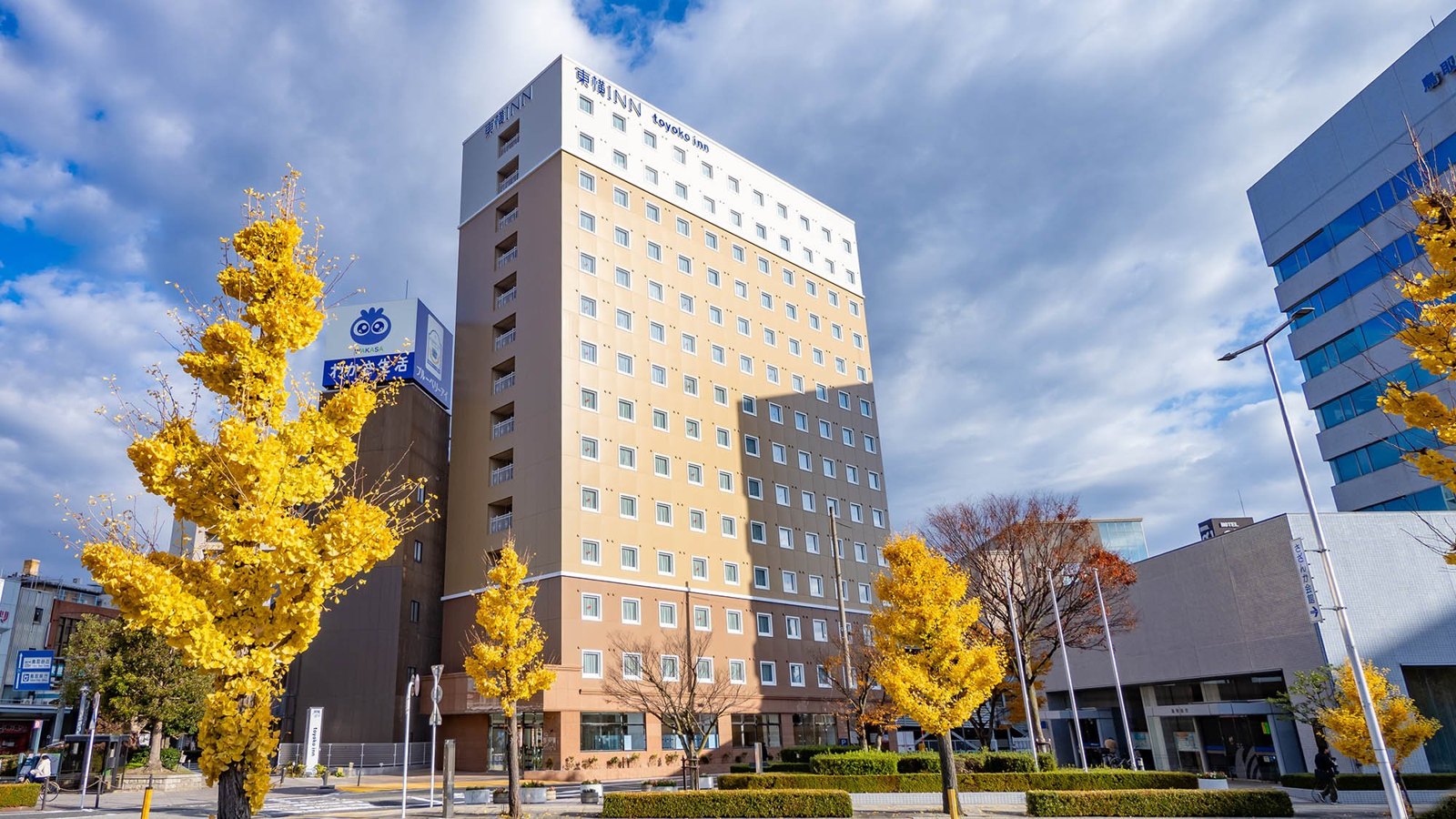
| Property | Opened | Rooms | Distance from station | Zoning (floor-area ratio) |
|---|---|---|---|---|
| Toyoko Inn Tottori-eki Kitaguchi (東横INN鳥取駅北口) | Dec 2024 | 245 | approx. 170m | Commercial (500%) |
| APA Hotel Tottori Ekimae (アパホテル〈鳥取駅前〉) | Oct 2025 | 205 | approx. 410m | Commercial (400%) |
| Hotel Livemax Tottori GRANDE (ホテルリブマックス鳥取GRANDE) | May 2026 | 158 | approx. 530m | Commercial (400%) |
| Smile Hotel Premium Tottori (スマイルホテルプレミアム鳥取) | Late Oct – early Nov 2026 | 119 | approx. 660m | Quasi-industrial (200%) |
| Total (4 properties) | — | 727 | — | — |
Price bands are distinctive too. Ranking the 22 properties in the radius with a confirmed estimated settled ADR for October 2026 by price band, 13 cluster in the ¥6,000–9,999 band, and the median of the 15 business hotels was about ¥7,900. By contrast, APA Hotel Tottori Ekimae was about ¥8,800 and Hotel Livemax Tottori GRANDE about ¥11,700 — both properties opened in 2025 or later sit above the median. New rooms are entering the market on top of the existing price bands, which can be read as pushing up the overall rate level around the station.
Current Rates — Tottori City’s October Estimated Settled ADR +12.9% YoY, Above Prior Year for Three Months Since August
To see how rates moved as supply increased, we look at the citywide estimated settled ADR. Tottori City came in at about ¥9,000 in October 2026 (N=36), up 12.9% from about ¥8,000 (N=33) a year earlier. Yonago City in the same prefecture also rose 11.1%, from about ¥7,500 to about ¥8,300, so both San’in cities posted double-digit growth. The depth of room supply by price band across the two San’in prefectures is analyzed in detail in our Tottori & Shimane hotel investment whitespace analysis.
Rates were not consistently strong throughout the year, however. From January to July 2026 they fell short of the prior year for seven straight months, by −10.7% in January and −10.5% in June. The trend turned in August, with growth widening from +5.6% to +10.8% in September and +12.9% in October. The average for the last 12 months (November 2025–October 2026) was about ¥8,200, or about ¥7,200 for business hotels only, so note that the October level is roughly 10% above the annual average.
The pattern holds within the 1km radius as well. Of the 18 properties opened in 2024 or earlier with a confirmed estimated settled ADR in both October 2025 and October 2026, 17 exceeded the prior-year month, with a median change of +7.4%. That existing properties also raised rates in an autumn of successive new openings indicates that, at least for October, demand absorbed the added supply.
Estimated Occupancy and Booking Pace — Tottori Prefecture Business Hotels at 89.0% in October, +7pt in the Final 7 Days
For occupancy, we refer to the estimated occupancy (based on OTA-listed inventory) of business hotels in Tottori Prefecture. Monthly averages for the finalized months of May–October 2026 ranged from 78.0% to 89.0%, with October at 89.0% (25 properties / 2,608 rooms, based on listings on major booking sites). Because data accumulation began in spring 2026, year-on-year comparisons are not possible; here we confine ourselves to monthly levels and booking pace.
| Stay month | Properties | Rooms | Occupancy (OTA-listed inventory basis, estimated) |
|---|---|---|---|
| May 2026 | 23 | 2,440 | 80.6% |
| June | 26 | 2,623 | 78.9% |
| July | 26 | 2,623 | 78.0% |
| August | 26 | 2,623 | 86.7% |
| September | 26 | 2,623 | 85.6% |
| October | 25 | 2,608 | 89.0% |
Because this estimate counts unlisted rooms as sold, it runs higher than actual room occupancy. For reference, in the Japan Tourism Agency’s Overnight Travel Statistics Survey for full-year 2025 (final figures), room occupancy for business hotels was 68.5% in Tottori Prefecture and 75.3% nationwide. We use the estimate less for its level than as an indicator of when inventory moves in the run-up to the stay date.
Tracing the monthly-average booking curve from 45 days out to the day before, October progressed from 62.4% at 45 days to 76.3% at 14 days, 81.7% at 7 days and 89.0% the day before. August followed nearly the same slope, rising from 58.3% to 86.7%. June, on the other hand, went from 58.2% at 45 days to only 68.5% at 7 days, then added 10.4pt in the final week to reach 78.9%. As befits a market centered on business demand, the slower the month, the heavier the weight of last-minute bookings. For operators, pricing up to two weeks out in busy months and sales design for the final week in slow months offer the greatest room to influence revenue.
Depth of the Catchment — 17,173 Workers Within 1km; Resident Population Projected −15.6% by 2040
Next, the catchment that underpins demand. According to the Economic Census (2021), 2,086 establishments and 17,173 workers are concentrated within 1km of Tottori Station, of whom 4,045 (23.6%) are office workers. That works out to about 6.5 workers per operating room (2,658 rooms), showing that, as the station front of a prefectural capital, the area has a reasonably deep base of business demand.
Rail ridership is also recovering. In the National Land Numerical Information data on passengers by station, Tottori Station (JR San’in Line) fell from 10,370 passengers/day in 2019 to 7,792/day in 2020, then recovered to 9,208/day in 2024 — 89% of the 2019 level.
The resident population, on the other hand, is expected to decline gradually. According to the National Land Numerical Information 250m-mesh future population projections, the resident population within 1.5km of the station is estimated at 29,984 in 2020, 28,870 in 2025 and 25,303 in 2040 — down 15.6% from 2020. In 2025, the working-age population accounted for 57.7% and seniors for 30.7%. In long-term business planning, capturing business travelers and tourists from outside the area will matter more than banquet and dining demand that depends on local residents.
Location Preconditions — 96.1% of Operating Rooms in the Flood Inundation Zone; Station-Front Land Prices Flat in 2026
Flood risk is indispensable to any location assessment. The area around Tottori Station is low-lying land between the Sendai and Fukuro rivers. Overlaying each property’s location on the flood inundation zone (maximum assumed scale) in MLIT’s Real Estate Information Library shows that 23 of the 24 operating properties, holding 2,555 of 2,658 rooms (96.1%), fall inside the zone. Assumed inundation depths are all within the “0.5m to under 3.0m” class; no property was found in the 3.0m-or-deeper classes.
| Item | Properties | Rooms | Share of operating rooms |
|---|---|---|---|
| Flood inundation zone (maximum assumed scale) | 23 | 2,555 | 96.1% |
| of which depth class 0.5m to under 3.0m | 23 | 2,555 | 96.1% |
| Sediment disaster warning zone | 0 | 0 | 0.0% |
| Liquefaction tendency: “prone to liquefaction” (deltas, coastal lowlands) | 22 | 2,350 | 88.4% |
| Liquefaction tendency: “somewhat prone to liquefaction” (back marshes) | 2 | 308 | 11.6% |
| Zoning: commercial district | 21 | 2,411 | 90.7% |
This result is best seen not as an assessment of any particular property but as a precondition of the station-front location itself. Because the depth class is one that stays within the ground floor, design responses — placing electrical and mechanical rooms on upper floors, using the ground floor for the lobby or parking with guest rooms on the second floor and above, and installing flood barriers — become standard items in investment plans, whether for new builds or renovations. No properties fall within sediment disaster warning zones; for liquefaction, the entire area is classified by landform as “prone” or “somewhat prone,” so ground survey and foundation costs should be budgeted early. How to translate inundation depth into equipment-floor placement and additional investment per room is laid out using five stations as examples in How Deep Could Station-Front Hotels Flood?
Land prices have entered a bottoming phase. The official land price in Sakae-machi, closest to the station’s north exit, fell 9.5% over three years from ¥126,000/㎡ in 2022 to ¥114,000/㎡ in 2025, then held at ¥114,000/㎡ in 2026 (0.0% YoY). Of the six commercial points in the radius, three were flat in 2026 and the remaining three declined only slightly, by −0.6% to −1.3%. The turn to flat land prices coincided with the run of hotel openings, and land acquisition costs settling at a stable level is a factor that makes the area easier for developers to consider.
Required ADR for a 100-Room Business Hotel — Around ¥11,500 for a 7% GOP Yield
Using the material so far, we back out the ADR required to build a new 100-room business hotel within 1km of the station. Assumptions are shown in the table below; construction cost is based on the 2025 steel-frame (S) unit cost of ¥2.405 million per tsubo from MLIT’s Building Construction Starts Statistics. The all-structure average rose 41% in two years, from ¥1.38 million in 2022 to ¥1.95 million in 2024, so we also show a case that factors in further increases until construction starts.
| Item | Assumption | Basis |
|---|---|---|
| Rooms / gross floor area | 100 rooms / approx. 2,308㎡ (approx. 698 tsubo) | 15㎡ rooms, 65% guest-room ratio (this article’s assumption) |
| Construction cost (2025 actual basis) | Approx. ¥1.68 billion | S-frame ¥2.405 million/tsubo (Building Construction Starts Statistics, 2025) |
| Construction cost (with escalation during construction) | Approx. ¥1.94 billion | Three years of increases at +5.3%, +5.0% and +4.5% → ¥2.779 million/tsubo |
| Design, FF&E and pre-opening | 10% of construction cost | This article’s assumption |
| Land | Approx. ¥46 million | 600㎡ site × official land price ¥76,100/㎡ (Tomiyasu 1-chome, 400% floor-area ratio) |
| Total investment | Approx. ¥1.89 billion / approx. ¥2.18 billion | 2025 actual basis / with escalation |
| Occupancy | 70% (sensitivity analysis at 65–75%) | Referencing 68.5% for Tottori Prefecture business hotels in JTA statistics (2025) |
| GOP margin | 45% | Midpoint between the 40–60% guideline for limited-service hotels and the 38.9% actual for 91 properties operated by MHM for Invincible Investment Corporation (fiscal period ended December 2024) |
Setting the GOP yield (GOP ÷ total investment) at 7% and occupancy at 70%, the required ADR is about ¥11,500 at 2025 actual construction costs, and about ¥13,300 when escalation during construction is factored in. That is 1.45× the October 2026 median for business hotels in the radius (about ¥7,900), and nearly equal to the highest business-hotel rate in the radius that month, about ¥11,700.
| GOP yield | Annual occupancy 65% | Annual occupancy 70% | Annual occupancy 75% |
|---|---|---|---|
| 6% | ¥10,635 | ¥9,876 | ¥9,217 |
| 7% | ¥12,408 | ¥11,522 | ¥10,753 |
| 8% | ¥14,180 | ¥13,168 | ¥12,290 |
| 7% (with construction cost escalation) | ¥14,290 | ¥13,269 | ¥12,384 |
Two points emerge from this estimate. First, making a new build pencil out presupposes a product designed to secure upper-tier rates in the radius on a full-year basis. The direction of recent openings — capturing rate through added value such as large public baths, larger rooms and breakfast — is consistent with this calculation. Second, it shows why openings that reuse existing buildings make sense. In a structure where construction accounts for about 90% of total investment, taking over a building and limiting spend to renovation can sharply lower the required ADR (for the cost profile of converting existing buildings, see the case of two existing buildings with 342 rooms revitalized in Asahibashi, Naha). With 9 properties and 1,131 rooms opened in the 1970s–1990s around the station, there also appear to be broad opportunities for reinvestment through rebranding and renovation. Rising construction costs also tend to restrain new supply, which could work as a tailwind for already-operating properties by stabilizing the competitive environment.
Investment Takeaways — Three Points to Watch
| Issue | What we confirmed | Points to watch |
|---|---|---|
| Supply | 24 operating properties / 2,658 rooms. The 4 properties / 727 rooms opened since 2024 are all business hotels | Rate and occupancy trends in winter–spring after the wave of openings has passed |
| Demand / rates | Tottori City’s estimated settled ADR was +5.6% to +12.9% YoY in August–October. 17 of 18 existing properties in the radius beat last year in October | Lifting the off-season, which ran below the prior year from January to July |
| Catchment | 17,173 workers within 1km; station ridership at 89% of 2019 | Resident population projected −15.6% by 2040 vs. 2020. Capturing demand from outside the area |
| Location | 96.1% of operating rooms inside the flood inundation zone (0.5m to under 3.0m class). Official land prices flat in 2026 | Placement of equipment floors, flood countermeasures, budgeting for ground surveys |
| Feasibility | Required ADR for a new 100-room build at a 7% GOP yield is about ¥11,500 (70% annual occupancy) | Rising construction costs; comparison with reusing existing buildings |
In sum, the Tottori Station front is a market where the recent track record that “rates rose even as supply increased” coexists with the feasibility condition that “a new build needs upper-tier rates for the radius.” With the wave of new station-front supply now complete, the next inputs for investment decisions will be how much tourism demand the station front can capture during the winter snow-crab (matsuba-gani) season, and whether it can beat the prior year in the off-season after the New Year. From an acquisition or renovation perspective, the presence of several older properties with more than 100 rooms and the settling of land prices are worth viewing as reinvestment opportunities.
Related Articles
You May Also Like
- How Deep Could Station-Front Hotels Flood? — 29,800 Rooms Within 1km of Nagoya, Gifu, Okayama, Hiroshima and Kumamoto Stations, 24% in 3–5m Depth Zones
- Tokuyama Station Hotel Rooms — 13 Operating Hotels / 1,634 Rooms Within 1km, +29% in 9 Years; Shunan City ADR ¥6,932 and Storm-Surge Risk
- Niigata Station Hotel Site Evaluation: 31 Hotels / 5,742 Rooms Within 1km, +1,001 Rooms in 2022 and Chuo Ward ADR ¥8,036
- Hotel Route-Inn Grand Izumo’s 244 Rooms Add 8.9% to Izumo City’s Supply — Reading the Impact of 2027+ Openings From Published Figures
- Two Existing Buildings With 342 Rooms Revitalized in Asahibashi, Naha — 14,900 Rooms Within 1km, Supply Without New Builds and Naha City ADR ¥10,300
References and Sources
■ Data Sources
OTA public price and inventory data (compiled by MetroEngines Research & Consulting; within 1,000m of Tottori Station, 10+ rooms, excluding love hotels; 24 operating properties / 2,658 rooms); MLIT Real Estate Information Library and National Land Numerical Information (official land prices, zoning, flood inundation zones, sediment disaster warning zones, liquefaction tendency, passengers by station, 250m-mesh future population projections); Economic Census for Business Activity (2021); JTA Overnight Travel Statistics Survey; MLIT Building Construction Starts Statistics.
■ Estimate Assumptions
100 rooms, 15㎡ rooms, 65% guest-room ratio (gross floor area approx. 2,308㎡); construction cost in two cases — S-frame ¥2.405 million/tsubo (2025) and ¥2.779 million/tsubo with escalation during construction; design, FF&E and pre-opening at 10% of construction cost; land = 600㎡ site × official land price ¥76,100/㎡; GOP margin 45%; annual occupancy 70% (sensitivity at 65–75%). Rooms revenue only.
■ Limitations
Estimated settled ADR is an estimate (tax-exclusive equivalent) obtained by applying segment-specific adjustment factors to the lowest-plan level on OTAs, and differs from actual settled prices. Estimated occupancy is based on OTA-listed inventory and therefore runs higher than actual occupancy. Flood and liquefaction judgments are based on each property’s representative point and do not assess building countermeasures. Required ADR is a simplified estimate that excludes ancillary revenue, rent, fixed-asset tax, depreciation and financing costs.
■ Market Data
MetroEngines Research & Consulting — Room stock within 1km of Tottori Station (24 operating properties / 2,658 rooms), estimated settled ADR (Tottori City N=36, radius N=22), estimated occupancy and booking curves (25 Tottori Prefecture business hotels)
■ Government Statistics and Public Data
MLIT Real Estate Information Library — official land prices, zoning, flood inundation zones, sediment disaster warning zones, liquefaction tendency map, passengers by station
MLIT National Land Numerical Information, “Flood Inundation Zones (by River) Product Specification v4.2” (inundation depth classes)
MLIT National Land Numerical Information (250m-mesh future population projections)
Ministry of Internal Affairs and Communications / Ministry of Economy, Trade and Industry, “Economic Census for Business Activity” (2021)
Japan Tourism Agency, “Overnight Travel Statistics Survey (2025, Annual Final Figures)”
MLIT, “Building Construction Starts Statistics”
■ REITs and Industry Reports
Invincible Investment Corporation (8963) — Hotel Portfolio and Operating Results
Relo Hotel Solutions, “GOP Benchmarks by Hotel Type”
■ News and Official Information
TRAICY — articles on Hotel Livemax Tottori GRANDE (opening in the former Bird Stay Hotel building)
APA Hotel Tottori Ekimae — official website