

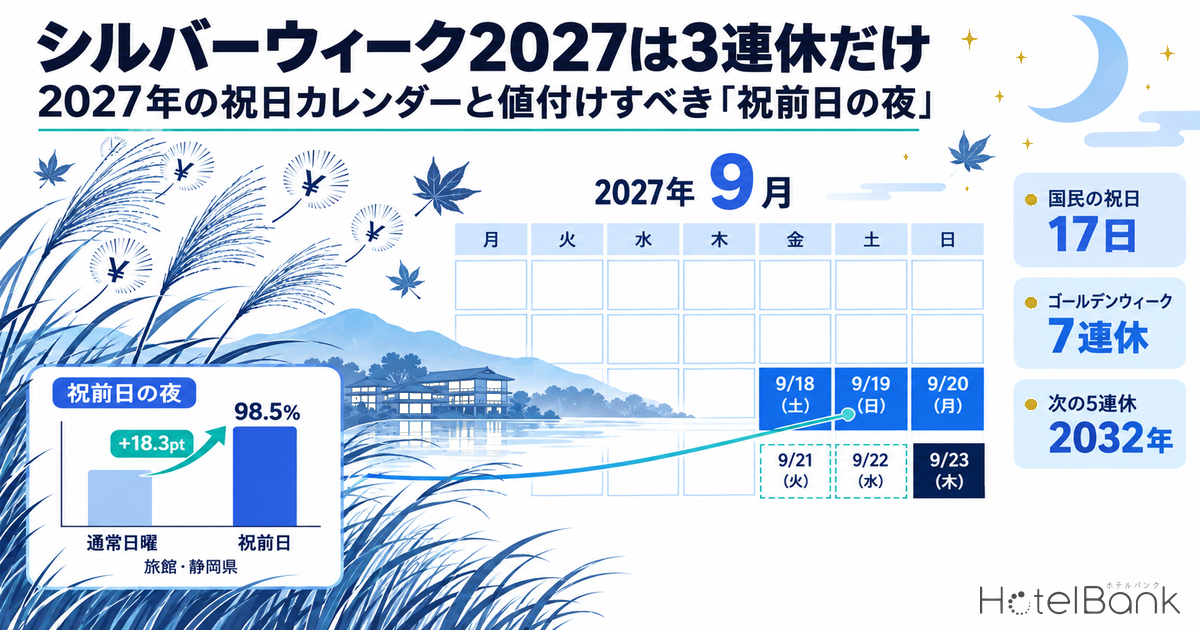
Japan will have 17 national holidays in 2027. A look at the calendar officially published by the Cabinet Office shows that September’s Respect for the Aged Day (Monday, September 20) and Autumnal Equinox Day (Thursday, September 23) are two days apart, so the Holiday Act’s “citizens’ holiday” rule does not apply. The five-day September break that returned in 2026 for the first time in 11 years will not repeat in 2027: Silver Week shrinks to a three-day weekend from September 18 to 20. Golden Week, by contrast, delivers five consecutive days off with zero paid leave, and taking just one day off on Friday, April 30 stretches it to seven. For annual budgeting and rate design, 2027 rests on entirely different assumptions from 2026.
Metric Definitions Used in This Article
- ADR (Average Daily Rate): An estimated transacted rate (tax-exclusive equivalent), calculated by applying category-specific adjustment factors to the lowest-plan price level each property publishes on OTAs and similar channels (per room, 2 guests, tax-inclusive). Validated against property-level results disclosed by listed hotel REITs (91 properties, most recent 3 months), with a median error of about 7%. These are estimates and differ from each property’s actual transacted rates and accounting figures. Area-level ADR is the median of the properties covered (the level of a typical property in the area).
- OCC (Occupancy Rate): The share of rooms sold against total rooms in the area (an estimate based on OTA sales inventory; consistency checks against monthly REIT disclosures confirm accuracy within roughly a few points). Because it is based on how inventory sold on OTAs is absorbed, it differs from each property’s actual overall occupancy.
- Listed price: The average selling price published on OTAs and similar channels at the time of observation (per room, 2 guests, tax-inclusive, average across all plans). Because its basis differs from the estimated transacted ADR, the two are not compared directly.
- Holiday eve: The night before a day off (based on check-in date). In this article, stay dates are referred to as “nights.”
- Data sources: MetroEngines Research / Cabinet Office, “About National Holidays”
- — Silver Week 2027 is only a three-day weekend, Sep 18–20. Respect for the Aged Day (Mon, Sep 20) and Autumnal Equinox Day (Thu, Sep 23) are two days apart, so the Holiday Act’s “citizens’ holiday” does not apply and 2026’s five-day break will not repeat.
- — The next five-day September break is projected for 2032. With a six-year gap after 2026, areas that have relied on a long September holiday need to replace that assumption in their 2027 plans.
- — Golden Week gives five days off with no paid leave; one day off on Fri, Apr 30 makes it seven (Apr 29–May 5). 2027 has six opportunities to stretch a break to four days or more with a single day of paid leave, spread across the February off-season and the November autumn-foliage season.
- — Measured data show a holiday-eve Sunday running +18.3pt above a regular Sunday. Over the July 2026 three-day weekend, 375 ryokan in Shizuoka reached an estimated OCC of 98.5%, beating even a regular Saturday (87.9%) by 10.6pt.
- — 2027 has 11 “non-Saturday nights followed by a day off.” These are Sunday, Monday, Tuesday and Wednesday nights that a day-of-week rate table classifies as cheap, so day-of-week-based pricing leaves the opportunity on the table.
Silver Week 2027 Is Only Three Days — No Citizens’ Holiday Occurs
We start with “Silver Week 2027,” the topic drawing the most search interest. Among the 2027 (Reiwa 9) national holidays published by the Cabinet Office, Respect for the Aged Day falls on Monday, September 20 and Autumnal Equinox Day on Thursday, September 23. The days between them, Tuesday, September 21 and Wednesday, September 22, span two days, so they do not meet the condition in Article 3, Paragraph 3 of the Holiday Act that “a day whose preceding and following days are both national holidays shall be a holiday” (i.e., only a single sandwiched day qualifies). As a result, no citizens’ holiday occurs in 2027, and September’s long weekend ends as a three-day break from Saturday, September 18 to Monday, September 20.
In 2026, Respect for the Aged Day fell on Monday, September 21 and Autumnal Equinox Day on Wednesday, September 23, making Tuesday, September 22 a citizens’ holiday and creating a five-day break from Saturday, September 19 to Wednesday, September 23. It was the first extended Silver Week in 11 years, and occupancy jumped across the country. 2027 takes the rebound a year later. September’s demand peak will be compressed into the middle night of the three-day weekend (Sunday, September 19), while Thursday, September 23 later in the week stands alone as an isolated holiday.
Respect for the Aged Day is fixed on the third Monday of September, while Autumnal Equinox Day moves each year based on astronomical calculation, so the arrangement with exactly one day between them occurs irregularly. Projections based on the National Astronomical Observatory of Japan’s formula put the next citizens’ holiday and five-day break in 2032, a six-year gap after 2026. Note that Autumnal Equinox Day is officially fixed only in the “Rekiyoko” (ephemeris) published in the Official Gazette each February for the following year, so dates from 2028 onward are projections.
Bottom line for September 2027: The long weekend is three days, Sep 18 (Sat) – Sep 20 (Mon). Autumnal Equinox Day on Sep 23 (Thu) is an isolated holiday; taking Sep 24 (Fri) off creates a four-day break from Sep 23 to Sep 26 (Sun). Design September inventory around two peaks: an “early three days” and a “later four days.”
Japan’s 17 National Holidays in 2027 — The Full Cabinet Office List
Japan’s national holidays and days off for 2027 (Reiwa 9) are the 17 days below. There is only one substitute holiday, Monday, March 22, and no citizens’ holiday. None of the holidays fall on a Saturday; all 17 land on a weekday or Sunday, which is favorable for lodging demand.
| Date | Day | Holiday | Long-weekend pattern |
|---|---|---|---|
| Jan 1 | Fri | New Year’s Day | 3-day break, Jan 1–3 |
| Jan 11 | Mon | Coming of Age Day | 3-day break, Jan 9–11 |
| Feb 11 | Thu | National Foundation Day | 4 days with Feb 12 (Fri) off |
| Feb 23 | Tue | The Emperor’s Birthday | 4 days with Feb 22 (Mon) off |
| Mar 21 | Sun | Vernal Equinox Day | 3-day break, Mar 20–22 |
| Mar 22 | Mon | Substitute holiday | Same as above |
| Apr 29 | Thu | Showa Day | 7 days, Apr 29–May 5, with Apr 30 (Fri) off |
| May 3 | Mon | Constitution Memorial Day | 5-day break, May 1–5 (no leave needed) |
| May 4 | Tue | Greenery Day | Same as above |
| May 5 | Wed | Children’s Day | Same as above |
| Jul 19 | Mon | Marine Day | 3-day break, Jul 17–19 |
| Aug 11 | Wed | Mountain Day | 5 days, Aug 11–15, with Aug 12–13 off |
| Sep 20 | Mon | Respect for the Aged Day | 3-day break, Sep 18–20 |
| Sep 23 | Thu | Autumnal Equinox Day | 4 days with Sep 24 (Fri) off |
| Oct 11 | Mon | Sports Day | 3-day break, Oct 9–11 |
| Nov 3 | Wed | Culture Day | 5 days, Oct 30–Nov 3, with Nov 2 (Tue) off |
| Nov 23 | Tue | Labor Thanksgiving Day | 4 days with Nov 22 (Mon) off |
Source: Compiled by HotelBank Editorial Team from Cabinet Office, “About National Holidays” (2027 national holidays)
By day of the week, the holidays break down as 6 Mondays, 3 Tuesdays, 3 Wednesdays, 3 Thursdays, 1 Friday, 1 Sunday and 0 Saturdays. With not a single holiday “lost” to a Saturday, the arrangement is straightforward for lodging demand. Of the six Monday holidays, the five outside Golden Week’s May 3 (Jan 11, Mar 22, Jul 19, Sep 20, Oct 11) each attach directly to a weekend to form a three-day break. That means Sunday night turns into the middle night of an effective weekend five times a year. As shown below, these Sunday nights are the unit where revenue design pays off most in 2027.
Long Breaks Made With One Day of Leave — Six Chances in 2027, Longest Is Apr 29–May 5
In practice, what drives lodging demand is less the holiday itself than “how many days guests can string together.” In 2027 there are seven breaks of three days or more that require no paid leave, and six opportunities to extend a break to four days or more with one day of leave. The chart below stacks, for each holiday, the “days off that occur automatically” and the “days that can be added with paid leave.”
Source: Compiled by HotelBank Editorial Team from Cabinet Office, “About National Holidays”
Golden Week has the most upside. Saturday, May 1 through Wednesday, May 5 is a five-day break with zero paid leave, and adding one day, Friday, April 30, makes it a seven-day break from Thursday, April 29 to Wednesday, May 5. Taking Thursday, May 6 and Friday, May 7 off as well yields 11 days, from April 29 to Sunday, May 9. Compared with Golden Week 2026, a five-day break from Saturday, May 2 to Wednesday, May 6, 2027 adds two days of depth at the front. Inventory should be placed on the assumption that demand starts building on the night of Wednesday, April 28.
February and November deserve attention next. In February, both National Foundation Day (Thu, Feb 11) and The Emperor’s Birthday (Tue, Feb 23) take the “four days with one day of leave” form, creating two demand peaks in the off-season. In November, taking Tuesday, November 2, the day before Culture Day (Wed, Nov 3), off makes a five-day break from Saturday, October 30, and taking Monday, November 22, the day before Labor Thanksgiving Day (Tue, Nov 23), off makes a four-day break from Saturday, November 20. Two weekend-extending breaks land in the latter half of the autumn-foliage season.
Mountain Day (Wed, Aug 11), on the other hand, does not create a long weekend on its own. However, because many companies designate Thursday, August 12 and Friday, August 13 as summer closure days, it is in practice treated as a five-day break from Wednesday, August 11 to Sunday, August 15. Taking Monday, August 9 and Tuesday, August 10 off as well makes nine days, from Saturday, August 7 to Sunday, August 15. As usual, the Obon demand peak is expected to concentrate on the nights of August 12–14.
| Opportunity | Paid leave on | Resulting break | Days |
|---|---|---|---|
| National Foundation Day | Feb 12 (Fri) | Feb 11 (Thu) – Feb 14 (Sun) | 4 |
| The Emperor’s Birthday | Feb 22 (Mon) | Feb 20 (Sat) – Feb 23 (Tue) | 4 |
| Golden Week | Apr 30 (Fri) | Apr 29 (Thu) – May 5 (Wed) | 7 |
| Mountain Day / Obon | Aug 12 (Thu), Aug 13 (Fri) | Aug 11 (Wed) – Aug 15 (Sun) | 5 |
| Autumnal Equinox Day | Sep 24 (Fri) | Sep 23 (Thu) – Sep 26 (Sun) | 4 |
| Culture Day | Nov 2 (Tue) | Oct 30 (Sat) – Nov 3 (Wed) | 5 |
| Labor Thanksgiving Day | Nov 22 (Mon) | Nov 20 (Sat) – Nov 23 (Tue) | 4 |
Source: Compiled by HotelBank Editorial Team from Cabinet Office, “About National Holidays”
Measured: Holiday-Eve Nights Beat a “Regular Saturday” — Up to +18.3pt for Ryokan
Moving from the calendar to measured data, we now examine how the day-of-week arrangement actually plays out. We use the Marine Day (Monday, July 20) three-day weekend in July 2026. It has the same arrangement as the Monday holidays that occur five times in 2027, and it is a past month with finalized observations, making it a suitable benchmark.
The comparison works as follows. We build day-of-week averages from regular days between June 1 and July 31, 2026, excluding holidays, three-day weekends and Obon, and use them as the baseline against the estimated OCC and listed prices for the holiday eve, Sunday, July 19. The chart below compares three bars, “regular Sunday,” “holiday-eve Sunday” and “regular Saturday,” by property type and area.
Source: Compiled by MetroEngines Research and HotelBank Editorial Team (see table in text for property counts)
The results are clear. For leisure-oriented property types, a holiday-eve Sunday outperforms even a regular Saturday. Ryokan in Shizuoka went from 80.2% on a regular Sunday to 98.5% on the holiday eve, +18.3pt, beating a regular Saturday’s 87.9% by 10.6pt. Ryokan in Nagano rose from 81.9% to 97.3% (+15.4pt), and resort hotels in Shizuoka from 82.3% to 98.5% (+16.2pt). Sunday is normally the weakest night of the week, so a structure that lifts it above Saturday levels, even once a year, matters enormously for rate design.
The same happens for business hotels in tourist destinations. Business hotels in Kyoto went from 78.2% on a regular Sunday to 92.4% on the holiday eve (+14.2pt), and in Nagano from 81.5% to 98.3% (+16.8pt), both exceeding a regular Saturday. Business hotels in Tokyo, by contrast, rose only +3.6pt, from 89.5% to 93.1%, falling short of a regular Saturday’s 95.8%. Separate from the structure in which central-city demand lifts Saturdays, the gap shows that holiday eves matter more the more tourism-driven the destination.
Source: Compiled by MetroEngines Research and HotelBank Editorial Team (listed price, per room for 2 guests, tax-inclusive)
Listed prices show the same pattern. Resort hotels in Shizuoka went from ¥33,100 on a regular Sunday to ¥58,400 on the holiday eve (+77%), ryokan in Nagano from ¥27,800 to ¥40,100 (+44%), and business hotels in Kyoto from ¥11,700 to ¥19,700 (+68%). In areas where occupancy exceeds Saturday levels, prices have also been raised to Saturday levels. Put the other way, if a holiday-eve Sunday is left at the regular Sunday rate, there is revenue left on the table.
| Type / Area | Regular Sun | Holiday eve (Sun, Jul 19) | Regular Sat | vs. Sun | Properties |
|---|---|---|---|---|---|
| Ryokan / Shizuoka | 80.2% | 98.5% | 87.9% | +18.3pt | 375 properties / 9,253 rooms |
| Business / Nagano | 81.5% | 98.3% | 94.4% | +16.8pt | 139 properties / 13,035 rooms |
| Resort / Shizuoka | 82.3% | 98.5% | 90.7% | +16.2pt | 132 properties / 7,765 rooms |
| Ryokan / Nagano | 81.9% | 97.3% | 89.2% | +15.4pt | 410 properties / 9,196 rooms |
| Business / Kyoto | 78.2% | 92.4% | 89.4% | +14.2pt | 292 properties / 31,657 rooms |
| Ryokan / Hokkaido | 84.8% | 94.1% | 92.0% | +9.3pt | 258 properties / 11,451 rooms |
| Resort / Okinawa | 89.2% | 95.2% | 92.1% | +6.0pt | 237 properties / 24,700 rooms |
| Business / Tokyo | 89.5% | 93.1% | 95.8% | +3.6pt | 858 properties / 125,367 rooms |
Source: Compiled by MetroEngines Research and HotelBank Editorial Team (estimated OCC; baseline is the day-of-week average of regular days, June 1–July 31, 2026, excluding holidays, three-day weekends and Obon)
The Longer the Break, the More Value Shifts to the Front — Daily Decay in Golden Week 2026
A longer break does not mean every night fills evenly. Tracking Golden Week 2026 (Saturday, May 2 to Wednesday, May 6) day by day across 131 resort hotels (7,747 rooms) in Shizuoka shows demand and prices clearly skewed toward the front half.
Source: Compiled by MetroEngines Research and HotelBank Editorial Team (Golden Week 2026, 131 resort hotels / 7,747 rooms in Shizuoka; listed price per room for 2 guests, tax-inclusive)
The peak came on Sunday, May 3, with an estimated OCC of 99.4% (May 2026, 131 resort hotels in Shizuoka) and a listed price of ¥84,800, and Monday, May 4 held at nearly the same level. But Tuesday, May 5, the second-to-last night of the break, fell to 93.9% and ¥57,800, and Wednesday, May 6 dropped to 78.6% and ¥34,100. Listed prices on the final day were roughly 60% below the peak day. Even within the same break, the last two nights need to be treated as an entirely different product from the first three.
This shape applies directly to Golden Week 2027. In 2027 the largest block runs from Thursday, April 29 to Wednesday, May 5; since the last day is May 5, the final night of the stay is Tuesday, May 4, corresponding to Tuesday, May 5 in 2026. A three-part design, with Saturday, May 1 and Sunday, May 2 as the top-rate zone, Thursday, April 29 to Friday, April 30 as the ramp-up zone, and Monday, May 3 to Tuesday, May 4 as the decay zone, is therefore consistent with the measured pattern. The night of Wednesday, May 5 falls on the return day, so it should be handled separately as short-haul one-night demand rather than as capacity for multi-night stays.
Differences by property type also matter. Within the same Shizuoka market, 210 business hotels sank to 70.8% on Wednesday, May 6, while 384 ryokan rode the leisure-demand peak cleanly at 94.6% on Saturday, May 2 and 98.8% on Sunday, May 3. For ryokan and resorts the middle nights of a break are the peak; for business hotels, the night of the holiday itself (i.e., the night before a workday) is the trough. Our analyses of day-of-week occupancy in Gunma and occupancy by property type in Kumamoto likewise confirm that the trough falls on different days depending on property type.
Where to Set the Annual Price Baseline — Seasonality of Monthly ADR
Alongside night-by-night design for long weekends, an annual rate plan needs a monthly baseline. The chart below overlays Tokyo’s estimated transacted ADR by month (1,067–1,151 properties). It shows that demand itself swings substantially with the seasons, not just with the presence or absence of long weekends.
Source: Compiled by MetroEngines Research and HotelBank Editorial Team (Tokyo, estimated transacted ADR, N=1,067–1,151 properties, finalized months only)
In Tokyo, April and November form two peaks. April 2026 came in at ¥17,800, about 1.5 times August of the same year (¥11,800). In 2025, too, November (¥17,100) and June (¥12,600) were about 1.35 times apart. In other words, the strongest and weakest months of the year differ by around 50%, and how this monthly baseline is set shapes annual revenue even before any spot tactics for long weekends.
Kyoto swings even more. Estimated transacted ADR was ¥24,800 in November 2025 and ¥11,400 in June 2026, a gap of about 2.2 times. Demand is heavily concentrated in the autumn-foliage season, and in 2027 two breaks, the five days around Culture Day (Wed, Nov 3) and the four days around Labor Thanksgiving Day (Tue, Nov 23), fall within this peak period. In autumn-dominant areas like Kyoto, November 2027 will be a once-a-year moment where the long-weekend effect and the seasonal effect overlap.
Okinawa, conversely, peaks in July (¥13,700) and August (¥14,700) (both 2026) and settles to ¥10,600 in November (2025). The 2027 calendar, with its long weekends concentrated in autumn, is relatively less effective in Okinawa, where demand clusters in summer. Whether area seasonality or the holiday arrangement dominates depends on property type and location, so hotels should overlay the calendar on their own monthly results to check.
The Nights to Prepare for in 2027 — Date List
Putting it all together, the nights for which inventory and rates should be designed as a priority in 2027 are listed below. The measured data show the largest upside on “non-Saturday nights followed by a day off,” and 2027 has 11 of them. Adding the consecutive nights within Golden Week brings the total to 17 nights.
| Stay date (night) | Position | Design approach |
|---|---|---|
| Jan 10 (Sun) | Eve of Coming of Age Day | Move to Saturday-level rates. Top priority for winter leisure destinations |
| Feb 10 (Wed) | Eve of National Foundation Day | An off-season Wednesday. Prepare capacity for one-night demand |
| Feb 12 (Fri) – Feb 13 (Sat) | Middle nights of a 4-day break | Release multi-night plans early for guests taking one day of leave |
| Feb 21 (Sun), Feb 22 (Mon) | Middle nights of The Emperor’s Birthday 4-day break | Sunday and Monday become middle nights. February’s second peak |
| Mar 21 (Sun) | Eve of the substitute holiday | Middle night of a 3-day break overlapping spring vacation. Set allocations early |
| Apr 28 (Wed) | Holiday eve as Golden Week starts | Decide whether Golden Week rates start here |
| May 1 (Sat), May 2 (Sun) | Golden Week peak-demand zone | The top-rate zone of the year. Measured data show the peak here |
| May 3 (Mon), May 4 (Tue) | Golden Week decay zone | Do not price the same as the first half. Set tiered steps |
| Jul 18 (Sun) | Eve of Marine Day | The arrangement that recorded up to +18.3pt in 2026 measurements |
| Aug 10 (Tue) – Aug 14 (Sat) | Mountain Day / Obon | Aug 11 (Wed) is the holiday. Demand builds from the night of Aug 10 |
| Sep 19 (Sun) | Eve of Respect for the Aged Day | The only middle night in September 2027. Demand concentrates here |
| Sep 22 (Wed), Sep 24 (Fri) | Around Autumnal Equinox Day | For guests making a 4-day break. Design as a separate product from the 3-day weekend |
| Oct 10 (Sun) | Eve of Sports Day | Start of the autumn travel season. Likely starting point for multi-night stays |
| Oct 31 (Sun), Nov 2 (Tue) | Culture Day 5-day break | Overlaps foliage season. Top priority for autumn-driven areas such as Kyoto |
| Nov 21 (Sun), Nov 22 (Mon) | Middle nights of Labor Thanksgiving Day 4-day break | The only arrangement of the year where Monday night becomes a middle night |
Source: Cabinet Office, “About National Holidays” / compiled by MetroEngines Research and HotelBank Editorial Team
What these nights have in common is that a standard day-of-week rate table classifies them as “cheap days.” Because of the calendar, Sunday, Monday, Tuesday and Wednesday nights carry Saturday-equivalent demand. As long as prices are set by day of the week, that gap goes uncaptured. When building the 2027 rate table, pulling just the dates above out of the day-of-week categories and placing them on a separate calendar lets a hotel capture the opportunity throughout the year.
Summary
The 2027 calendar is thin in September and thick in April–May and November. Silver Week is only a three-day weekend, September 18–20, and with no citizens’ holiday, 2026’s five-day break will not repeat. The next five-day break is projected for 2032, so areas that have relied heavily on September need to replace that assumption in their 2027 plans.
Golden Week, meanwhile, takes a strong shape, five days with no leave and seven with one day off, and in November the five-day break around Culture Day and the four-day break around Labor Thanksgiving Day overlap the peak foliage season. Across the year, total demand does not shrink; it is more accurate to say that where it sits has shifted.
And what the measured data revealed is a structure in which the value of a long weekend lies not in “the holiday itself” but in “the night before.” Over the July 2026 three-day weekend, the holiday-eve Sunday at 375 ryokan in Shizuoka reached an estimated OCC of 98.5%, 10.6pt above a regular Saturday, with listed prices running +29% over a regular Sunday. This arrangement occurs five times in 2027. How hotels price these five Sunday nights, January 10, March 21, July 18, September 19 and October 10, will be the most repeatable lever for annual revenue in 2027.
Note on data scope: The estimated OCC and listed prices in this article are measured values based on finalized observations from May to August 2026. They are not forecasts of 2027 demand or prices, but show how the same day-of-week arrangement played out in the past. Holiday dates are based on the 2027 (Reiwa 9) calendar officially published by the Cabinet Office. Because Autumnal Equinox Day from 2028 onward is fixed each February in the “Rekiyoko” published in the Official Gazette, the references to 2032 in this article are projections based on the National Astronomical Observatory of Japan’s formula.
Related Reading
- Culture Day 2026 Falls on a Tuesday, and Demand Peaks on the Holiday Eve — Daily Prices in 7 Foliage Areas
- Gunma Day-of-Week Occupancy: The Trough Falls on Different Days by Type — Wednesday for Ryokan and Resorts, Sunday for Business Hotels
- Kumamoto Day-of-Week Occupancy Inverts by Type — Business Hotels Peak Thursday and Saturday, Ryokan Only on Saturday
- Year-End 2026-27 Room Rates Are Already Visible — December Forward ADR vs. Prior-Year Actuals
References and Sources
■ Data sources
All 17 holiday dates and names were checked against the finalized 2027 (Reiwa 9) calendar in the Cabinet Office’s “About National Holidays” (including its list CSV). Measured occupancy and prices use estimated OCC, listed prices and estimated transacted ADR calculated from OTA public inventory and published prices that we observe, limited to the finalized observation months of May to August 2026.
■ Calculation assumptions
The holiday-eve effect is the difference (pt) between the holiday eve and the day-of-week average of regular days between June 1 and July 31, 2026, excluding holidays, three-day weekends and Obon, for the same area and property type. Break lengths assume Saturdays and Sundays as regular days off and paid leave taken in one-day units. Because Autumnal Equinox Day from 2028 onward is fixed each February in the “Rekiyoko” published in the Official Gazette, the references to 2032 are projections based on the National Astronomical Observatory of Japan’s formula.
■ Limitations and caveats
Estimated transacted ADR has a median error of about 7% against property-level disclosures by listed hotel REITs (91 properties, most recent 3 months), and estimated OCC is accurate within roughly a few points based on consistency checks against monthly REIT disclosures. The holiday-eve uplift ranges from +3.6pt to +18.3pt depending on property type and area and cannot be represented by a single figure. This article does not forecast 2027 demand or prices; it is limited to measurements showing how the same day-of-week arrangement played out in the past. Listed prices and estimated transacted ADR have different bases and are not compared directly.
- Cabinet Office, “About National Holidays” (2026 and 2027 national holidays; Act on National Holidays)
- Cabinet Office, list of national holidays (CSV, finalized)
- National Astronomical Observatory of Japan, “Rekiyoko” (official publication of vernal and autumnal equinox dates)
- Japan Tourism Agency, “Overnight Travel Statistics Survey”
- MetroEngines Research — estimated OCC (based on OTA-listed inventory), listed prices, estimated transacted ADR