

Training programmes, project-based business trips, a home renovation, a stopgap while you wait for the next apartment to be finalised. There are more situations than you might expect where a long hotel stay is measured in “two months.” Yet while plenty has been written about one-week and one-month rates, almost nothing sets out the total cost of a 60-night block. This article calculates the real-world 60-night total from business hotel price data in Tokyo and Osaka, lines it up against the published rates of monthly serviced apartments on a like-for-like basis, and works through the practical issues that actually trip people up over a two-month stay.
Metric Definitions Used in This Article
- Lowest-plan level: for each day, the cheapest plan a property is selling on that date; averaged over the period per property, then taken as the median across the target area. Used because it is the closest indicator to the price band long-stay guests actually book. Per room, tax included.
- Listed price (all-plan average, tax incl.): the average price across every publicly listed plan, from room-only to meals-included. Because it includes higher-grade rooms and plans, it comes out above the lowest-plan level. Per room, based on two guests sharing.
- 60-night total: the per-night figures above multiplied by 60. It does not apply consecutive-night discounts or dedicated long-stay plans, so an actual booking total can come in below this.
- Data source: MetroEngines Research. Of roughly 168,000 accommodation properties in Japan tracked by the company, the analysis covers the roughly 27,000 properties and 1.26 million rooms whose operation can be confirmed on OTAs and other sales channels.
Note: this article does not use estimated settled ADR (average daily rate). Because it deals with the actual cash cost of a stay, it uses the listed selling prices as published.
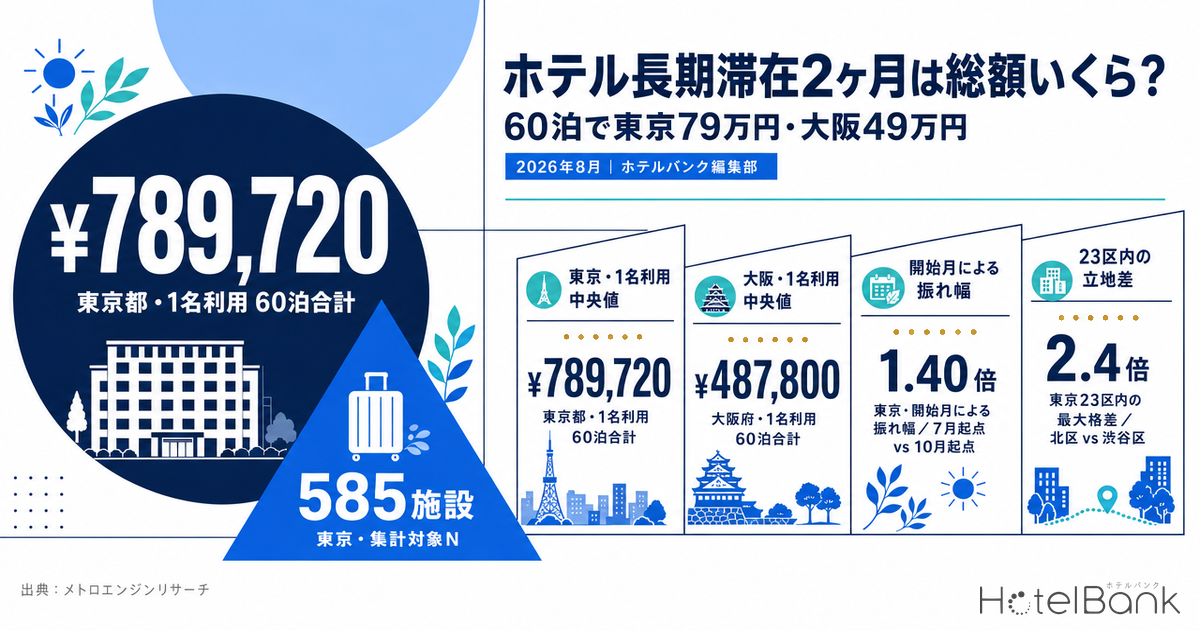
- — Roughly ¥790,000 in Tokyo and ¥488,000 in Osaka is the real-world median for one person staying 60 nights in a business hotel (check-ins 1 September – 30 October 2026; Tokyo N=585 properties, Osaka N=277 properties).
- — Up to 1.40× depending on the starting month — in Tokyo, a July start comes to roughly ¥1.19 million against roughly ¥1.66 million for an October start, a swing of about ¥470,000. If you have any discretion over timing, this is the single most powerful variable.
- — Up to 2.4× within Tokyo’s 23 wards — the cheapest, Kita, comes to roughly ¥1.13 million against roughly ¥2.73 million in Shibuya. Whether you can tolerate a 20–30 minute commute has a large bearing on your accommodation bill.
- — Long-stay plans are built in 30-night units. 267 properties in Tokyo and 128 in Osaka list plans of 30 nights or more, but a 60-night stay usually means signing two 30-night contracts, so confirm whether you can keep the same room.
- — Monthly serviced apartments win on headline cost, but they are a residence where you cook, do laundry and clean for yourself. Compare only after aligning move-in costs, cleaning frequency and occupancy terms.
Why the “two-month” bracket exists in the first place
Two months is an awkward length when viewed through the lens of how accommodation products are designed. Most long-stay hotel plans are built as “30-night units” or “30 nights and over,” treating one month as a single complete product. Standard residential leases, on the other hand, assume a year at minimum, or six months at the very shortest. Sixty nights fits neither standard size.
Demand for two months arises anyway, and the reason sits on the guest’s side. Group training for new graduates and mid-career hires is commonly organised in four- to eight-week blocks, and project assignments such as a system rollout or a factory start-up frequently use “two months on site” as the unit. On the housing side, a full renovation involving plumbing, the waiting period before an apartment is settled at a new posting, or the rebuild of a family home all land at about this length. All of them occupy the middle ground: not worth moving house for, but too long for a week in a hotel. If your stay will instead wrap up in about a month — as is often the case around starting a new job — the cost structure and the paperwork are a different matter entirely, and our article on hotel living around a new job is closer to that reality.
In this middle ground the choice narrows to two options: a hotel or a monthly serviced apartment. And because the two quote their prices in completely different ways, a straight comparison of the numbers rarely holds. Let us start with the actual cash figures on the hotel side.
The real 60-night total: about ¥790,000 in Tokyo, about ¥488,000 in Osaka
For the 60 nights from 1 September to 30 October 2026, we aggregated the daily lowest-plan prices of business hotels in Tokyo and Osaka. Each property’s cheapest price over the period was averaged, and the median across the area was then taken; the results are in the table below, split between single occupancy and two guests sharing one room. Monthly serviced apartments are quoted for one occupant as standard, so read the single-occupancy rows when making that comparison.
| Area and occupancy | Median per night | 60-night total (median) | Bottom 25% level | Top 25% level | N |
|---|---|---|---|---|---|
| Tokyo · 1 guest | ¥13,162 | ¥789,720 | ¥618,960 | ¥979,020 | 585 properties |
| Tokyo · 2 guests per room | ¥15,240 | ¥914,400 | ¥762,780 | ¥1,092,000 | 579 properties |
| Osaka · 1 guest | ¥8,130 | ¥487,800 | ¥404,760 | ¥602,460 | 277 properties |
| Osaka · 2 guests per room | ¥10,166 | ¥609,930 | ¥504,300 | ¥694,800 | 270 properties |
Source: compiled by the HotelBank Editorial Team from MetroEngines Research (check-ins 1 September – 30 October 2026, business hotels)
For one person staying 60 nights in a Tokyo business hotel the median came to roughly ¥790,000, and in Osaka roughly ¥488,000. Levelled out per night, that is about ¥13,200 in Tokyo and about ¥8,100 in Osaka. Aim at the cheaper quartile and the figures fall to about ¥619,000 in Tokyo and about ¥405,000 in Osaka; land in the upper quartile instead and Tokyo reaches about ¥979,000. In other words, even holding “two months in a Tokyo business hotel” fixed, the choice of property alone opens a spread of roughly ¥360,000.
Source: compiled by the HotelBank Editorial Team from MetroEngines Research
Note that these figures contain no consecutive-night discount or long-stay plan. Because the cheapest plan is picked up day by day, a degree of discounting is already reflected, but contracting a dedicated 30-night-plus plan separately leaves room to go lower still. For how many nights it takes before a hotel’s consecutive-night discount starts to bite, see our measured analysis of discount rates at 7, 14 and 30 nights.
Working the total back from a nightly rate and a night count
The figures so far are totals fixed at 60 nights. Actual training programmes and projects often shift to 45 or 75 nights, however, and the total also moves with the price band you target. The table below simply multiplies each per-night level shown in this article by a number of nights. It is not new research — it takes the medians and quartile levels already given and multiplies them out, so read across to the intersection of the row and column closest to your own situation.
| Level per night | 30 nights | 45 nights | 60 nights | 75 nights | 90 nights |
|---|---|---|---|---|---|
| ¥8,130 Osaka · 1 guest, median | ¥243,900 | ¥365,850 | ¥487,800 | ¥609,750 | ¥731,700 |
| ¥10,166 Osaka · 2 guests per room, median | ¥304,980 | ¥457,470 | ¥609,960 | ¥762,450 | ¥914,940 |
| ¥13,162 Tokyo · 1 guest, median | ¥394,860 | ¥592,290 | ¥789,720 | ¥987,150 | ¥1,184,580 |
| ¥15,240 Tokyo · 2 guests per room, median | ¥457,200 | ¥685,800 | ¥914,400 | ¥1,143,000 | ¥1,371,600 |
| ¥16,317 Tokyo · 1 guest, top 25% level | ¥489,510 | ¥734,265 | ¥979,020 | ¥1,223,775 | ¥1,468,530 |
Source: converted values obtained by multiplying out this article’s own aggregates (compiled by the HotelBank Editorial Team from MetroEngines Research)
Reading the 60-night column vertically shows the swing that conditions alone produce. The lightest case is Osaka at the single-occupancy median, about ¥488,000; the standard case is Tokyo at the single-occupancy median, about ¥790,000; and the heavy case is ending up in Tokyo’s upper quartile at about ¥979,000. The same “two months of hotel living” varies by close to a factor of two on choice of city and price band alone.
Shift the start by two months and the same 60 nights costs 40% more
What is most often overlooked in a two-month stay is the effect of when it begins. For one or two nights you can shrug off “landing on a slightly expensive date,” but 60 nights spans two whole months, so the gap between peak and off-peak stacks up directly into the total.
The chart below estimates the 60-night total starting from each month, based on the monthly listed prices (all-plan average, tax incl.) of business hotels in Tokyo and Osaka. The basis differs from the lowest-plan level in the previous section — it includes higher-grade rooms and meals-included plans, so the levels come out higher. What matters here is not the absolute figure but the swing by starting month.
Source: compiled by the HotelBank Editorial Team from MetroEngines Research (business hotels; Tokyo N=881–991 properties, Osaka N=487–548 properties)
Within 2026, Tokyo’s cheapest start is July at roughly ¥1.19 million and its most expensive is October at roughly ¥1.66 million. The difference is about ¥470,000, a ratio of 1.40×. The same room for the same number of nights moves by ¥470,000 on nothing more than whether you begin in July or October. Osaka shows the same pattern, with a low of roughly ¥831,000 for a June start and a high of roughly ¥1.08 million for an October start — a gap of about ¥250,000, or 1.30×.
Behind this lies the overlap of autumn leisure and foliage demand with the conference and exhibition season. Conversely, from June through early August the rainy season and extreme heat depress urban leisure demand, and prices ease. If there is any discretion over when a training programme or project starts, this seasonality carries an impact that cannot be ignored.
⚠ A note on prices for future dates: figures for periods starting from August 2026 onward are estimates based on the prices published on sales channels at the time of the survey. Plans are added and rates adjusted as the check-in date approaches, so actual levels will move. Bear in mind that periods currently showing on the high side may come down closer to the date.
More than a twofold gap inside Tokyo’s 23 wards — location is the biggest variable
Alongside the starting month, location is the other big lever. Estimating the 60-night total by ward for business hotels in Tokyo’s 23 wards from listed prices for September and October 2026, the gap between the lowest, Kita, and the highest, Shibuya, comes to 2.4×.
Source: compiled by the HotelBank Editorial Team from MetroEngines Research (listed price, all-plan average, tax-incl. basis; only wards with 10 or more properties in the aggregate = 16 wards, N=10–186 properties per ward)
Kita comes to roughly ¥1.13 million, Edogawa to roughly ¥1.21 million and Arakawa to roughly ¥1.23 million — the lower ranks are filled by wards outside the Yamanote Line loop that still hold decent access to the centre. At the other end, Shibuya is roughly ¥2.73 million, followed by Chuo at roughly ¥1.82 million and Minato at roughly ¥1.80 million. Even if your workplace is central, being able to spend 20 to 30 minutes commuting leaves room to cut your accommodation bill by close to half. Over a two-month stay, whether to accept that commute is well worth weighing. This centre-versus-periphery gap is not confined to long stays: our 12-month analysis of Tokyo business hotel rates confirms a persistent gap of about 30% between the five central wards and the 18 outer wards, on the separate basis of estimated settled ADR.
On the break-even point between hotel living and renting, our analysis using listed prices across Tokyo’s 23 wards sets it out by length of stay, and is worth reading alongside this piece.
Comparing with monthly serviced apartments on equal terms
The option hotels are always measured against for a two-month stay is the monthly serviced apartment. The two present their prices differently, however, so putting “¥X per month” next to “¥Y per night” is meaningless on its own. Aligning the terms means checking at least the following four points.
First, utilities. Monthly serviced apartments commonly fold them into the rent at a flat rate, and hotels of course include them. Second, move-in costs. A hotel charges none, while a monthly apartment adds cleaning fees, contract handling fees and key replacement charges. Third, cleaning frequency. Hotel long-stay plans typically cut cleaning back to once or twice a week, and in a monthly apartment you do it yourself. Fourth, occupancy terms. A monthly apartment’s quoted figure assumes one occupant, and a second person incurs an additional charge.
Here is a comparison using actual published rates. The “Monthly Contract Short-Term Plan Price List (30 / 60 / 90 days)” published by Leopalace21 Corporation is one of the few documents that states a tax-inclusive 60-day total explicitly by property grade.
| Item | Hotel (business hotel, 1 guest) | Monthly serviced apartment |
|---|---|---|
| Headline cost for 60 nights (60 days) | Tokyo approx. ¥790,000 / Osaka approx. ¥488,000 (median, lowest-plan level) | ¥188,100–¥776,600 (room usage fee + monthly handling fee, tax incl.; varies by property grade A–Z) |
| Move-in costs | None | Key replacement ¥16,500 (tax incl.) + monthly adjustment charge ¥451/day (¥27,060 over 60 days) |
| Water, electricity, gas | Included in the room rate | In principle no separate charge (included in rent) |
| Deposit, key money, agency fee | None | Not applied under the plan above |
| Cleaning and linen | Long-stay plans are typically once or twice a week; some cheaper plans include no cleaning at all | Carried out by the occupant |
| Occupancy terms | Priced per room (for two sharing, see the two-guest rows above) | Priced for one occupant; each additional occupant ¥110/day, maximum 3 per unit |
| Contract term | By the night; long-stay plans are mostly in 30-night units | From 30 days to 180 days, in one-day increments |
| Payment | Prepaid or paid on site, depending on the plan | Full prepayment for the contract term |
Sources: hotel side — MetroEngines Research; monthly apartment side — Leopalace21 Corporation, “Monthly Contract Short-Term Plan Price List (30 / 60 / 90 days)” (information dated 1 December 2023, retrieved 20 August 2026); compiled by the HotelBank Editorial Team
What to watch in this price list is that property grades run across 26 steps from A to Z, with properties nearer central stations sitting in the higher grades. The 60-day total for grade A is ¥188,100, but that level assumes a suburban property in a regional area. To gauge the real level in central areas, it is quicker to check the rates of properties actually listed.
Taking properties listed on the short-term rental site Weekly & Monthly as of 16 August 2026: a 1K unit of 21.84 m² in Minami-Shinagawa, Shinagawa, Tokyo (operator: Tokyo Concierge / Trust Infinity Co., Ltd.) was listed from a monthly guide price of ¥142,200 with move-in costs from ¥33,000, and a 1K unit of 24.86 m² in Kachidoki, Chuo, Tokyo (operator: Mynavi Corporation) from ¥200,400 a month with move-in costs from ¥27,500. In Osaka, a 1K unit of 20.9 m² in Awaza, Nishi Ward, Osaka City was listed from ¥119,400 a month with move-in costs from ¥27,500, and a 1K unit of 22.9 m² in Ukita, Kita Ward, Osaka City (operator: Appartement Agent Co., Ltd.) from ¥127,500 a month with move-in costs from ¥31,350.
Simply doubling the monthly guide price and adding move-in costs gives roughly ¥317,000 to ¥428,000 for the Tokyo examples and roughly ¥266,000 to ¥286,000 for the Osaka ones. Set against the 60-night hotel medians in the previous section (about ¥790,000 in Tokyo, about ¥488,000 in Osaka), the monthly serviced apartment has the advantage on price. Note, though, that this is not a like-for-like comparison. A monthly apartment is a residence in which you handle the cooking, laundry, cleaning and rubbish yourself, whereas a hotel outsources all of that. On top of that, monthly apartment unit rates vary by length band, so twice the monthly guide price is not necessarily the exact 60-day charge. Always confirm the actual amount with an individual quote.
Reframing what the “price gap” means over two months
In Tokyo, the gap between 60 nights in a hotel (about ¥790,000) and 60 days in a monthly serviced apartment (about ¥320,000 to ¥430,000) works out at roughly ¥180,000 to ¥240,000 a month. Whether you read that difference as “overpaying” or as “the price of outsourcing housework and the initial setup” changes the conclusion. A project assignment that runs at full tilt through the day tends toward the former reading; using the place as a base for daily life tends toward the latter.
Long-stay plans beyond 30 nights do exist — 267 properties in Tokyo, 128 in Osaka
Hotels do reliably offer dedicated plans premised on 30 nights or more. Within the scope tracked by MetroEngines Research, properties listing plans whose names include terms such as “30 nights” or “monthly” number 267 properties and 3,031 plans in Tokyo, and 128 properties and 1,386 plans in Osaka (as of August 2026).
| Property | Plan design (from the listing name) | Rooms |
|---|---|---|
| Hotel Resol Machida (Tokyo) | Monthly plan limited to 30 nights; designed with remote working in mind | 225 |
| Hotel Emisia Tokyo Tachikawa (Tokyo) | Monthly plan for 30 consecutive nights or more; available both room-only and with breakfast | 251 |
| Sky Heart Hotel Koiwa (Tokyo) | Limited to 30 nights or more; priced down by cutting cleaning to once a week | 100 |
| Daiwa Roynet Hotel Sakai-Higashi (Osaka) | Consecutive-night plan for stays of 30 nights or more (room only) | 230 |
| Comfort Hotel Sakai (Osaka) | 30-consecutive-night discount; aimed at office use and long stays, with complimentary breakfast | 119 |
| Hotel Le Beau Temps Namba (Osaka) | Monthly plan for 30 consecutive nights or more (room only) | 82 |
| Art Hotel Osaka Bay Tower (Osaka) | Monthly plan for 30 nights or more (room only) | 454 |
Source: compiled by the HotelBank Editorial Team from MetroEngines Research (listings confirmed as of August 2026)
The important point here is that almost all of these plans are designed in 30-night units. If you want 60 nights, in most cases that means contracting a 30-night plan twice. Because of how hotels manage inventory, there is no guarantee the same room can be held for 60 days, so plan on the possibility of a room change. Telling the property at the time of booking that you would like the same room for 60 consecutive nights, and confirming whether that is possible, saves trouble later.
Upper-grade properties have a place for long stays too. Imperial Hotel Osaka (帝国ホテル 大阪) offers a 30-night “Long Stay Plan,” and the rates published on its official site are ¥19,000 a night, or ¥570,000 for 30 nights across 31 days, for a Regular Floor Standard room (30 m²), and ¥23,000 a night, or ¥690,000 for 30 nights across 31 days, for a Superior room (40 m²), inclusive of service charge, consumption tax and accommodation tax. Cleaning and linen changes are twice weekly and amenities are supplied on the arrival day only, with benefits including ¥25,000 in hotel credit, 10% off at directly operated restaurants and complimentary meeting room use (up to two hours a day).
Note, however, that as of 20 August 2026 the rates published on the official site apply to stays through 31 March 2026. Whether the plan will continue to be sold, and at what price, needs to be confirmed with the hotel’s room reservations desk.
The practical issues that actually trip people up over two months
After the money, the next problem is paperwork. Things you never had to think about for a one-week stay become real issues at 60 nights. What follows is a general overview; for your own circumstances, we recommend confirming with your local government office or a professional.
What to do about your residence registration. Japan’s Basic Resident Registration Act requires a moving-in notification when you change your address, but the deciding criterion is where the “base of your daily life” sits. The treatment differs between a case like a solo posting, where you have another home to return to, and a case where you are moving your base itself. For reference, the Leopalace21 price list cited above carries the note that “the above rates apply to use for purposes other than residence (such as a second home or temporary use; excluding cases where, due to a solo posting or similar, you do not transfer your residence registration and make our property your place of abode).” In other words, the operator too distinguishes the product by whether or not the residence registration is transferred. Our article on residence registration during hotel living sets this point out in detail.
How to receive your post. Japan Post’s change-of-address forwarding service redirects mail addressed to your old address to a new one, free of charge, for one year from the date of filing. Registering the notification takes three to seven business days, however, so filing it just before your stay begins leaves a gap. Whether a hotel can be used as a forwarding destination also depends on the property’s own policy, so check in advance. For a period as short as two months, it is often more practical to skip forwarding altogether, receive post at a family home or your workplace, and deal with important documents case by case.
Expenses and tax filing. For business travel, costs are generally processed as travel expenses, but the treatment varies with circumstances — for instance where the period runs long, or where a salaried employee bears the cost personally. Including the treatment of accommodation tax, confirm the name on the receipt and its breakdown (room charge, service charge and accommodation tax shown separately) when you obtain it. Whether a specific treatment is permissible should be confirmed with the tax office or a tax accountant.
Luggage and laundry. Sixty nights’ worth of clothing will not fit in a suitcase. Simply choosing a property with an on-site coin laundry, or a location with one within walking distance, changes the burden of daily life substantially. Where a long-stay plan cuts cleaning back to once a week, it is also worth checking in advance when towels and linen are changed. On the inconveniences of hotel living in general and how to handle them, our guide to six downsides and their fixes is a useful reference.
Frequently asked questions
Q. Can you stay in a hotel for two months straight?
There is no regulatory restriction, and it is perfectly feasible in practice. Because most long-stay plans are designed in 30-night units, however, 60 nights usually means contracting a 30-night plan twice. Whether the same room can be held for 60 consecutive days depends on the property’s inventory, so confirm at the time of booking.
Q. What does 60 nights cost in total?
On a median basis using business hotels’ daily lowest plans, single occupancy comes to about ¥790,000 in Tokyo and about ¥488,000 in Osaka (check-ins 1 September – 30 October 2026; Tokyo N=585 properties, Osaka N=277 properties). Targeting the cheaper quartile brings that to about ¥619,000 in Tokyo and about ¥405,000 in Osaka.
Q. Which is cheaper, a hotel or a monthly serviced apartment?
On headline cost alone, monthly serviced apartments tend to be cheaper. But a monthly apartment is a residence in which you cook, do laundry and clean for yourself, whereas a hotel outsources all of that. Make the call only after aligning cleaning frequency, the treatment of utilities, move-in costs and occupancy terms.
Q. Are there ways to bring the cost down?
If you can shift the starting month, seasonality has a large effect: in Tokyo the 60-night total differs by about 1.4× between a July start and an October start. Location matters too, with a gap of up to 2.4× inside the 23 wards, so accepting a 20- to 30-minute commute can cut your accommodation bill substantially. Beyond that, you can choose plans that cut cleaning to once a week, or prepayment-only plans.
Conclusion
A two-month, 60-night hotel stay comes to about ¥790,000 in Tokyo and about ¥488,000 in Osaka as the real-world median for one person. That figure is not fixed: it carries a spread of up to 1.4× on the starting month and up to 2.4× on location within the 23 wards. Which is to say that, before reaching for the general claim that “long hotel stays are expensive,” deciding when and where to stay has the larger effect on the total.
Against a monthly serviced apartment, the hotel costs more on headline price — but zero move-in costs, utilities included, cleaning provided and the ability to cancel on a night-by-night basis are values specific to a hotel. For stays whose length may shift, such as training programmes and projects, that flexibility can offset the price gap. Precisely because 60 nights is such an in-between length, it is worth understanding how both products are designed before choosing.
If you are considering a stay of about a month instead, the shorter period changes both the options and the cost structure. Our article on one month of hotel living sets out how to keep costs down and how to choose a property, and is worth checking as well.
Methodology and sources
The accommodation prices in this article are based on the publicly listed selling prices of accommodation properties in Japan, compiled on an ongoing basis by MetroEngines Research. The real-world 60-night total was produced by taking, for each check-in date from 1 September to 30 October 2026, the price of the cheapest plan on sale that day at each property, averaging it per property over the period, and then calculating the median within the prefecture. The scope is business hotels in Tokyo and Osaka, restricted to properties with at least 45 days of observation within the period. The estimates by starting month and by ward are a separate series based on monthly listed prices (all-plan average, tax incl.), which sits at a different level from the lowest-plan basis.
Related Reading
- Japan Hotel Long-Stay Discounts: 15% at 7 Nights, 20% at 30 Nights
- Is Hotel Living Cheaper Than Rent in Tokyo? Break-Even at 24 Nights
- Hotel Living: Keep Residence Registration Home, or File Within 14 Days
- 6 Downsides of Hotel Living in Japan: ¥502,000 per 30 Nights & Fixes
- A Month of Hotel Living in Japan: ¥554,900 in Tokyo, or ¥100,000
- Hotel Living for a New Job: 1 Month Max, ¥17,238 Median Night in Tokyo
- Hotel Living in Japan: 4 Room Criteria, Packing & Daily Routines
- Tokyo Business Hotel ADR 12-Month Trend: 30% Central vs Outer Ward Gap
References and Sources
■ Data source
Accommodation prices are the publicly listed selling prices of accommodation properties in Japan as compiled by MetroEngines Research. The real-world 60-night total takes, for each check-in date from 1 September to 30 October 2026, the cheapest plan price on sale that day at each property, averages it per property over the period, and calculates the median within the prefecture (Tokyo N=585 properties, Osaka N=277 properties for single occupancy; N=579 and 270 properties for two guests per room). The estimates by starting month and by ward are a separate series based on monthly listed prices (all-plan average, tax incl., two guests per room), with Tokyo N=881–991 properties and Osaka N=487–548 properties; the 23-ward breakdown covers the 16 wards with 10 or more properties in the aggregate (N=10–186 properties per ward). The monthly serviced apartment and Imperial Hotel Osaka rates are quoted as published in each company’s own materials.
■ Calculation assumptions
The 60-night total is a simple product of the per-night price and 60, and does not apply consecutive-night discounts or long-stay plans of 30 nights or more. The 60 nights by starting month combine the monthly prices of that month and the following month as 30 nights each. Each cell of the conversion table is the per-night level shown in the body multiplied by a number of nights; no new aggregation was performed. The 60-day equivalent for monthly serviced apartments is an approximation obtained by doubling the published monthly guide price and adding move-in costs, and does not reflect unit-rate variation by length band. All prices are per room, tax included.
■ Limitations and caveats
(1) Figures for periods starting from August 2026 onward are estimates based on prices published on sales channels at the time of the survey, and will move as the check-in date approaches. (2) The lowest-plan level and the all-plan-average listed price are different bases, so absolute figures cannot be compared directly across sections (only the swings are comparable). (3) Whether the same room can in fact be held for 60 consecutive days depends on each property’s inventory. (4) The descriptions of residence registration, mail forwarding and expense processing are general overviews; individual cases need to be confirmed with a local government office, tax office or tax accountant. (5) The published Imperial Hotel Osaka rates apply to stays through 31 March 2026, and availability and pricing thereafter are undetermined.
■ Accommodation price data
- MetroEngines Research — publicly listed selling prices of accommodation properties in Japan (business hotels in Tokyo and Osaka, August 2025 – November 2026)
■ Official property and operator information
- Imperial Hotel Osaka, “For Long Stays” (retrieved 20 August 2026)
- Leopalace21 Corporation, “Monthly Contract Short-Term Plan Price List (30 / 60 / 90 days)” (information dated 1 December 2023; retrieved 20 August 2026)
- Weekly & Monthly, monthly apartment listings for Tokyo (listings updated 16 August 2026; retrieved 21 August 2026)
- Weekly & Monthly, monthly apartment listings for Osaka (listings updated 16 August 2026; retrieved 21 August 2026)
■ Public institutions
- Japan Post Co., Ltd., “Change of Address and Mail Forwarding Service” (retrieved 20 August 2026)