

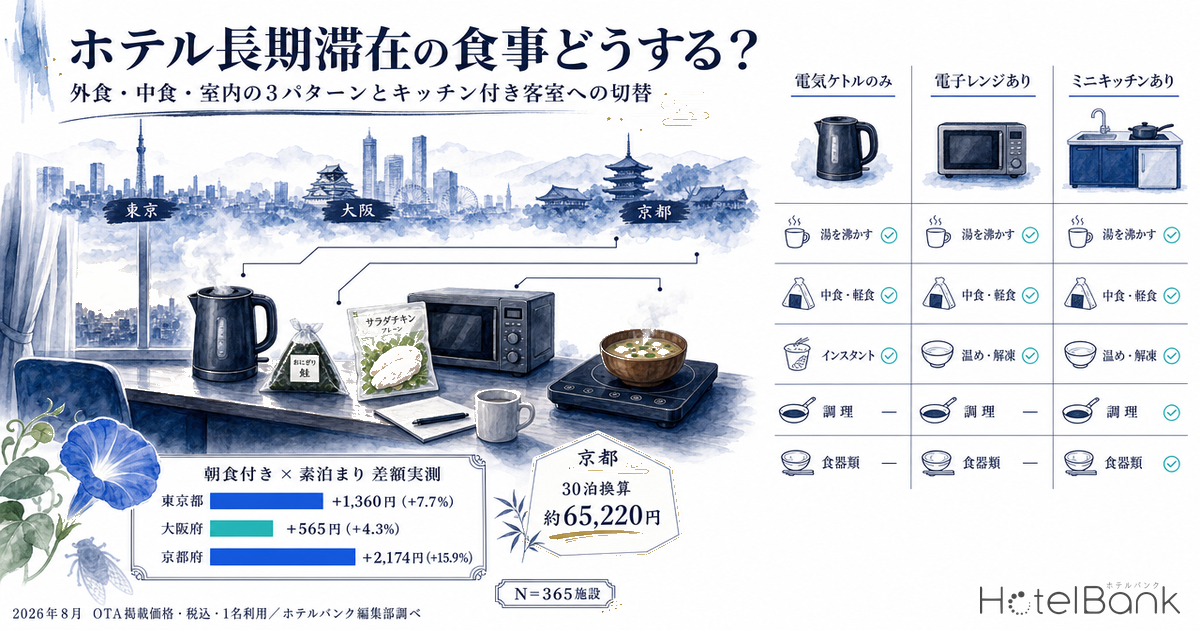
Meals during a long hotel stay come down to three patterns you rotate through: eating out, “naka-shoku” (buying food and eating it in your room), and finishing the meal entirely in the room (cooking or reheating). And as your stay stretches to two weeks or a month, switching to a room with a microwave or a mini-kitchen opens up dramatically more options. This article breaks down what you can actually eat in your room by in-room equipment, the practical ways to keep food costs down, and the measured price gap between breakfast-included and room-only plans (OTA listed prices, tax included, as of August 2026) — written for anyone about to start a long stay.
- — Combining the three patterns is the foundation — eating out, buying food to eat in the room, and finishing the meal in the room. Fixing a default for each time of day cuts the daily burden of deciding.
- — What you can eat in the room is almost entirely determined by the room’s equipment — an electric kettle alone means “just add hot water,” a microwave means bento and frozen food, and a mini-kitchen means simple cooking.
- — If the stay runs two weeks or a month, switch to a room with a kitchen — bulk grocery shopping and batch cooking start to pay off, and both cost and nutrition become easier to manage.
- — The breakfast-included premium runs +¥565 to +¥2,174 per night (business hotels in Tokyo, Osaka, and Kyoto; OTA listed prices as of August 2026, tax included, single occupancy).
- — Decide on “gap × nights” — in areas where the gap tops ¥2,000, 30 nights means a difference on the order of ¥60,000, so if you have equipment to handle breakfast in the room, room-only wins.
The bottom line: combine the three patterns, then use equipment to raise the “in-room” share
For the first few days, eating out and buying food to bring back works fine. Past one week, though, the act of choosing where to eat every single meal becomes a burden in itself, and costs tend to balloon. Most people experienced with long stays fix a default by time of day — breakfast in the room, lunch out or bought, dinner varies — to cut down how often they have to decide. On top of that, since the range of meals you can prepare in the room is essentially set by the room’s equipment, the longer the stay, the more “which equipment does this room have?” becomes the real answer to the meal question.
What you can eat in the room, by in-room equipment
Equipment in a typical hotel room falls into roughly three tiers. Checking the room-equipment section on the property’s official site before booking lets you estimate how much freedom you will have with meals during the stay.
| In-room equipment | What you can do in the room | Stay length it suits |
|---|---|---|
| Electric kettle only (standard at most limited-service hotels) | “Just add hot water” meals — cup noodles, soup, freeze-dried dishes, ochazuke. Combined with bread or onigiri, this is enough to cover breakfast | Up to about one week. Eating out and buying food lead |
| Microwave available (in-room or in a shared area) | Reheating bento and prepared deli dishes; frozen food, packaged rice, and retort pouches all become usable. The range of bought-in food widens considerably, and you can eat a hot meal in the room | One week to one month. You can run mainly on bought-in food |
| Mini-kitchen available (IH cooktop, sink, refrigerator — apartment-style hotels and similar) | Simple cooking and batch cooking are possible. You can work through groceries bought in bulk and make hot pot, stir-fries, miso soup — meals close to what you would eat at home | One month or more. Self-catering leads, and both cost and nutrition are easier to manage |
Rooms with mini-kitchens are common at apartment hotels and properties built for extended stays, and in urban areas they can be booked alongside monthly or consecutive-night plans. A practical approach is to fix the area first and then filter on equipment, as in this comparison of extended-stay hotels with kitchens in Nagoya’s Fushimi–Marunouchi area.
Note that even at properties without an in-room microwave, one is often installed in a shared area or beside the front desk. When the equipment listing on a booking site does not make it clear, asking the property directly is the reliable route. Some properties also lend out microwaves, washing machines, and trouser presses to guests staying multiple nights — “not in the room” does not necessarily mean “not available.”
Keeping food costs down, and countering an unbalanced diet
Total food spending varies widely with the area you stay in and your own habits, so no single figure applies — but the patterns for keeping it down are universal.
- Check for a supermarket within walking distance first. Whether or not you end up relying solely on convenience stores changes your daily spending. Looking up where the supermarkets are on a map app while you are still choosing the hotel is the first saving you make.
- Take advantage of markdown hours for bento and deli dishes. If you can use a microwave, you can buy discounted items in the evening and carry them over to the next morning.
- Keep frozen food, retort pouches, and packaged rice “in stock.” Having a stash in the refrigerator — especially one with a freezer compartment — stops you from defaulting to eating out on days you are worn out.
- Counter an unbalanced diet by “adding,” not restricting. A run of eating out and bought-in food tends to leave you short on vegetables and protein. Deciding in advance on no-cook additions — cut vegetables, salad chicken, frozen vegetables, instant miso soup, fruit — makes this easier to manage.
- Be mindful of smells and rubbish. When eating in the room, ventilate for strongly scented food and sort containers into the bin. Rules for rubbish in the room differ by property, so checking at check-in alongside the cleaning frequency for consecutive nights saves you stress later.
The first of these five — whether you can buy groceries within walking distance — is essentially locked in the moment you choose the hotel. Hotels Near Convenience Stores & Supermarkets: National Ranking, which organizes properties close to convenience stores and supermarkets by area, is a useful reference while you are still narrowing down where to stay.
Breakfast-included or room-only: which wins on a long stay
The HotelBank Editorial Team ran a paired comparison of OTA listed prices (tax included, single occupancy, business hotels, as of August 2026) at properties listing both a breakfast-included plan and a room-only plan. The per-night gaps came out as follows.
| Area | Room-only average | Breakfast-included average | Gap per night | Over 30 nights |
|---|---|---|---|---|
| Tokyo (N=365 properties) | ¥17,772 | ¥19,132 | +¥1,360 (+7.7%) | approx. ¥40,800 |
| Osaka (N=168 properties) | ¥13,218 | ¥13,783 | +¥565 (+4.3%) | approx. ¥16,950 |
| Kyoto (N=72 properties) | ¥13,647 | ¥15,821 | +¥2,174 (+15.9%) | approx. ¥65,220 |
Source: HotelBank Editorial Team research. A paired comparison limited to properties listing both a breakfast-included and a room-only plan (average of OTA listed prices for August 2026, single occupancy, tax included).
In areas and at properties where the gap is in the hundreds of yen per night, adding a buffet breakfast, eating well in the morning, and going light at lunch is a perfectly reasonable trade. Where the gap exceeds ¥2,000, however, 30 nights turns it into a difference on the order of ¥60,000, so handling breakfast yourself with a microwave or kitchen keeps costs lower. Working out “gap × nights” before you decide is the iron rule of long stays. Since the room rate itself also attracts consecutive-night discounts as the night count grows, the quickest way to compare totals alongside the breakfast gap is against the measured figures in Japan Hotel Long-Stay Discounts: 15% at 7 Nights, 20% at 30 Nights.
Laundry, your address, and total cost of the stay
Beyond meals, hotel living raises questions about laundry, post, residence registration, and the total cost of the stay. The four criteria for choosing a room, what to pack, and the tricks for day-to-day life are collected in Hotel Living in Japan: 4 Room Criteria, Packing & Daily Routines — worth reading next, once you have meals sorted. The full picture of the inconveniences of hotel living, from food to laundry to your address, along with how to deal with each, is listed out in 6 Downsides of Hotel Living in Japan: ¥502,000 per 30 Nights & Fixes.
Looking for specific properties
For hands-on comparisons of specific properties, these articles go deeper.
Compares five properties by room equipment and monthly rate structure, including Espacio Time Sharing For Urban (エスパシオ タイムシェアリング フォーアーバン), where all 54 rooms have an IH kitchen and a washer-dryer (a 2-minute walk from Fushimi Station); Nagoya B’s Hotel ANNEX (名古屋ビーズホテル ANNEX), which has mini-kitchens; and GRANDBASE Osu (グランドベース大須), which discounts stays of four nights or more.
Introduces five family-friendly properties where “breakfast in the room, dinner out” works in practice, including MIMARU Tokyo Ikebukuro (MIMARU東京 池袋), where every room has an IH kitchen, microwave, and rice cooker (a 5-minute walk from Ikebukuro Station, 39–58 m²), and Wisteria Condominium Resort (ウィステリア・コンドミニアム・リゾート) in Motobu, Okinawa, where IH kitchens and washing machines in every room suit consecutive nights.
Frequently asked questions
Can I cook for myself during a long hotel stay in Japan?
Whether you can comes down to the room’s equipment. A room with a mini-kitchen (IH cooktop, sink, refrigerator) allows simple cooking and batch cooking — hot pot, stir-fries, miso soup, meals close to what you would eat at home. With a microwave you can reheat bento and deli dishes and use frozen food, packaged rice, and retort pouches. In a room with only an electric kettle, you are limited to “just add hot water” items such as cup noodles, soup, and freeze-dried dishes.
What should I do if there is no microwave in the room?
Plenty of properties have a microwave installed in a shared area or beside the front desk. When the equipment listing on a booking site does not make it clear, asking the property directly is the reliable route. Some properties also lend microwaves and washing machines to guests staying multiple nights, so “not in the room” does not necessarily mean “not available.”
On a long stay, is breakfast-included or room-only the better deal?
Judge it on “gap × nights.” Comparing business hotels that list both plans at the same property, the per-night gap was +¥1,360 (+7.7%) in Tokyo, +¥565 (+4.3%) in Osaka, and +¥2,174 (+15.9%) in Kyoto (as of August 2026, OTA listed prices, tax included, single occupancy). Where the gap is in the hundreds of yen, adding breakfast and eating well in the morning is a reasonable trade — but once it exceeds ¥2,000, 30 nights makes for a difference on the order of ¥60,000, so preparing breakfast in the room keeps costs lower.
Won’t my diet become unbalanced if I keep eating out and buying food?
Vegetables and protein are what tend to fall short. The fix is to think in terms of “adding”: decide in advance on no-cook additions such as cut vegetables, salad chicken, frozen vegetables, instant miso soup, and fruit, and it becomes much easier to manage.
How much do meals cost during a long stay?
This varies widely with the area you stay in and your own eating habits, so this article does not state a figure. The patterns for keeping it down are universal, and three work best: check whether there is a supermarket within walking distance while choosing the hotel, use markdown hours for bento and deli dishes, and keep frozen food, retort pouches, and packaged rice in stock.
About the data in this article
■ Data sources
The gap between breakfast-included and room-only plans (Tokyo N=365 properties / Osaka N=168 properties / Kyoto N=72 properties) is HotelBank Editorial Team research, averaging OTA listed prices for August 2026 (single occupancy, tax included) at the property level, limited to business hotels listing both plans at the same property. The three equipment tiers (electric kettle only / microwave available / mini-kitchen available) are an editorial framing based on the typical equipment found at limited-service and apartment-style hotels, and do not represent the equipment of any specific property.
■ Calculation assumptions
The price basis is “single occupancy, per-room rate (tax included).” The 30-night figures are calculated mechanically as the per-night gap × 30 nights (for example, Tokyo: ¥1,360 × 30 nights = ¥40,800). Consecutive-night discounts, long-stay plans, and differences in breakfast content (buffet, Japanese set meal, and so on) are not taken into account.
■ Limitations and caveats
These are averages of listed prices and do not match actual transacted rates. Because the scope is limited to properties listing breakfast-included and room-only plans side by side, properties offering only one of the two are not included in the population. Room equipment varies by room type even within the same hotel, and the presence of a microwave or kitchen, as well as whether shared facilities may be used, should be confirmed on each property’s official site before booking. Actual food costs vary widely with the area of stay and eating habits, so this article does not present a figure.
Related reading
- 6 Downsides of Hotel Living in Japan: ¥502,000 per 30 Nights & Fixes
- Japan Hotel Long-Stay Discounts: 15% at 7 Nights, 20% at 30 Nights
- Is Hotel Living Cheaper Than Rent in Tokyo? Break-Even at 24 Nights
- Hotel Living for a New Job: 1 Month Max, ¥17,238 Median Night in Tokyo
- Hotel Living: Keep Residence Registration Home, or File Within 14 Days
- Hotels Near Convenience Stores & Supermarkets: National Ranking