

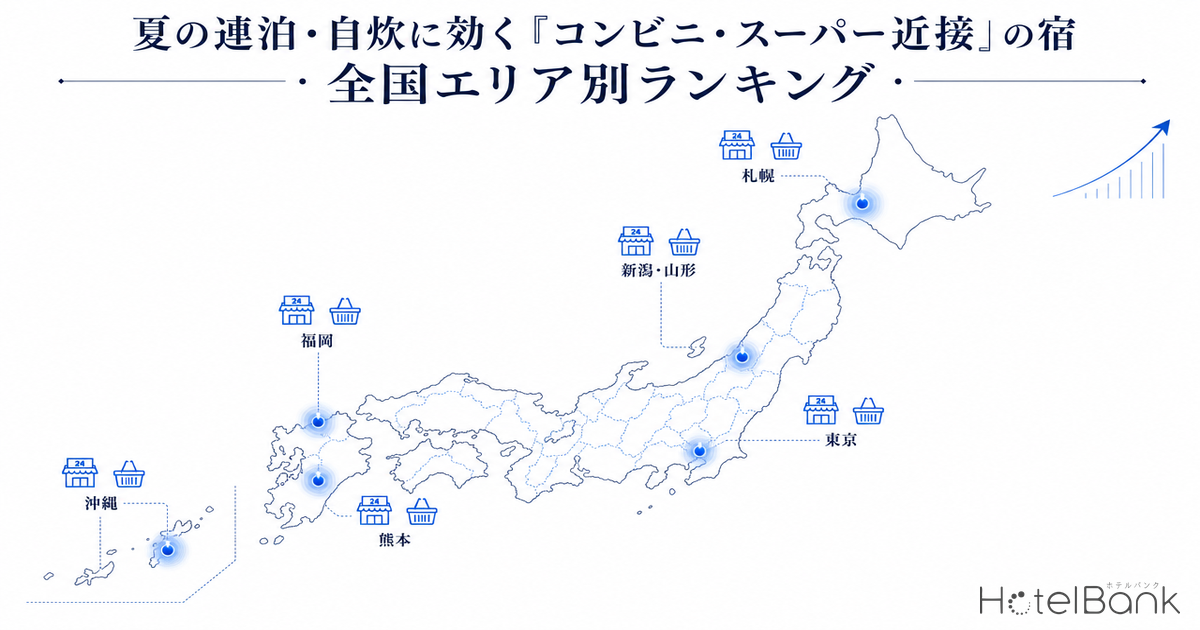
Summer break is the season when the shape of travel expands from “sightseeing” to “living.” Settling into the same hotel for several nights, topping up on drinks and groceries at a nearby convenience store or supermarket as you go—for this kind of extended-stay, self-catering trip, day-to-day convenience (what lies within walking distance) sways satisfaction even more than the luxury of the property itself. This article focuses on the guest-review comment “the convenience store and supermarket are close and handy,” aggregating nationwide and by area the hotels that earn high marks for such locational convenience. We quantitatively map out where the areas best suited to extended stays are concentrated.
Metric Definitions Used in This Article
- Mention of locational convenience: Guest reviews classified via natural language processing, aggregating positive mentions of “proximity to daily-life facilities such as convenience stores and supermarkets.” The count is the actual number of reviews mentioning this theme; the mention rate is the share of a property’s total reviews. Unlike the star rating (★), it expresses “how much it was talked about.”
- Aggregation scope: Guest reviews from the most recent 24 months. Area comparisons target, in principle, properties with 15 or more mentions of the same theme. The sample size (N) is stated in each chart.
- Data source: HotelBank Editorial Team research. Price (ADR) is not the focus of this article and is not covered.
- — Mention rate of 2.64% (+1.3pt): Guest-review mentions of “convenience store / supermarket proximity” reached 2.64% of all reviews in the most recent 3 months, up from 1.36% in the prior 12 months—reflecting rising demand for extended-stay, self-catering travel.
- — Ibis Styles Sapporo (ibis Styles Sapporo) leads nationwide (100 mentions): The top ranks are dominated by urban extended-stay hotels near stations and city centers, where in-house or adjacent convenience stores and supermarkets win support from long-stay guests.
- — Regional cities and remote islands stand out by mention rate: Led by APA Hotel Ishigakijima (APAホテル〈石垣島〉) at 13.36%, Okinawa and regional cities top the list. Hotels with a “livable location” are concentrated in regional city centers rather than resort areas.
Mentions of “daily-life convenience nearby” are rising nationwide
First, let us confirm the overall trend. Guest-review mentions of “convenience store / supermarket proximity” reached 2.64% of all reviews in the most recent 3 months, up roughly 1.3 points from 1.36% in the prior 12 months. On a count basis, too, the most recent 3 months exceeded 10,000 reviews. It is clear that travelers are increasingly conscious of nearby daily-life convenience when choosing—and reflecting on—their accommodation.
Behind this lies the spread of extended and long-term stays. The Japan Tourism Agency is promoting workation and bleisure travel to level out demand amid population decline, and condominium-type accommodations equipped with kitchens and washing machines—letting guests “stay as if living there”—are drawing attention. On stays where you buy ingredients at the local supermarket and cook at leisure, daily-life convenience within a few minutes’ walk greatly influences the quality of the trip. The spread of this style of stay appears to be reflected in how reviews are worded.
Source: HotelBank Editorial Team research
National ranking: hotels where convenience store / supermarket proximity is talked about most
Next, we extracted from across the country the properties that attract an especially large number of positive mentions of daily-life convenience. The top ranks feature urban hotels located near stations and in central business districts, with convenience stores or supermarkets on-site or adjacent. As voices such as “there was a convenience store inside the hotel, which was handy” (a Takamatsu property) and “on the first floor… convenient for shopping” (a Niigata property) symbolize, the reassurance of “not having to travel far to shop” is highly valued by extended-stay guests.
Source: HotelBank Editorial Team research
| # | Property | Area | Mentions | Mention rate | Total reviews |
|---|---|---|---|---|---|
| 1 | Ibis Styles Sapporo (イビススタイルズ札幌) | Hokkaido | 100 | 9.13% | 1,095 |
| 2 | Hotel Okura JR Huis Ten Bosch (ホテルオークラJRハウステンボス) | Nagasaki | 82 | 2.8% | 2,930 |
| 3 | Kansai Airport Washington Hotel (関西エアポートワシントンホテル) | Osaka | 82 | 2.48% | 3,305 |
| 4 | La’gent Stay Sapporo Odori (ラ・ジェント・ステイ札幌大通) | Hokkaido | 77 | 5.08% | 1,516 |
| 5 | Kobe Portopia Hotel (神戸ポートピアホテル) | Hyogo | 74 | 1.89% | 3,924 |
| 6 | ANA Crowne Plaza Hotel Sapporo (ANAクラウンプラザホテル札幌) | Hokkaido | 72 | 4.52% | 1,592 |
| 7 | Tokyu Stay Okinawa Naha (東急ステイ沖縄那覇) | Okinawa | 71 | 7.77% | 914 |
| 8 | Tokyu Stay Sapporo Odori (東急ステイ札幌大通) | Hokkaido | 71 | 9.16% | 775 |
| 9 | Tokyu Stay Hakata (東急ステイ博多) | Fukuoka | 67 | 3.72% | 1,800 |
| 10 | Villa Fontaine Kobe Sannomiya (ヴィラフォンテーヌ神戸三宮) | Hyogo | 66 | 3.97% | 1,661 |
| 11 | Ours Inn Hankyu (アワーズイン阪急) | Tokyo | 66 | 2.28% | 2,899 |
| 12 | Mercure Hotel Okinawa Naha (メルキュールホテル沖縄那覇) | Okinawa | 63 | 5.72% | 1,102 |
Source: HotelBank Editorial Team research (most recent 24 months; top by count of positive mentions of convenience store / supermarket proximity)
Regional concentration: the “volume” of big cities and the “prominence” of regional cities
Here is the heart of the matter. Looking at where mentions of daily-life convenience concentrate, two distinct pictures emerge. One is the absolute volume of mentions. Tokyo (76 properties), Hokkaido (48 properties, many of them in central Sapporo), and major metropolitan areas such as Hyogo, Kanagawa, and Osaka top the list. With large numbers of hotels and review bases, these areas simply offer an abundance of choices among hotels that can boast daily-life convenience.
The other is the prominence of mentions (median mention rate). Here, Okinawa (3.7%), Niigata (3.7%), Yamagata (3.6%), Shizuoka (3.5%), Fukuoka (3.4%), Hokkaido (3.1%), and Kumamoto (2.9%) rank high, while Tokyo (2.0%), Kyoto (1.5%), and Aichi (1.9%) are relatively low. This is likely because, in big cities where convenience stores and supermarkets are densely packed as a matter of course, convenience becomes a “given not worth mentioning,” whereas in regional cities and resort-adjacent areas, “this location has high daily-life convenience” stands out in reviews as a clear differentiator. The structure in which the location itself is discussed in reviews as an axis of evaluation also resonates with our analysis aggregating the locational value of venue proximity nationwide by area. The graph below overlays this “volume (bars)” and “prominence (line).”
Source: HotelBank Editorial Team research
Aggregating mention counts by regional block, the major consumption areas of Kanto, Hokkaido, and Kinki are followed by layers of Kyushu, Chubu, Tohoku, and Okinawa. Meanwhile, in prefectures with high resort ratios such as Gunma, Wakayama, Yamanashi, Tottori, and Kagoshima, hotels where daily-life convenience is notably discussed were very limited. This is because many accommodations are scattered within tourist areas, with few daily-life facilities within walking distance. Hotels with high daily-life convenience suited to extended, self-catering stays are concentrated in the centers of regional cities rather than in resorts themselves—this is the core of the regional concentration that today’s data reveals.
Source: HotelBank Editorial Team research
Hotels that stand out by mention rate: the “livable locations” of regional cities and remote islands
Looking at the hotels that rank high by mention rate (share of total reviews), the picture of regional concentration grows even sharper. Hotels in regional cities and remote islands—Ishigaki Island and Ginowan (Okinawa), Hachinohe (Aomori), Yatsushiro (Kumamoto), and Tsukuba (Ibaraki)—line up, each gathering reviews directly tied to self-catering and shopping, such as “the supermarket is close” and “the supermarket next door is open late.” It can be read that a location where daily necessities can be procured without strain in between sightseeing directly connects to stay satisfaction.
| # | Property | Area | Mention rate | Mentions |
|---|---|---|---|---|
| 1 | APA Hotel Ishigakijima (アパホテル〈石垣島〉) | Okinawa | 13.36% | 33 |
| 2 | Sannomiya Terminal Hotel (三宮ターミナルホテル) | Hyogo | 12.16% | 36 |
| 3 | APA Hotel Sapporo Susukino (アパホテル〈札幌すすきの〉) | Hokkaido | 11.04% | 33 |
| 4 | Moon Ocean Ginowan Hotel & Residence (ムーンオーシャン宜野湾 ホテル&レジデンス) | Okinawa | 9.55% | 34 |
| 5 | Hotel Wing International Kumamoto Yatsushiro (ホテルウィングインターナショナル熊本八代) | Kumamoto | 9.28% | 48 |
| 6 | Tokyu Stay Sapporo Odori (東急ステイ札幌大通) | Hokkaido | 9.16% | 71 |
| 7 | Ibis Styles Sapporo (イビススタイルズ札幌) | Hokkaido | 9.13% | 100 |
| 8 | Daiwa Roynet Hotel Okinawa Kenchomae (ダイワロイネットホテル沖縄県庁前) | Okinawa | 9.0% | 37 |
| 9 | Hotel Route Inn Isehara Oyama Inter -Route 246- (ホテルルートイン伊勢原大山インター-国道246号-) | Kanagawa | 8.68% | 35 |
| 10 | Tokyu Stay Kyoto Sanjo Karasuma (東急ステイ京都三条烏丸) | Kyoto | 8.14% | 38 |
Source: HotelBank Editorial Team research (top by mention rate among properties with 15+ mentions)
Convenience stores and supermarkets satisfy “different demands”
Even under the single banner of daily-life convenience, convenience stores and supermarkets play different roles. Convenience stores serve as a “substitute for urban functions”—24-hour procurement of drinks, snacks, and daily goods, plus delivery, ATMs, and ticket issuance—valued even on business trips and short stays. Supermarkets, by contrast, cut deep into the needs of the extended-stay, self-catering segment by letting guests bulk-buy fresh food and prepared dishes. The comment from a guest at a Hachinohe hotel—”it helps that the supermarket is open late”—is a textbook example of supermarket proximity being valued as infrastructure supporting one’s diet during a stay.
An earlier article of ours examined extended-stay-friendly hotels from the angle of laundry as stay infrastructure, focusing on properties equipped with coin laundries. This article’s “convenience store / supermarket proximity” illuminates the same extended-stay need from a different axis: food and daily goods. Hotels where the three elements of daily life—laundry, meals, and shopping—are all completed within walking distance can be said to meet the conditions for being chosen for a long summer stay.
Inbound long stays and a domestic shift push up “daily-life convenience” demand
This trend also overlaps with the lengthening of inbound stays. In 2025, the average number of nights per inbound visitor was 9.5, up 0.5 nights from the previous year, with the trend toward longer stays continuing. India in particular stands out at an average of 17.7 nights—three to four times that of nearby Asian markets such as South Korea (4.0 nights) and Taiwan (6.5 nights). The Japan Tourism Agency is also targeting the Middle East (the United Arab Emirates, Saudi Arabia, Qatar, and others) as a priority market; in these markets, where long summer vacations are common, there is likely strong demand for a living-style stay in which guests procure ingredients and daily goods locally. How inbound visitors evaluate location and daily-life convenience, and how much they weight them as tags when choosing a hotel, is also evident in our analysis of the tag concentration among super-repeat Korean guests.
Domestically as well, while the total number of travelers is expected to be roughly flat in 2026, per-person spending is projected to rise year over year, with the center of gravity shifting from volume toward quality and richer stays. If the style of “living-like” extended stays takes root, daily-life convenience such as convenience store / supermarket proximity will carry even more weight as an evaluation axis in choosing a hotel. For hotels located in the centers of regional cities and equipped with daily-life convenience within walking distance, this is a domain with substantial room to grow as a receptacle for extended and long-term stays.
For hotels: hints for plan names that work on this theme
Frequent appeal elements among plan names published under the extended-stay theme (N=924) ——
Multi-night discount 60% Breakfast included 33% Room only 20% Two meals included 13% Eco (no cleaning on consecutive nights) 9% Long stay / living 8%
Examples of actual names (anonymized):
- [Room only] Near the station & free parking ☆ Long-stay plan
- [Japanese breakfast included] Multi-night discount, stay-as-if-living long-stay plan
- [Eco cleaning] 3+ consecutive nights, great-value multi-night stay plan
*Trends based on aggregating published plan names; this does not demonstrate a causal link in which naming generates sales. For a deeper dive into market × naming, please refer to the naming-benchmark and event articles.
Summary
The “convenience store / supermarket proximity” spoken of in guest reviews has now grown into a firm evaluation axis underpinning satisfaction with extended-stay, self-catering trips. Nationwide, major metropolitan areas lead in the “volume” of choices, while in regional cities and resort-adjacent areas such as Okinawa, Niigata, Yamagata, Shizuoka, Fukuoka, and Kumamoto, daily-life convenience stands out in reviews as a clear differentiator. The reality is that hotels with a “livable location” suited to extended stays are concentrated in the centers of regional cities rather than in resorts themselves. As the lengthening of inbound stays overlaps with a domestic orientation toward richer stays, hotels where laundry, meals, and shopping are all completed within walking distance are likely to raise their presence in the summer long-stay market.
Related reading
- The Locational Value of Venue Proximity — Hotels Valued for Event and MICE Demand, Aggregated Nationwide by Area
- Hotels in Car-Society Areas Read Through Parking Ratings — Prefectural Rankings and EV Charging as a New Differentiator
- Hotels With Rising ‘Room View’ Ratings, National TOP 30 — The Rarity of ‘Visible From Your Room’ in Fireworks Season
- Tasting the Local at Breakfast | Hotels Highly Rated for Locally-Sourced Morning Meals, National Ranking by Area
- The Granular-Tag Concentration Chosen by Super-Repeat Korean Guests — A Food × Location × Language-Evaluation Map
References and sources
- HotelBank Editorial Team research — aggregation of locational-convenience theme mentions in guest reviews (most recent 24 months; positive mentions of convenience store / supermarket proximity)
- JNTO (Japan National Tourism Organization) Statistics of Visitors to Japan
- Japan Tourism Agency, “White Paper on Tourism FY2025 (Summary)” (May 2025)
- JNTO, “Japan Tourism Data Handbook” (average nights by market; Middle East market)
- JTB, “2026 Travel Trend Outlook” (January 2026)