

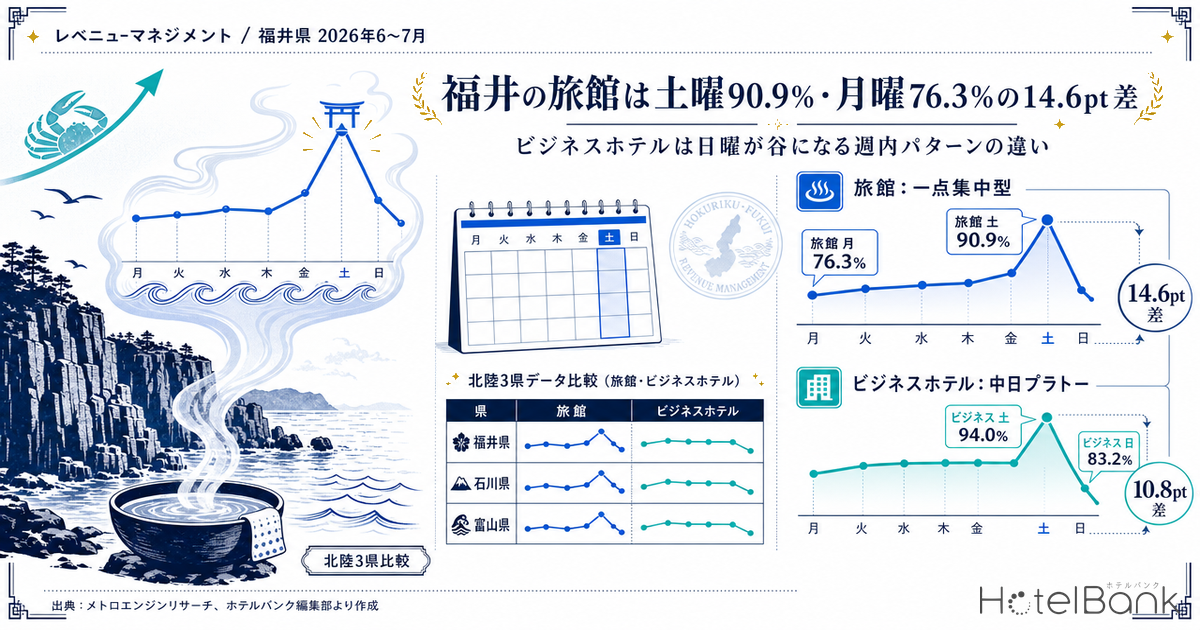
Aggregating Fukui Prefecture’s daily estimated OCC for June-July 2026 (completed months) by day of week, ryokan recorded 90.9% on Saturdays against 76.3% on Mondays — a 14.6-point spread within the week. Business hotels, by contrast, posted 94.0% on Saturdays and 85.5% on Mondays, a spread of only 8.5 points, and their weekly low fell not on Monday but on Sunday, at 83.2%. Same prefecture, same two months — yet the position of the weekly trough switches depending on property type. This article works through that difference in weekly pattern, including a comparison across the three Hokuriku prefectures and how bookings build from 45 days out.
Scope: Fukui Prefecture ryokan N=113 properties and business hotels N=39 properties (period average of daily observed property counts for June-July 2026; the all-property basis is N=255 properties). Occupancy is an estimate based on OTA-listed inventory. Because this article addresses day-of-week occupancy patterns, no price metrics are used. Definitions appear at the end of the article. Data as of August 17, 2026.
- — Fukui ryokan run 90.9% on Saturdays and 76.3% on Mondays, a within-week range of 14.6 points. The four weekdays sit in a narrow 76.3-79.8% band, making Saturday a single, isolated spike.
- — For business hotels the trough is not Monday but Sunday at 83.2%. They hold a midweek plateau of 91.6% on Wednesday and 92.4% on Thursday, giving a within-week range of 10.8 points — flatter than ryokan.
- — The sign of “Sunday minus Monday” works as an indicator that distinguishes property types. Across all six segments in the three Hokuriku prefectures, ryokan are positive (+4.2 to +5.7pt) and business hotels negative (-0.2 to -3.6pt).
- — Excluding the three-day weekend (July 18-20, 2026) deepens the trough further. Business hotel Sundays move from 83.2% to 81.0%, and ryokan Sundays from 82.0% to 79.5%.
- — The ryokan Saturday premium is built during the 15 days from T-45 to T-30 (the Saturday-Monday gap widens from 2.1pt to 6.8pt). For business hotels, Saturday is already 6.2 points above Sunday at T-45.
Ryokan concentrate on Saturday; business hotels hold a midweek plateau
Start with estimated OCC by day of week. These are the 61 days of daily results from June 1 to July 31, 2026, averaged by day of week without weighting. Ryokan averaged 80.9% over the period, business hotels 89.2%, and the all-property basis 86.8%.
Source: Compiled by the HotelBank Editorial Team from MetroEngines Research
The shapes differ clearly. For ryokan only Saturday breaks out, at 90.9%, while the remaining six days sit in a narrow 76.3%-82.2% band. Across Monday to Thursday the figures are 76.3%, 77.5%, 79.8% and 78.8% — a spread of at most 3.5 points. Weekdays are flat and only Saturday jumps: a single-peak profile.
Business hotels, by contrast, hold a midweek plateau of 91.6% on Wednesday and 92.4% on Thursday. Thursday’s 92.4% is only 1.6 points below the weekly high of 94.0% on Saturday, so the structure is effectively two peaks — Saturday and Thursday. And Friday, at 88.8%, sits below both Wednesday and Thursday. For business hotels, Friday is not the gateway to the weekend but the first day of the downslope as weekday demand withdraws.
| Day | Ryokan N=113 | Business hotels N=39 | All properties N=255 | Ryokan – business |
|---|---|---|---|---|
| Mon | 76.3% | 85.5% | 83.1% | −9.2pt |
| Tue | 77.5% | 89.0% | 85.1% | −11.5pt |
| Wed | 79.8% | 91.6% | 87.5% | −11.8pt |
| Thu | 78.8% | 92.4% | 87.6% | −13.6pt |
| Fri | 82.2% | 88.8% | 87.4% | −6.6pt |
| Sat | 90.9% | 94.0% | 93.3% | −3.1pt |
| Sun | 82.0% | 83.2% | 84.0% | −1.2pt |
| Within-week range | 14.6pt | 10.8pt | 10.2pt | — |
Daily estimated OCC for Fukui Prefecture, June 1 – July 31, 2026, averaged by day of week. Source: Compiled by the HotelBank Editorial Team from MetroEngines Research
Reading the right-hand difference column vertically shows the distance between the two property types stretching and contracting by day. On Thursday ryokan run 13.6 points below business hotels, but on Saturday the gap is 3.1 points and on Sunday it narrows to just 1.2 points. On weekends the two types compete on the same ground; on weekdays they are entirely separate markets.
One driver of that gap is property size. Over the observation period ryokan averaged 21.4 rooms per property, business hotels 112.5 rooms and city hotels 125.8 rooms. At a 20-room property a handful of group bookings moves occupancy sharply, so the contrast between days that attract demand and days that do not translates directly into a wider swing in the figures.
The trough changes places — the relationship between Sunday and Monday
To bring the weekly shape into sharper focus, the next chart converts each property type’s figures into deviations (in points) from its own period average. When benchmarking your own weekly design against the market, comparing across property types is easier using this “distance from your own average” than using absolute levels.
Source: Compiled by the HotelBank Editorial Team from MetroEngines Research
For ryokan, Saturday sits 10.0 points above the period average, while Friday (+1.3pt) and Sunday (+1.1pt) line up at almost the same height. In other words, the ryokan weekend is not “Friday, Saturday and Sunday” but “one day — Saturday — with a slight lift on either side”. The trough is Monday, at -4.6 points.
Business hotels are the mirror image: Sunday, at -6.0 points, is the deepest trough of the week — lower than Monday (-3.7pt). Wednesday (+2.4pt) and Thursday (+3.2pt) run above average and, together with Saturday (+4.8pt), form three peaks. The natural reading is that the Sunday drop appears as the blank space before the following week’s business-travel demand starts to build. How general this “Sunday trough” is can be seen in day-of-week occupancy at Saitama business hotels, where it is set out as a back-to-back Sunday-Monday trough.
From this a simple diagnostic emerges: “Sunday estimated OCC minus Monday estimated OCC”. In Fukui, ryokan are +5.7 points and business hotels -2.3 points. The sign alone captures the character of the property type.
To check that this is not a Fukui-only coincidence, the same aggregation was run across the three Hokuriku prefectures.
| Prefecture and type | N | High | Low | Within-week range | Sun – Mon |
|---|---|---|---|---|---|
| Fukui ryokan | 113 | Sat 90.9% | Mon 76.3% | 14.6pt | +5.7pt |
| Ishikawa ryokan | 95 | Sat 86.2% | Wed 71.8% | 14.4pt | +4.2pt |
| Toyama ryokan | 55 | Sat 89.5% | Mon 79.5% | 10.0pt | +4.8pt |
| Fukui business hotels | 39 | Sat 94.0% | Sun 83.2% | 10.8pt | −2.3pt |
| Ishikawa business hotels | 101 | Sat 90.8% | Sun 74.2% | 16.6pt | −0.2pt |
| Toyama business hotels | 58 | Sat 90.9% | Sun 76.2% | 14.7pt | −3.6pt |
Daily estimated OCC for June 1 – July 31, 2026, averaged by day of week. N = period average of daily observed property counts. Source: Compiled by the HotelBank Editorial Team from MetroEngines Research
In all three prefectures, the lowest day for business hotels was Sunday. On the ryokan side the low day splits — Monday in Fukui and Toyama, Wednesday in Ishikawa — but in every case Sunday runs higher than any day from Monday through Thursday. The sign of “Sun – Mon” matches property type in all six rows, so this is not a Fukui quirk but a weekly structure shared by ryokan and business hotels across Hokuriku. Examples of peaks and troughs switching by property type can be found outside Hokuriku as well: Kumamoto day-of-week occupancy inverts by property type tests the same structure in a different market.
The within-week range itself does vary by prefecture. Fukui business hotels, at 10.8 points, are the flattest of the three — noticeably narrower than Ishikawa’s 16.6 points and Toyama’s 14.7 points. Put another way, it is a market where weekdays fill without relying on the weekend.
A three-day weekend temporarily overwrites the weekly pattern
Before putting day-of-week averages to practical use, one thing is worth confirming. The observation period contains a single three-day weekend, including Monday July 20, 2026 (Marine Day), and those three days move the day-of-week averages.
On Saturday July 18, estimated OCC was 99.7% for ryokan and 100.0% for business hotels, and on Sunday July 19 it stayed at 99.3% and 99.2% respectively — the middle day of the holiday weekend was lifted to the same level as Saturday. On Monday July 20, the final day of the break, ryokan ran 82.1% and business hotels 80.4%; for business hotels that Monday came in below the Monday average of 85.5%. Even on a public holiday, the day people travel home does not fill.
Re-aggregating with those three days excluded makes the ordinary-week picture more extreme still. Ryokan run 89.7% on Saturday, 79.5% on Sunday and 75.6% on Monday; business hotels 93.1% on Saturday, 81.0% on Sunday and 86.1% on Monday. The business hotel Sunday trough deepens by 2.2 points, from 83.2% to 81.0%, widening the gap against Monday to -5.1 points. On the ryokan side Sunday also falls, from 82.0% to 79.5%, leaving Friday (82.2%) alone in second place behind Saturday.
Put differently, the published day-of-week averages show the picture after a three-day weekend has smoothed it out. For anyone operating an ordinary week without a holiday, it is safer to assume the trough sits one step deeper.
The Saturday gap opens during the 15 days from T-45 to T-30
So far the discussion has covered day-of-week occupancy as an outcome. Next comes the question of when that gap is created. For the week from Monday September 7 to Sunday September 13, 2026, booking curves were drawn from observations running from 45 days before the stay date up to the present. It is an ordinary week with no public holidays.
Fukui Prefecture: estimated OCC trajectory for arrivals September 7-13, 2026 (T-45 to T-30). Source: Compiled by the HotelBank Editorial Team from MetroEngines Research
Ryokan for Saturday September 12 built from 62.4% at T-45 to 72.6% at T-30, a gain of 10.2 points. Monday September 7 in the same week moved from 60.3% to 65.8%, a gain of only 5.5 points. At T-45 the Saturday-Monday gap is just 2.1 points, but by T-30 it has widened to 6.8 points. The ryokan Saturday premium has not yet appeared in the market at T-45.
Business hotels start from a different place. Saturday September 12 was already at 73.8% at T-45, 6.2 points above 67.6% for Sunday September 13 in the same week, and by T-30 the gap was 83.1% against 74.1%, or 9.0 points. The build was 9.3 points for Saturday and 6.5 points for Sunday. For more on how the T-45 starting point and the remaining runway differ by property type, a comparison of booking curves across three property types in Hiroshima is also useful.
Looking at the same 15-day window from T-45 to T-30, the gap between Saturday and weekdays is created inside that window for ryokan, whereas for business hotels the gap already exists when the window opens. The stretch of time in which there is still room to move differs by property type.
For revenue managers running ryokan and business hotels in Fukui — implications and an action plan
The following translates the figures above into operating decisions.
1. Start by checking whether your own trough day matches the standard shape for your property type. In Fukui the standard is a Monday trough for ryokan (market 76.3%) and a Sunday trough for business hotels (83.2%). If your property shows the reverse — a ryokan whose Sunday runs below Monday, or a business hotel whose Monday runs below Sunday — that is a cue to suspect a property-specific cause rather than a market-wide seasonal one. Day-of-week aggregation is worth using first and foremost to check whether that sign agrees or disagrees.
2. For ryokan, there is room to treat Friday as a day to win in its own right rather than as preparation for Saturday. The market Friday is 82.2%, 8.7 points below Saturday’s 90.9%. And in ordinary weeks excluding the three-day weekend, Friday’s 82.2% runs above Sunday’s 79.5% to become the clear runner-up to Saturday. Rather than viewing Friday as the overflow catcher once Saturday is full, it is worth considering a design that fills Friday on its own.
3. For business hotels, treat Sunday as a slot for a different segment rather than an extension of the weekday catchment. Sunday’s 83.2% is below Monday’s 85.5%, and excluding the three-day weekend it drops to 81.0%. On the same Sunday, ryokan reach 82.0% — almost level with business hotels — so this is the one day of the week when both property types compete for the same demand. Whether to leave Sunday inventory positioned for weekday guests or redirect it toward weekend segments is the point in the week that leaves the most room for judgment.
4. Split the timing of your preparation by property type. The ryokan Saturday is only 2.1 points ahead of weekdays at T-45 and widens to 6.8 points by T-30 — that calls for a design that acts while the gap is still being created. The business hotel Saturday is already 6.2 points above Sunday at T-45, so decisions taken before T-45 are what count. Running the same tasks on the same calendar for both will leave one of the two property types acting too late.
Mapped onto a timeline, that looks as follows.
| Time horizon | Action | Decision trigger | Objective |
|---|---|---|---|
| Today to this week | Aggregate your own past two months by day of week and calculate the sign of “Sunday minus Monday” | Your sign runs opposite to the market (ryokan +5.7pt / business hotels -2.3pt) — for example negative at a ryokan or positive at a business hotel | Narrow the review of weekly design down to a single day |
| Today to this week | Separate weeks containing public holidays out of the aggregation and hold a second set of day-of-week averages for ordinary weeks only | You are operating on averages that still include holiday weekends (in the market, Sunday moves 2.2pt, from 83.2% to 81.0%) | Avoid under-estimating the depth of the trough in ordinary weeks |
| Within two weeks | Ryokan: design Friday selling conditions and inventory allocation separately from Saturday | Your Friday is tracking below the market’s 82.2% | Smooth out Saturday dependence (market range 14.6pt) |
| Within two weeks | Business hotels: manage Sunday inventory in a separate bucket from weekday-oriented demand | Your Sunday runs below the market’s 83.2% and stays below your own Monday | Direct a different segment at the deepest trough of the week (-6.0pt) |
| Looking to next month (T-45 to T-30) | Ryokan: move to recording Saturday booking progress at two fixed points, T-45 and T-30 | The build from T-45 to T-30 is clearly smaller than the market Saturday (+10.2pt) | Avoid missing the 15 days in which the gap is created |
| Looking to next month (before T-45) | Business hotels: lock in the initial Saturday settings before T-45 | Your Saturday at T-45 has not reached the market level of 73.8% | Avoid falling behind in a phase where the gap already exists |
Source: Compiled by the HotelBank Editorial Team from MetroEngines Research
Summary — three yardsticks for weekly design
First, the trough day. In Fukui the weekly floor was Monday at 76.3% for ryokan and Sunday at 83.2% for business hotels. When the floor sits in a different place within the same prefecture and the same two months, no single measure summarised as “fill the weekdays” can exist. Identify where your own floor is before choosing an action.
Second, the sign of Sunday minus Monday. Across all six segments in the three Hokuriku prefectures, ryokan were positive (+4.2 to +5.7pt) and business hotels negative (-0.2 to -3.6pt). That sign expresses the demand structure of the property type itself, so a sign that runs opposite to the market is a clear signal to review your weekly design.
Third, the window in which the gap is created. The ryokan Saturday is only 2.1 points ahead of weekdays at T-45 and widens to a 6.8-point gap by T-30. The business hotel Saturday is already 6.2 points above Sunday at T-45. Grasping not just the day-of-week outcome but when that outcome gets locked in turns the same observation data from a review of the past into a calendar for preparation.
About the data
■ Data sources
The day-of-week aggregation uses daily estimated OCC results for Fukui Prefecture from June 1 to July 31, 2026 (61 days). Period averages of daily observed property counts are ryokan N=113 properties, business hotels N=39 properties and all properties N=255 properties. The three-prefecture Hokuriku comparison covers the same period, with Ishikawa ryokan N=95 and business hotels N=101, and Toyama ryokan N=55 and business hotels N=58. The booking curves cover arrivals in Fukui Prefecture from September 7 to 13, 2026, with observed property counts averaged over T-45 to T-30 of 122 ryokan and 38 business hotels. Source: Compiled by the HotelBank Editorial Team from MetroEngines Research. Data as of August 17, 2026.
■ Calculation assumptions
Estimated OCC (based on OTA-listed inventory) is calculated as “100 − 100 × rooms remaining on OTA listings ÷ total rooms”. Day-of-week figures are simple averages of the daily results falling on each day of the week, with no weighting by property size. Deviations from the period average (in points) are taken against each property type’s own period average. Booking curves are based on observations from 45 days before the stay date up to the present, and the text compares the two fixed points of T-45 and T-30. Because this article addresses day-of-week occupancy patterns, price metrics (estimated settled ADR) are not covered.
■ Limitations and caveats
Estimated OCC is an estimate based on how inventory offered on OTAs is taken up, and its definition differs from actual room occupancy (it reads higher). Ryokan average 21.4 rooms per property, a small scale at which a handful of bookings moves the daily figure, so their swings tend to be wider than those of business hotels (112.5 rooms). The observation period includes one three-day weekend, July 18-20, 2026, which lifts the day-of-week averages (re-aggregated figures excluding it are given in the text). Selling conditions and inventory change daily, so the figures in this article are a snapshot as of the time of retrieval.
Related reading
- Kumamoto Day-of-Week Occupancy Inverts by Type: Thu 88.3% vs Sat 89.9%
- Saitama Business Hotels: Sat 77.2% vs Sun 70.1%, Gap Widens to 11pt
- Hiroshima Booking Curves: 26.2pt Gap at T-45, Ryokan +10.9pt Late
- Fukui Settled ADR H1 2026: Business +4.4%, City +7.0%, Gains in Q2
- Owara Kaze no Bon 2026: 85.0% OCC on 3 Weekdays, 45 Days Out