

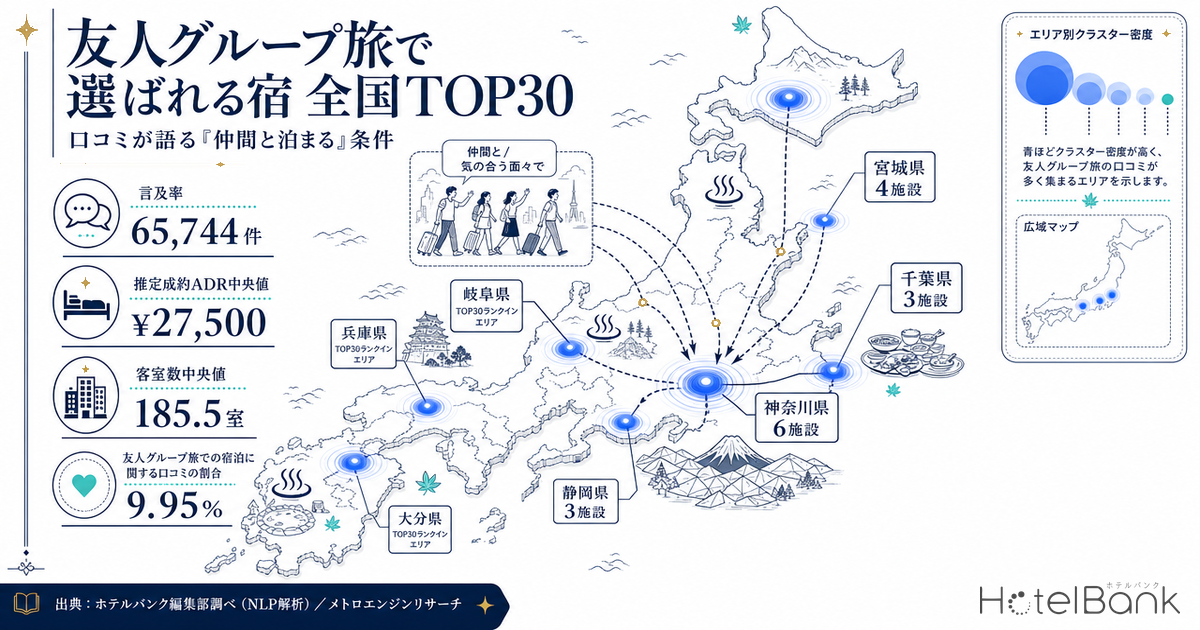
Solo trips, trips with kids, girls’ trips — the way a hotel gets chosen shifts with who you travel with. So what about trips with friends? We pulled the properties across Japan where guest-written reviews most densely carry the language of travelling “with friends,” “with the gang,” “with people we get on with.” The scope is the last 24 months of reviews, and the 30 properties with the highest count of positive friend/group-trip mentions. What surfaced was not room quality, and not the calibre of the cuisine, but something far plainer.
Metric Definitions Used in This Article
- Mention rate: the share of a property’s total reviews over the last 24 months in which the friend/group-trip context appears positively. This is an indicator of how readily a property is talked about in that context, not of how highly it is rated (star score), and it does not rank quality.
- ADR (average daily rate): an estimated settled rate derived by applying a property-type correction coefficient to the lowest published plan level each property lists on OTAs and similar channels (two guests per room, per-room price, tax included); the result is on a pre-tax-equivalent basis. Cross-checked against property-level results disclosed by listed hotel REITs, the median error is approximately 7%. It is an estimate and differs from each property’s actual transacted prices and accounting figures. This article uses the monthly average over the last 12 months (August 2025 to July 2026). Area-level ADR is the median of the properties covered (the level of a typical property in that area).
- Aggregation period: reviews cover the 24 months from August 2024 to August 2026. The reference date for aggregation is 11 August 2026.
- Data sources: reviews = HotelBank Editorial Team research (NLP analysis) / prices = MetroEngines Research
- — Of 65,744 reviews, 615 were written in a friend/group-trip context. Mention rates range from 0.40% to 9.95%, with large properties carrying big review counts and small pensions sitting at the two ends.
- — The median room count is 185.5, and 26 of the 30 properties have 100 rooms or more. Whether you can lock in adjacent rooms together for the same night is the entry condition for choosing a hotel.
- — All 30 properties shared five elements: food satisfaction, service, cleanliness, value for money and room size. Breakfast buffets were mentioned at 28 properties, and onsen and open-air baths at 24 each.
- — The median estimated settled ADR is about ¥27,500, in a range of ¥11,500 to ¥39,300. Not one property exceeds ¥40,000 — friend trips converge on “a price everyone can agree to.”
- — Across the five prefectures where the top 30 cluster, estimated settled ADR for autumn 2026 (September to November) is above the previous year in every case. Miyagi leads at +27.4%, followed by Gifu +20.8%, Tochigi +15.3%, Kanagawa +10.7% and Shizuoka +2.3%.
Japan’s Top 30 Hotels Talked About for Friend Trips
The extraction conditions were 20 or more total reviews and 10 or more positive friend/group-trip mentions. More than 100 properties nationwide met that bar (the population is larger still, as the retrieval ceiling was reached during aggregation). Narrowing to 15 or more mentions leaves 33 properties; 20 or more leaves 14. In other words, this top 30 covers nearly the whole of the “15 mentions or more” band. Together these 30 properties hold 65,744 reviews, of which 615 were written in a friend/group-trip context.
Mention rates span a wide 0.40% to 9.95%. The upper reaches are dominated by large properties with big review denominators — ranking by mention count lets scale do the work. Look instead at the mention rate and small properties stand out: Pension SHIOSAI (ペンションSHIOSAI) in Manazuru, Kanagawa (9 rooms) at 9.95%, and Hotel Mille Coeur Shogetsu (ホテルマイユクール祥月) in Hakone-Yumoto, also in Kanagawa (38 rooms), at 3.52%. A size you can effectively take over as a group shows up plainly in how guests write.
| # | Property | Prefecture | Type | Rooms | Total reviews | Mentions | Mention rate | Est. settled ADR |
|---|---|---|---|---|---|---|---|---|
| 1 | Hotel New Grand (ホテルニューグランド) | Kanagawa | City hotel | 238 | 3,436 | 31 | 0.90% | ¥28,900 |
| 2 | Yokohama Bay Hotel Tokyu (横浜ベイホテル東急) | Kanagawa | City hotel | 480 | 3,531 | 29 | 0.82% | ¥34,400 |
| 3 | Grand Nikko Tokyo Bay Maihama (グランドニッコー東京ベイ 舞浜) | Chiba | Resort hotel | 707 | 7,039 | 28 | 0.40% | ¥26,200 |
| 4 | Hotel Mille Coeur Shogetsu (ホテルマイユクール祥月) | Kanagawa | Ryokan | 38 | 766 | 27 | 3.52% | ¥27,700 |
| 5 | Hotel Zuiho (ホテル瑞鳳) | Miyagi | Ryokan | 117 | 1,676 | 27 | 1.61% | ¥32,300 |
| 6 | Kobe Meriken Park Oriental Hotel (神戸メリケンパークオリエンタルホテル) | Hyogo | City hotel | 323 | 4,285 | 25 | 0.58% | ¥34,400 |
| 7 | Hotel New Akao (ホテルニューアカオ) | Shizuoka | Resort hotel | 351 | 3,045 | 25 | 0.82% | ¥26,600 |
| 8 | Hotel Kintetsu Universal City (ホテル近鉄ユニバーサル・シティ) | Osaka | City hotel | 456 | 2,707 | 25 | 0.92% | ¥29,300 |
| 9 | Beppu Onsen Suginoi Hotel (別府温泉 杉乃井ホテル) | Oita | Resort hotel | 791 | 3,163 | 24 | 0.76% | ¥27,500 |
| 10 | Asaya Hotel (あさやホテル) | Tochigi | Ryokan | 192 | 2,322 | 24 | 1.03% | ¥34,400 |
| 11 | Hotel Kusakabe Armeria (ホテルくさかべアルメリア) | Gifu | Resort hotel | 125 | 1,570 | 23 | 1.46% | ¥19,600 |
| 12 | Pension SHIOSAI (ペンションSHIOSAI) | Kanagawa | Pension | 9 | 211 | 21 | 9.95% | — |
| 13 | Mitsui Garden Hotel Prana Tokyo Bay (三井ガーデンホテルプラナ東京ベイ) | Chiba | Resort hotel | 550 | 3,504 | 20 | 0.57% | ¥29,100 |
| 14 | Imagine Hotel & Resort Hakodate (イマジン ホテル&リゾート函館) | Hokkaido | Resort hotel | 130 | 1,530 | 20 | 1.31% | ¥15,000 |
| 15 | Shirahama Koganoi Resort & Spa (白浜古賀の井リゾート&スパ) | Wakayama | Resort hotel | 172 | 1,765 | 18 | 1.02% | ¥23,500 |
| 16 | Gero Onsen Suimeikan (下呂温泉 水明館) | Gifu | Ryokan | 264 | 2,821 | 18 | 0.64% | ¥21,800 |
| 17 | New Otani Inn Yokohama Premium (ニューオータニイン横浜プレミアム) | Kanagawa | Business hotel | 240 | 2,181 | 18 | 0.83% | ¥24,300 |
| 18 | Hotel Sakurai (ホテル櫻井) | Gunma | Ryokan | 179 | 1,975 | 17 | 0.86% | ¥30,500 |
| 19 | Minamisanriku Hotel Kanyo (南三陸ホテル観洋) | Miyagi | Resort hotel | 244 | 1,599 | 17 | 1.06% | ¥14,800 |
| 20 | Kobe Minato Onsen Ren (神戸みなと温泉 蓮) | Hyogo | Resort hotel | 90 | 1,209 | 17 | 1.41% | ¥39,300 |
| 21 | Aizu Higashiyama Onsen Onyado Toho (会津・東山温泉 御宿 東鳳) | Fukushima | Ryokan | 160 | 2,109 | 17 | 0.81% | ¥20,900 |
| 22 | Harazuru Grand Sky Hotel (原鶴グランドスカイホテル) | Fukuoka | City hotel | 106 | 861 | 17 | 1.97% | ¥16,400 |
| 23 | Hakone Ashinoko Hanaori (箱根・芦ノ湖 はなをり) | Kanagawa | Resort hotel | 154 | 2,806 | 17 | 0.61% | ¥35,100 |
| 24 | Hotel Emion Tokyo Bay (ホテルエミオン東京ベイ) | Chiba | City hotel | 583 | 3,119 | 16 | 0.51% | ¥31,100 |
| 25 | KIKI Shiretoko Natural Resort (KIKI知床 ナチュラルリゾート) | Hokkaido | Resort hotel | 176 | 941 | 16 | 1.70% | ¥17,700 |
| 26 | Hotel Matsushima Taikanso (ホテル松島大観荘) | Miyagi | Resort hotel | 256 | 1,731 | 16 | 0.92% | ¥25,400 |
| 27 | Atami New Fujiya Hotel (熱海ニューフジヤホテル) | Shizuoka | Ryokan | 349 | 1,160 | 16 | 1.38% | ¥11,500 |
| 28 | Hotel & Spa Anda Resort Izukogen (ホテル&スパ アンダリゾート伊豆高原) | Shizuoka | Resort hotel | 68 | 839 | 16 | 1.91% | ¥35,200 |
| 29 | Denshou Sennen no Yado Sakan (伝承千年の宿 佐勘) | Miyagi | Ryokan | 173 | 738 | 15 | 2.03% | ¥30,600 |
| 30 | Atema Kogen Resort Belnatio (あてま高原リゾートベルナティオ) | Niigata | Resort hotel | 155 | 1,105 | 15 | 1.36% | ¥18,400 |
Source: HotelBank Editorial Team research (NLP analysis, N=30 properties / 65,744 reviews, last 24 months) / estimated settled ADR from MetroEngines Research
All 30 properties listed were confirmed to have observed selling-price records within the last 90 days (operating status was cross-checked via the presence of price records, to avoid mixing in closed or suspended properties). Some are renovating while continuing to trade. Hotel New Akao (ホテルニューアカオ) in Atami, for instance, has announced that it will renovate guest rooms, restaurants and the large bath in stages from 2026 into 2027 while retaining its Showa-era design — work carried out alongside normal operation.
Source: HotelBank Editorial Team research (NLP analysis, last 24 months)
Friend-Trip Hotels Skew Toward Large Onsen Resorts
By property type the 30 break down as 14 resort hotels, 8 ryokan, 6 city hotels, 1 business hotel and 1 pension. The median room count is 185.5, with 26 properties at 100 rooms or more and 11 at 250 or more. The largest is Beppu Onsen Suginoi Hotel (別府温泉 杉乃井ホテル) at 791 rooms, followed by Grand Nikko Tokyo Bay Maihama (グランドニッコー東京ベイ 舞浜) at 707 and Hotel Emion Tokyo Bay (ホテルエミオン東京ベイ) at 583.
This runs with intuition rather than against it. A trip with friends tends to mean three to six people booking multiple rooms, and whether adjacent rooms can be secured together for the same night becomes the precondition for choosing a hotel. At a small property, nights with “four rooms free” are scarce to begin with. Votes gather around large onsen resorts because of a physical condition that comes before taste or furnishing: everyone’s allocation can be taken at once.
By prefecture, Kanagawa leads with 6 properties, followed by Miyagi with 4, Chiba 3, Shizuoka 3, and Hyogo, Gifu and Hokkaido with 2 each — spread across 15 prefectures. Kanagawa enters the upper ranks through a two-layer structure: the Yokohama city-hotel cluster (Hotel New Grand, Yokohama Bay Hotel Tokyu, New Otani Inn Yokohama Premium) and the Hakone and Izu resorts (Hakone Ashinoko Hanaori, Hotel Mille Coeur Shogetsu). Miyagi lines up large onsen and sea-view ryokan across Matsushima, Akiu and Minamisanriku. We analyse in detail how Kanagawa’s accommodation market splits into four tiers — Hakone, Minato Mirai, Shonan and the business band — and how the rate gap widens into autumn in Kanagawa Hotel Market 2026.
Source: HotelBank Editorial Team research / MetroEngines Research
What All 30 Share — Onsen, Buffets and Value for Money
Next, for each of the top 30 we extracted the 40 most-discussed elements in reviews and counted how many of the 30 properties they appear at in common. The result was unambiguous.
Source: HotelBank Editorial Team research (NLP analysis, N=30 properties)
Five elements appeared at all 30 properties: overall food satisfaction (median mention rate 31.6%), attentive service (22.8%), room cleanliness (20.1%), value for money (18.3%) and room size (14.4%). Beyond those, breakfast buffets were mentioned at 28 properties (median 27.4%), onsen at 24 (25.2%) and open-air baths at 24 (13.3%).
What is striking is that all 30 properties are simultaneously discussed as family-trip destinations too (median 16.3%). Hotels chosen for friend trips are also chosen for family trips. Put the other way round, a design that can absorb several people across several rooms does not care who the companions are. The combination of a large communal bath, a buffet and generously sized rooms keeps working as the make-up of the group changes.
As a cross-check we also looked at the overlap with rankings built on other axes. Of the top 30 properties discussed for dinner buffets, 11 also appear in the friend-trip top 30 (37% overlap). Of the top 24 discussed for Japanese-style rooms, 7 overlap. By contrast, the overlap with the top 30 discussed for communal large baths (the shared in-house bath itself) came to just 2 properties. The upper ranks of the large-bath ranking are dominated by urban, lodging-focused properties, whereas the “bathing” spoken of in a friend-trip context leans toward onsen and open-air baths.
| Axis compared | Overlapping properties | Properties also in the friend-trip top 30 |
|---|---|---|
| Dinner buffet (top 30 properties) | 11 | Hotel Zuiho, Hotel New Akao, Beppu Onsen Suginoi Hotel, Asaya Hotel, Hotel Kusakabe Armeria, Shirahama Koganoi Resort & Spa, Hotel Sakurai, Aizu Higashiyama Onsen Onyado Toho, Hakone Ashinoko Hanaori, Hotel Matsushima Taikanso, Denshou Sennen no Yado Sakan |
| Japanese-style rooms (top 24 properties) | 7 | Hotel New Akao, Asaya Hotel, Hotel Kusakabe Armeria, Imagine Hotel & Resort Hakodate, Gero Onsen Suimeikan, Aizu Higashiyama Onsen Onyado Toho, Hotel Emion Tokyo Bay |
| Communal large bath (top 30 properties) | 2 | Mitsui Garden Hotel Prana Tokyo Bay, Hotel Emion Tokyo Bay |
Source: HotelBank Editorial Team research (NLP analysis, last 24 months; properties with 10 or more positive mentions)
The Price Band Is Thickest Between ¥20,000 and ¥30,000
Across the 29 properties for which an estimated settled ADR could be obtained (one pension falls outside the estimation scope because of its property-type classification), the median is about ¥27,500 and the range roughly ¥11,500 to ¥39,300. By band, ¥20,000–¥29,999 is thickest with 12 properties, followed by ¥30,000–¥39,999 with 10 and under ¥20,000 with 7. Not a single property exceeds ¥40,000.
That ceiling is telling. On friend trips the cost is often split individually, so the room rate converges on “an amount everyone can accept.” Because it is discussed in terms of the burden per person, once a property enters the luxury band the review context itself shifts toward anniversaries and treats, and it stops being written about as a friend group trip. That is consistent with value for money being discussed at all 30 properties. What price range actually gets written up as “good value” in the first place is examined band by band in our price-satisfaction map drawn from 2.9 million reviews.
Source: MetroEngines Research (estimated settled ADR, 12-month average, N=29 properties) / mention counts from HotelBank Editorial Team research
Overlay room count and a second pattern appears: large properties above 300 rooms cluster in the ¥25,000–¥35,000 band, while the three sub-100-room properties with an obtainable estimated settled ADR sit at ¥27,700–¥39,300 — toward the upper edge of the large properties rather than below them. Large properties are “hotels where everyone’s allocation can be taken at once”; small ones are “hotels that can price in the feeling of having the place to yourselves.” Both catch friend-trip demand, but they are chosen for different reasons.
What the Mention Rate Does and Does Not Mean
A word here on the nature of the metric. The mention rate in this article measures how readily something is talked about, not how highly it is rated. It captures how often the friend/group-trip context appears in the body of reviews, and it sits on a different axis from star scores or satisfaction rankings.
It therefore does not follow that a property with a low mention rate is ill-suited to friend trips. The mention rate reflects which kind of travel memory a property gets tied to when guests write. A property used mainly for business will show the friend-trip context less often at identical quality, and one used heavily for anniversaries will push couple and anniversary vocabulary to the front. It is more accurate to read these 30 properties as a group of “hotels where the time spent with companions is itself what gets written down.”
Note too that the more total reviews a property has, the more mention counts accumulate. That is why large properties gather at the top of the count-ordered ranking, and why the mention rate is the figure to look at when judging smaller properties. That is precisely why both are shown side by side.
Autumn Long Weekends and Foliage Season — When Friend-Trip Demand Moves
Autumn 2026 brings a five-day run from Saturday 19 September through Wednesday 23 September. Sandwiched between Respect for the Aged Day (21 September) and the Autumn Equinox (23 September), 22 September becomes a citizens’ holiday — an alignment that has not occurred for 11 years. Three-day weekends also follow on 10–12 October and 21–23 November. For friend trips, which require several people’s schedules to line up, long weekends are the easiest moment to move. What three generations of one family look for in a hotel over that same five-day run is set out from 2,426 reviews in our analysis of multigenerational travel over Japan’s September Silver Week.
It is worth checking the autumn price level in the regions where the top 30 concentrate. Overlaying Shizuoka’s monthly trend year by year, the same shape holds in all three years: a peak in August, a dip in September, then a climb back toward November. The recovery into foliage season shows up as a fixed annual pattern.
Source: MetroEngines Research (Shizuoka, median estimated settled ADR, 662–861 properties covered)
Lining up three years of average autumn (September to November) estimated settled ADR for the five prefectures where the top 30 are most concentrated, autumn 2026 is set to exceed the previous year in every one. Miyagi rises most at +27.4% year on year (about ¥9,400 to about ¥12,000), followed by Gifu +20.8%, Tochigi +15.3%, Kanagawa +10.7% and Shizuoka +2.3%. The largest gains fall in prefectures holding major onsen destinations such as Sendai-Akiu, Gero and Kinugawa.
Source: MetroEngines Research (average of September–November median estimated settled ADR; 2026 is an estimate based on published levels at the time of the survey)
The autumn 2026 figures are estimates calculated from selling prices published as of the survey date, and will move with future inventory adjustments. In particular, properties that have not yet opened sales are not included — the count covered in Gifu falls from 391 properties in autumn 2024 to 311 in autumn 2026 — so the figures should be read with that discount in mind.
Conclusion — Three Conditions for “Staying With the Gang”
The conditions visible across 65,744 reviews nationwide come down to three. First, enough scale to secure several rooms at once. A median of 185.5 rooms, with 26 properties at 100 rooms or more, shows that the entry point for choosing a hotel is inventory. Second, a vessel for time everyone can share. Onsen and open-air baths (24 properties each) and breakfast buffets (28 properties) — places to gather and spend time — were discussed in common. Third, a price everyone can agree to. That the ceiling on estimated settled ADR sits below ¥40,000, and that value for money was discussed at all 30 properties, both support it.
Read the other way, these three conditions are design variables on the hotel’s side: multi-night and adjacent-room bundled selling, the operating hours of shared baths and buffet halls, and how the price is presented when viewed as a per-person burden. Heading into the autumn long weekends, the way the same inventory is presented to “guests who come as a group” can be reassembled. The mention rate tells you where that reassembly is already working.
For hotels: plan-naming cues that work for this theme
The most common appeal elements in published plan names containing “friends” (N=1,076) —
Groups 73%Families with children 38%Breakfast included 29%Room only 23%Women 21%Buffet 9%
Examples of actual names (anonymised):
- 通年★【コテージ限定素泊まり】グループ、ファミリーで自炊OK!貸別荘でわいわい過ごす♪貸切風呂は無料 — “Year-round ★ [Cottage-only, room-only] Cook for yourselves as a group or family! A lively stay in a rental villa ♪ Private bath free”
- 【最大6名OK】ご家族・グループ歓迎|朝食バイキング付・大浴場|観光アクセス良好 — “[Up to 6 guests] Families and groups welcome | Breakfast buffet included, large communal bath | Great access to sightseeing”
* A tendency observed in published plan names; it does not show that naming causes sales.
⚠ A note on ADR for future dates: ADR figures for September to December 2026 in this article are estimates based on selling prices published as of the survey date, and will move as check-in approaches. Please bear in mind that prices set high at present may fall through last-minute adjustment, and that levels and the number of properties covered may change as properties yet to open sales are added.
Related reading
- Solo Travel Hits 18.0%: Japan’s Solo-Mention Map from 25,076 Reviews
- What Makes a Hotel Kid-Friendly: Japan’s Top Family-Stay Ranking
- What Price Gets Called ‘Good Value’? 2.9M Reviews Map a U-Curve
- Kanagawa Hotel Market 2026: Four Tiers and a ¥15,400 Autumn Peak
- 16M Reviews: Japan’s 47 Prefectures Split Into 4 Review Profiles
References and Sources
■ Data sources
Reviews = HotelBank Editorial Team research (NLP analysis of guest reviews). The aggregation window is the 24 months from August 2024 to August 2026, with a reference date of 11 August 2026. Extraction conditions were 20 or more total reviews and 10 or more positive friend/group-trip mentions; the scope is N=30 properties, 65,744 reviews and 615 mentions. Prices = estimated settled ADR from MetroEngines Research. Property-level figures use the monthly average over the last 12 months (August 2025 to July 2026); prefecture-level figures use the average of September–November monthly medians.
■ Calculation assumptions
Mention rate = positive friend/group-trip mentions ÷ that property’s total reviews. Estimated settled ADR is an estimated transacted rate (pre-tax equivalent) derived by applying a property-type correction coefficient to the lowest published plan level each property lists on OTAs and similar channels (two guests per room, per-room price, tax included); area-level figures are the median of the properties covered (the level of a typical property). Prefecture-level autumn 2026 ADR is an estimate based on selling prices published as of the survey date. Operating status for the listed properties was cross-checked via the presence of observed selling-price records over the last 90 days.
■ Limitations and caveats
The mention rate is an indicator of how readily a property is talked about; it does not indicate rating level (star score) or rank satisfaction. Because mention counts accumulate with total review volume, a count-ordered ranking carries a scale effect. The properties meeting the extraction conditions hit the retrieval ceiling during aggregation, so the population exceeds 100 properties (33 at 15 or more mentions, 14 at 20 or more). Estimated settled ADR is an estimate with a median error of about 7% when cross-checked against property-level disclosure by listed hotel REITs, and differs from actual transacted prices and accounting figures. Pension SHIOSAI falls outside ADR estimation because of its property-type classification, so ADR aggregation is N=29 properties. The autumn 2026 estimate excludes properties that have not yet opened sales, so the number of properties covered is smaller (in Shizuoka, 662 properties for December 2026 against a maximum of 861) and figures will move with future inventory adjustments.
■ Review and price data
- HotelBank Editorial Team research (NLP analysis of guest reviews, last 24 months, N=30 properties / 65,744 reviews)
- MetroEngines Research — estimated settled ADR (by property and by prefecture), operating-status cross-check via observed selling-price records
■ Public statistics
- Japan Tourism Agency, “Overnight Travel Statistics Survey”
- Japan Tourism Agency, “Overnight Travel Statistics Survey (April 2026 second preliminary report, May 2026 first preliminary report, and confirmed annual figures for 2025)”
■ Property and calendar information