

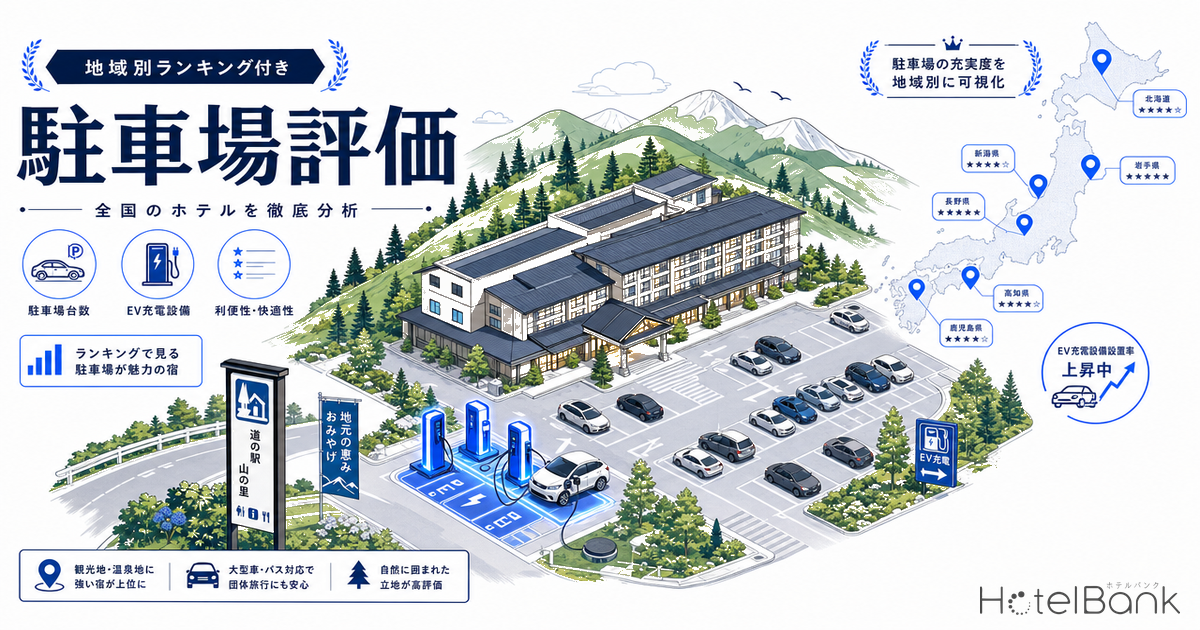
As an axis for choosing a place to stay, “parking” has long been treated as secondary. Yet when guest reviews are aggregated at scale, a large number of properties in regional, car-dependent areas show a parking mention rate above 20% — revealing that a completely different evaluation dynamic is at work compared with metropolitan hotels. This article aggregates guest-review mentions of “parking” by prefecture and ranks the concentration patterns of properties located in car-dependent regions. It also analyzes the co-occurrence of parking mentions with overall in-house facility ratings, and presents EV charging availability as a new axis of differentiation for car-dependent regions. The correlation with ADR trends is treated only as supplementary; the primary lens is reviews × location.
Metric Definitions Used in This Article
- Parking mention rate: Of guest reviews from the most recent 24 months, the share of reviews that mention parking. Based on NLP analysis by the HotelBank Editorial Team (79 semantic tags extracted from review text).
- ADR (Average Daily Rate): The average of publicly listed selling prices on OTAs and similar channels. This differs from actual transaction prices (it tends to run +25–30% higher than a transaction-based figure). Per-room rate for double occupancy (tax included), averaged across all plans.
- Data source: MetroEngines Research (review aggregation is NLP analysis of guest reviews; prices are OTA publicly listed prices)
- — The top parking mention rates are Shizuoka (15.9%), Okayama (15.0%) and Aomori (14.8%) — roughly double the metropolitan areas of Tokyo (8.6%) and Kyoto (6.9%). In the regions, the primary axis of the lodging decision shifts to parking.
- — The single top property is Okayama City Hotel Koseicho at 35.8% (more than one in three reviews mentions parking). The Top 20 contains zero properties from the Tokyo metropolitan area, while Shizuoka, Okayama and Kagawa each place three.
- — The top ranks converge on three types: interchange-adjacent, suburban roadside, and regional main-station front. The common thread is a stay flow that “arrives by car and is completed within the property.”
- — The ADR correlation is weak: Aomori ¥26,700 and Tokushima ¥28,300 show high parking ratings at affordable price points. High metropolitan rates ≠ high parking ratings — an asymmetric structure.
- — The next axis of differentiation is EV charging availability. Comfort Inn’s 84 units, Route Inn’s ongoing expansion, and Hoshino Resorts’ 39 locations mark its arrival. The top layer for parking × in-house-facility co-occurrence is the optimal customer base for the early phase of EV adoption.
A Prefecture Ranking by Parking Mention Rate — the Top Layer Concentrates in Regional and Suburban Areas
Extracting parking mentions from guest reviews and computing the average parking mention rate of the top 10 properties in each prefecture, the leaders were prefectures anchored by regional cities: Shizuoka (15.9%), Okayama (15.0%), Aomori (14.8%), Kochi (13.6%) and Aichi (13.5%). Conversely, Tokyo sat at 8.6% and Kyoto at 6.9% — a clear structure in which the relative importance of parking mentions declines in the large metropolitan areas.
This gap is not merely ranking noise; it can be read as a proxy indicator of how far “parking” has become the primary axis of the lodging decision. In regions such as Shizuoka, Okayama and Kagawa, where travel by car is effectively a given, the presence, size and price of parking heavily influence post-booking satisfaction, and as a result they surface repeatedly in reviews. At metropolitan properties, station access and proximity to downtown areas sit at the center of reviews, and parking in most cases remains a sub-topic. How location evaluation anchored on station access is now qualitatively shifting is decoded on a review basis in The End of the “Near-Station” Myth.
Source: created from MetroEngines Research and the HotelBank Editorial Team (top 10 properties per prefecture, most recent 24 months, N = average of each prefecture’s top 10)
Shizuoka is especially notable: interchange-located hotels in Hamamatsu, Numazu and Yaizu occupy the top ranks. Properties whose very names contain “IC” (interchange) — Hiset Hotel Shizuoka Inter (23.7%), Hotel Gen Hamamatsu Inter (25.9%) — line up, showing that there is deep-rooted business and tourism demand completed within a one-to-two-hour drive of the main interchanges of the Tomei and Shin-Tomei expressways. This point also becomes important from the perspective of EV charging availability discussed below.
Property Ranking — Top 20 by Parking Mention Rate
The table below ranks the properties with the highest parking mention rates over the most recent 24 months, drawn from guest reviews nationwide. The No. 1 property, Okayama City Hotel Koseicho, has parking mentioned in 35.8% of its reviews (83 of 232) — meaning more than one review in three touches on parking.
| Rank | Property | Location | Mention rate | Mentions / total reviews |
|---|---|---|---|---|
| 1 | Okayama City Hotel Koseicho (岡山シティホテル厚生町) | Okayama | 35.78% | 83/232 |
| 2 | Hotel Pearl Garden (ホテル パールガーデン) | Kagawa | 28.75% | 94/327 |
| 3 | Vessel Hotel Fukuoka Kaizuka (ベッセルホテル福岡貝塚) | Fukuoka | 28.65% | 147/513 |
| 4 | Hotel Gen Hamamatsu Inter (ホテル玄浜松インター) | Shizuoka | 25.86% | 68/263 |
| 5 | N Hotel (エヌホテル) | Aichi | 24.91% | 68/273 |
| 6 | HOTEL1-2-3 Kurashiki (HOTEL1-2-3 倉敷) | Okayama | 24.28% | 84/346 |
| 7 | Hiset Hotel Shizuoka Inter (ハイセットホテル静岡インター) | Shizuoka | 23.69% | 68/287 |
| 8 | Hotel Diamonte Niigata Nishi (ホテルディアモント新潟西) | Niigata | 23.62% | 77/326 |
| 9 | Hotel Sealuckpal Sendai (ホテルシーラックパル仙台) | Miyagi | 23.44% | 109/465 |
| 10 | Bright Park Hotel (ブライトパークホテル) | Kochi | 22.53% | 66/293 |
| 11 | Pacific Hotel Okinawa (パシフィックホテル沖縄) | Okinawa | 21.73% | 103/474 |
| 12 | Takamatsu Kokusai Hotel (高松国際ホテル) | Kagawa | 20.79% | 74/356 |
| 13 | Sun Royal Utsunomiya (サンロイヤル宇都宮) | Tochigi | 20.45% | 63/308 |
| 14 | Smile Hotel Yonago (スマイルホテル米子) | Tottori | 19.12% | 61/319 |
| 15 | Hotel Sealuckpal Takasaki (ホテル シーラックパル高崎) | Gunma | 18.95% | 65/343 |
| 16 | Star Hotel Koriyama (スターホテル郡山) | Fukushima | 18.77% | 73/389 |
| 17 | Hotel Concorde Hamamatsu (ホテルコンコルド浜松) | Shizuoka | 18.69% | 106/567 |
| 18 | Hotel Sealuckpal Mito (ホテル シーラックパル水戸) | Ibaraki | 18.26% | 105/575 |
| 19 | APA Hotel Takaoka-Marunouchi (アパホテル〈高岡丸の内〉) | Toyama | 17.87% | 77/431 |
| 20 | The Selecton Takamatsu (ザ・セレクトン高松) | Kagawa | 17.65% | 102/578 |
Source: created from MetroEngines Research and the HotelBank Editorial Team (most recent 24 months; properties with 20+ total reviews and 15+ mentions)
Viewed by regional structure, not a single Top 20 property is located in the Tokyo metropolitan area (Tokyo or Kanagawa); instead, Shizuoka (3 properties), Kagawa (3) and Okayama (3) stand out. As names such as “Hotel Gen Hamamatsu Inter” and “Hiset Hotel Shizuoka Inter” make plain, these are lodging clusters whose primary access flow is “from an interchange or trunk road” rather than “on foot from a station,” and the richness of their parking forms the core of the product.
Typical voices extracted from guest reviews
“The free multi-level parking is right next door and very convenient” (Okayama City Hotel Koseicho)
“There is both surface and multi-level parking, and the multi-level lot lets you settle the ticket yourself, which saved time and was excellent” (Hotel Pearl Garden)
“Parking is free — and unrestricted” (Vessel Hotel Fukuoka Kaizuka)
“Parking is the same lot as the AEON mall; if you park under the elevated section, the hotel entrance is close” (JR Inn Asahikawa)
Source: excerpted from guest reviews (HotelBank Editorial Team survey)
Concentration in Car-Dependent Regions — Structure by Property Type
Classifying the top 20 properties by type, three archetypes emerge. The first is the “roadside hotel” type, interchange-adjacent and located at Numazu, Hamamatsu or Shizuoka interchanges, where the Shizuoka contingent concentrates. The second is the “roadside self-contained” type in the outskirts of regional cities — Sealuckpal (Sendai, Mito, Takasaki), HOTEL1-2-3 Kurashiki and Pearl Garden belong here. The third is the “regional main-station front” type, where parking is effectively free or ample even in front of a major regional station — Tokushima Grandvrio Hotel and Rembrandt Hotel Oita fall into this category.
What these three archetypes share is the premise that a substantial share of guests arrive by private car. In the roadside self-contained type in particular, “ease of parking” stands on its own as a selling point — Hotel Sealuckpal Sendai’s “location surrounded on four sides by trunk roads × large surface lot,” or HOTEL1-2-3 Kurashiki’s “combining tourist-area access with multi-level parking.” A perspective that evaluates roadside locations themselves within an investment framework is explored as a three-tier yield model in our analysis of the re-evaluation of idle-land utilization schemes for roadside hotels (2026).
Source: created from MetroEngines Research and the HotelBank Editorial Team (top 15 properties, color-coded by location)
The Relationship with ADR — High Ratings ≠ High Rates
The prefectures with the highest parking mention rates are not necessarily high-ADR prefectures. Looking at the relationship between double-occupancy ADR in mid-May 2026 (May 15–17) and the top parking-mention prefectures, no clear positive correlation appears between price level and parking rating: Shizuoka (mention rate 15.9% / ADR ¥44,700), Okayama (15.0% / ¥34,000), Aomori (14.8% / ¥26,700) and Tokushima (10.9% / ¥28,300).
What is more interesting is the structure whereby the higher the parking mention rate, the more the prefecture tends to sit a notch or two below the metropolitan areas on rate. Aomori, Tokushima and Okayama remain in the relatively affordable band around ¥30,000, where cost performance is valued on the premise of car travel. ADR functions not as the primary axis of reviews but merely as a background condition.
Source: MetroEngines Research (review aggregation over the most recent 24 months; ADR is the double-occupancy average for May 15–17, 2026; N = 24 prefectures)
Co-occurrence Analysis of “Parking × In-House Facilities” — EV Charging as a New Axis of Differentiation
Next, we ranked properties for which a single review mentioned both “parking” and “overall in-house facility rating.” Their co-occurrence signifies a property that is not merely good at parking, but earns high marks across the entire stay experience — including in-room amenities, the front desk and shared spaces.
| Rank | Property | Location | Co-occurring reviews | Co-occurrence rate |
|---|---|---|---|---|
| 1 | JR Inn Asahikawa (JRイン旭川) | Hokkaido | 13 | 0.59% |
| 2 | Hotel Sealuckpal Sendai (ホテルシーラックパル仙台) | Miyagi | 8 | 1.72% |
| 3 | Kawaguchiko Country Cottage Ban (河口湖カントリーコテージBan) | Yamanashi | 8 | 0.71% |
| 4 | New Otani Inn Yokohama Premium (ニューオータニイン横浜プレミアム) | Kanagawa | 7 | 0.39% |
| 5 | Sapporo International Youth Hostel (札幌国際ユースホステル) | Hokkaido | 7 | 2.6% |
| 6 | Premier Hotel -TSUBAKI- Sapporo (プレミアホテル-TSUBAKI-札幌) | Hokkaido | 7 | 0.53% |
| 7 | Nagoya Kasadera Hotel (名古屋笠寺ホテル) | Aichi | 7 | 1.76% |
| 8 | Pacific Hotel Okinawa (パシフィックホテル沖縄) | Okinawa | 7 | 1.48% |
| 9 | Shimonoseki Grand Hotel (下関グランドホテル) | Yamaguchi | 7 | 1.63% |
| 10 | Himeji Castle Grandvrio Hotel (姫路キヤッスルグランヴィリオホテル) | Hyogo | 7 | 0.98% |
| 11 | Sapporo Park Hotel (札幌パークホテル) | Hokkaido | 7 | 0.51% |
| 12 | KOKO STAY Sagamihara (KOKO STAY 相模原) | Kanagawa | 6 | 1.28% |
Source: created from MetroEngines Research and the HotelBank Editorial Team (both “parking” and “in-house facilities” mentioned within the same review; most recent 24 months)
The properties topping this co-occurrence analysis — JR Inn Asahikawa, Hotel Sealuckpal Sendai, Kawaguchiko Country Cottage Ban, Himeji Castle Grandvrio Hotel, Sapporo International Youth Hostel and others — are lodgings in areas with a strong regional-resort character. When both parking and in-house facilities are discussed within the same review, it can be taken as a sign that guests are valuing a stay that “arrives by car and is completed within the property.”
This structure strongly suggests that, for lodgings in car-dependent regions, the next axis of differentiation is “EV charging availability.” In February 2026, a total of 84 EV chargers (6 kW normal chargers) were rolled out simultaneously across 21 Comfort Inn–brand hotels nationwide operated by Greens Co., Ltd., and Route Inn Hotels continues to expand the number of equipped properties. Hoshino Resorts has already installed EV chargers at 39 locations nationwide. The geographic concentration of EV charging infrastructure at regional resorts reached by car is analyzed ahead of the curve in Regional Lodgings You Drive To: Where Are Parking and EV Charging Now?.
The higher a lodging sits in the parking mention rate, the greater the absolute number of guests arriving by car — and among them, a small but certain share are EV users. In particular, among the interchange-adjacent, suburban roadside and regional main-station-front types, the cluster of properties that also earn high in-house facility ratings offers strong customer-fit for EV charging installation and a readable return on the initial investment. A structure that combines a stay experience completed within the property (large communal bath, breakfast, in-house restaurant) with the time spent charging — the “value of time while charging” — already exists there.
A Complementary Relationship with Roadside-Station (Michi-no-Eki) Hotels
Another category worth watching among car-dependent-region lodgings is the roadside-station (michi-no-eki) hotel. Marriott’s “Fairfield by Marriott” is advancing a michi-no-eki–adjacent format at a scale of roughly 1,000 rooms across 15 locations in six prefectures, and about 50 of Japan’s roughly 1,200 michi-no-eki are equipped with an RV Park (a paid space dedicated to sleeping in one’s car).
In the review aggregation, Fairfield properties such as Tochigi Motegi, Kyoto Kyotamba and Kyoto Amanohashidate appear within the parking-mention Top 100. Because the michi-no-eki–adjacent format carries a flow in which “a place you were going to stop by becomes your lodging base,” it can capture both the arrival mode and the reason-to-stay of car-traveling guests at the same time. As a site for EV charging, the michi-no-eki–adjacent hotel is strategically well-aligned, with a secondary benefit that public subsidies are easier to secure through cooperation with local governments.
Conclusion — the Weight of “Parking Ratings” for Lodgings in Car-Dependent Regions
What the large-scale aggregation of guest reviews reveals is a clear structure: parking mention rates are high in prefectures anchored by regional cities — Shizuoka, Okayama, Aomori, Kochi and Aichi — and relatively low in the Tokyo metropolitan area. The top of the property ranking splits into three types — interchange-adjacent, suburban roadside and regional main-station front — all of which are lodgings premised on a stay that “arrives by car and is completed within the property.”
The correlation with ADR is limited: the top-rated properties for parking are not necessarily high-rate, and a structure emerges in which cost performance is valued on the premise of car travel. The parking × in-house-facility co-occurrence analysis goes one step further, isolating the cluster of lodgings that “arrive by car, are completed within the property, and also score highly on facility satisfaction.” It is precisely this layer that holds the customer base best fitted to the early introduction of the next axis of differentiation — EV charging availability.
As of 2026, EV charger installation by the major hotel chains has entered a full-scale phase: Comfort Inn’s 84 units, Route Inn’s ongoing expansion and Hoshino Resorts’ 39 locations. For lodgings in car-dependent regions — regional resorts, suburbs, and michi-no-eki–adjacent sites — a high parking rating is an already-established strength, and layering EV charging availability on top of it can quietly expand the value of “the time car-traveling guests spend within the property.” The next axis of investment judgment for roadside-type lodging facilities lies within this overlay.
Related Articles
- Regional Lodgings You Drive To: Where Are Parking and EV Charging Now? — The Geographic Concentration of “Charging Infrastructure” Seen Through Reviews
- The End of the “Near-Station” Myth — Qualitative Shifts in the Location-Evaluation Axis as Reflected in Guest Reviews
- Venue Proximity as Location Value — Aggregating Lodgings Valued for Event and MICE Demand, Nationwide and by Area
- How Mandarin Oriental Setouchi Will Change the Regional Luxury Market | The Background to Kagawa’s +17% ADR and an Opening-Impact Estimate
- Review-Quality Ranking of Hotels with Pools — A Thorough Analysis of 419 Properties Across the Tokyo Area, Kansai and Okinawa
References & Sources
■ Data sources
Aggregated data from MetroEngines Research & Consulting (NLP analysis of 79 tags from guest reviews, most recent 24 months), and OTA publicly listed ADR (May 2026, double-occupancy average). The prefecture aggregation is the average of each prefecture’s top 10 properties; the property ranking targets properties with 20+ total reviews and 15+ mentions.
■ Estimation assumptions
Parking mention rate = number of reviews with an extracted “parking” tag ÷ total reviews for the target property (most recent 24 months). ADR is tax-inclusive, all-plan average, on a publicly listed price basis that tends to run +25–30% higher than actual transaction prices. The co-occurrence analysis is the share in which both the “parking” and “in-house facilities” tags were assigned within the same review.
■ Limitations & caveats
The review mention rate is a proxy indicator of the structure of guests’ interest and does not directly measure the physical quality of the parking itself (number of spaces, price, multi-level/surface). EV charger counts are aggregated from manufacturer and chain official announcements, spanning multiple points in time between February and July 2026. The count of michi-no-eki–adjacent hotels is based on publicly available information and may include non-disclosed rollouts.
■ Review & price data
- MetroEngines Research — “parking” and “in-house facilities” mention tags extracted from guest reviews (NLP analysis, most recent 24 months)
- MetroEngines Research — OTA publicly listed ADR (May 2026, double occupancy, tax included)
■ EV charging & hotel industry trends
- Greens Co., Ltd. “EV chargers installed at 21 Comfort Inn hotels” (February 1, 2026)
- Route Inn Hotels — list of hotels with electric vehicle (EV) chargers (as of January 19, 2026)
- Hoshino Resorts Electric Vehicle (EV) Travel (39 locations nationwide)
- EV Charge ENECHANGE “Zero-Cost EV Charger Installation Plan for Hotels, Ryokan and Guests”
■ Roadside-station (michi-no-eki) hotels