

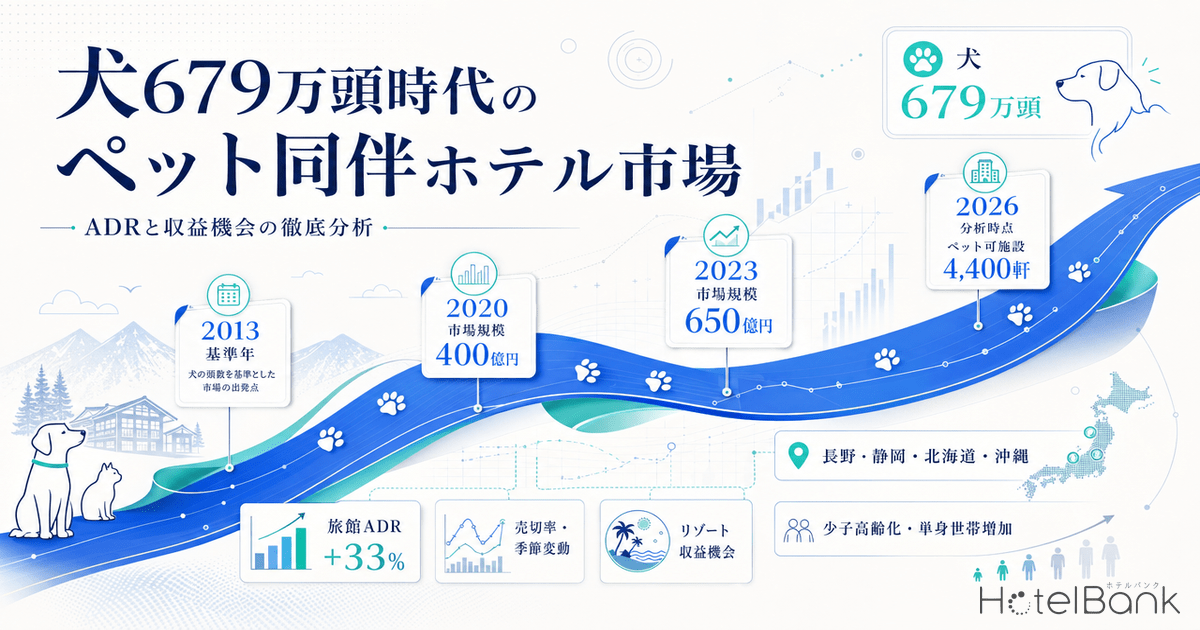

Against the backdrop of Japan’s declining birthrate, aging society, and growing single-person households, the perception of dogs and cats as “family members” is firmly taking root. Travel demand premised on bringing pets along is quietly but steadily expanding. This article uses lodging facility data collected by MetroEngines Research to compare the ADR and sold-out rates of pet-friendly properties against standard ones, quantifying revenue opportunities by location, category, and season.
* Metric Definitions Used in This Article: ADR (Average Daily Rate) = the average of publicly listed sales prices at surveyed properties, which differs from actual transaction prices. Sold-out rate = the proportion of sales plans that had stopped accepting reservations as of the survey date, which differs from the property’s overall occupancy rate. Prices are per-room rates (tax included) for double occupancy.
A Market of 6.79 Million Dogs and 2,300 Pet-Friendly Properties
According to the nationwide dog and cat ownership survey by the Japan Pet Food Association, the domestic dog population stands at approximately 6.8 million — a double-digit increase from 2013. Adding cats brings the total to over 15 million, making pets a major category that influences household spending and consumer behavior. Furthermore, the National Institute of Population and Social Security Research projects single-person households will reach 44.3% of the total by 2050, and these households tend most strongly to position pets as “family.”
Industry surveys indicate that pet-friendly accommodations in Japan have expanded into the 2,000s, concentrated in resort-oriented regions led by Nagano, Shizuoka, Hokkaido, and Okinawa. Japan Tourism Agency interviews show that over 70% of dog owners “want to travel with their pets,” and one estimate puts market size growth at 1.6x — from ¥40 billion in 2020 to ¥65 billion by 2023.
Among domestic lodging facilities currently sold via OTAs and tracked by MetroEngines Research, approximately 4,400 properties carry tags such as “pet allowed,” “pet accompaniment,” or “dogs OK.” This is close to the 2,300-property figure on a publicly disclosed basis, with roughly half of supply made up of resort-oriented ryokans, pensions, and cottages.
Source: Compiled by HotelBank Editorial Team from MetroEngines Research (N=4,374 properties)
ADR Premium for Pet-Friendly Hotels: +33% in Ryokans
When compared in the same period and category, how much higher is the ADR at pet-friendly properties? The table below shows results aggregated by category as of April 2026 based on MetroEngines Research data. Comparison is limited to properties with sales activity on OTAs that month, excluding extreme outliers (under ¥1,000 and over ¥200,000).
Source: Compiled by HotelBank Editorial Team from MetroEngines Research (April 2026, N=23,911 properties)
| Category | Pet-Friendly ADR | Standard ADR | Premium | Sold-out Rate Diff |
|---|---|---|---|---|
| Ryokan | ¥52,200 | ¥39,100 | +33.3% | +10.1pp |
| Business Hotel | ¥21,200 | ¥18,000 | +17.6% | +15.9pp |
| City Hotel | ¥35,500 | ¥30,300 | +17.1% | +14.2pp |
| Pension | ¥25,300 | ¥23,900 | +5.9% | ±0pp |
| Resort Hotel | ¥47,200 | ¥49,500 | −4.7% | +14.4pp |
| Vacation Rental | ¥45,300 | ¥53,300 | −14.9% | +0.1pp |
Source: Compiled by HotelBank Editorial Team from MetroEngines Research (April 2026)
The most pronounced premium is observed in the ryokan category. Pet-friendly ryokans (N=722) post an ADR of approximately ¥52,200 — 33% higher than the ¥39,100 ADR of standard ryokans (N=6,218). Sold-out rates also show a wide gap of 13.9% versus 3.8%, indicating a clear advantage in both pricing and demand. This reflects geographic concentration in high-priced hot spring resort areas like Karuizawa, Izu, Nasu, and Yufuin, combined with pet fees of ¥3,000–¥10,000 per dog and amenity differences such as private guest rooms and open-air baths.
Conversely, in vacation rentals and resort hotels, pet-friendly properties have lower ADRs than standard ones. This is because the “pet-friendly” tag is concentrated in mid-priced cottage-style facilities rather than in the high-priced luxury segment — note that this does not mean the pure pet premium has disappeared.
Prefectural Revenue Trends: Nagano (Karuizawa) and Shizuoka (Izu) Drive Demand
The geographic concentration of pet-friendly properties mirrors regional demand structures. Below we compare ADR and sold-out rates during Golden Week (May 2–5, 2026) for the eight prefectures with the highest concentrations of pet-friendly properties nationwide.
Source: Compiled by HotelBank Editorial Team from MetroEngines Research (May 2-5, 2026 check-ins, N=10,279 properties)
| Area | Pet-Friendly ADR | Standard ADR | Premium | Pet-Friendly Sold-out Rate |
|---|---|---|---|---|
| Yamanashi | ¥65,800 | ¥53,300 | +23.4% | 22.2% |
| Tochigi | ¥63,100 | ¥50,200 | +25.8% | 21.9% |
| Gunma | ¥60,100 | ¥50,600 | +18.7% | 28.1% |
| Shizuoka | ¥62,300 | ¥54,200 | +15.0% | 26.8% |
| Okinawa | ¥53,600 | ¥46,900 | +14.3% | 45.0% |
| Hokkaido | ¥45,400 | ¥35,600 | +27.6% | 38.9% |
| Nagano | ¥53,500 | ¥52,500 | +2.0% | 32.3% |
| Chiba | ¥44,800 | ¥47,500 | −5.6% | 32.4% |
Source: Compiled by HotelBank Editorial Team from MetroEngines Research
What stands out is the strong premium observed in three areas: Tochigi (+25.8%), Hokkaido (+27.6%), and Yamanashi (+23.4%). Nasu Highlands in Tochigi, the Fuji Five Lakes and Yatsugatake in Yamanashi, and the Tokachi and eastern Hokkaido areas are all blessed with nature and highland resorts, and long-stay travel with dogs is expanding in these regions.
Nagano’s standard ADR is itself high (¥52,500), reflecting the depth of high-end resorts like Karuizawa, Tateshina, and Hakuba — leaving smaller relative “headroom” for a pet-friendly premium. However, the sold-out rate gap of 32.3% (pet-friendly) versus 14.0% (standard) — over 18 percentage points — surpasses other prefectures in demand intensity. Chiba is the only prefecture where pet-friendly ADR falls below standard, but this reflects mid-priced pet-focused hot spring pensions in Inubosaki and the southern Boso Peninsula, so direct comparison with luxury hotels requires caution.
Okinawa’s pet-friendly sold-out rate of 45% is the highest among the eight prefectures compared. Given the cost of travel from the mainland, dog-accompanied trips to Okinawa center on long-stay demand from affluent travelers, and concentrated bookings on limited supply likely push up the sold-out rate.
→ [Summer 2026] Hotel Price Comparison: Okinawa, Hokkaido & Kyoto — When to Book
Seasonal Demand: Premium Expands in May (New Greenery) and August (Summer Holidays)
Pet accompaniment demand has clear seasonality. The chart below compares mid-month check-ins in May (new greenery), June (rainy season), and August (summer holidays) for Nagano and Shizuoka prefectures.
Source: Compiled by HotelBank Editorial Team from MetroEngines Research (Nagano & Shizuoka, 15th of each month check-in)
May overlaps with weekday-centered demand following Golden Week and the new greenery season. Pet-friendly ADR reaches ¥48,700 — 11% above standard properties. Sold-out rates show a wide gap of 24.4% versus 13.7%, confirming a structure where limited supply fills first. June, with the start of the rainy season, sees both pet-friendly and standard ADRs pushed down by softer demand — yet sold-out rates still favor pet-friendly properties at 15% versus 9% (a 6-point gap). This likely reflects bookings concentrating on facilities with indoor dog runs or in-room activities for rainy days.
In mid-August during summer holidays, pet-friendly ADR surges to ¥68,700, 12% above the ¥61,300 of standard properties. Notably, sold-out rates show a 22-point gap of 38.4% versus 16.0% — pet-friendly properties function as “impossible to book” inns during the heat of summer. As discomfort grows around leaving family-like pets in cars or empty homes during extreme heat, the scarcity of facilities equipped with air conditioning, dog runs, and dedicated private baths is reflected in pricing.
In short, pet-friendly properties maintain high sold-out rates year-round, with premiums expanding particularly during peak periods of May new-greenery season and August summer holidays. Conversely, even June off-season retains a baseline of supportive demand, suggesting that annual occupancy can be smoothed across the calendar.
Converting Existing Properties to Pet-Friendly: Initial Investment and Payback Scenarios
What the data shows is that pet-friendly conversion is not merely a niche response but a revenue strategy that lifts both ADR and occupancy beyond baseline. So when an existing hotel or ryokan converts to pet-friendly, what level of investment and timeframe enables payback?
| Investment Item | Estimated Cost (10-room scale) | Main Contents |
|---|---|---|
| Room Renovation (odor/scratch resistant) | ¥1.5–3.0M | Flooring replacement, wall guards, deodorizing equipment |
| Dog Run Installation | ¥1.0–5.0M | Fencing, artificial turf, water taps, night lighting |
| Pet Equipment & Fixtures | ¥0.3–0.8M | Cages, feeding bowls, litter, paw-washing stations |
| Staff Training & Operations | ¥0.3–0.5M | Acceptance manuals, waivers, insurance enrollment |
| Total | ¥3.1–9.3M | 10-room scale, partial to full conversion |
Source: Compiled by HotelBank Editorial Team from interviews with lodging industry renovation cases
Suppose an existing ryokan (10 rooms, 60% annual occupancy, standard ADR of ¥39,000) converts a portion of rooms to pet-friendly, lifts ADR closer to the ¥52,200 average for pet-friendly ryokans, and improves occupancy by +5 points. Estimated annual incremental revenue would be as follows.
Source: Compiled by HotelBank Editorial Team based on the renovation estimate above
If 4 of the 10 rooms are converted to pet-friendly, ADR rises on average from ¥39,000 to ¥44,300 (prorated 25% increase). Combined with a 5-point occupancy improvement, annual incremental revenue is estimated at approximately ¥7.8 million. Even with a conservative 50% gross margin, ¥3.9 million in annual cash flow upside is expected. Assuming a mid-range initial investment of ¥6 million, payback is achievable in roughly 1.5 to 2 years.
That said, pet-friendly conversion comes with risks of trouble. Without operational preparation, complaints from other guests over barking, shedding, and accidents — plus liability risk from biting incidents — can damage the brand instead of generating returns. Four minimum safeguards: obtaining waivers, enrolling in liability insurance, preparing response manuals, and separating dedicated floors (avoiding mixed use).
Conclusion: Capital Investment That Converts “Pets Are Family” Into Pricing
Japan’s dog population stands at approximately 6.8 million, and single-person households are heading toward 44% by 2050. Pet-friendly accommodations have expanded into the 2,300s, and within MetroEngines Research’s coverage, ryokans show an ADR premium of +33% — and during May in Nagano and Shizuoka, sold-out rates reach 24% versus 14%, outperforming standard properties on both pricing and demand.
Of course, not every property suits pet-friendly conversion. In resort hotels and vacation rentals, the “pet-friendly” tag tends to associate with mid-priced segments, making pure premium hard to detect. By contrast, ryokans, pensions, and cottage-style facilities offer clear revenue opportunities — particularly in highland resort prefectures like Tochigi, Yamanashi, Gunma, and Hokkaido, where ADR premiums above 20% are observed.
The “familization” of pets is an irreversible social shift, and this market’s growth is likely to continue. If a payback scenario of 1.5 to 2 years is achievable at 10-room scale, it warrants consideration as capital investment. What matters is not chasing demand, but building the operational design and risk management to coexist with other guests.
Related Articles
- Summer 2026: ADR, Sold-Out Rate, and YoY Analysis Across 5 Major Resort Areas
- Shizuoka’s “31 Hidden Openings” 2026: Mt. Fuji Entry Fee + Summer Foothill Hotel Shifts
- [Summer 2026] Hotel Price Comparison: Okinawa, Hokkaido & Kyoto — When to Book
- Summer Resort Comparison 2026: Niseko, Okinawa, Karuizawa — ADR, Booking Pace, and FX Sensitivity
- GW2026 Last-Minute Demand: Lead-Time ADR Analysis Across 4 Cities