

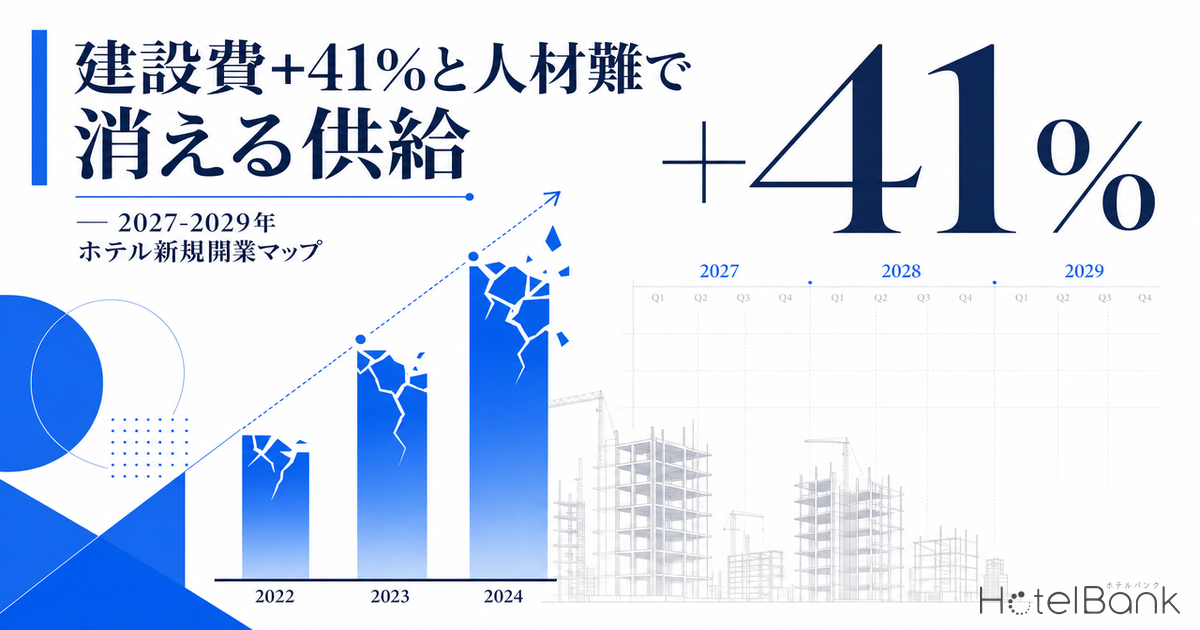
This report quantifies how a staircase-like surge in construction costs — +41.1% per tsubo over the two years from 2022 to 2024 (¥1.383M → ¥1.950M per tsubo, per the Construction Research Institute, 一般財団法人 建設物価調査会) — combined with the construction-industry labor shortage stemming from the Work Style Reform Act enforced in April 2024, is structurally cutting Japan’s new hotel supply for 2027-2029. Drawing on the latest cases and pipeline data, it extends the analysis to the re-rating of existing stock value and to rebrand-type alternative strategies.
Metric Definitions Used in This Article
- ADR (Average Daily Rate): The average of publicly listed selling prices on OTAs and similar channels. This differs from actual transaction prices (tends to run +25-30% above the contracted ADR disclosed by REITs). Per-room rate for double occupancy (tax included), averaged across all plans (room-only through meal-inclusive).
- OCC (Occupancy Rate): The ratio of sold rooms to total rooms in the area (an estimate based on OTA sales inventory). Used in this article only for macro analysis at the prefecture / municipality level.
- New-Opening Data: Compiled by MetroEngines Research & Consulting from the MLIT “Building Construction Statistics Survey.” These are planning figures on a building-confirmation-application basis, referenced as the lower bound of the currently confirmed pipeline. Counts and room numbers are expected to rise as further applications are filed.
- — +41.1% (¥1.383M → ¥1.950M/tsubo) Hotel construction costs climbed in staircase fashion over 2022→2024; JLL estimates Japan’s new-supply rate at 1.7%, roughly a quarter of the APAC average of 6.6%.
- — Meitetsu bid withdrawal / Nakano agreement termination Following the Nagoya station-front redevelopment (project cost undisclosed) and the Nakano Station New North Exit (project cost ~¥350.0B → TBD), the Hakata “Sky City” and the Imperial Hotel Tower Wing are also seeing a chain of delays.
- — 2027: 11 projects / 2,526 rooms; 2028: 6 projects / 1,175 rooms The confirmed pipeline (100+ rooms, confirmation-application basis) has narrowed sharply; even with additional filings it is likely to fall well short of prior projections.
- — Kyoto ADR +17.2% / Osaka +5.9% ADR resilience during the supply-void period is proportional to demand intensity: Kyoto ¥49,700 / Osaka ¥27,800-class rates keep pushing higher, while regional core cities show a rising preference for rebrand alternatives.
- — Re-rating of existing stock Renovation investment (¥700K-1M/tsubo) further strengthens its relative advantage over new build (¥1.95M/tsubo), intensifying acquisition competition for rebrand/conversion deals.
The Reality of +41% Construction Costs — From ¥1.38M in 2022 to ¥1.95M/Tsubo in 2024
The starting point for any discussion of new hotel supply is the extreme, staircase-like rise in construction costs. Hotel construction costs compiled by the Construction Research Institute (一般財団法人 建設物価調査会) (nationwide, new construction, structure-weighted average) rose +41.1% over two years, from ¥1.383M per tsubo in 2022 to ¥1.950M in 2024 — a rise concentrated in the hotel segment, far exceeding the overall construction-cost index gain over the same period (roughly in the low-teens percent). According to analysis by Nomura Real Estate Solutions, the Work Style Reform Act enforced in April 2024 (two-day weekends and overtime caps for the construction industry) pushed labor costs up 5-10%, compounded by material-delivery delays and the largest increase in public-works standard labor unit prices in a decade (¥23,600, up over 5%).
What is decisive is that this increase has risen to a level at which the previously common 50-100-room lodging-focused hotels can no longer pencil out. Analysis published by JLL in December 2025 likewise notes that currently planned new developments are skewed toward “full-service formats with high ADR and monetizable F&B/banqueting” and “openings as part of large-scale mixed-use complexes,” and that supply volume itself is being suppressed. Japan’s new hotel supply rate of 1.7% remains conspicuously low compared with Vietnam’s 21.3% and the APAC average of 6.6%.
Latest Rundown of Frozen & Delayed Projects — Meitetsu Bid Withdrawal and Nakano Agreement Termination
From late 2025 into early 2026, freezes and postponements of redevelopments including large hotels were announced in rapid succession. Especially significant are the Meitetsu Nagoya Station district redevelopment — where the prospective contractor filed a bid-withdrawal notice on November 26, 2025 citing “difficulty building a construction workforce amid the labor shortage” — and the Nakano Station New North Exit area redevelopment, whose basic agreement was terminated in June 2025 after project costs ballooned from an initial ¥181.0B to over ¥350.0B. Both were symbolic projects — encompassing Hyatt’s top-tier lifestyle “Andaz” brand and one of the Tokyo metropolitan area’s premier concentration zones, respectively — and were received as structural signals for the market.
The Meitetsu project had originally scheduled demolition to start in FY2026, new construction in FY2027, Phase 1 completion in FY2033, and Phase 2 completion in the early 2040s; but at the December 12, 2025 presidential press conference, the entire schedule was changed to “undetermined.” Within this ~¥888.0B redevelopment — one of the Chubu region’s largest — the roughly 150-room “Andaz Nagoya” (all rooms 50㎡+, planned to open in FY2034) also became undated. For the impact on the medium-to-long-term pipeline and ADR tiers around Nagoya Station, see our detailed analysis in Nagoya’s Development Pipeline on the Eve of the Linear Shinkansen, 2026-2033. For the Nakano project, the ballooning from ¥181.0B initially to over ¥350.0B as of September 2024 triggered the halt of talks on the prospective contractor’s “twin-tower proposal,” leading to the June 2025 termination of the basic agreement. Nakano Ward plans to hold a new public solicitation for a private developer in April 2027, locking in an approximately two-year void.
Similar moves have spread across large projects generally. The Imperial Hotel Tokyo Tower Wing rebuild was, in the March 27, 2026 announcement, delayed by roughly six years — with tower-wing demolition pushed from the original FY2024 to around the end of FY2030. On September 26, 2025, JR Kyushu announced the cancellation of the “Hakata Station Sky City Project” (¥43.5B investment; 12 stories above ground; office + hotel), citing that construction costs had “nearly doubled.” Shibuya Scramble Square Phase II (Central and West Towers) was likewise delayed by four years on May 9, 2025, with completion pushed from the original FY2027 to FY2031. In every case, the overlap of construction and labor costs rendered the business plan “unable to achieve profitability” upon review.
| Project | Announcement | Change | Scale of Impact |
|---|---|---|---|
| Meitetsu Nagoya Station District Redevelopment | Nov 2025 bid withdrawal / Dec presidential press conference | Both demolition and new build now “undetermined” | ¥888.0B investment / Andaz Nagoya 150 rooms |
| Nakano Station New North Exit Area | Jun 2025 basic agreement terminated | Project cost ballooned ¥181.0B → over ¥350.0B | Ward office / Sunplaza district re-solicitation Apr 2027 |
| Imperial Hotel Tokyo Tower Wing | Announced 2026/3/27 | Demolition start FY2024 → around end of FY2030 | ~6-year delay from original plan |
| JR Kyushu Hakata Station Sky City | Cancelled 2025/9/26 | Construction cost nearly doubled; project cancelled | ¥43.5B initial investment / ¥6.0B preparatory work already spent |
| Shibuya Scramble Square Phase II | Announced 2025/5/9 | Completion FY2027 → FY2031 | 4-year delay; ~95,000㎡ gross floor area |
2027-2029 New Supply Forecast Map — The Lower Bound of the Confirmed Pipeline
In the confirmation-application-basis planning pipeline that we compile from MLIT’s “Building Construction Statistics Survey” (hotels with 100+ rooms, within MetroEngines Research & Consulting’s coverage), completions scheduled for 2027 total 11 projects / 2,526 rooms, 2028 totals 6 projects / 1,175 rooms, and 2029 is 1 project / 100 rooms. Compared with the 21 projects / 4,967 rooms scheduled for completion in 2026, 2027 is down 48% in project count and 49% in rooms, while 2028 is down 71% and 76% respectively. Note that these are “lower bounds for projects with filed confirmation applications,” and counts will grow as further applications are filed. However, since it typically takes 2-3 years from confirmation application to completion, projects completing in 2028 would need their applications largely in by the end of 2026 — so the current scarcity can be read as a signal of structural supply thinning.
Looking at the geographic distribution of these plans, the 100+-room projects for 2027-2029 are dispersed across secondary metropolitan areas: Tokyo, Chiba, Kanagawa, Osaka, Hokkaido, Okayama, Gunma, Aomori, Tochigi, and Gifu. In particular, mid-to-large full-service formats dominate — a ~1,000-room project in Mihama Ward, Chiba City, Chiba (scheduled for December 2027), 300-room projects in Okayama City and Utsunomiya City, a 272-room project in Naka Ward, Yokohama, and a 220-room project in Dojima-hama, Kita Ward, Osaka. As JLL notes, 50-100-room lodging-focused formats increasingly fail to pencil out, confirming a structure skewed toward parts of large mixed-use complexes or high-rate full-service formats.
| Completion | Location | Rooms | Category |
|---|---|---|---|
| 2027/12 | Hibino, Mihama Ward, Chiba City | 1,000 | Large mixed-use |
| 2027/05 | Kitanaka-dori, Naka Ward, Yokohama | 272 | Urban full-service |
| 2027/12 | Furano, Hokkaido | 200 | Resort |
| 2027/04 | Dojima-hama, Kita Ward, Osaka | 220 | Urban full-service |
| 2027/04 | Ekimae-cho, Kita Ward, Okayama City | 190 | Regional city, station-front |
| 2027/04 | Midori, Gunma | 150 | Resort |
| 2028/10 | Ikegami-cho, Utsunomiya City | 300 | Regional city |
| 2028/12 | Nodaya-cho, Kita Ward, Okayama City | 300 | Regional city |
| 2028/05 | Maebaru-nishi, Funabashi City | 238 | Tokyo suburbs |
| 2028/08 | Honmachi, Chuo Ward, Osaka | 117 | Urban midscale |
| 2029/02 | Uchisaiwaicho, Chiyoda Ward | 100 | Urban mixed-use |
ADR Resilience in Affected Areas — Implications of Kyoto +17.2% and Osaka +5.9%
How far ADR will rise in areas where supply is being cut can be quantified from the public price data tracked by MetroEngines Research. As of April 2026, YoY ADR growth rates for major cities were: Kyoto +17.2% (¥42,400 → ¥49,700), Osaka +5.9% (¥24,700 → ¥26,200), Fukuoka +4.8% (¥27,800 → ¥29,100), and Tokyo essentially flat (-0.0%, ¥36,200 → ¥36,200). Kyoto’s double-digit growth can be read as the result of thinning room supply since 2024 and recovering inbound demand creating a supply-demand gap that was passed through to ADR ahead of the curve.
Especially notable is that Kyoto rose ¥2,300 in five months, from ¥47,400 in November 2025 to ¥49,700 in April 2026. Over the same period the nationwide lodging CPI was roughly flat (175.9 in November 2025 → 172.3 in May 2026), suggesting the driver was Kyoto-specific supply-demand tightness rather than CPI pass-through. With the Nakano Station New North Exit re-solicitation scheduled for April 2027, a similar structure could emerge in the Nakano/Shinjuku areas during the interim. In the Nagoya area too, the freezing of the Meitetsu project pushes the station-front ~150-room luxury property to FY2034 or later, tending to increase the scarcity of the existing luxury tier (Nagoya Marriott, The Cypress Nagoya, and others).
Tokyo’s flatness looks surprising at first glance, but this is likely because the population of N=1,584 properties as of April 2026 includes several new openings in Shinagawa, Ikebukuro, Otemachi and elsewhere, so the sheer size of the base dilutes the scarcity effect. The supply void materializes in 2027-2028, and if renovation/rebranding of existing properties advances in the meantime, median ADR is quite likely to ratchet up further.
Investor Implications — Re-rating Existing Stock and Rebrand Alternative Strategies
The investor implications derived from this structure can be organized into three layers. First, the re-rating of existing stock value. When the economics of new construction break down, the relative scarcity of operating existing hotels rises. In particular, properties in prime station-front locations with 100-200 rooms and full-service capability see their acquisition value rise in an inverted fashion in 2027-2029, when new-build alternatives become difficult. Under a cap-rate-compression scenario, there is room for roughly 50-100bps of compression from current transaction yields, centered on the luxury tier and the urban upper-midscale tier.
Second, rebrand/conversion-type alternative strategies. At a level where new-build costs run about ¥6.5B for a 10,000㎡ gross-floor-area building at ¥1.95M/tsubo, cases increasingly arise where acquiring an equivalently sized office/commercial building plus converting it to hotel use makes economic sense. In practice, deals converting existing offices into high-rate full-service hotels are on the rise, and construction periods can be shortened to less than half that of new builds — a tipping point driven by lower investment unit prices relative to the achievable ADR lift. The strategies of major developers such as Mitsui Fudosan, Tokyu Land, and Nomura Real Estate are also showing a rising share of existing-stock utilization.
Third, the structural upside of regional cities. In the confirmation-application-basis pipeline, 2027-2028 features multiple mid-sized projects of 200-300 rooms in regional areas that have been relatively under-invested until now — Okayama, Utsunomiya, Funabashi, Midori (Gunma), Furano (Hokkaido), and others. These can be read as the result of developers shifting to regional areas amid soaring Tokyo-area construction costs. As the regional dispersion of tourism demand combines with station-front redevelopment in secondary metropolitan areas, room for growth in both ADR and OCC can be expected.
Re-rating of Existing Stock Value
The relative scarcity of existing properties in prime station-front locations with 100-200 rooms and full-service capability rises. In 2027-2029, when new-build alternatives become difficult, a structural rise in acquisition value is expected.
Rebrand-Type Alternative Strategy
New-build costs at ¥1.95M/tsubo have risen to a level that breaks new-build economics. Acquiring an existing office/commercial building plus converting it to hotel use holds economic rationality as an alternative to new construction.
Structural Upside in Regional Cities
A confirmed pipeline of 200-300-room projects in secondary metropolitan areas such as Okayama, Utsunomiya, Funabashi, and Furano. A growth opportunity where developers’ regional shift amid soaring construction costs overlaps with tourism dispersion.
That said, when putting these strategies into practice there are also risk factors to weigh carefully. If construction and labor costs continue to rise, even rebrand deals may struggle to pencil out. And while the 2027-2029 supply thinning ultimately underpins OCC, if inbound demand slows from current levels, the room for ADR increases would shrink rapidly. Monitoring the Construction Research Institute’s construction-cost index alongside the JTA “Overnight Travel Statistics Survey” monthly OCC in parallel is a prerequisite for investment judgment.
⚠ Note on pipeline data: The 2027-2029 pipeline in this article is compiled by MetroEngines Research & Consulting on a confirmation-application basis (derived from MLIT’s “Building Construction Statistics Survey”) and represents the lower bound of the currently confirmed pipeline. Because confirmation applications are typically filed 2-3 years before opening, counts and room numbers may rise as further applications are filed. Please reference this as a structural signal rather than a definitive figure.
Conclusion
The dual constraint of +41% construction costs per tsubo and a labor-supply shortage is working to cut Japan’s new hotel supply for 2027-2029 by 48-71% versus 2026 on a confirmed-pipeline basis. The freezes and delays of five symbolic projects — Meitetsu Nagoya Station district, Nakano Station New North Exit, Imperial Hotel Tokyo Tower Wing, JR Kyushu Hakata Station Sky City, and Shibuya Scramble Square Phase II — should be read as structural signals. The market implications can be organized into three layers: the rising relative scarcity of existing stock, the economic rationality of rebrand/conversion-type alternative strategies, and the investment opportunity in the confirmed 200-300-room pipeline of regional secondary cities. What Kyoto’s ADR +17.2% shows ahead of the curve is the fact that the supply-demand gap is already beginning to be passed through into prices.
Related Reading
- Nagoya’s Development Pipeline on the Eve of the Linear Shinkansen, 2026-2033
- HotelBank — Latest Hotel Industry Reports
References & Sources
■ Data Sources
Construction costs use the Construction Research Institute (一般財団法人 建設物価調査会) “Construction Cost Index (Hotels)” (nationwide, new build, structure-weighted average, 2022→2024) and Nomura Real Estate Solutions’ “On the Surge in Construction Costs and Its Causes” as primary sources; the new-supply pipeline is extracted by MetroEngines Research & Consulting for 100+-room confirmation applications (scheduled for completion 2027-2029) from MLIT’s “Building Construction Statistics Survey” (confirmation-application basis, Stat ID: 0003114490). Market ADR/OCC are from OTA public prices (Tokyo 1,584 / Osaka 863 / Kyoto 1,502 / Fukuoka 724 properties, as of April 2026). Investment metrics are from JLL’s “Latest Trends in Japan’s Hotel Market” (December 2025).
■ Estimation Assumptions
The new-supply forecast is the lower bound of the confirmed confirmation-application-basis pipeline and excludes unfiled projects. ADR levels are for double occupancy, tax included, averaged across all plans, and tend to run +25-30% above the contracted ADR disclosed by REITs. Cross-area comparisons are simple aggregates for the same period (as of April 2026) and are not neutralized for differences in format mix. Construction-cost increases are a composite of structure, equipment, and labor; refer separately for breakdowns by use and grade.
■ Limitations & Caveats
Freeze/delay cases are limited to major projects announced between November 2025 and March 2026, and unannounced withdrawals are not captured. Because confirmation-application-basis data reflects changes and withdrawals of business plans with a lag, recent freezes (Meitetsu, Nakano, Hakata) may only be partially reflected in the 2027-2029 forecast figures. Regional rebrand potential depends heavily on assumptions of demand recovery and labor procurement, and this article’s implications should be interpreted mainly around the four major markets of Tokyo, Kyoto, Osaka, and Fukuoka.
■ Market Data
- MetroEngines Research & Consulting — OTA public price data (Tokyo 1,584 / Osaka 863 / Kyoto 1,502 / Fukuoka 724 properties, as of April 2026)
■ Government Statistics & Public Data
- Construction Research Institute (建設物価調査会) “Construction Cost Index”
- archi-book “What Level Is Hotel Construction Cost per Tsubo? [2025 Edition]”
- e-Stat “Consumer Price Index,” lodging fees (Stat ID: 0003427113)
- MLIT “Building Construction Statistics Survey” (Stat ID: 0003114490)
■ Real Estate & Investment Reports
- JLL “Latest Trends in Japan’s Hotel Market: Undervalued in Global Comparison; New Hotel Supply Limited by Soaring Construction Costs” (December 2025)
- Nomura Real Estate Solutions “On the Surge in Construction Costs and Its Causes, 2024”
- Nomura Real Estate Solutions “On the Surge in Construction Costs and Its Causes, 2025”
■ News & Press Releases (Freeze/Delay Cases)
- Nagoya Railroad (Meitetsu) “On Schedule Changes to the Nagoya Station District Redevelopment Plan and the Start of Re-verification and Review of the Current Plan” (December 12, 2025)
- Nikkei “Meitetsu Makes Nagoya Station Redevelopment Opening Timing ‘Undetermined'” (December 2025)
- Nikkei xTECH “Nakano Sunplaza Redevelopment Plan Redone; Renovation/Reuse Ruled Out; Re-solicitation in FY2027”
- Tokyo Shimbun “Nakano Sunplaza Redevelopment: Nakano Ward to Terminate Agreement with Developer as Early as July”
- Nikkei “Imperial Hotel Tokyo to Demolish Tower Wing by End of FY2030; Six Years Behind Original Plan” (March 2026)
- Nikkei “JR Kyushu Cancels Hakata Station Mixed-Use ‘Sky City’ Plan Amid Soaring Construction Costs” (September 2025)
- FASHIONSNAP “Shibuya Scramble Square Development Phase II Delayed Four Years, to Complete in FY2031” (May 2025)
- Hyatt Japan “Press Materials, April 2026”
- Meitetsu Press Release “Andaz, Hyatt’s Top-Tier Lifestyle Brand, Selected as the Hotel Brand for the Nagoya Station District Redevelopment Plan”