

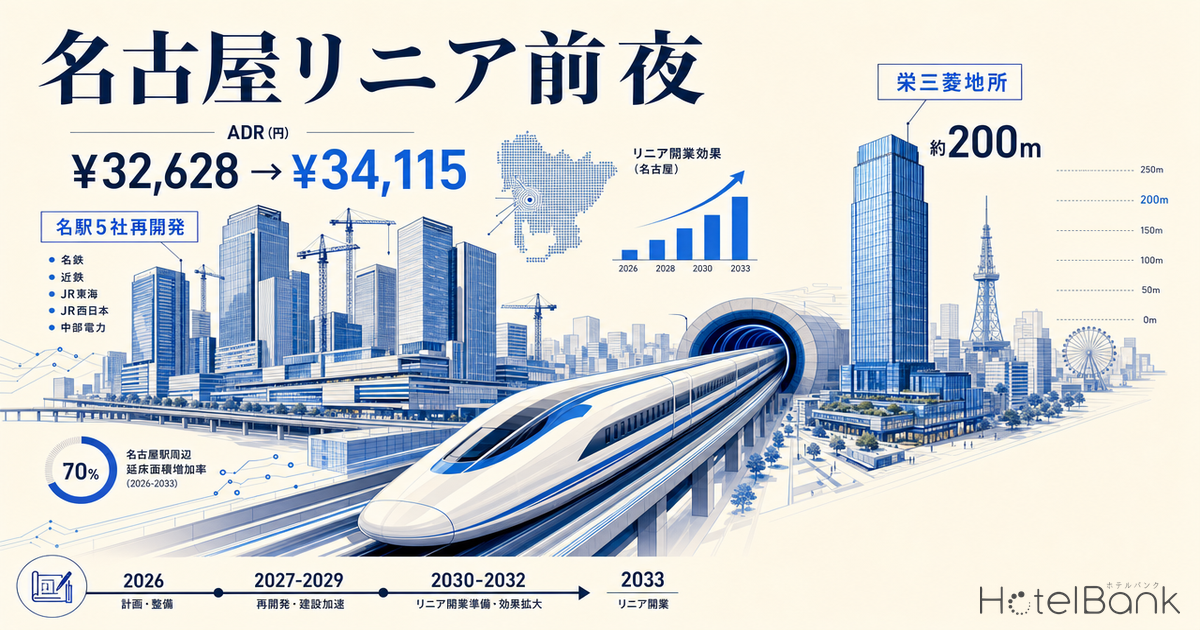
Nakamura Ward, which hosts the area around Nagoya Station, and Naka Ward, which encompasses the Sakae district. As of the April 2026 survey, the published ADRs of the two areas were neck and neck — Nakamura Ward at ¥34,115 and Naka Ward at ¥32,628 — and the long-standing “Nagoya Station premium” hierarchy has effectively flattened. This report examines, using both data and public documents, how three luxury-tier projects — the joint redevelopment by five companies around Nagoya Station, The Landmark Nagoya Sakae (Conrad Nagoya) in Sakae, and Andaz Nagoya — together with the rescheduling of the Linear Chuo Shinkansen, will reshape the ADR hierarchy within Nagoya.
Metric Definitions Used in This Article
- ADR (Average Daily Rate): The average of the publicly listed selling prices on OTAs and similar channels. This differs from the actual transacted price (it tends to run +25–30% higher than the transacted ADR disclosed by REITs, because unsold high-priced plans remain visible on OTAs). Per-room rate for double occupancy (tax included), averaged across all plans (room-only through meals-included).
- YoY: Year-on-year, same month of the prior year.
- Data sources: MetroEngines Research & Consulting (OTA published-price data), the Ministry of Land, Infrastructure, Transport and Tourism “Statistical Survey on Building Dynamics” (building-plan basis), monthly operating results disclosed by each REIT, and press releases.
- — With Naka Ward at ¥32,628 / Nakamura Ward at ¥34,115 (April 2026 published ADR) now neck and neck, the long-standing “Nagoya Station premium” hierarchy has effectively flattened. In some months Naka Ward even surpasses Nakamura Ward.
- — The five-company joint redevelopment around Nagoya Station entered a “full schedule review” in December 2025. Now that the assumption of a 2027 Linear opening has collapsed, the Nagoya Station area’s early-2030s pipeline is effectively a blank.
- — The Landmark Nagoya Sakae (Conrad Nagoya — 170 rooms, opening summer 2026) is the only confirmed luxury project for the same period. It is expected to lift Sakae’s Naka Ward ADR toward the ¥38k tier.
- — The only J-REIT holding is Hilton Nagoya (460 rooms, JHR, acquired 1989 for ¥15,250M). Other major luxury properties (Marriott, Tokyu, JR Gate Tower) are mainly held on the operators’ own balance sheets, so liquidity is limited.
- — 2026–2030 is assumed to be a “Sakae-concentration” phase, with the restart of the five-company Nagoya Station redevelopment dovetailing with YoY +6–7% ADR momentum in 2031–2033. The investment thesis is a two-stage structure: Sakae first, plus a long-term Nagoya Station option.
Executive Summary — The Turning Point Where Naka Ward Closes In on Nakamura Ward
As of April 2025, Nakamura Ward — home to Nagoya Station — had an ADR of ¥34,438, while Naka Ward, centered on Sakae, stood at ¥28,049; the ¥6,389 gap meant Nakamura carried roughly a 23% premium. This reflected a market structure of segment specialization: “Nagoya Station for business travel” and “Sakae for tourism and nightlife.”
By the April 2026 survey, however, Nakamura Ward stood at ¥34,115 and Naka Ward at ¥32,628, narrowing the gap to ¥1,487, or about 4.6%. Naka Ward posted YoY +16.3%, one of the largest growth rates in Nagoya, while Nakamura Ward remained essentially flat at YoY -0.9%. Behind this pressure for a reversal is the March 2026 completion of “The Landmark Nagoya Sakae” — led by Mitsubishi Estate — in the Sakae district, and the market pricing in Conrad Nagoya (170 rooms, opening summer 2026), which will occupy that building.
On the Nagoya Station side, meanwhile, Nagoya Railroad (Meitetsu) and Hyatt announced in May 2025 the Chubu region’s first “Andaz Nagoya.” It was initially slated to open in FY2034, but a schedule change disclosed by Meitetsu on December 12, 2025 turned the original roadmap — demolition starting in 2026, main construction in 2027, and Phase 1 completion in 2033 — into a “full review,” and the opening timing is currently undetermined (Hyatt Japan’s April 2026 press materials still list “Andaz Nagoya / TBD / TBD”). The Nagoya opening of the Linear Chuo Shinkansen has also been officially pushed back from 2027 to 2034 or later, transforming the Nagoya hotel market into a two-stage-rocket structure: “Sakae supplies first in 2026 → limited supply in 2027–2030 → Linear plus Nagoya Station redevelopment in the late 2030s.” The pricing dynamics of the 2026–2030 luxury void that begins with the opening of Conrad Nagoya are an important forward scenario, with Sakae’s confirmed supply forming the only firm anchor during that window.
The Reality of Nagoya’s ADR Hierarchy — Naka Ward Even Overtakes Nakamura in Some Months
The published ADRs and year-on-year changes for Nagoya’s nine major wards as of April 2026 are organized below. Wards with N=1 carry large sample variance and are treated as reference values; the core of this analysis rests on Naka Ward (N=76) and Nakamura Ward (N=60).
What stands out is the monthly trajectory of Naka and Nakamura Wards. Lining up the monthly ADR over the most recent 18 months, the “Nagoya Station premium” structure — in which Nakamura always exceeded Naka — was stable throughout 2025, whereas from January 2026 Naka Ward accelerated sharply, and by March 2026 Naka Ward’s ¥34,076 had closed to within ¥1,000 of Nakamura’s ¥35,054. Then in June 2026, Naka Ward fell to ¥27,656 against Nakamura’s ¥33,279, with Nakamura pulling ahead again — so the ranking volatility on a monthly basis has risen. The gains on the Naka Ward side are likely driven in part by the Sakae-district redevelopment entering its completion phase, with high-rate plans for rooms still under fit-out being listed in advance.
At the individual-property level, the high-rate tier of ADR ¥30,000 or above (luxury through high-grade) as of April 2026 amounts to just 12 properties — 7 in Naka Ward and 5 in Nakamura Ward. Nakamura Ward’s core is anchored by large city/luxury properties such as Nagoya Marriott Associa Hotel (765 rooms, ADR ¥80,300) and Hilton Nagoya (460 rooms, ADR ¥59,100), while Naka Ward is likewise supported by large properties such as Nagoya Kanko Hotel (369 rooms, ADR ¥60,100) and Nagoya Tokyu Hotel (564 rooms, ADR ¥49,700).
| Rank | Hotel | Area | Rooms | Grade | ADR (2026/4) |
|---|---|---|---|---|---|
| 1 | Nagoya Prince Hotel Sky Tower | Nakamura Ward | 170 rooms | High-grade | ¥80,965 |
| 2 | Nagoya Marriott Associa Hotel | Nakamura Ward | 765 rooms | Luxury | ¥80,306 |
| 3 | Nagoya Kanko Hotel | Naka Ward | 369 rooms | Luxury | ¥60,111 |
| 4 | Hilton Nagoya | Naka Ward | 460 rooms | Luxury | ¥59,095 |
| 5 | Nagoya Tokyu Hotel | Naka Ward | 564 rooms | Luxury | ¥49,723 |
| 6 | Nagoya JR Gate Tower Hotel | Nakamura Ward | 350 rooms | High-grade | ¥47,999 |
| 7 | Meitetsu Grand Hotel | Nakamura Ward | 241 rooms | Upper | ¥47,655 |
| 8 | ANA Crowne Plaza Hotel Grand Court Nagoya | Naka Ward | 245 rooms | Luxury | ¥38,738 |
| 9 | Mitsui Garden Hotel Nagoya Premier | Nakamura Ward | 295 rooms | Luxury | ¥38,199 |
| 10 | The Royal Park Canvas Nagoya | Nakamura Ward | 153 rooms | Luxury | ¥35,133 |
This list contains only currently operating properties, but what is notable is that all three of the largest luxury hotels in the 170-room-and-above class (Marriott 765 rooms, Hilton 460 rooms, Kanko Hotel 369 rooms) are existing properties that opened by the 1990s. From 2026 through 2033, following the Linear review, foreign-affiliated luxury brands — “Conrad Nagoya, 170 rooms” and “Andaz Nagoya (opening TBD, roughly 150 rooms planned)” — will be added to this lineup, layering up to two new properties and around 320 new luxury rooms on top of the three existing properties.
Where the Five-Company Nagoya Station Redevelopment Stands — A “Full Schedule Review” in December 2025
The “Nagoya Station District Redevelopment Plan,” promoted by five companies — Nagoya Railroad (Meitetsu), Meitetsu Urban Development, Nippon Life Insurance, Kintetsu, and Kintetsu Real Estate — is a large-scale project that integrates the Meitetsu Department Store main building, Kintetsu Passe (closing February 2026), the Meitetsu Bus Center, Meitetsu Grand Hotel, the Sky Parking, and the former Lejac site (closed at the end of March 2023). The original plan called for 31 floors above ground and 2 below, a maximum height of about 172m, a total floor area of roughly 520,000 m², and a total project cost of about ¥888.0 billion — one of the largest development plans in the history of the Tokai region.
Of this, a May 2025 joint announcement by Nagoya Railroad and Hyatt decided that “Andaz Nagoya” would occupy the hotel section. The plan calls for roughly 150 rooms, all 50 m² or larger, about 27,000 m² of hotel floor area, plus restaurants, banquet halls, and a rooftop bar.
However, on November 26, 2025, the candidate general contractor declared that it would withdraw from bidding because “the construction setup cannot be assembled under the current plan,” and on December 12, 2025 Meitetsu issued a news release titled “On the Schedule Change to the Nagoya Station District Redevelopment Plan and Others, and the Start of a Re-examination and Review of the Current Plan.” The original roadmap can be summarized as follows.
| Phase | Original plan (as of May 2025) | Status from December 2025 |
|---|---|---|
| Closure of Meitetsu Dept. Store main building & Kintetsu Passe | End of February 2026 | Proceeding as planned (Feb 2026 closure confirmed) |
| Demolition start | FY2026 | Timing undetermined |
| Main construction start | FY2027 | Timing undetermined |
| Phase 1 completion | FY2033 | Timing undetermined |
| Phase 2 completion | Early 2040s | Timing undetermined |
| Andaz Nagoya opening | FY2034 | TBD (Hyatt Japan press materials, April 2026) |
The reasons for the review are the difficulty of assembling a construction setup amid labor shortages, and the roughly two-fold swelling of construction costs relative to the project budget at the planning stage. As the Ministry of Land, Infrastructure, Transport and Tourism’s construction-starts statistics show, hotel construction costs rose +41% across all structure types from 2022 to 2024, and in long-term projects such as redevelopments, the structural risk of cost inflation after the design is fixed has materialized.
At its June 2025 management strategy briefing, Meitetsu touted a scale of “roughly 400m north-to-south, 520,000 m² of floor area, two super-high-rise towers exceeding 170m,” but by December it had changed its wording to “the start of a re-examination and review of the current plan.” For the market, this means that large-scale luxury supply from the Nagoya Station side over the medium-term span of 2027–2032 must now be assumed to be “near zero” — which for the Nakamura Ward side eases competition for existing properties, and for the Sakae side means a relative strengthening of positioning.
Sakae’s “The Landmark Nagoya Sakae” — Conrad Nagoya Lands in Summer 2026
“The Landmark Nagoya Sakae” (Nishiki 3-chome Block 25 Plan, Naka Ward, Nagoya), developed by six companies — Mitsubishi Estate, J. Front Urban Development, Japan Post Real Estate, Meiji Yasuda Life Insurance, The Chunichi Shimbun, and Parco — was completed on March 31, 2026. At 41 floors above ground, 4 below, and a height of about 211m, it is the tallest mixed-use building in the Sakae district, and the hotel section will house “Conrad Nagoya,” the first foray into the Tokai area by Conrad Hotels & Resorts, at a scale of 170 rooms.
In the building-plan database we maintain (derived from the MLIT “Statistical Survey on Building Dynamics”), the project is registered as a mixed-use development at Nishiki 3-25-1, Naka Ward, Nagoya, with 23,900 m² of floor area, 41 floors, and hotel + office + theater + retail uses; the listed builders are five companies — Mitsubishi Estate, Parco, Japan Post Real Estate, Meiji Yasuda Life, and The Chunichi Shimbun. The scheduled completion is July 31, 2026, consistent with Conrad Nagoya’s opening announcement (summer 2026).
Conrad is Hilton’s top-tier brand, with properties in Singapore, Seoul, Tokyo, Osaka, Kyoto, Hong Kong, and elsewhere. Within Japan, this will be the fifth entry, following Osaka (164 rooms, opened 2017). The hotel floor area is about 23,900 m², all rooms are envisioned at 30 m² or larger, and the plan includes an all-day dining venue, a signature restaurant, a rooftop bar, an executive lounge, an indoor pool, a spa, and a ballroom.
The site adjoins Sakae Hiroba (Sakae Square), within walking distance of Sakae Station, along the Higashiyama Park line, on the east side of Nagoya PARCO. The Sakae district has long been associated with “department stores and nightlife,” but since construction began on the Chunichi Building rebuild in 2018, large-scale renewals have continued — extending to Sakae Hiroba, Yabacho, and the Marunouchi direction — and Conrad Nagoya will be the symbolic anchor tenant of this “Sakae Renaissance.”
Reviewing the Linear Chuo Shinkansen’s 2027 Opening — From “Single Event” to “Long-Term Infrastructure Expansion”
On March 29, 2024, JR Central officially announced that it was abandoning its target of a “2027 opening” for the Shinagawa–Nagoya segment of the Linear Chuo Shinkansen. The new opening timing is stated as “2034 or later,” and as of 2025 there have even been reports of “2035 or later.” Although the un-started Shizuoka section tends to draw attention as the main cause of the delay, in reality 31 of the 84 construction sections nationwide have no prospect of completing by 2027 — this is a structural delay.
This review carries three implications for the hotel market. First, the scenario of “a temporary demand explosion timed to a 2027 opening” has vanished. Second, with the opening timing now dispersed, the timing of hotel investment decisions has become more flexible than before. Third, the three elements of “Linear + Nagoya Station redevelopment + Andaz Nagoya” will now all come together only in the late 2030s and beyond, positioning 2026–2030 as “the period when Conrad Nagoya alone captures demand.”
In its 2018 “Urban Center Development Concept Toward the Opening of the Linear Chuo Shinkansen,” the City of Nagoya positions the Nagoya Station district and the Sakae district as “the twin cores of two major economic zones,” and sets out a policy of developing “Hirokoji-dori,” which links the two districts, as the structural axis. At the city-planning level, development is framed over “a 25-year span around the Linear,” and hotel investment too must be evaluated from this long-term perspective.
J-REIT Ownership of Existing Luxury Properties — Hilton Nagoya Is Held by JHR
As of April 2026, of the top 10 luxury-tier properties in Nagoya, the only one confirmed to be J-REIT-held is Hilton Nagoya (460 rooms). According to our ownership master (snapshot as of 2026-05-27), Hilton Nagoya has been held since February 1989 by Japan Hotel REIT Investment Corporation (8985, JHR) at an acquisition price of ¥15,250 million, and it remains a flagship full-service-hotel asset operated by that REIT.
JHR’s April 2026 monthly operating results (official figures) for the overall portfolio (8 variable-rent properties) were OCC 85.8%, ADR ¥21,133, and RevPAR ¥18,131, with year-on-year ADR +4.6% and RevPAR +4.1% — a solid showing. However, since JHR does not disclose monthly operating data on a per-property basis, the standalone KPIs for Hilton Nagoya cannot be confirmed. Note that JHR’s ADR of ¥21,133 differs in nature from the published-price ADR used in this article (which tends to run +25–30% above transacted prices), so a direct comparison is not possible.
Conversely, the other major luxury properties — Nagoya Marriott Associa Hotel (765 rooms), Nagoya Kanko Hotel (369 rooms), Nagoya Tokyu Hotel (564 rooms), and Nagoya JR Gate Tower Hotel (350 rooms) — are not among the holdings of the seven major hotel REITs we track (JHR, Hoshino Resorts REIT (星野リゾート・リート), Invincible, NHR, Ichigo Hotel, Kasumigaseki Hotel, and Mori Trust). These are mainly held directly by operating companies (Nagoya Railroad, Nagoya Kanko Hotel, Tokyu Hotels, JR Central, and others).
On the new-supply side, Conrad Nagoya is a development under a joint venture led by Mitsubishi Estate and others, with Hilton participating under a management contract. The timing of any J-REIT structuring or sale has not been disclosed, but the possibility of it becoming a securitization target after the operation stabilizes is a medium-term point to watch. Andaz Nagoya has been announced as a management-contract project between Nagoya Railroad and Hyatt, with the ownership scheme undetermined.
Comparison with Other Major Regional Cities — Nagoya’s YoY of +6–7% Is Half of Kyoto’s
Lining up the April 2026 ADRs and year-on-year changes for major cities, Nagoya (aggregating Naka + Nakamura Wards on a property-count-weighted basis: N=136) has an ADR of roughly ¥33,300 and a YoY of about +8%. Against Kyoto (¥49,714, YoY +17.2%, N=1,502) and Hokkaido (¥29,397, +11.0%, N=1,524), Nagoya’s YoY growth is half that of Kyoto, while in absolute terms it has closed to within ¥2,900 of Tokyo (¥36,208).
Compared with the double-digit growth of Kyoto and Hokkaido, Nagoya’s YoY of +8% gives a modest impression. This, however, reflects a structural characteristic: whereas Kyoto and Hokkaido directly enjoy inbound “revenge spending,” Nagoya — by nature a “business-travel and MICE-centric city” — is less easily triggered by inbound demand. Rather, the narrowing of the ADR gap with Tokyo to ¥2,900 suggests that the Nagoya hotel market sits “at an intermediate stage of a price-appreciation phase.” The luxury-development competitive landscape of “downtown tri-polarization” — Tokyo Station, Shinagawa, and Nagoya — is a geographic competitive map worth keeping in view as a broader frame for Nagoya’s position.
Looking at the accommodation-fee index from e-Stat (Consumer Price Index), April 2026 was 170.0 (2020 = 100), about +70% above the pre-COVID level. It rose +3.4% from 164.4 in April 2025; this can be decomposed into roughly 3–4% from nationwide-average inflation and roughly 4–5% from Nagoya’s urban factors (about 13% in the case of Naka Ward). Naka Ward’s YoY of +16.3% clearly reflects “local factors exceeding nationwide inflation,” and the leading factor is thought to be the market pricing in the Sakae-district completion ahead of time.
A Framework for Investment Decisions — “2026–2030 Is a Sakae-Concentration Phase”
Drawing on the data and public documents organized in this report, the Nagoya hotel market can be sorted into the following four phases.
Phase 1: 2026 (Sakae first)
Conrad Nagoya opens with 170 rooms. Naka Ward’s ADR may overshoot further. Existing luxury properties gain expanded room for price adjustment as Sakae goes “high-end.” Nakamura Ward stays relatively on the sidelines.
Phase 2: 2027-2030 (Interim)
The five-company Nagoya Station redevelopment is pre-main-construction. Andaz Nagoya’s timing is undetermined. Nakamura Ward absorbs demand through existing properties such as Marriott, Hilton, and JR Gate Tower. The investment appeal is the mid-scale upper tier in the Sakae district.
Phase 3-4: 2030s and beyond
A super-long-term phase where the Linear opening (2034 or later) and the completion of the main Nagoya Station redevelopment (timing undetermined) overlap. Luxury supply on the Nagoya Station side may come on at once, potentially re-strengthening the bipolar structure with Sakae. The prime timing for long-term investment.
For decision-makers in new development, today’s construction-cost surge (+41% across all structure types from 2022 to 2024) and labor shortages are short-term negatives. But these are also a restraining pressure on new supply, and for existing and early-supply properties (Conrad Nagoya and the 10 existing luxury properties), they act as an upside factor by easing competition. The postponement of the Linear opening is, for the Nagoya hotel market as a whole, not merely that “the upswing on the demand side has been deferred” but a double-slide structure in which “the supply side is pushed back simultaneously,” so the impact on the supply-demand balance is close to neutral. The cross-sector effect of supply contraction driven by construction-cost inflation in 2027–2029 is a structural backdrop worth weighing when shaping an investment strategy.
By individual area, it is clear that the completion of The Landmark Nagoya Sakae is driving a structural shift in Naka Ward’s ADR, and Naka Ward’s ¥32,628 is highly likely to climb further in the near future. On the Nakamura Ward side, given the aging of existing properties (Marriott opened 2000, Hilton 1989, Tokyu 1976, and so on), this is a juncture to consider the timing of rebranding and renovation investment toward 2027–2030.
Conclusion
Nagoya’s hotel-market ADR hierarchy has flattened, moving from “Nakamura Ward ¥34,438 vs Naka Ward ¥28,049” as of April 2025 to “Nakamura Ward ¥34,115 vs Naka Ward ¥32,628” as of April 2026. The main drivers of this change are the completion of “The Landmark Nagoya Sakae” in the Sakae district (March 31, 2026) and the market pricing in, ahead of time, the 170-room opening of Conrad Nagoya.
On the Nagoya Station side, meanwhile, the five-company joint redevelopment entered a “full schedule review” in December 2025, and the opening timing of Andaz Nagoya is now undetermined. The Linear Chuo Shinkansen has also been firmly pushed back from 2027 to 2034 or later, effectively resetting the pricing-in of future demand that had underpinned the “Nagoya Station premium.”
As a result, the Nagoya hotel market in 2026–2030 is highly likely to be “a leading phase of Sakae concentration,” and the investment and operating appeal of the Naka Ward luxury tier (especially the new 170-room Conrad) is set to persist over the medium term. For the Nakamura Ward side, the key questions become rebranding and renovation investment in existing large luxury properties, or a long-term holding strategy aimed at the Linear opening in the late 2030s.
⚠ A note on ADR for future dates: The ADR figures in this article are the average of selling prices publicly listed on OTAs at the time of the survey, and they fluctuate as the check-in date approaches. Figures from May 2026 onward may change due to future plan additions and price adjustments. New-opening timing and pipeline information are based on publicly available information as of early June 2026, and will be updated as candidate general contractors are reselected and operators issue additional releases.
References & Sources
■ Data sources
MetroEngines Research & Consulting aggregated data — OTA published prices for January 2025 to June 2026 covering Aichi Prefecture and Nagoya’s nine wards (N=136 properties). Combining monthly city-level aggregation with a city-category matrix, the ADR hierarchy is computed at the ward level. J-REIT ownership relationships reference a snapshot of the ownership master as of 2026-05-27 (290 properties, nationwide coverage).
■ Estimation assumptions
ADR figures are on a published-price basis (tending to run +25–30% above transacted prices). Conrad Nagoya’s attainable ADR level is estimated from the brand’s domestic precedents (Tokyo, Osaka) and the range of other luxury-tier properties (Marriott, JR Gate Tower). The Linear Chuo Shinkansen’s opening timing is discussed on the “review” premise disclosed by JR Central as of December 2025; a 2027 opening is not assumed. The completion timing of the five-company Nagoya Station redevelopment is discussed with 2031–2033 as the midpoint, over a range that factors in re-delay risk.
■ Limitations & caveats
There is a structural divergence between OTA published prices and transacted ADR, so this article’s hierarchy comparison is limited to a discussion of relative levels. Because the J-REITs do not individually disclose per-property monthly operating data (OCC, ADR, GOP), Hilton Nagoya’s standalone KPIs cannot be estimated. Since the tenant mix and whether a hotel will be attracted to the five-company Nagoya Station redevelopment have not been disclosed as of June 2026, the hotel-supply impact is treated as a future option.
■ Market data
- MetroEngines Research & Consulting — OTA published-price data (Nagoya’s nine major wards, N=136 properties, January 2025 to June 2026)
■ Government statistics & public data
- Ministry of Land, Infrastructure, Transport and Tourism “Statistical Survey on Building Dynamics” — building-plan data for Nishiki 3-25-1, Naka Ward, Nagoya
- e-Stat “Consumer Price Index, Accommodation Fees” (statistics ID: 0003427113)
- City of Nagoya “Urban Center Development Toward the Opening of the Linear Chuo Shinkansen”
■ Five-company Nagoya Station redevelopment
- Nagoya Railroad Co., Ltd. “On the Schedule Change to the Nagoya Station District Redevelopment Plan and Others, and the Start of a Re-examination and Review of the Current Plan” (December 12, 2025)
- Nagoya Railroad “Nagoya Station District Redevelopment Plan / Mid-to-Long-Term Management Strategy Briefing” (June 5, 2025)
- Travel Voice “‘Andaz Nagoya’ in the Nagoya Station Redevelopment District, Opening 2034 or Later” (May 27, 2025)
■ The Landmark Nagoya Sakae / Conrad Nagoya
- Mitsubishi Estate “‘The Landmark Nagoya Sakae’ Is Born” (March 17, 2026)
- Hilton “‘Conrad Nagoya’ in Sakae, Nagoya, Scheduled to Open in 2026”
■ Andaz Nagoya / Hyatt
- Hyatt Japan Co., Ltd. “Press Materials, April 2026” (pipeline entry “Andaz Nagoya / TBD / TBD”)
- Hyatt Chain Services Limited “Hyatt Plans to Introduce the ‘Andaz’ Brand to Nagoya”
■ Linear Chuo Shinkansen
- Nikkei “JR Central Abandons 2027 Linear Opening” (March 2024)
- JR Central Chuo Shinkansen official site
■ J-REIT monthly operating results
Source: Hyatt Japan Co., Ltd. “Press Materials, April 2026”