

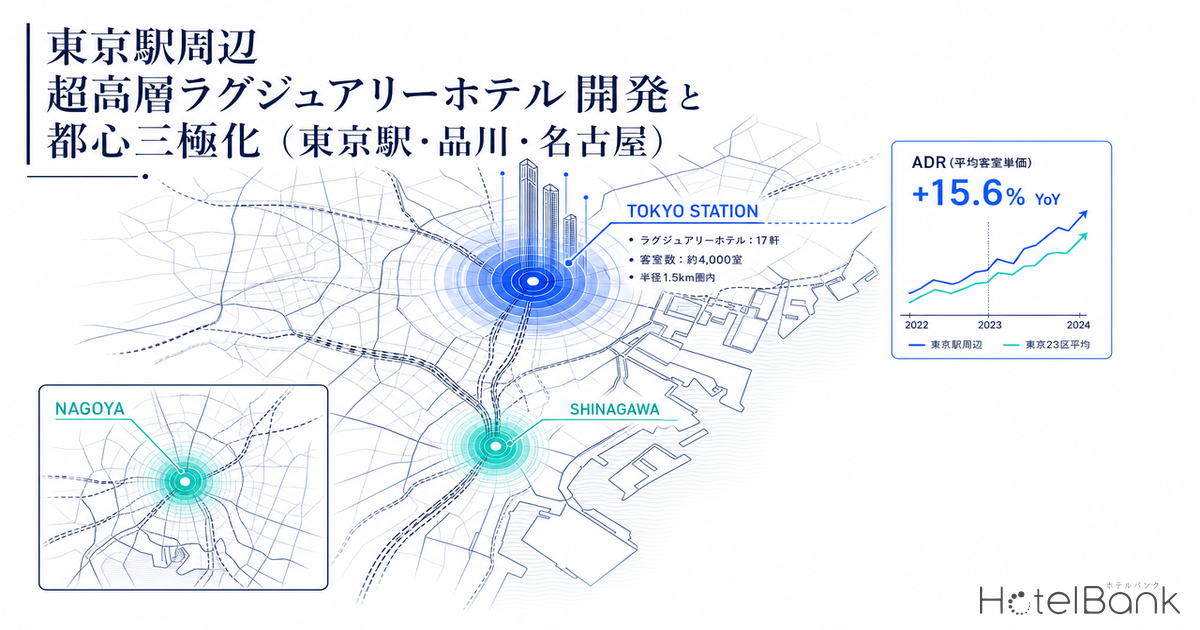
Between 2027 and 2028, three of the world’s top luxury hotel brands will open in succession within walking distance of Tokyo Station. Dorchester Collection Tokyo (110 rooms, scheduled to open in fiscal 2028, the brand’s first property in Asia) will occupy Mitsubishi Estate’s Torch Tower (approximately 390m); Waldorf Astoria Tokyo Nihonbashi (197 rooms, scheduled to open in autumn 2027) will occupy Tokyo Midtown Nihonbashi The Tower (284m); and Bulgari Hotel Tokyo (98 rooms, Tokyo Midtown Yaesu) opened in 2023. Combined with JW Marriott Hotel Tokyo (200 rooms, opened October 2025) at Takanawa Gateway City in Shinagawa, and Conrad Nagoya (170 rooms, scheduled to open July 2026), urban luxury is increasingly forming a tri-pole of “Tokyo Station, Shinagawa, and Nagoya.”
Metric Definitions Used in This Article
- ADR (Average Daily Rate): Average of published prices on OTAs. Differs from actual transaction prices (cross-checks with REIT disclosure data show OTA-published ADR runs roughly +25-30% above realized ADR, because unsold high-priced plans remain visible on OTAs and pull the average up). Per-room rate for 2 guests in 1 room (tax included), averaged across all plans (room-only through meal-inclusive).
- OCC (Occupancy): Share of total rooms in the area that are sold (estimated from OTA inventory).
- Data Source: MetroEngines Research & Consulting
17 Existing Luxury Properties / ~4,000 Rooms within 1.5km of Tokyo Station — ADR Up +15.6% YoY
First, the statistical baseline for the 1.5km radius around Tokyo Station (Marunouchi/Otemachi in Chiyoda Ward; Nihonbashi/Kyobashi/Yaesu and northern Ginza in Chuo Ward). Among the operating hotels tracked by MetroEngines Research, 17 properties with 50+ rooms classified as “luxury” exist in this zone, totaling approximately 4,000 rooms. Representative names include Aman Tokyo (84 rooms), The Peninsula Tokyo (314 rooms), Mandarin Oriental Tokyo (179 rooms), Four Seasons Hotel Tokyo at Marunouchi (57 rooms), Shangri-La Tokyo (200 rooms), Palace Hotel Tokyo (290 rooms), Hoshinoya Tokyo (84 rooms), and Tokyo Station Hotel (150 rooms) — all regular fixtures in Japan’s top hotel rankings.
The monthly average ADR (published-price basis) across these 17 luxury properties rose from ¥118,000 in May 2025 to ¥136,400 in April 2026, a +15.6% year-on-year increase. Since October 2025 in particular, the level has consistently exceeded ¥130,000, confirming that inbound high-net-worth demand and the perceived discount on dollar-denominated prices under a weak yen are propagating even into the highest price tier. For a detailed analysis of how Japanese luxury hotels compare in dollar terms against New York, Paris, and London, see our earlier piece Are Japan’s Hotels Cheap by Global Standards? Tokyo/Osaka/Kyoto ADR in USD vs. NYC, Paris, London.
Source: MetroEngines Research & Consulting (16-17 luxury properties within 1.5km of Tokyo Station)
Supertall Luxury Pipeline 2027-2028 — Adding ~400 Rooms to Existing Supply
The supertall luxury hotels scheduled to open within walking distance of Tokyo Station between 2027 and 2028, to the extent that can be confirmed, are summarized below. Combined, the three projects total approximately 405 rooms, representing a +10% addition to current supply in the area’s luxury tier (~4,000 rooms).
| Hotel / Project | Location | Height | Rooms | Opening |
|---|---|---|---|---|
| Dorchester Collection Tokyo (provisional) | TOKYO TORCH / Torch Tower (Otemachi-Tokiwabashi, Chiyoda) | ~390m (63 floors) | ~110 | FY2028 |
| Waldorf Astoria Tokyo Nihonbashi | Tokyo Midtown Nihonbashi / The Tower (Nihonbashi, Chuo) | ~284m (52 floors) | 197 | Autumn 2027 |
| SEN/KA TOKYO by The Crest Collection (Ascott) | Yaesu 1-chome North District (Yaesu, Chuo) | 218m (44 floors) | Undisclosed (long-stay) | H2 FY2029 |
| Four Seasons Hotel Tokyo at Marunouchi (rebrand) | Pacific Century Place Marunouchi (Marunouchi, Chiyoda) | Existing (renovated) | 57 | Re-open April 2026 |
| (Reference) Bulgari Hotel Tokyo | Tokyo Midtown Yaesu (Yaesu, Chuo) | 240m (45 floors) | 98 | Opened April 2023 |
Source: Press releases and official project information from each developer, organized by MetroEngines Research & Consulting
Two features stand out within the confirmable data: Dorchester Collection will occupy floors 53-58 of Japan’s tallest building (~390m) with 110 rooms, and Waldorf Astoria will open with 197 rooms on the upper floors of the 284m The Tower. Both will sit on the upper floors of supertall office towers within walking distance of Tokyo Station — a globally rare combination of locational attributes. In terms of physical differentiators such as room size, ceiling height, and panoramic views, both are expected to outclass the 17 existing properties competitively.
Rooms × ADR Positioning — New Supply Competes Directly with 6 Existing Properties in the ¥150-300k Band
The chart below maps the 1.5km-radius luxury hotels around Tokyo Station by room count (X-axis) and ADR (Y-axis), with the two new-supply projects overlaid as red markers (Dorchester assumed ¥250k / 110 rooms; Waldorf assumed ¥180k / 197 rooms).
Source: MetroEngines Research & Consulting (average published prices April-July 2026, N=13 properties). Red markers = assumed positioning
Three structural features emerge from the positioning map. First, the ¥150,000-¥300,000 ADR band is already densely populated by 6 properties — Aman, Four Seasons, Peninsula, Mandarin, Palace, and Shangri-La — so the arrival of a 200-room Waldorf into this band will test the band’s near-term price elasticity. Second, above ¥300,000 (Aman ¥406k, Four Seasons ¥301k) only 2 properties exist, leaving ample room for Dorchester Collection’s planned 110-room entry in the ¥250-300k band. Third, the strength of demand at Tokyo Station Hotel (¥155k, 150 rooms, immediate station access plus heritage value) — which posts OCC of 53.8% — suggests demand-side headroom to absorb new supply.
Global Luxury Brands Running Dry — Few Asia-First Names Remain
Reviewing the Japan-entry status of the world’s leading ultra-luxury hotel brands shows that, with Tokyo and Kyoto as the focal points, the majority have already arrived. With the 2028 opening of Dorchester Collection, the list of major global luxury chains yet to enter Japan will narrow to a very short tail.
| Brand | Japan Entry Status | Flagship Property / Notes |
|---|---|---|
| Aman | Operating (Tokyo, Kyoto, Amanemu in Ise-Shima) | Aman Tokyo occupies the upper floors of Otemachi Tower, 84 rooms, ADR ~¥406,600 |
| Mandarin Oriental | Operating (Tokyo; Setouchi scheduled 2027) | Upper floors of Nihonbashi Mitsui Tower, 179 rooms |
| Four Seasons | Operating (Marunouchi, Otemachi, Kyoto) | April 2026: Marunouchi 57-room property rebrands as boutique luxury |
| Peninsula | Operating (Tokyo) | Opened 2007, 314 rooms, Yurakucho |
| Bvlgari Hotels | Operating (Tokyo, 2023) | Tokyo Midtown Yaesu, 98 rooms |
| Waldorf Astoria (Hilton) | Scheduled (2027, Nihonbashi) | Brand’s debut in Japan, Tokyo Midtown Nihonbashi, 197 rooms |
| Dorchester Collection | Scheduled (2028, Tokiwabashi) | Brand’s debut in Asia, Torch Tower, 110 rooms |
| Rosewood | Operating (March 2025, Miyakojima) | Sole Rosewood property in Japan |
| Six Senses | Operating (April 2024, Kyoto) | Higashiyama Ward, 81 rooms, under IHG |
| Shangri-La | Operating (Tokyo) | Marunouchi Trust Tower Main, 200 rooms |
| JW Marriott | October 2025, Tokyo (Takanawa Gateway) | Brand’s Tokyo metropolitan debut, 200 rooms, 2nd property in Japan |
Source: Official brand websites and developer press releases, organized by MetroEngines Research & Consulting (as of May 2026)
Remaining global luxury brands yet to enter Japan are limited to names like Cheval Blanc (LVMH), One&Only, Faena, Eden Rock, Auberge Resorts, and SO/ (Accor). In other words, the universe of “luxury brands that could still be brought into Japan” is approaching exhaustion, which structurally reinforces the long-term competitive position of incumbent operators and properties that already hold brand scarcity. For an impact assessment of the six major luxury openings already on the 2026 calendar, see Six Luxury Hotel Openings in 2026: Market Impact Analysis from an Investor’s Perspective.
Three-City Comparison — ADR Hierarchy Across Tokyo Station / Shinagawa / Nagoya
Urban luxury is increasingly tri-polar across “Tokyo Station, Shinagawa, and Nagoya.” Aggregating hotels with 50+ rooms within a 1.5km radius of each station by grade produces the comparison below. Luxury ADR is ¥120,600 around Tokyo Station (17 properties), ¥99,600 around Shinagawa (3 properties), and ¥50,500 around Nagoya (6 properties) — a clear three-tier structure.
Source: MetroEngines Research & Consulting (April-June 2026, 1.5km radius each station, 50+ rooms)
While Tokyo Station is the focal point of concentrated new supply through 2025-2028, Shinagawa’s growth is anchored by JW Marriott (200 rooms, October 2025) at Takanawa Gateway City, with additional Keikyu Hotel and IHG new-brand projects in the pipeline. Nagoya will see Conrad Nagoya open in July 2026 (170 rooms, Hilton’s luxury brand), positioned as a pre-emptive investment ahead of the Linear Chuo Shinkansen. The simultaneous unfolding of the same “city-center supertall luxury” format across all three cities is the single most defining feature of Japan’s luxury hotel market today.
For related deep dives, see our Nagoya analysis Nagoya Hotel Investment 2026 — Conrad and Linear Shinkansen.
Locational Fundamentals — Land Values and Urban Renewal Designation in Otemachi-Tokiwabashi
The Tokyo Station walking zone (Otemachi/Marunouchi in Chiyoda Ward) sits at the very top of Japan’s land-value distribution. In 2025, average published land prices around Otemachi Station reached ¥17.56 million per square meter (roughly ¥58 million per tsubo); the average for all commercial land in Chiyoda Ward was ¥6.62 million/sqm, up +13.3% YoY. The highest single point (Otemachi 2-2-1, Chiyoda) recorded ¥29.4 million per sqm.
This area falls within the “Designated Urban Renaissance Emergency Development Zone” for Tokyo Central and Bay area, with Otemachi designated as the “International Financial and Business Hub,” Marunouchi as the location for “Cityscape Befitting a National Capital,” and Yaesu as the location for “Enhanced Transport Interchange Function.” Floor-area ratios reach 1,490% at the TOKYO TORCH site (under the special FAR Application Zone plus comprehensive design system) and approximately 1,400% at Tokyo Midtown Nihonbashi — globally exceptional high-density development allowances that form the technical and regulatory foundation enabling the “highest hotel rooms in Japan” on the upper floors of supertall towers.
Source: MetroEngines Research & Consulting, CartoDB (map tiles). Blue = existing luxury; Red = new development
Investment Scenario — NOI Sensitivity for 200 Rooms × ADR ¥80k × OCC 80% × ¥60M Per-Room Build Cost
A simplified feasibility study for a 200-room city-center luxury hotel development is presented below. Assumptions: ADR ¥80,000, OCC 80%, construction cost ¥60 million per key (pure room-attributable cost, excluding common areas), brand fee plus management fee at 10% of revenue, GOP margin 40%, and a 3.5% Cap Rate.
| Item | Assumption | Rationale |
|---|---|---|
| Room count | 200 rooms | Same as Waldorf; comparable to Peninsula, Palace, Shangri-La |
| ADR (realized basis) | ¥80,000 | Conservative value reflecting -25% gap between published ¥100k band and realized prices |
| OCC | 80% | Conservatively scaled down from JHR central Tokyo portfolio’s 85.1% |
| Construction cost per key | ¥60,000,000 | Luxury tsubo unit cost ¥3M × avg. 20 tsubo per room + common area allocation |
| GOP margin | 40% | Adopts 38-40% disclosed by JHR and Invincible |
| Cap Rate | 3.5% | JLL “Japan Hotel Investment Market 2025”: central-Tokyo luxury band 3.0-4.0% |
Under these assumptions, annual revenue equals 200 rooms × ¥80,000 × 0.80 × 365 days = approximately ¥4.67 billion. GOP (40% of revenue) is approximately ¥1.87 billion. NOI, after deducting the 10% brand fee, is approximately ¥1.40 billion. Capitalizing at 3.5% values the property at approximately ¥40 billion. Against total investment — assuming ¥20 billion in total project cost when land acquisition and common-area construction are added to the ¥12 billion in room-attributable construction (200 rooms × ¥60M) — NOI / total project cost is approximately 7.0%, leaving roughly a 3.5pt risk premium over the 3.5% Cap Rate.
The chart below shows NOI sensitivity across combinations of ADR and OCC. At ADR ¥70k × OCC 75% (downside case), NOI is approximately ¥1.15 billion; at ADR ¥90k × OCC 85% (upside case), NOI reaches approximately ¥1.67 billion — the range is contained within roughly a 1.5x spread.
Source: MetroEngines Inc. and HotelBank Editorial Team (basis: 200 rooms × ¥12 billion construction, GOP 40%, after 10% brand fee)
REIT Indicators Confirm the Picture — JHR Central Tokyo Portfolio at 85% OCC and +9% RevPAR YoY
To corroborate the earning power of the central Tokyo luxury tier, we refer to monthly operating data from listed hotel REITs. Japan Hotel REIT (8985) reported portfolio-wide OCC of 85.1%, ADR of ¥20,800, and RevPAR of ¥17,700 (+9.0% YoY) for March 2026. Hoshino Resorts REIT (3287) reported OCC 76.5%, ADR ¥20,800, and RevPAR ¥15,900 (+10.5% YoY) for February 2026. These REITs primarily hold standard city and business hotels, so luxury-only ADR runs several multiples higher than these figures.
Source: REIT monthly operating data, compiled by HotelBank Editorial Team (Feb-Mar 2026)
Japan Hotel REIT, Hoshino Resorts REIT, and Ichigo Hotel REIT have all posted RevPAR YoY growth between +1% and the low double digits, indicating that post-COVID demand recovery is stable and persistent. As a context for the operating environment that new luxury supply will face, this can be assessed as neutral to mildly supportive.
Investment Takeaways — “Tokyo Station Upper-Floor / 100-200 Rooms / ¥150-300k” Remains a Premium Position
Integrating the analysis, five judgment axes emerge for evaluating the 2027-2028 Tokyo Station supertall luxury new supply.
1. White-space structure: The ¥150,000-300,000 ADR / 100-200 room band is occupied by only 6 of the 17 existing properties. Dorchester (110 rooms, assumed ¥250k) is positioned to take a near-exclusive position in the ¥250-300k band; Waldorf (197 rooms, assumed ¥180k) is positioned alongside Peninsula and Palace in the ¥150-200k band. The former targets scarcity premium; the latter targets economies of scale.
2. Supply impact is limited: The combined ~405 rooms across the three projects represents +10% against existing supply of ~4,000 rooms. Meanwhile, inbound visitors hit a fresh all-time high in 2025 and luxury-tier ADR has risen +15.6% in one year — demand-side growth has been outpacing supply increases.
3. Structural strengthening of brand scarcity: From 2028 onward, the universe of global luxury chains yet to enter Japan approaches exhaustion. This underwrites the long-term competitiveness of brands and properties already in place.
4. Tri-polarization continues: Tokyo Station, Shinagawa, and Nagoya each form distinct price tiers, allowing dispersed absorption of guest segments, MICE demand, and inbound traffic. From an investment standpoint, Tokyo Station is the “top price tier,” Shinagawa is the “business plus luxury mix,” and Nagoya is the “Linear Shinkansen / Chubu-economy preemptive bet” — the segmentation is clearly defined.
5. Risk factors: (i) further rises in construction costs (national average tsubo cost reached ¥1.95M in 2024, +41% versus 2022); (ii) potential oversupply risk from the 2030s onward; (iii) geopolitical risk to inbound high-net-worth demand; (iv) policy-driven pushback against Tokyo concentration. Scenario-based sensitivity analysis and an explicit exit strategy designed up front are essential for managing these.
Caveat on future-dated ADR: ADR figures in this article reflect average published OTA prices at the time of research and will fluctuate as check-in dates approach. Currently elevated prices may be discounted closer to arrival. The scenario analysis is also a simplified estimate; an actual investment decision requires a detailed feasibility study.
Conclusion
Within walking distance of Tokyo Station, large supertall luxury hotels will open in succession on the upper floors of new towers, anchored by Waldorf Astoria Tokyo Nihonbashi in 2027 and Dorchester Collection Tokyo in 2028. Existing luxury ADR has risen +15.6% in a single year, with demand expanding faster than the +10% supply increase. The wave of global luxury brand entries into Japan is nearly complete, locking in a structural scarcity premium. At the same time, the 2025-2026 openings in Shinagawa (JW Marriott) and Nagoya (Conrad) are pushing urban luxury into a tri-pole structure across “Tokyo Station, Shinagawa, and Nagoya.” From the investor and developer perspective, existing and new projects that have captured the top-price position in the Tokyo Station zone are positioned to form the market’s core for the next decade.
Related Reading
- Nagoya Hotel Investment 2026 — Conrad Opening, Luxury Whitespace, and the Linear Shinkansen Delay
- Six Luxury Hotel Openings in 2026: Market Impact Analysis from an Investor’s Perspective
- Are Japan’s Hotels Cheap by Global Standards? Tokyo/Osaka/Kyoto ADR in USD vs. NYC, Paris, London
- Osaka Expo 2025 Impact on Hotel ADR: Verified with REIT and OTA Data
- Weekday ADR Across Tokyo, Nagoya, Osaka, and Fukuoka: Visualizing the Return of Business Demand
- Tokyo 23-Ward Business Hotels (March 2026): Diversifying Supply and the Demand-Supply Balance Underpinning the Urban Lodging Market
- The True Nature of Labor-Cost Pass-Through ADR: 2026 Hotel Pricing Structure via OCC × ADR Divergence
References & Sources
– Market Data
- MetroEngines Research & Consulting — OTA published-price data (N=17 luxury properties within 1.5km of Tokyo Station), estimated occupancy (OCC), monthly ADR trend analysis
– Government Statistics & Public Data
- Otemachi Station Land Price Map (2025, MLIT published land prices, etc.)
- Reiwa 7 Published Land Prices (Tokyo Metropolitan Bureau of Finance)
- Tokyo Urban Renaissance Special Districts (Tokyo Bureau of Urban Development)
– Project Official Information & Press Releases
- Mitsubishi Estate “TOKYO TORCH (Tokiwabashi Project)” Official Site
- Mitsubishi Estate “TOKYO TORCH”: Hotel at Japan’s Highest Elevation Set for 2027 (Monthly Hoteres)
- Dorchester Collection to Open in Tokyo in 2028, First Property in Asia (TravelVoice)
- Nihonbashi 1-Chome Central District First-Class Urban Redevelopment Project (Offisite)
- Mitsui Fudosan “Tokyo Midtown Nihonbashi” Block Name Decided
- Tokyo Tatemono “Yaesu 1-Chome North District First-Class Urban Redevelopment Project” New Construction Starts
- Four Seasons Hotel Tokyo at Marunouchi: All 57 Rooms Renovated, Reopens April 29, 2026
- JW Marriott Hotel Tokyo Opening Information (October 2, 2025, Takanawa Gateway City)
– REIT Monthly Operating Data
– Industry Reports & Construction Cost References