

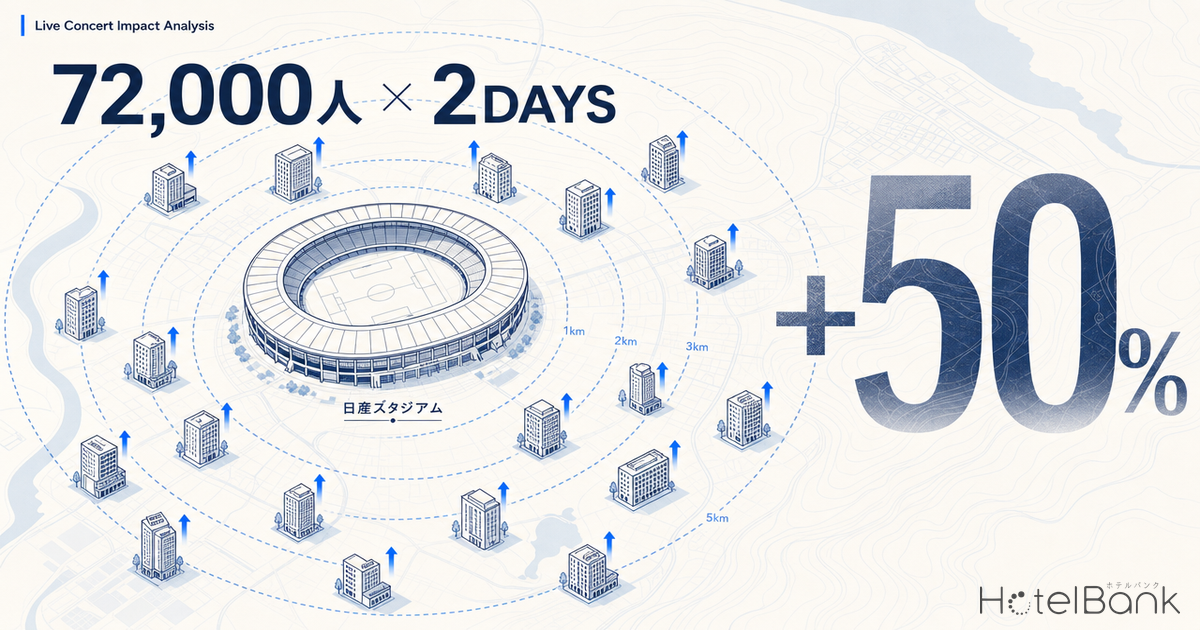
On June 13 (Sat) and 14 (Sun), 2026, Japan’s national favorite band back number will hold its first-ever five-stadium tour “Grateful Yesterdays Tour 2026” at Nissan Stadium in Yokohama. With capacity of approximately 72,000 × 2 days, the Yokohama leg alone will mobilize roughly 140,000 attendees in total. Stadium-scale large concerts have long drawn industry attention as moments that create “ceiling rates” in the hotel market, but cases quantified with price data are rare. In this article, we examine 26 properties within a 5km radius of Nissan Stadium that are tracked by MetroEngines Research, comparing the selling price and estimated OCC for that weekend (6/13 Sat) against the comparison weekends before and after (6/6 and 6/20).
Metric Definitions Used in This Article
- ADR (Average Daily Rate): Average of published selling prices on OTAs and similar channels. This differs from actual transaction prices (because higher-priced plans that did not sell remain visible on OTAs, the average of published prices structurally exceeds the average of transacted prices). Price per room (tax-included) for double occupancy, averaged across all plans (room-only through meal-inclusive).
- OCC (Occupancy Rate): Ratio of sold rooms to total rooms in the area (estimated value based on OTA inventory).
- Analysis Scope: 84 hotels totaling 7,421 rooms within a 5km radius of Nissan Stadium (Kohoku-ku, Yokohama). Of these, 26 properties are continuously tracked for OTA prices.
- Data Source: MetroEngines Research
ADR on back number Weekend: +30.6% YoY, +22.7% vs Normal Saturdays
First, we look at the trend of average selling price (ADR) and estimated OCC across the 26 properties around Shin-Yokohama and Yokohama Station for each Saturday from May to July 2026. Normal Saturday ADRs fall within a ¥39,000–¥45,000 range, but on June 13 (the back number opening day), ADR jumps to ¥53,200 and estimated OCC reaches 74.8%. The straightforward difference against the surrounding comparison Saturdays (6/6: ¥44,000 / 6/20: ¥43,300) is roughly +¥9,500, an uplift effect of approximately +22%.
At the same time, the year-on-year comparison is worth noting. The ADR on June 14, 2025 (Sat) was ¥40,700, so Saturday June 13, 2026 — overlapping with the back number show — registers a sizeable +30.6% YoY increase. Compared with the control normal Saturday (6/20: +6.4% YoY), the pure uplift from the concert alone can be calculated as approximately +22 percentage points.
Source: MetroEngines Research (N=26 properties)
What deserves attention is that not only June 13, but other stadium concert days exhibit similar spikes. April 25 (Tohoshinki opening day) saw ADR ¥55,400 / estimated OCC 82.9%; July 4 (Ado opening day) saw ADR ¥57,500 / estimated OCC 86.5%. Both stand roughly ¥10,000–¥15,000 above the background demand level, showing that stadium mobilization carries a quantitatively reproducible uplift pattern on Shin-Yokohama area ADR. Similar spot demand uplifts have been observed in the Yokohama area on cruise port-call days, and a comparative analysis of port-type events is provided in Hotel Prices on Cruise Port-Call Days — ADR Premium Verification for Yokohama, Kobe and Naha.
Booking Curve: Even Across Kanagawa, Concert Days Show Distinctly Faster Booking Pace
Beyond just the individual 5km radius hotels, looking at the booking curve across all of Kanagawa Prefecture, the booking pace for June 13 is exceptionally fast. At lead time (LT) 80 days, estimated OCC had already reached 66.8%; at LT 40 days, 76.6%; at LT 35 days, 80.3%. The control normal weekends (6/6 and 6/20) sit 5–10 points lower at the same lead times.
Source: MetroEngines Research (Kanagawa-wide, N=639–661 properties)
In other words, hotels across Kanagawa anticipating the back number concert had a structure where early bookings accumulated from 2–3 months out. This is consistent with the behavior of long-distance fans who won the ticket pre-lottery (early April 2026) quickly securing nearby hotels. Live concert mobilization demand is characterized by “definitively securing a spot” rather than “waiting until the last minute.” A specific upside that fan-pilgrimage travel (“oshikatsu ensei”) brings to area demand is analyzed for the Hamamatsu area case in Oshikatsu Pilgrimage Lodging Demand — Magical Mirai 2026 and the Vocaloid Compound Event Creating a New Segment.
Property-Level Rate Hikes: Smaller Properties Raise Rates More Aggressively
At the individual property level, pricing strategies vary widely. Ranking the price uplift on June 13 versus the average of the surrounding Saturdays (6/6 and 6/20), the most aggressive hikes come from small and mid-sized business hotels: Super Hotel Shin-Yokohama (スーパーホテル新横浜) went from ¥96,200 to ¥162,200 (+68.6%), nearly doubling. Meanwhile, the 875-room Shin-Yokohama Prince Hotel (新横浜プリンスホテル) kept the increase relatively modest at ¥91,900 → ¥113,000 (+32.9%).
| Property | Rooms | 6/6 (Sat) | 6/13 (Sat) BN | 6/20 (Sat) | Uplift |
|---|---|---|---|---|---|
| Super Hotel Shin-Yokohama (スーパーホテル新横浜) | 252 | ¥96,200 | ¥162,200 | ¥96,200 | +68.6% |
| Hotel Livemax Shin-Yokohama (ホテルリブマックス新横浜) | 132 | ¥61,200 | ¥113,400 | ¥45,900 | +111.5% |
| Shin-Yokohama Prince Hotel (新横浜プリンスホテル) | 875 | ¥91,900 | ¥113,000 | ¥78,500 | +32.9% |
| Daiwa Roynet Hotel Shin-Yokohama (ダイワロイネットホテル新横浜) | 163 | ¥52,000 | ¥72,000 | ¥45,000 | +48.5% |
| Shin-Yokohama Kokusai Hotel (新横浜国際ホテル) | 206 | ¥43,200 | ¥63,000 | ¥38,200 | +54.7% |
| Hotel Associa Shin-Yokohama (ホテルアソシア新横浜) | 203 | ¥49,300 | ¥67,400 | ¥44,900 | +42.8% |
| Sotetsu Fresa Inn Yokohama Higashiguchi (相鉄フレッサイン 横浜駅東口) | 283 | ¥38,400 | ¥50,600 | ¥33,300 | +41.2% |
| Yokohama Bay Sheraton Hotel & Towers (横浜ベイシェラトンホテル&タワーズ) | 348 | ¥192,700 | ¥188,900 | ¥185,100 | +0.1% |
Source: MetroEngines Research (prices are representative plans for that date, 1 room / 2 guests, tax-included)
What is noteworthy is that high-class full-service hotels (such as Yokohama Bay Sheraton) barely move prices even on concert weekends. This can be inferred as a conscious decision: the high-rate customer segment is not necessarily aligned with live-concert demand, and aggressive price hikes risk losing core customers (business travelers, couples, inbound luxury guests). On the other hand, the business hotel segment is positioned to take advantage of weak Saturday core demand (versus weekday business demand) and can adopt aggressive pricing toward concert demand.
No Spillover to Central Tokyo Confirmed — Impact Remains Local
Next, we examine whether there is spillover demand flowing from Shin-Yokohama into central Tokyo. Comparing Saturday ADR across all of Tokyo (1,800+ properties) in the same June, 6/6 was ¥48,700, 6/13 was ¥48,500, and 6/20 was ¥48,300 — essentially flat, with no spike observed on the back number concert day.
This is reasonable given the concert times: doors at 16:00, start at 17:30, end at 19:45. From Shin-Yokohama Station (the closest to Yokohama International Stadium) to Tokyo Station, the JR Tokaido Line takes about 30 minutes; even accounting for the last Shinkansen, post-concert lodging demand is fully absorbed around the Shin-Yokohama and Yokohama Station areas. Conversely, this quantitatively confirms that live-concert mobilization ADR uplift is concentrated within a 5–10km radius of the venue and does not propagate at scale to central Tokyo. In the Yokohama area, such pinpoint demand has also been observed on cruise port-call days, with that uplift structure covered in detail in Hotel Prices on Cruise Port-Call Days — ADR Premium Verification for Yokohama, Kobe and Naha.
Source: MetroEngines Research
“Stadium Mobilization × ADR Uplift” Model: ¥1,000 Uplift Per Attendee
For quantification, we set out a simple model. Nissan Stadium’s capacity is approximately 72,000; hotels within the Shin-Yokohama / Yokohama Station 5km radius total 84 properties / approximately 7,421 rooms. If we assume 20–30% of concert attendees stay overnight nearby, that generates lodging demand of 14,400–21,600 people. Meanwhile, 5km-radius supply is 7,421 rooms (about 14,800–15,000 person capacity at double occupancy), so supply–demand clearly tightens on concert days.
In our data, the per-room uplift from the concert averages ¥9,500. If we hypothetically sell out all 7,421 rooms in the 5km radius, the entire area generates approximately ¥70 million in incremental revenue per night. Converted per attendee, this is roughly ¥1,000 of uplift — a useful indicator of the pure hotel-industry portion of a stadium concert’s “economic ripple effect.”
| Date | Concert | ADR (Sat) | Est. OCC | Uplift vs Normal |
|---|---|---|---|---|
| 4/25 (Sat) | Tohoshinki Day 1 | ¥55,400 | 82.9% | +¥12,000 |
| 6/13 (Sat) | back number Day 1 | ¥53,200 | 74.8% | +¥9,500 |
| 7/4 (Sat) | Ado Day 1 | ¥57,500 | 86.5% | +¥14,000 |
| Normal Saturday (May–Jun avg) | No concert | ¥43,500 | 46.4% | Baseline |
Source: MetroEngines Research
Aligning three concerts, the uplift sits within a ¥9,500–¥14,000 range. While the range varies by mobilization size, fan-base age, fan-base travel rate (Greater Tokyo–based or not), and seasonal demand balance versus other weekends, a rough rule of thumb appears to hold: a 72,000-person stadium concert ≈ approximately ¥10,000 of area ADR uplift.
RM Perspective: The Importance of Moving Rates When the Concert Schedule Is Announced
For hotels around Shin-Yokohama and Yokohama Station, the stadium concert schedule serves as a de-facto leading demand indicator. From the ticket sale timing onward (early April lottery in back number’s case), area demand reliably begins to move. The Kanagawa booking curve analysis also showed that 6/13 OCC was already 3–5 points ahead of other weekends at LT 80 days.
To maximize this upside, an effective strategy is to close the rate inventory for the target day at the concert announcement stage (November 2025) and progressively sell from higher-priced plans first. Conversely, scrambling to raise rates only after the lottery results in April risks finding the inventory already filled with early bookings — losing some of the revenue opportunity. The aggressive hikes observed in this dataset, such as Super Hotel Shin-Yokohama’s +68.6% and Hotel Livemax Shin-Yokohama’s +111.5%, can be inferred as the result of a phased rate-up design beginning early after concert disclosure.
Large full-service hotels (such as Yokohama Bay Sheraton) adopt a “non-reliant on live-concert mobilization” pricing strategy, which is also a rational decision. The fan-pilgrimage travel demand structure is explored further — including Hamamatsu and Yokohama cases — in Magical Mirai 2026 and the Vocaloid Compound Event Creating a New Segment. That said, depending on the in-house guest mix, there is room to capture additional revenue while protecting core customers by designing special concert plans (e.g., no-dinner, later check-out).
Summary: Stadium Mobilization ADR Ceiling Is a Reproducible Pattern
The back number Nissan Stadium 2-day concerts (2026/6/13–14) were confirmed to push ADR around Shin-Yokohama / Yokohama Station up by +22% versus normal Saturdays and +30% YoY. The same pattern is observed for Tohoshinki (4/25) and Ado (7/4), and the rule of thumb that 72,000-person stadium concerts deliver approximately ¥10,000 of area ADR uplift is gaining empirical support. For the contrast with a single large concert — versus the impact of a 15-day continuous main tournament on the Ryogoku area — see Grand Sumo May Tournament 2026 Ryogoku Lodging Demand Analysis, which highlights the difference in event “shape.”
The impact is concentrated within a 5–10km radius, with virtually zero propagation to central Tokyo. To maximize this “local ceiling,” rate design from the concert announcement stage and phased rate hikes are key. Going forward, in the Yokohama area where multi-tier live venues including K Arena Yokohama (20,000-person capacity) and Yokohama BUNTAI (5,000-person capacity) are operating, the importance of supply–demand forecasting for weekends with overlapping concerts will rise further. The cumulative effect of a long-duration, area-concentrated event is verified in Grand Sumo May Tournament 2026 Ryogoku Lodging Demand Analysis for the 15-day continuous event case.
⚠ Note on Future-Date ADR: The ADRs in this article are averages of selling prices published on OTAs at the time of survey (May 2026) and fluctuate as check-in dates approach. Currently high-set prices may decline through last-minute discounts, or may rise further through additional hikes; both possibilities should be kept in mind.
Related Reading
- Hotel Prices on Cruise Port-Call Days — ADR Premium Verification for Yokohama, Kobe and Naha
- Oshikatsu Pilgrimage Lodging Demand — Magical Mirai 2026 and the Vocaloid Compound Event Creating a New Segment
- Grand Sumo May Tournament 2026 Ryogoku Lodging Demand Analysis | Impact of a 15-Day Continuous Event on Ryogoku Area ADR
- July Beach-Opening Kanto Coastal ADR — Summer Peak Price Structure of Chiba, Kanagawa, and Izu Beach Hotels
- Obon 2026 Reservation Structure Analysis — Reading the Map by Lead Time
- Silver Week 2026 After 11 Years — ADR Analysis of the 9-Day Holiday and Pricing Strategy via Booking Curve
References and Sources
- back number official “Grateful Yesterdays Tour 2026” special site
- Universal Music “back number’s Largest-Ever 5-Stadium Tour Announcement” (November 14, 2025)
- Kyodo Yokohama “back number Grateful Yesterdays Tour 2026 Kanagawa Show”
- Ado official “July 4 (Sat) and 5 (Sun), 2026 Nissan Stadium Live Announcement”
- Nissan Stadium Official Event Calendar
- Shin-Yokohama Shimbun “Nissan Stadium Live Shows From Spring 2026”
- MetroEngines Research — OTA published price data for 26 properties within 5km of Shin-Yokohama and Yokohama Station; booking-curve and estimated OCC for 639–661 properties across Kanagawa Prefecture
Related Reading
- Hotel Prices on Cruise Port-Call Days — ADR Premium Verification for Yokohama, Kobe and Naha
- Oshikatsu Pilgrimage Lodging Demand — Magical Mirai 2026 and the Vocaloid Compound Event Creating a New Segment, Up to +¥75M Upside in Hamamatsu Area
- Grand Sumo May Tournament 2026 Ryogoku Lodging Demand Analysis | Impact of a 15-Day Continuous Event on Ryogoku Area ADR
- Silver Week 2026 After 11 Years — ADR Analysis of the 9-Day Holiday and Pricing Strategy via Booking Curve
- Nagaoka Fireworks Festival 2026 — Nagaoka City Sold Out in March; Quantifying Spillover to Surrounding Areas with Internal Data