

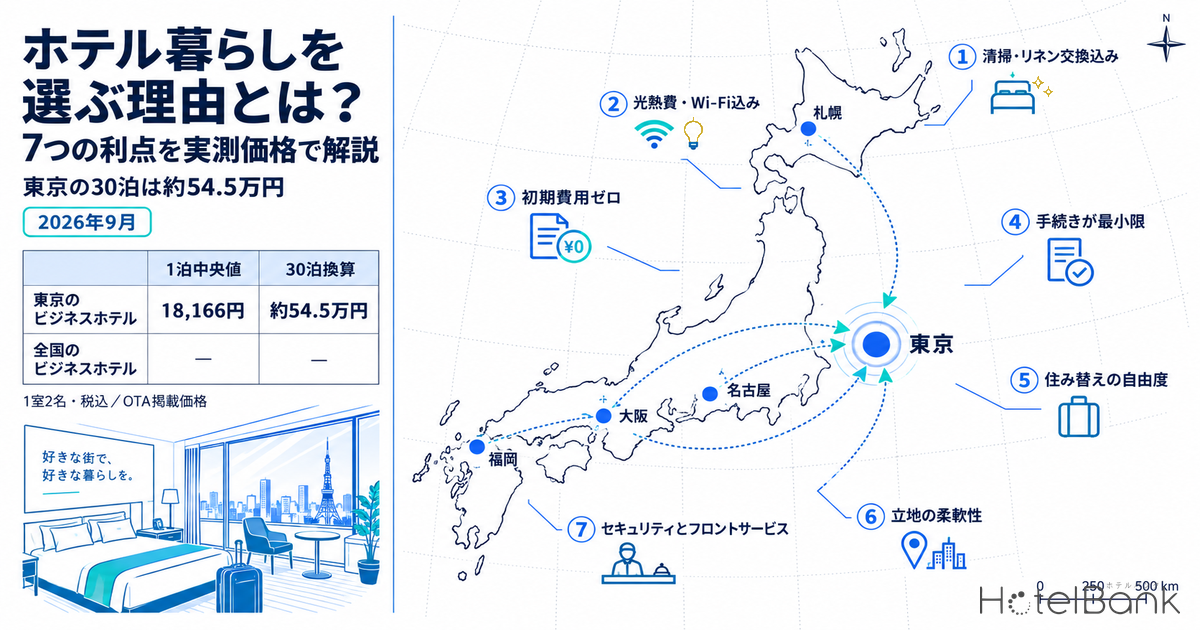
Strip it down and the reasons people choose hotel living come to three things: housework and utilities are bundled into the room rate, you can start with zero move-in costs, and you can move out whenever you like. Cleaning, linen changes, utilities and Wi-Fi are all included in the nightly rate, and there is no security deposit, key money or furniture and appliances to buy. According to OTA listed prices compiled by the HotelBank Editorial Team (as of September 2026, per room for 2 guests, tax included), the average nightly rate for a business hotel is ¥18,166 in Tokyo and ¥15,625 nationwide, which adds up to roughly ¥545,000 in Tokyo and ¥469,000 nationwide for 30 nights. Using these measured prices as the baseline, this article sets out the seven benefits that people who choose hotel living most often cite.
- — Seven benefits: cleaning and linen included / utilities and Wi-Fi included / zero move-in costs / minimal paperwork / freedom to relocate / flexible location / the reassurance of a staffed front desk.
- — ¥18,166 in Tokyo, ¥15,625 nationwide: average nightly listed price for business hotels (September 2026, per room for 2 guests, tax included; N=968 / 7,900 properties).
- — 30 nights: about ¥545,000 in Tokyo, ¥469,000 nationwide: a simple 30× multiple of the nightly average. The figure already covers cleaning, utilities, Wi-Fi, furniture and appliances, and long-stay discounts can bring it down further.
- — You get your housework time back: the Ministry of Internal Affairs and Communications survey (2021) puts it at 51 minutes a day for men and 3 hours 24 minutes for women.
- — Weigh the benefits against the caveats: check resident registration, mail handling and room size in advance with the six-point downsides checklist.
Why People Choose Hotel Living — The Seven Benefits at a Glance
Compared with renting an apartment, the benefits of hotel living can be grouped into seven points.
- Cleaning and linen changes included — the hotel handles cleaning, sheet changes and fresh towels
- Utilities and Wi-Fi included — no contracts or bills for electricity, gas, water or internet
- Zero move-in costs — no security deposit, key money, agency fee or furniture and appliances to buy
- Minimal paperwork — there is no equivalent of a rental tenant screening; a booking is all it takes to start today
- Freedom to relocate — checking out is moving out. There is no notice period and no early-termination penalty
- Flexible location — you can stay a few minutes’ walk from a station or right in the city centre, locations where rents would shoot up
- Security and front-desk service — staffed front desk, key-card access and parcel reception
In short, the biggest reason to choose hotel living is that it bundles both the “money hassle” and the “time hassle” of a home into a single room rate. Below, we first confirm the cost baseline and then look at each benefit in turn.
The Cost Baseline — ¥18,166 a Night in Tokyo, ¥15,625 Nationwide (Measured, September 2026)
Before discussing the benefits, it is worth pinning down what you actually pay. The average OTA listed prices compiled by the HotelBank Editorial Team (2 guests per room, per room, tax included) are as follows.
| Scope | Nightly average | 30-night equivalent | Per person per night (÷2) | Sample |
|---|---|---|---|---|
| Business hotels in Tokyo | ¥18,166 | approx. ¥545,000 | approx. ¥9,083 | N=968 properties |
| Business hotels nationwide | ¥15,625 | approx. ¥469,000 | approx. ¥7,813 | N=7,900 properties |
Source: HotelBank Editorial Team research (OTA listed prices as of September 2026; per-room, tax-included rates for 2 guests. The 30-night equivalent is a simple multiple of the nightly average; long-stay discounts and plan choice can bring it lower.)
About ¥545,000 for 30 nights in Tokyo looks expensive next to rent alone. But that amount already includes cleaning, utilities, Wi-Fi, furniture and appliances, and once you line up a rental’s move-in costs and fixed monthly bills alongside it, the gap narrows. You can see at how many nights long-stay discounts kick in from our measured market rates for hotel long-stay discounts. A detailed side-by-side comparison with rent is the subject of our analysis of hotel living versus rent in Tokyo, and the costs for a couple sharing one room are covered in our article on hotel living for two, so we leave the detailed cost calculations to those pieces.
Benefits 1 & 2: Housework and Fixed Bills Are Built Into the Room Rate
The first thing people who choose hotel living mention is freedom from housework. Room cleaning, sheet and towel changes, taking out the rubbish and cleaning the bathroom are handled by the hotel, depending on the stay plan. How often rooms are cleaned during a multi-night stay varies by property and plan — daily, every few days, or linen changes only — but either way, moving from being the one who cleans to the one whose room gets cleaned is a big change. The Ministry of Internal Affairs and Communications’ Survey on Time Use and Leisure Activities (2021) puts time spent on housework-related activities, averaged over the whole week, at 51 minutes a day for men and 3 hours 24 minutes for women — time that comes straight back to you.
The same goes for fixed costs. There are no contracts or bills for electricity, gas, water or internet, and no need to watch your usage. Even in summer and winter, when heating and air conditioning run for long hours, the amount you pay stays the same, and household budgeting is simplified to a single line: accommodation. If you choose an apartment-style property with a kitchen and washer-dryer in the room, cooking and laundry can be done without leaving your room. There are dedicated comparisons of this type of property, such as this comparison of apartment-style hotels with kitchens and washer-dryers (in Japanese), so if facilities are your priority, that is the quickest place to start.
Benefits 3 & 4: Zero Move-In Costs — Start Today With Just a Booking
Renting a new apartment in Japan typically involves a security deposit, key money, an agency fee, a guarantor-company fee and moving costs, plus the purchase of furniture and appliances such as a fridge, washing machine and bed; the total move-in cost commonly amounts to several months’ rent. With hotel living, this is in principle zero. You pay only for the room, and all furniture and appliances are provided. The lightness of starting with a single suitcase is especially valuable when the end date is hard to predict — a job transfer, a secondment, waiting for a renovation, or bridging the gap while house-hunting.
The paperwork is light too. There is no process equivalent to rental tenant screening, no proof of income or guarantor to arrange, and if you can get a booking you can move in that same day. Being able to secure a place to live even at times when documents are hard to assemble — as a freelancer or right after changing jobs — is a practical reason people choose hotel living. The steps from booking through to handling your belongings and resident registration are laid out in order in How to Start Hotel Living in Japan: 5 Steps.
Benefits 5 & 6: Freedom to Relocate, and Locations Rentals Rarely Reach
Rental leases in Japan are typically two years, and ending one early involves a notice period and penalties. With hotel living, checking out is moving out, and you can move to a different city or a different hotel from next month. “Tokyo this month, Fukuoka next month” works simply by packing your bags. For people whose work base changes often, or who want to try out a neighbourhood before committing, this reversibility is something renting cannot offer. And because the average listed price is ¥18,166 in Tokyo against ¥15,625 nationwide (as of September 2026), changing the city you stay in is itself a way of adjusting your living costs.
Location works the same way: business hotels cluster within a few minutes’ walk of major terminal stations. The structural strength of hotel living is that you can live, at the listed room rate, in places where renting an apartment in the same spot would push the rent sharply higher. It makes it practical to live in the city centre only for the period when you want to cut your commute to work or school.
Benefit 7: Security and Front-Desk Service — the “Invisible Rent”
A staffed front desk, key-card access and in-house cameras offer reassurance, particularly for people living alone or settling into an unfamiliar city. Parcels are received at the front desk, and visitors pass through it. This “someone is always here” reassurance, a step above an auto-lock apartment building, comes at no extra charge. Late-night check-in support, and having someone in the building to turn to if you fall ill, also set it apart from living alone. What you can ask the hotel to handle — parcels, cleaning, breakfast and more — varies by property, so it is worth confirming the scope of services before you book.
Choosing a property with a large communal bath, a coin laundry, or complimentary late-night snacks and after-bath treats raises everyday comfort further. Room criteria, what to pack and how to structure your days are covered in Hotel Living in Japan: 4 Room Criteria, Packing & Daily Routines.
Check the Flip Side of Each Benefit Before You Decide
We have laid out the benefits, but there are also points to check in advance: how resident registration and mail are handled, room size, and the absolute monthly cost. To avoid a wrong call, we recommend reviewing the corresponding caveats first in our six-point checklist of hotel living downsides. Looking at both the benefits and the caveats, then judging whether it fits your life, is the order that avoids regrets.
To Explore Specific Properties
For side-by-side comparisons of specific properties, these articles (in Japanese) go into detail.
When a Business Trip Runs Past 3 Nights, Stop Choosing a “Hotel” — Top 5 Apartment-Style Stays With Kitchens and Washer-Dryers (HotelPicks, in Japanese)
Compares five apartment-style properties in Tokyo, Osaka, Fukuoka and Sapporo by multi-night rate and living facilities — including Tokyu Stay Hakata (東急ステイ博多), with a washer-dryer in every room and a mini-kitchen in its residential-type rooms, and MIMARU Osaka Namba STATION (MIMARU大阪 難波STATION), with spacious rooms of around 40 m².
Can You Do It for ¥200,000 a Month? Top 5 Serviced Apartments in 5 Japanese Cities — Comparing the Pricing Structure of Monthly Plans (innippon, in Japanese)
Breaks down the pricing structure of monthly plans — down to how cleaning and utilities are treated — for five properties in five cities, including Citadines Namba Osaka (シタディーンなんば大阪), where all 313 units have a kitchen and washer-dryer, and Weekly Sapporo (ウィークリーさっぽろ), which publishes rates for stays of 30 nights or more (a single with kitchenette from ¥95,700 for 30 nights).
Frequently Asked Questions
Q. Why do people choose hotel living?
A. There are three main reasons: cleaning, linen, utilities and Wi-Fi are included in the room rate, freeing you from housework and managing fixed bills; you can start with zero move-in costs, with no security deposit, key money or furniture and appliances to buy; and you can relocate at any time simply by checking out. Locations close to stations and the reassurance of a staffed front desk add to the appeal.
Q. How much does hotel living cost per month?
A. Multiplying the average OTA listed price (as of September 2026, per room for 2 guests, tax included) by 30 nights gives about ¥545,000 for a business hotel in Tokyo and about ¥469,000 nationwide. Long-stay discount plans, how you combine days of the week and which city you stay in all leave room to bring this down. Detailed cost calculations are covered in our cost-focused articles.
Q. Who is hotel living suited to?
A. It suits people in situations where the end date is hard to predict, such as a job transfer, a secondment or waiting for a renovation; people who travel often for work and find it hard to settle on a base; and people who want to redirect housework time to work or life. Because a booking alone secures a place to live even when documents are hard to assemble, it is also chosen by freelancers and people who have just changed jobs.
Q. How do move-in costs compare between hotel living and renting?
A. Renting involves a security deposit, key money, an agency fee, a guarantor-company fee and moving costs, plus the purchase of furniture and appliances, and the total commonly amounts to several months' rent. With hotel living, furniture and appliances are provided and you pay only for the room, so move-in costs are in principle zero.
Q. How much does the cost differ between Tokyo and the rest of Japan?
A. The average nightly listed price for a business hotel (as of September 2026, per room for 2 guests, tax included) is ¥18,166 in Tokyo and ¥15,625 nationwide, a difference of ¥2,541 per night, or about ¥76,000 over 30 nights. Changing the city you stay in is itself a way of adjusting your living costs.
Q. Do I have to do my own cleaning and laundry when living in a hotel?
A. The hotel handles room cleaning and sheet and towel changes. How often rooms are cleaned during a multi-night stay varies by property and plan, so it is worth confirming before you book. For laundry, you can use a coin laundry on site, or choose an apartment-style room with a washer-dryer and do it without leaving your room.
Methodology and Sources
References and Sources
■ Data sources
Listed prices are per-room, tax-included rates for 2 guests, compiled by the HotelBank Editorial Team from publicly available OTA data. They are monthly averages built up from daily listed prices by property and date for September 2026, covering 7,900 business hotels nationwide, of which 968 are in Tokyo. Housework-related time is from the Ministry of Internal Affairs and Communications’ 2021 Survey on Time Use and Leisure Activities (whole-week average, population aged 10 and over).
■ Calculation assumptions
The 30-night equivalent is a simple multiple of the average nightly listed price × 30 nights (Tokyo ¥18,166 × 30 = approx. ¥545,000; nationwide ¥15,625 × 30 = approx. ¥469,000). The per-person figure is a reference value obtained by dividing the 2-guest room rate by two, and does not reflect long-stay discounts, multi-night plans or single-occupancy rates.
■ Limitations
Listed prices are the prices displayed on booking sites and do not match actual transaction prices. Averages are easily pulled up by high-priced properties and tend to come out higher than the median. Actual payments vary by plan, day of the week, season and property. Rental move-in costs describe a typical breakdown; comparison against specific rent levels is left to our cost-focused articles.
■ Market data
Statistics Bureau, Ministry of Internal Affairs and Communications, “2021 Survey on Time Use and Leisure Activities: Results” (in Japanese) / HotelBank Editorial Team research (OTA listed prices, September 2026)
Related Reading
- How to Start Hotel Living in Japan: 5 Steps, ¥479,000 for 30 Nights
- Japan Hotel Long-Stay Discounts: 15% at 7 Nights, 20% at 30 Nights
- Is Hotel Living Cheaper Than Rent in Tokyo? Break-Even at 24 Nights
- Monthly Hotels in Japan: No Lease, 20% Off at 30 Nights (Aug 2026)
- Remote Work Hotel Living in Japan: 3 Options, ¥502,000 a Month
- Hotel Living in Japan: 4 Room Criteria, Packing & Daily Routines