

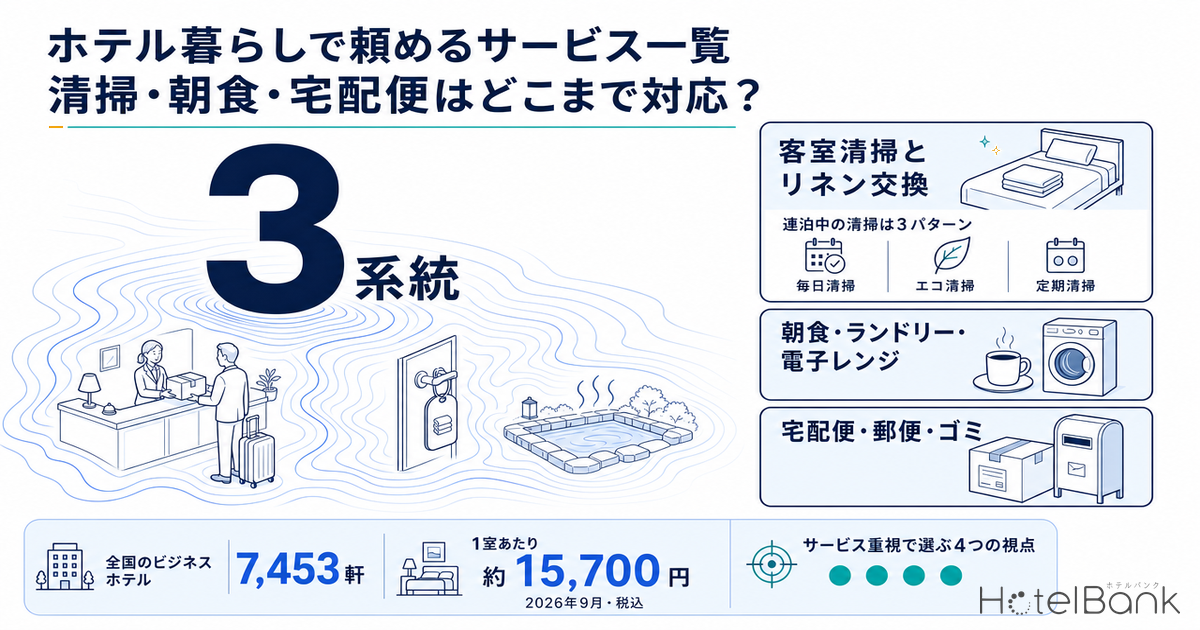
The services you can ask a hotel for during an extended stay fall into three groups: room cleaning and linen changes; everyday facilities such as breakfast, laundry and microwaves; and day-to-day errands such as parcels, mail and rubbish. Much of this comes at no extra charge, and the one trick for getting it is to tell the front desk how long you are staying and what you want at check-in. This article sets out what you can ask for, and how far it goes, on a multi-night or long stay, plus what to look for when choosing a hotel on service. As a price benchmark it uses the OTA listed price of 7,453 business hotels across Japan: about ¥15,700 per room (September 2026, two guests per room, tax included; compiled by the HotelBank Editorial Team).
- — Room cleaning on a multi-night stay comes in three patterns: daily cleaning, eco cleaning (no cleaning), or scheduled cleaning every few days. The basic move is to state your length of stay and preference at check-in.
- — Even on days without cleaning, extra towels, rubbish collection and a linen-only change are available if you ask at the front desk.
- — Some chains include a free breakfast as standard, and laundry can be done in the on-site coin laundry or an in-room washer-dryer. The more meals and laundry you can handle inside the hotel, the lower your living costs.
- — For parcels, writing “check-in date + name on the booking” on the delivery slip usually gets them received and held at the front desk. Mail can also be received care of the front desk, but a hotel cannot be used as your registered residence (juminhyo) or as the address for a bank account.
- — The OTA listed price of 7,453 business hotels across Japan is about ¥15,700 per room (September 2026, two guests per room, tax included). Even within the same price range, the depth of services for multi-night guests varies.
How to Ask for Room Cleaning and Linen Changes on a Multi-Night Stay
For multi-night stays, most hotels let you choose from the following three cleaning patterns.
| Cleaning option | What it involves | Best for |
|---|---|---|
| Daily cleaning | Bed-making, towel change and rubbish collection every day. The standard on regular plans | Business trips and holidays of 2–3 nights |
| Eco cleaning (no-cleaning) plan | Cleaning is skipped during the stay in return for a rate discount or perks such as mineral water or loyalty points. Towels and amenities can be collected at the front desk at any time | Remote-work stays where you spend long hours in the room |
| Scheduled cleaning every few days | Cleaning at a set interval, such as two or three times a week, with the option to choose linen-change days. Common on long-stay plans | Hotel living for one week to one month |
The key point is that cleaning frequency is no longer “something the hotel decides” but “something you choose when you book or check in”. Eco cleaning plans pass the hotel’s savings on cleaning back to guests as perks or discounts, and often appear as a “no cleaning needed” or “eco plan” option on the booking screen for multi-night stays. Even on days without cleaning, extra towels or toothbrushes and rubbish collection are provided almost without exception if you ask at the front desk. If all you want is fresh sheets, saying “linen change only” is enough.
If you want to stay in your room during cleaning hours, you can also ask for “no cleaning, but please hang fresh towels on the door handle”. Hotels with long-stay plans often have these finer arrangements set out as a menu in advance, so checking the multi-night or monthly plan page on the official website before booking makes it easier to plan your stay.
Breakfast, Laundry and Microwaves — How Much of Daily Life Can Stay In-House
Meals and laundry are what drive the cost of hotel living. Most business hotels offer plans with breakfast, and some chains include a free breakfast as standard. For example, Comfort Hotel advertises a free breakfast service on its official website, and Toyoko Inn likewise promotes free breakfast on its official website, so breakfast does not add to the room rate. Choosing a hotel with an in-house restaurant that also serves dinner lets you cover all your meals without eating out (the comparison of long-stay hotels serving two meals a day (innippon, in Japanese), introduced below, is a useful reference).
For laundry, the on-site coin laundry is the most common answer, and apartment-style hotels with an in-room washer-dryer let you do it all inside your room. Typical laundry prices, how detergent works and tips for drying clothes in your room are covered in detail in our guide to hotel laundry.
Microwaves are either in the room or placed on each floor or in the lobby. A shared microwave is enough for heating convenience-store meals, but if you will use one every day, check the floor map for where it is before choosing your room. Beyond that, trouser presses, humidifiers, irons, plug adapters and charging cables are often available as free loan items at the front desk; the more complete a hotel’s “items for loan” list on its official website, the less luggage you need to live there.
Parcels, Mail and Rubbish — Daily Errands Run Through the Front Desk
Receiving deliveries matters more than you might expect when living in a hotel. For parcels addressed to guests, the usual practice is that if you write “check-in date + name on the booking” on the delivery slip, the front desk will receive and hold them, and items arriving before check-in are often held too, as long as the booking can be confirmed. For sending, most hotels will arrange a courier pickup at the front desk. The tips for asking are threefold: (1) let the front desk know in advance that “a parcel will arrive on such-and-such a date”; (2) make the addressee name on the slip match the name on the booking; and (3) check beforehand whether large items or refrigerated/frozen deliveries can be accepted.
As for mail, a hotel is not a residential address, so it cannot be your registered residence (juminhyo) or the address for a bank account; many hotels will, however, accept registered and ordinary mail for you care of the front desk during your stay. Rubbish left in the room’s bin is normally collected during cleaning, and if you have skipped cleaning on an eco plan, there are usually collection points by the front desk or on each floor. Sorting rules differ by municipality, so checking them at the front desk on the first day of a long stay keeps things smooth. The order in which to prepare everything, including where to keep your address, mail and residence registration, is set out in How to Start Hotel Living in Japan: 5 Steps.
Four Things to Check When Choosing a Hotel on Service
The OTA listed price of 7,453 business hotels across Japan is about ¥15,700 per room (September 2026, two guests per room, tax included; compiled by the HotelBank Editorial Team). Even within the same price range, the depth of services for multi-night guests differs clearly from hotel to hotel. If service is your priority, check the following four points on the official website.
- Whether there are multi-night or long-stay plans — Hotels that list weekly or monthly plans on their official website often have arrangements in place that let you choose cleaning frequency and linen-change days.
- How far meals can be covered in-house — Hotels with a free breakfast or a restaurant open for dinner cut both eating-out costs and travel time.
- Large public baths and after-bath services — How tired you feel over a long stay depends a great deal on the bathing facilities. For example, Dormy Inn advertises on its official website a large public bath and sauna, plus a free late-night bowl of “Yonaki Soba” noodles, which becomes an evening treat on a long stay.
- Membership and app perks — Booking through the official website or app is often designed to be the best deal, with perks and points. APA Hotel, for example, officially promotes its app-based “1-Second Check-in”, and when you come and go every day as a hotel resident, fast check-in makes a difference.
Each chain’s services can be confirmed from what it publishes on its official website, and each puts its strengths in a different place. Rather than asking “which one is best”, the way to choose hotel living you will not regret is to work backwards from the services you will use every day on your own stay.
Where to Look Next
For side-by-side comparisons of specific hotels, these articles go into detail.
When a business trip runs past three nights, stop staying in a “hotel” — Top 5 apartment-style hotels with kitchens and washer-dryers where you stay as if you lived there (HotelPicks, in Japanese)
Five apartment-style hotels in Tokyo, Osaka, Fukuoka and Sapporo with in-room kitchens and washer-dryers, compared on multi-night price range (from ¥24,000 for two guests per room) and living facilities — including Tokyu Stay Hakata (東急ステイ博多), where every room has a washer-dryer, and MIMARU Osaka Namba Station (MIMARU大阪 難波STATION), with spacious rooms of around 40 m².
Five long-stay hotels where you can also eat dinner in-house — reading multi-night business trips through breakfast hours, dinner opening hours and monthly plans (innippon, in Japanese)
A comparison of five long-stay hotels across Japan where both breakfast and dinner can be had on site — including Hotel Mystays Premier Narita (ホテルマイステイズプレミア成田), with three in-house restaurants and long-stay plans from 7 and 30 nights, and Hotel Route-Inn Grantia Tokai (ルートイングランティア東海), whose set-meal restaurant stays open through the day — down to dinner opening hours and how meals are served.
Frequently Asked Questions
Q. Is my room cleaned every day on a multi-night stay?
Daily cleaning is the standard on regular plans, but you can also choose an “eco cleaning (no-cleaning)” plan, which skips cleaning during the stay in return for a discount or perks, or scheduled cleaning at a set interval such as two or three times a week. Cleaning frequency is no longer decided unilaterally by the hotel; increasingly, you choose it by stating your preference when you book or check in.
Q. Can I still get towels and rubbish collection on a no-cleaning plan?
Yes. Even on days without cleaning, extra towels or toothbrushes and rubbish collection are provided almost without exception if you ask at the front desk. If you only want the sheets changed, saying “linen change only” is enough.
Q. Can I receive parcels at a hotel?
For parcels addressed to guests, the usual practice is that if you write “check-in date + name on the booking” on the delivery slip, the front desk will receive and hold them. Items arriving before check-in are often held too, as long as the booking can be confirmed. Let the front desk know in advance, make the name on the slip match the booking, and check beforehand whether large items or refrigerated/frozen deliveries can be accepted.
Q. Can I use a hotel’s address for mail or my residence registration?
A hotel is not a residential address, so it cannot be your registered residence (juminhyo) or the address for a bank account. Many hotels will, however, accept registered and ordinary mail for you care of the front desk during your stay.
Q. What should I check when choosing a hotel for a long stay?
On the official website, check four things: whether there are multi-night or long-stay plans, whether meals can be covered in-house, large public baths and other after-bath services, and membership or app perks. Even within the same price range, the depth of services for multi-night guests varies, so working backwards from the services you will use every day is the safest way to choose.
Methodology and Sources
The listed price is the per-room rate for 7,453 business hotels across Japan, compiled by the HotelBank Editorial Team from public OTA data (September 2026, two guests per room, tax included), and came to about ¥15,700 per room (N=7,453 hotels). Arrangements for cleaning, parcels, loan items and so on summarise the general practices widely seen in multi-night service; conditions differ by property. Each chain’s services are based on the information published on the official websites below.
- Comfort Hotel, “Brand Concept (Free Breakfast Service)” (in Japanese)
- Toyoko Inn, “Free Genki Breakfast” (in Japanese)
- Dormy Inn, “What Makes Dormy Inn Different (Large Public Bath, Free Services / Yonaki Soba)” (in Japanese)
- APA Hotel, “About 1-Second Check-in” (official website, as of September 2026)
■ Data Sources
Prices: OTA public listed prices compiled by the HotelBank Editorial Team (business hotels across Japan, stay dates in September 2026, N=7,453 hotels). Services: information published on the official websites of Comfort Hotel, Toyoko Inn, Dormy Inn and APA Hotel (as of September 2026).
■ Assumptions
The listed price is the per-room rate for two guests sharing one room (tax included, all plans), not a per-person amount. It excludes multi-night discounts, accommodation tax and additional costs such as meals and laundry. Cleaning frequency and parcel handling summarise practices widely seen on multi-night and long-stay plans; they are not the terms and conditions of any specific property.
■ Limitations
Listed prices are public prices at the time of collection and may differ from actual booking rates and availability. Cleaning frequency, whether parcels and mail can be received, the loan items available and how rubbish is handled vary by property, and can differ between hotels of the same chain. Each chain’s services may be revised, so check the latest information on the official website before booking and confirm individual conditions with the front desk.
Related Reading
- Remote Work Hotel Living in Japan: 3 Options, ¥502,000 a Month
- Business Hotels for Long Stays: 6 Checks and ¥16,722 a Night in Tokyo
- Hotel Long-Stay Meals in Japan: 3 Patterns & ¥565–2,174 Breakfast Gap
- Hotel Laundry in Japan: Free–¥600 a Wash, 5 Room-Drying Steps
- How to Start Hotel Living in Japan: 5 Steps, ¥479,000 for 30 Nights
- Hotel Living in Japan: 4 Room Criteria, Packing & Daily Routines
- Japan Hotel Long-Stay Discounts: 15% at 7 Nights, 20% at 30 Nights