

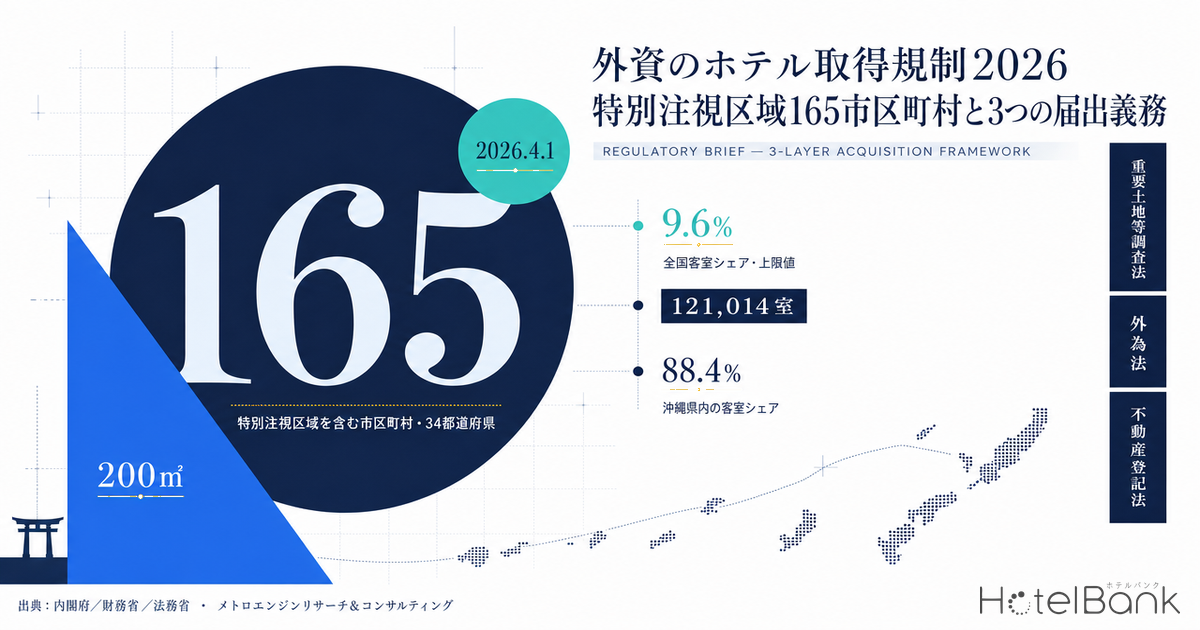
What decides who can buy Japanese hotel real estate — and what is required in order to buy it — is neither zoning nor floor-area ratio. It is a completely separate set of three laws that bite at the moment ownership transfers. Two of them moved at once in 2026. An amendment to the reporting ordinance under the Foreign Exchange and Foreign Trade Act (FEFTA; promulgated 20 February 2026, effective 1 April 2026) expanded non-resident real estate acquisition reporting to, in principle, every transaction “regardless of purpose,” and the mandatory filing of registrations of change of address under the Real Property Registration Act began on 1 April 2026. This article organizes the three layers of acquisition regulation — the Important Land Survey Act, FEFTA and the Real Property Registration Act — from primary sources, and quantifies on a room-count basis how much of the hotel market each layer overlaps.
How this differs from our earlier coverage. Our previous articles on the hotel allocation inside foreign private-equity value-add strategies, on the 2.5-year assessment of the Ooedo Onsen × Yukai Resort integration, and on the investment impact of the Minor Hotels × Royal HD joint venture all took the strategy of overseas players as their subject; none of them dealt with the acquisition procedure itself. And Hotel Development Capacity 2026: zoning, FAR and land price is about whether you may build, under the City Planning Act and the Building Standards Act, whereas this article is about the notification duties attaching to the transfer of ownership itself. The statutes differ, and so does the point at which they bite (not before you build, but when you buy). This is also a different track from operating regulations such as the lodging tax.
Metric Definitions Used in This Article
- ADR (average daily rate): an estimated settled rate (tax-exclusive equivalent) derived by applying a segment-specific adjustment coefficient to the lowest published plan level each property lists on OTAs (double occupancy, per-room rate, tax-inclusive). Cross-checked against the property-level results disclosed by listed hotel REITs (91 properties, most recent three months), the median error is approximately 7%. These are estimates and differ from each property’s actual transacted prices and accounting figures. Area-level ADR is the median of the properties covered (the level of a typical property in that area).
- Room and property counts: of roughly 168,000 lodging facilities in Japan tracked by MetroEngines Research, the base population is the 27,249 properties / 1,266,986 rooms confirmed to be active on OTAs (as of August 2026). Ryokan, minshuku and simple lodging houses not listed on OTAs are excluded.
- “Municipalities containing a Special Watch Zone”: municipalities appearing on the Cabinet Office’s “List of Special Watch Zones.” Because the zones themselves are confined to roughly 1,000 m around the perimeter of an important facility, municipality-level aggregation represents an upper bound for the affected room count.
- Data sources: MetroEngines Research & Consulting / published materials from the Cabinet Office, Ministry of Finance and Ministry of Justice
- — Special Watch Zones sit inside 165 municipalities across 34 prefectures. Of these, 147 municipalities contain lodging supply, amounting to 3,032 properties and 121,014 rooms — 9.6% of Japan’s room stock (upper bound).
- — Once zone coverage and the 200 m² area threshold are factored in, the stock actually subject to notification falls in a range of 0.6% to 4.3% of national rooms. Reading the headline 9.6% as the deal universe overstates it.
- — The skew is extreme: 88.4% of Okinawa’s rooms sit in affected municipalities, along with 77.3% in Shimane and 66.2% in Aomori. Tokyo stands at just 1.8%.
- — From 1 April 2026, FEFTA expanded non-resident real estate acquisition reporting to every transaction “regardless of purpose.” Bilateral deals between non-residents now also require a report, and the counterparty, the purpose of acquisition and the real property number were added as reportable items.
- — The hotel and ryokan business (Japan Standard Industrial Classification 7511) is not a designated sector requiring prior notification for inward direct investment. The procedural weight is therefore asymmetric: an asset acquisition triggers a report within 20 days plus, inside a zone, a pre-contract notification, while an equity acquisition is covered by a post-transaction report within 45 days.
Conclusion — the overlap spans 165 municipalities in 34 prefectures, up to 9.6% of rooms
Under the Important Land Survey Act (the Act on the Investigation and Regulation of the Use of Land Surrounding Important Facilities and on Remote Territorial Islands, Act No. 84 of 2021), Watch Zones have been designated in all 47 prefectures according to the Cabinet Office list. Of those, the Special Watch Zones — where a transfer of ownership triggers a prior notification — extend across 34 prefectures and 165 municipalities. Lodging facilities confirmed active on OTAs exist in 147 of those 165 municipalities, amounting to 3,032 properties and 121,014 rooms: 9.6% of Japan’s 1,266,986 rooms.
That 9.6% is, however, an upper bound. As the Cabinet Office’s summary material states explicitly, zones are designated individually within roughly 1,000 m of the perimeter of an important facility. Because an entire municipality does not become a zone, the room count actually subject to the notification duty is smaller than this. Even so, the fact that raising the map’s resolution by a single step places 88.4% of Okinawa’s lodging supply, 77.3% of Shimane’s and 66.2% of Aomori’s into the “municipalities that need checking” bucket changes how due diligence opens.
Layer 1: the Important Land Survey Act — 200 m² and above requires prior notification from both seller and buyer
This Act was promulgated on 23 June 2021, and the provisions on zone designation, investigation, use regulation and prior notification took effect on 20 September 2022. The framework splits into three parts: (i) zone designation (Watch Zones and Special Watch Zones); (ii) investigation of how land and buildings inside a zone are used; and (iii) prior notification of transfers of ownership within Special Watch Zones. The part that bears directly on hotel transactions is (iii).
According to the Cabinet Office, the notification applies to land and buildings inside a Special Watch Zone whose area (for buildings, the sum of the floor area of each storey) is 200 square metres or more. The area test is applied per parcel for land and per building for structures. The duty falls on both the seller and the buyer, who must notify the Prime Minister in advance, before the contract is executed (Article 13, paragraphs 1 and 3). Reportable items include name, address and nationality, the intended use, the location and the area.
Three points matter in practice. First, this is not a permit system. It bars you from contracting without notifying; it does not condition the purchase on clearing a review. Second, the rights covered are limited to ownership and rights aimed at acquiring ownership (the right to complete a reservation to purchase, the right of repurchase); transfers of superficies, leasehold rights or mortgages fall outside it. Schemes that take a hotel on a fixed-term leasehold, or transactions that succeed only to a leasehold right under a management-contract structure, are therefore beyond the reach of this notification. Third, there are penalties. Contracting without notifying, failing to notify within two weeks including the contract date, and filing a false notification each carry imprisonment of up to six months or a fine of up to ¥1 million (Article 26).
Zone designation has proceeded in stages: the Cabinet Office page carries 12 public notices dated from 27 December 2022 through 1 April 2026. The notification form also changed as of 1 April 2026. In addition, Article 2 of the Supplementary Provisions calls for a review five years after entry into force, which falls in September 2027. The outer edge of the zones should be assumed to keep moving.
The distribution is extremely skewed. In Okinawa, 22 municipalities are affected, accounting for 88.4% of the prefecture’s rooms. The zones built around Kadena Air Base, the Kadena Ammunition Storage Area and Camp Foster (Camp Zukeran) as designated important facilities span nine municipalities — Ginowan, Okinawa City, Uruma, Onna Village, Yomitan Village, Kadena Town, Chatan Town, Kitanakagusuku Village and Nakagusuku Village — which is very nearly the resort belt of central Okinawa Island. Island markets such as Ishigaki, Miyakojima, Taketomi Town, Yonaguni Town and Kumejima Town also contain Special Watch Zones tied to garrisons and sub-bases. How those island markets stratify on rate is shown in our analysis comparing lodging rates across 10 major island municipalities, which found a 2.37x spread.
On the main islands, Aomori (12 municipalities, 66.2% of prefectural rooms) and Shimane (3 cities, 77.3%) run high. In Hokkaido, Chitose and Tomakomai contain zones around Chitose Air Base and other facilities, and those two cities alone hold 4,269 rooms (we track the supply build-up under way in both in worker lodging stacking up in central Hokkaido). Among onsen destinations, Kaga in Ishikawa appears on the designation list as a city containing the Komatsu Air Base zone, and 3,149 rooms are located there.
| # | Prefecture | Municipality | Properties | Rooms |
|---|---|---|---|---|
| 1 | Okinawa | Naha | 227 | 16,614 |
| 2 | Okinawa | Onna Village | 100 | 4,830 |
| 3 | Okinawa | Ishigaki | 165 | 4,803 |
| 4 | Shimane | Matsue | 64 | 4,630 |
| 5 | Aomori | Aomori City | 45 | 4,064 |
| 6 | Nagasaki | Sasebo | 60 | 3,836 |
| 7 | Okinawa | Miyakojima | 194 | 3,161 |
| 8 | Ishikawa | Kaga | 62 | 3,149 |
| 9 | Aomori | Hachinohe | 42 | 3,107 |
| 10 | Hokkaido | Obihiro | 34 | 3,076 |
| 11 | Hokkaido | Chitose | 26 | 2,703 |
| 12 | Gunma | Takasaki | 40 | 2,689 |
| 13 | Mie | Tsu | 34 | 2,317 |
| 14 | Gunma | Shibukawa | 48 | 2,191 |
| 15 | Okinawa | Chatan Town | 54 | 2,051 |
Layer 2: FEFTA — expanded in April 2026 to all-transaction reporting “regardless of purpose”
The second layer is the Foreign Exchange and Foreign Trade Act. Two procedures of quite different character run in parallel when hotel real estate is acquired.
(a) Post-transaction report on real estate acquisition by a non-resident. Where a non-resident acquires real estate in Japan or a right relating to it, a “Report on the Acquisition of Real Estate in Japan or Rights Relating Thereto” must be submitted to the Minister of Finance via the Bank of Japan within 20 days of acquisition (FEFTA Article 55-3(1)(xii); Foreign Exchange Order Article 18-5; Reporting Ordinance Article 5(2)(x) and Article 12). The Ministry of Finance leaflet states explicitly that a report is required “regardless of the size of the amount or the area” — there is no threshold comparable to the 200 m² test in the Important Land Survey Act. Failing to report, or filing a false report, carries imprisonment of up to six months or a fine of up to ¥500,000 (FEFTA Article 71(1)(iii)).
This is where 2026 moved. Under the amendment to the Reporting Ordinance promulgated on 20 February 2026 and effective 1 April 2026, acquisitions dated on or after 1 April 2026 are reportable “regardless of purpose.” Previously the target was “real estate acquired for investment or similar purposes,” and four categories were exempt: the non-resident’s own residential use, non-profit business use, office use and property acquired from another non-resident. That fourth exemption has been removed. In plain terms, a hotel changing hands between two non-residents now requires a report. In addition, the counterparty (resident or non-resident), the purpose of the acquisition and the real property number were added as reportable items. Who bought from whom, for what purpose, and which registered property moved now reaches the authorities on a transaction-by-transaction basis. The Ministry of Finance FAQ also makes clear that villas and second homes do not qualify as “residential use.”
Separately, the Ministry of Finance’s overview page also carries “Request concerning real estate transactions using crypto assets (28 April 2026),” so visibility is being pursued from the settlement side at the same time.
(b) Notification for inward direct investment (share acquisition). Buying the company rather than the building puts the deal inside the inward direct investment framework. The fork here is the industry sector. Under the “Notice specifying the business sectors designated by the Minister of Finance and the competent minister pursuant to Article 3(3) of the Order on Inward Direct Investment” (Notice No. 1 of 2014, last amended by Notice No. 4 of 16 August 2024), the sectors requiring prior notification are those listed in Appended Tables 1 and 2, plus any sector not listed in Appended Table 3. Japan Standard Industrial Classification 7511, “Ryokan and hotels,” is listed in Appended Table 3 and is not included in Appended Tables 1 or 2. The hotel and ryokan business is therefore not a prior-notification sector, and a foreign investor acquiring shares in a hotel operating company is in principle covered by a post-transaction report filed within 45 days of acquisition. Only for a “specified acquisition” — taking unlisted shares over from another foreign investor — does the procedure itself become unnecessary where no designated sector is involved, as the Bank of Japan Q&A indicates.
That asymmetry shapes investor structuring. Buy the real estate (the asset) and a non-resident always carries the 20-day report, plus a pre-contract notification if the property sits inside a Special Watch Zone. Buy the company (the equity) and, so long as the sector is not designated, no prior notification is required and a post-transaction report within 45 days suffices. It is a different story if the target company also runs a business in a designated sector: prior notification then applies, and the prohibition period serving as the review window can be extended to as long as five months (FEFTA Article 27(3) and (6)). Where subsidiaries hold hotel-adjacent businesses such as electricity and heat supply, telecommunications, or railways and ropeways, a sector inventory is essential.
| Regime | Who | When | Threshold | Penalty |
|---|---|---|---|---|
| Important Land Survey Act Prior notification in a Special Watch Zone | Both seller and buyer (regardless of nationality) | Before contract execution (if mailed, must arrive by the day before the intended contract date) | 200 m² or more per land parcel / per building | Imprisonment up to 6 months or a fine up to ¥1 million (Article 26) |
| FEFTA Post-transaction report on real estate acquisition | Non-residents (may be filed by a resident agent) | Within 20 days of acquisition | Every transaction, regardless of amount or area | Imprisonment up to 6 months or a fine up to ¥500,000 (Article 71(1)(iii)) |
| FEFTA Inward direct investment (share acquisition) | Foreign investors | Post-transaction report within 45 days of acquisition / prior notification for designated sectors | For listed companies, thresholds of 1%, 3% and 10%. The hotel and ryokan business is not a prior-notification sector | — (for prior-notification cases, the prohibition period can be extended to as long as 5 months) |
| Real Property Registration Act Domestic contact information | Registrations in which an overseas resident (individual or corporation) becomes the registered owner | At the time of the registration application (from 1 April 2024) | No area or value requirement | — (an application lacking the item is not accepted) |
| Real Property Registration Act Mandatory registration of change of address | Registered owners | Within 2 years of the change (effective 1 April 2026) | No area or value requirement | Non-penal fine of up to ¥50,000 for violation without justifiable grounds |
Layer 3: the Real Property Registration Act — making “who holds it” traceable from within Japan
The third layer is the regime governing owner information itself. Here too the change came in two stages, in 2024 and 2026.
From 1 April 2024, an application to register an overseas resident (individual or corporation) as the owner of record must provide, as part of the application information, the name and address of a person serving as a domestic contact (the domestic contact information). Supporting documents must include that person’s consent and a seal registration certificate. The domestic contact may be an individual or a corporation; the Ministry of Justice cites real estate professionals and judicial scriveners as expected candidates. The registered owner may also designate its own Japanese business office as the domestic contact. Alongside this, registrations naming a corporation as owner must now provide corporate identification information (the corporate number; for foreign corporations without one, the country of the governing law of establishment, and otherwise the law under which it was established). The legal basis lies in the Act Partially Amending the Civil Code and Other Acts (Act No. 24 of 2021), the Cabinet Order Partially Amending the Order for Enforcement of the Real Property Registration Act (Cabinet Order No. 297 of 2023) and the Ministerial Ordinance Partially Amending the Regulation for Enforcement of the Real Property Registration Act (Ministry of Justice Ordinance No. 7 of 2024).
From 1 April 2026, the filing of registrations of change of address became mandatory. Where the name or address of a registered owner changes, the owner must apply to register the change within two years of the change. Violation without justifiable grounds may attract a non-penal fine of up to ¥50,000. Changes predating the mandate are also covered: where the change occurred before 1 April 2026, registration must be completed by the end of March 2028. A “smart change registration,” in which the registrar makes the change ex officio, was introduced at the same time.
Taken alone, these two look like unremarkable procedure. Combined with the FEFTA amendment described in the previous section — reporting of the counterparty, the purpose and the real property number — their meaning changes. For a property identified by its real property number, the owner of record has a domestic contact, and any address change is reflected within two years. Reporting at the point of acquisition and the freshness of ownership information during the holding period were raised at the same time, from two separate statutes. Where an SPC holds a hotel and its shareholders sit overseas, note that it is the SPC’s own registered-owner information that falls under this duty.
Location read — how the hotel markets in affected municipalities are performing
A thick overlay of regulation does not make an area weak as a market. If anything, the opposite. Across eight major markets containing Special Watch Zones, comparing the confirmed January–July 2026 average estimated settled ADR with the same period a year earlier, six are above prior year: Naha +19.6%, Miyakojima +13.9%, Chatan Town +10.7%, Onna Village and Ishigaki both +9.8%, and Chitose +7.2%. Sasebo (-1.3%) and Kaga (-7.8%) tracked below prior year.
The resort belt of central Okinawa Island (Onna Village, Chatan Town, Yomitan Village and others) overlaps geographically with the Kadena Air Base zone, yet rates have grown steadily. Onna Village reached ¥30,400 in July 2026, up 26.0% from ¥24,100 in the same month a year earlier. Ishigaki was at ¥14,600 in July 2026, above the ¥13,300 recorded in the same month a year earlier. Adding one more procedural step and a loosening of market supply-demand balance are, as the data shows, separate events.
Kaga and Sasebo tracked below prior year. Acquisition regulation is not the kind of thing that acts directly on price formation, and this movement should be read as the area’s own supply and demand. Note that Kaga’s January–July 2026 average of ¥19,100 is the second-highest level among the eight markets covered here, after Onna Village (¥21,100).
What carries weight for investment judgement is the fact itself that affected municipalities are heavily distributed among markets where rates are rising. Okinawa’s outer islands and central main island, Hokkaido’s airport-adjacent cities, and the onsen towns on the Sea of Japan coast have all gained standing in recent years as places inbound demand disperses to. The map of acquisition regulation and the map of rate growth overlap to a considerable degree. For anyone structuring a transaction, this reads not as a list of areas to avoid but as a list of areas where the procedure must be built into the closing schedule.
Unpacking the 9.6% ceiling — sensitivity to zone coverage and the area threshold
The 9.6% (121,014 rooms) used so far is an upper bound that counts every room in every municipality that contains a Special Watch Zone. Prior notification actually applies only to properties that (1) sit inside a zone and (2) meet the area test of 200 m² or more per land parcel or per building. Neither of these exists as published statistics, so the only honest approach is a range.
We therefore ran a sensitivity analysis with zone coverage (the share of an affected municipality’s rooms located inside a zone) on one axis and the area-threshold hit rate (the share of parcels and buildings that meet the test) on the other, expressing the result as the share of national rooms subject to notification. Both variables in the table below are assumptions, not measured values.
| Zone coverage \ Area-threshold hit rate | 60% | 75% | 90% |
|---|---|---|---|
| 10% | 0.57% 7,261 rooms | 0.72% 9,076 rooms | 0.86% 10,891 rooms |
| 20% | 1.15% 14,522 rooms | 1.43% 18,152 rooms | 1.72% 21,783 rooms |
| 30% | 1.72% 21,783 rooms | 2.15% 27,228 rooms | 2.58% 32,674 rooms |
| 40% | 2.29% 29,043 rooms | 2.87% 36,304 rooms | 3.44% 43,565 rooms |
| 50% | 2.87% 36,304 rooms | 3.58% 45,380 rooms | 4.30% 54,456 rooms |
The result is that the national share of rooms subject to notification falls within a range of 4.3% in the pessimistic (broad reach) case, 2.1% in the mid case and 0.6% in the optimistic (narrow reach) case. The gap to the 9.6% upper bound is between 2x and 16x, so reading the headline “165 municipalities” straight across as the deal universe overstates it. At the same time, even the bottom of the range works out to roughly 7,000 rooms nationally — not a level that can be ignored.
The practical implication lies not in the size of the universe but in where it bites. In a market like Okinawa, where 88.4% of prefectural rooms sit in affected municipalities, the odds of a given deal being caught remain high even if zone coverage proves to be on the low side. Conversely, in Tokyo (1.8% of prefectural stock) or Fukuoka (5.0%), an affected municipality does not guarantee that a particular property sits inside a zone. The width of the sensitivity range is itself the priority order for pulling up the web map at the outset.
Practical implications — closing schedules and the DD checklist
1. Settle zone applicability before the contract is drafted
Whether a site falls in a Special Watch Zone can be checked by address and lot number on the Cabinet Office’s “Important Land Web Map.” The notification is due before contract execution, and if mailed it must arrive by the day before the intended contract date. Because both seller and buyer carry the duty, build the seller’s preparation into the schedule as well. Online submission via e-Gov is also available.
2. Apply the area test per parcel and per building
The 200 m² test is applied per land parcel, and per building by total floor area. Where a hotel site spans several parcels, only the parcels of 200 m² or more are subject to notification. Conversely, a transaction covering only small ancillary buildings may fall outside it. That transfers of superficies and leasehold rights are also outside the scope is another fork in scheme design.
3. If the buyer is a non-resident, run a separate 20-day calendar
The FEFTA real estate acquisition report is due within 20 days of acquisition. Acquisitions from 1 April 2026 are covered regardless of purpose, and transactions between non-residents require a report too. The report is prepared in Japanese and may be submitted by a resident agent such as a real estate broker. If day 20 falls on a Bank of Japan non-business day, the deadline moves to the next business day.
The difference in procedural weight between an asset acquisition and an equity acquisition bites at the earliest stage of structuring. When working through the structure in which hotel acquisition costs stack up to 7.1% of price, the lead time attached to these notifications and reports — small in monetary terms — cannot be ignored as schedule risk. For properties inside a Special Watch Zone in particular, the pre-contract notification removes any room to pull signing forward, so allowing an extra one to two weeks in the exclusivity period is the realistic operating assumption.
On the due diligence side, four items are worth adding. (1) Whether the target property falls in a Special Watch Zone, and identification of the parcels and buildings meeting the 200 m² test. (2) Confirmation that the seller discharged the required notifications and reports on its own acquisition (the Important Land Survey Act notification, and the FEFTA report if it was a non-resident). (3) A sector inventory to check whether the target company also runs a business in a designated sector. (4) Where the registered owner is an overseas resident, the state of the domestic contact information on the register and readiness for the change-of-address registration duty effective April 2026. Item (4) matters especially because of the transitional deadline at the end of March 2028, which means the duty surfaces during the holding period. And when acquiring an onsen ryokan, the form in which the hot spring source is held drives the valuation itself, on top of these notification and registration questions. Own source, piped supply or centralised management — how each splits ryokan acquisition valuation belongs next to the same DD checklist.
Summary
Japanese hotel real estate is not closed to foreign investors. According to JLL, commercial real estate investment in Japan totalled ¥5.4875 trillion for full-year 2024 (up 63% year on year), of which hotels accounted for ¥1.0613 trillion, or 19% of the domestic total — the first time hotels have exceeded ¥1 trillion since the survey began in 2008. The market is open.
What changed is the machinery on the “make it visible” side. The Important Land Survey Act imposes a pre-contract notification for specific zones; FEFTA, from April 2026, brings non-resident real estate acquisitions into all-transaction reporting regardless of purpose; and the Real Property Registration Act now requires a domestic contact from overseas residents and a change-of-address registration within two years from every owner. None of these prohibits acquisition. All of them exist to establish who acquired what, where, and for what purpose.
The implication for hotel investment practice is simple. Regulation shows up not in whether a deal can be done, but in its schedule and its paperwork design. Municipalities containing a Special Watch Zone hold up to 9.6% of Japan’s rooms — 88.4% in Okinawa alone — and in most of those markets estimated settled ADR is running above prior year. Whether a buyer can build the procedure into the timetable is what decides whether deals in these areas can be closed.
⚠ Note on ADR for future dates: Among the ADR figures in this article, months from August 2026 onward are estimates based on selling prices published on OTAs as of the survey date, and will move as the check-in date approaches. Year-on-year comparisons use only the confirmed months of January–July 2026.
⚠ This article is a general explanation of the law and does not constitute legal advice on any specific transaction. Please confirm zone applicability and the existence and deadlines of notification and reporting duties with the Cabinet Office Important Land Survey Act call centre, the Ministry of Finance and the Bank of Japan, a Legal Affairs Bureau, or a qualified professional. Zone designations are added and amended by public notice from time to time.
Related reading
- Hotel Development Capacity 2026: Zoning, FAR & Land Price in 5 Markets
- Hotel Acquisition Costs 7.1%: A 6.5% Gross Yield Becomes 4.65% Net
- Leasehold Hotel Development: 1.38x Land Price Reach Across 9 Markets
- Japan Lodging Tax 2026: All 62 Municipalities, Rates and ADR Burden
- Autumn on Japan’s Islands: 2.37x ADR Gap Across 10 Municipalities
- Chitose & Tomakomai Worker Lodging — 7 New Hotels, 738 Rooms in 2026
- Who Owns the Hot Spring? Water Rights and Ryokan Valuation
References and Sources
■ Data sources
Primary materials from the Cabinet Office (zone lists, public notices and summary materials under the Important Land Survey Act), the Ministry of Finance (non-resident real estate acquisition reporting — overview, leaflet and FAQ; the inward direct investment review system and Appended Table 3), the Bank of Japan (FEFTA Q&A) and the Ministry of Justice (domestic contact information; mandatory registration of change of address). Lodging supply uses as its base population the 27,249 properties / 1,266,986 rooms confirmed active on OTAs (as of August 2026) out of roughly 168,000 facilities in Japan tracked by MetroEngines Research & Consulting; matching the 165 municipalities on the Cabinet Office “List of Special Watch Zones” against the property master yielded 147 municipalities, 3,032 properties and 121,014 rooms.
■ Estimation assumptions
The affected room count is an upper bound that treats the entire municipality as affected. Because zones are confined to roughly 1,000 m around the perimeter of an important facility, the effective scale depends on “zone coverage” and the “area-threshold hit rate” for the 200 m² test. The sensitivity table in this article sets those two variables as assumptions (coverage 10–50%, hit rate 60–90%) and is an estimate, not a measured value. Year-on-year ADR comparisons use only the confirmed months of January–July 2026 against the same months a year earlier; estimates for August onward are excluded from the calculation.
■ Limitations and caveats
(1) Zone designations are added and amended by public notice from time to time, and Article 2 of the Supplementary Provisions brings a five-year post-enforcement review in September 2027, so the zone aggregation here is as of the time of writing. (2) Room counts are limited to properties confirmed active on OTAs and exclude ryokan, minshuku and simple lodging houses not listed on OTAs. (3) Municipality-level aggregation is an upper bound for the affected room count; zone applicability for an individual property must be confirmed by address and lot number on the Cabinet Office “Important Land Web Map.” (4) ADR is an estimate based on published selling prices and differs from each property’s actual transacted prices and accounting figures. (5) This article is a general explanation of the law, not legal advice on any specific transaction.
■ Market data
- MetroEngines Research & Consulting — estimated settled ADR based on published selling prices; property and room counts (27,249 properties / 1,266,986 rooms confirmed active on OTAs)
■ Acquisition regulation (primary sources)
- Cabinet Office, “Important Land Survey Act”
- Cabinet Office, “On zone designation” (lists of Watch Zones and Special Watch Zones, and related public notices)
- Cabinet Office, “On notification” (area threshold, deadlines, penalties)
- Cabinet Office, “Overview of the Important Land Survey Act” (PDF)
- Ministry of Finance, “Reporting on the acquisition of real estate in Japan by non-residents — overview of the system”
- Ministry of Finance, leaflet on submitting the “Report on the Acquisition of Real Estate in Japan or Rights Relating Thereto” under FEFTA (June 2026) (PDF)
- Ministry of Finance, Frequently Asked Questions (FAQ, June 2026 edition, with reference provisions) (PDF)
- Ministry of Finance, “On the inward direct investment review system”
- Ministry of Finance, Appended Table 3 to the “Notice specifying the business sectors designated by the Minister of Finance and the competent minister pursuant to Article 3(3) of the Order on Inward Direct Investment” (PDF)
- Bank of Japan, “FEFTA Q&A (inward direct investment and specified acquisition)” (PDF)
- Ministry of Justice, “Applications for registration concerning ownership made on or after 1 April 2024”
- Ministry of Justice, “Special page on mandatory registration of change of address”
■ Industry reports