

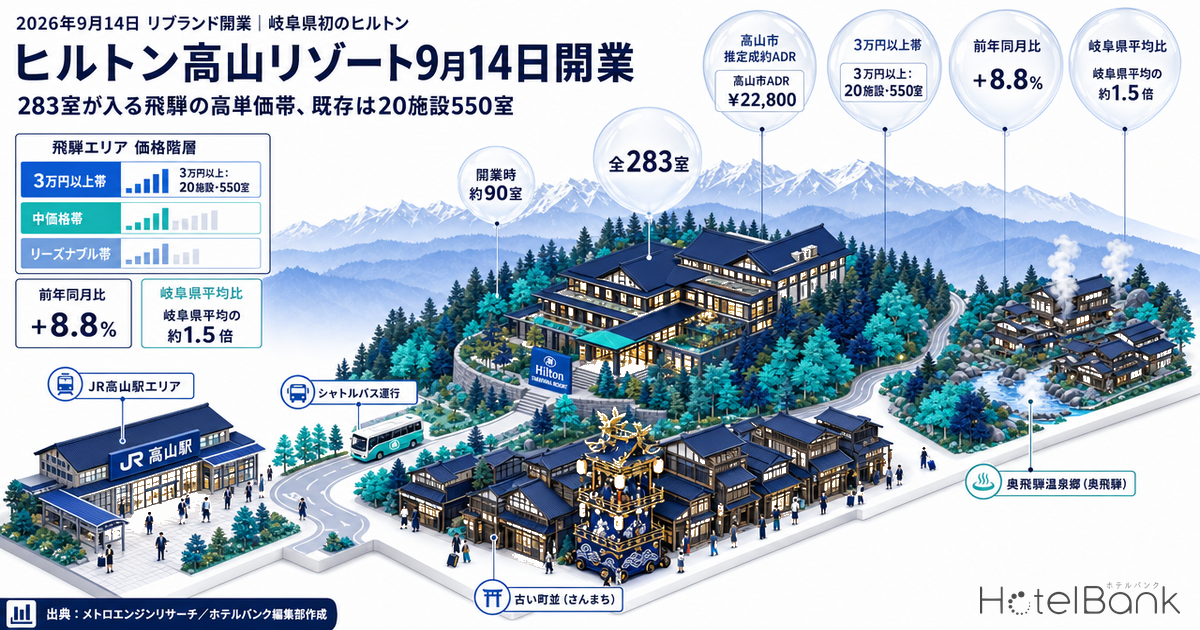
Hotel Associa Takayama Resort, operated by JR Central Hotels, will be rebranded and reopen as Hilton Takayama Resort on Monday, September 14, 2026. It will be the first Hilton in Gifu Prefecture. Of its 283 rooms, roughly 90 will be in service at opening, with the full inventory scheduled to come online in spring 2027. This article quantifies where that phased opening lands within the price tiers of the Hida area, using MetroEngines Research data.
Metric Definitions Used in This Article
- ADR (average daily rate): An estimated settled rate (tax-exclusive equivalent) calculated by applying a property-type correction coefficient to the lowest published plan level each property lists on OTAs and similar channels (double occupancy, per-room rate, tax-inclusive). Cross-checked against property-level results disclosed by listed hotel REITs (184 property-months, April–May 2026), the median error is approximately 7.5%. These are estimates and differ from each property’s actual transacted prices and accounting figures. Area-level ADR is the median of the covered properties (the level of a typical property in that area).
- Listed price: The selling price as published on OTAs and similar channels (double occupancy, per-room rate, tax-inclusive, averaged across all plans). Because its basis differs from estimated settled ADR, the two are not compared directly.
- Data source: MetroEngines Research
- — This is a rebranding, not new construction. Takayama City’s total room count stays flat while the “price placement” of 283 rooms shifts into a higher tier.
- — Takayama City’s estimated settled ADR is ¥22,800 in October 2026 (+8.8% year on year, N=126), roughly 1.5x the ¥14,900 figure for Gifu Prefecture as a whole.
- — The ¥30,000-and-above tier holds 21 properties and 562 rooms (10.0% of covered rooms). Twenty of those 21 are ryokan, with a median of 15 rooms — large-format capacity in this tier is thin.
- — If all 283 rooms land in that tier, it grows from 562 to 845 rooms (about 1.5x). At the roughly 90 rooms open on day one, it reaches 652 rooms (+16%) — the phased opening is designed to smooth the pace of supply.
- — The property’s own estimated settled ADR is ¥37,300 in October 2026 (+28.0% year on year), climbing at more than three times the +8.8% pace of Takayama City overall.
About 90 of 283 Rooms at Opening — The Facts
According to JR Central Hotels’ announcement of May 20, 2026, Hilton Takayama Resort will open on September 14, 2026 under Hilton’s flagship “Hilton Hotels & Resorts” brand. Reservations opened on June 1, 2026.
The point worth holding onto is that this is a rebranding, not new construction. Hotel Associa Takayama Resort, which opened in 1994, is being renovated and converted; no rooms are being added on a net basis. Takayama City’s total room count stays essentially flat while the “price placement” of 283 of those rooms moves upward. For the three major 2026 second-half openings that include this one, we mapped the competitive sets in advance in 3 Hotels Opening in 2026: Competitive Set Analysis for Kyoto, Hamamatsu & Takayama.
| Item | Detail |
|---|---|
| Property name | Hilton Takayama Resort (formerly Hotel Associa Takayama Resort) |
| Opening date | Monday, September 14, 2026 |
| Brand | Hilton Hotels & Resorts (first in Gifu Prefecture) |
| Operator | JR Central Hotels Co., Ltd. (株式会社ジェイアール東海ホテルズ) |
| Rooms | 283 rooms in total (including 5 suites: one 70㎡ Japanese-style suite, two 70㎡ deluxe suites, two 90㎡ premium suites) |
| Room size | Guest room 35㎡ / deluxe room 46㎡, among others |
| Phased opening | Opens with approximately 90 rooms, expanding as renovation progresses. All 283 rooms in service by spring 2027 |
| Main facilities | Executive lounge (new), fitness center (new), restaurants, banquet halls, hot-spring bathing facilities including an open-air bath, retail shop |
| Location | 1134 Echigo-machi, Takayama City, Gifu Prefecture / about 8 minutes from JR Takayama Station by free shuttle bus |
| Reservations opened | June 1, 2026 |
Source: Compiled by the HotelBank Editorial Team from a JR Central Hotels Co., Ltd. press release (May 20, 2026)
The demand base is solid. According to Takayama City statistics, 978,312 foreign visitors stayed overnight in the city in 2025, a record high and 27.1% above the 769,743 recorded in 2024. By region, Asia and the Middle East accounted for roughly 389,000, Europe roughly 220,000, and North America roughly 71,000 — the high share of Western and Australian travelers is a defining feature of Hida Takayama. Length of stay is longer, and the segment willing to pay for upper-grade rooms is relatively deep.
Takayama Runs 1.5x the Gifu Average — Price Tiers Across the Hida Area
First, some context on where Takayama sits within the prefecture. As of October 2026, estimated settled ADR is ¥22,800 in Takayama City, ¥24,600 in Shirakawa Village, ¥20,000 in Gero City and ¥14,000 in Gifu City. Against Gifu Prefecture as a whole (¥14,900), Takayama runs at roughly 1.5x. Takayama, Gero and Shirakawa-go together form a single touring circuit, and the investment headroom across that circuit — including the economics of room-reducing rebrands — is a distinct question from the one examined here.
| Area | Estimated settled ADR October 2026 | October 2025 | Year on year | Properties covered (October 2026) |
|---|---|---|---|---|
| Takayama City | ¥22,800 | ¥20,900 | +8.8% | N=126 |
| Shirakawa Village | ¥24,600 | ¥14,600 | +68.3% | N=6 |
| Gero City | ¥20,000 | ¥18,100 | +10.4% | N=45 |
| Hida City | ¥10,600 | ¥6,000 | +78.2% | N=13 |
| Gifu City | ¥14,000 | ¥8,700 | +59.9% | N=29 |
| Gifu Prefecture (all) | ¥14,900 | ¥12,300 | +20.7% | N=341 |
*October 2026 is a future month; figures are estimates based on listing levels as of the survey date. Please note that Shirakawa Village and Hida City cover few properties, so their figures carry a wide margin of variation.
Source: MetroEngines Research; compiled by the HotelBank Editorial Team
Takayama’s monthly trend shows unusually clear seasonality. In 2026, June is the trough at ¥14,000 and October the peak at ¥22,800 — a 1.6x spread. Anchored by the spring Takayama Festival (April 14–15) and the autumn Takayama Festival (October 9–10), October in the foliage season posts the annual high, a pattern that holds in both 2025 and 2026.
Source: MetroEngines Research; compiled by the HotelBank Editorial Team
21 Properties and 562 Rooms Above ¥30,000 — Scale Is Missing at the Top
Next, a breakdown of Takayama City by price band. Allocating the 140 properties and 5,645 rooms for which estimated settled ADR can be calculated (monthly average of actuals over the trailing 12 months, August 2025–July 2026) across six price bands gives the following.
| Estimated settled ADR band | Properties | Rooms | Share of rooms |
|---|---|---|---|
| Under ¥10,000 | 38 | 1,546 rooms | 27.4% |
| ¥10,000–15,000 | 20 | 723 rooms | 12.8% |
| ¥15,000–20,000 | 29 | 1,115 rooms | 19.8% |
| ¥20,000–30,000 | 32 | 1,699 rooms | 30.1% |
| ¥30,000–40,000 | 13 | 423 rooms | 7.5% |
| ¥40,000 and above | 8 | 139 rooms | 2.5% |
| Total | 140 | 5,645 rooms | 100% |
Source: MetroEngines Research; compiled by the HotelBank Editorial Team
Source: MetroEngines Research; compiled by the HotelBank Editorial Team
The ¥30,000-and-above tier holds 21 properties and 562 rooms, just 10.0% of covered rooms. And the composition of that tier is highly distinctive: 20 of the 21 are ryokan, with a median of only 15 rooms. Just one property exceeds 100 rooms — Takayama Green Hotel, at 207 — and excluding it leaves 20 properties and 355 rooms, an average of 18 rooms each.
Put the other way around, the larger the property, the lower its price band. The 19 properties with 100 or more rooms (3,079 rooms, 54.5% of covered rooms) have a median estimated settled ADR of ¥15,600, slightly below the ¥16,700 median across all 140 properties. Large properties in the middle band, high rates at small properties — that is the skeleton of Takayama City today.
Source: MetroEngines Research; compiled by the HotelBank Editorial Team
The upper-right quadrant of the scatter plot — 100-plus rooms and estimated settled ADR above ¥30,000 — is essentially empty today. That is precisely the space the 283-room Hilton Takayama Resort is heading into.
Capacity at the Top Grows 1.5x — What the Phased Opening Means
If Hilton Takayama Resort’s estimated settled ADR lands in the ¥30,000s, the number of rooms in Takayama City’s ¥30,000-and-above tier goes from 562 to 845 — roughly 1.5x. Restricted to large-format properties outside the ryokan segment, that is enough to essentially replace the core of the tier.
This is where the phased opening matters. At the roughly 90 rooms open on day one, the tier moves from 562 to 652 rooms, an increase of only about 16%. Rather than pushing 1.5x into the market at once, the design runs the October foliage peak with about 90 rooms and scales to 283 by the following spring — a sensible way to pace how demand absorbs the new supply.
| Phase | Timing | Rooms in service | Rooms in ¥30,000+ tier | Increase |
|---|---|---|---|---|
| Current | As of August 2026 | — | 562 rooms | — |
| Phase 1 | From September 14, 2026 | approx. 90 rooms | approx. 652 rooms | +16% |
| Full inventory | Spring 2027 | 283 rooms | 845 rooms | +50% |
*An estimate assuming the property’s estimated settled ADR sits in the ¥30,000-and-above tier. The existing 562 rooms are based on trailing-12-month actuals covering 140 properties and 5,645 rooms.
Source: MetroEngines Research; compiled by the HotelBank Editorial Team
The timing lines up as well. The September 14 opening falls just before October, the annual peak. And spring 2027, when all 283 rooms come online, covers April–May and the spring Takayama Festival — a second peak running 20–30% above the June–July trough in Takayama’s monthly series. Test the autumn market with about 90 rooms, finish operational ramp-up through the winter low season, and bring the full inventory live at the spring peak. The phased-opening calendar tracks this market’s seasonal curve closely.
The Step-Up Is Already Visible in Listed Prices
This shift has already begun to surface in public data. Tracking the property’s monthly series (as the former Hotel Associa Takayama Resort), no valid selling prices are observed for June–August 2026, with listings resuming from September — consistent with the renovation schedule. And the level after resumption is clearly above the same months a year earlier.
Source: MetroEngines Research; compiled by the HotelBank Editorial Team
Estimated settled ADR for October 2026 is ¥37,300, up 28.0% against ¥29,200 in the same month last year. Given that Takayama City overall is at +8.8% for that month, the property is stepping up at more than three times the market pace. November shows the same pattern at ¥30,500 (+25.0% year on year). On a listed-price basis, the all-plan average for October 2026 is approximately ¥88,400, with the upper end observed in the ¥190,000 range (based on listings as of August 10, 2026). The addition of upper-tier products such as the five suites and the executive lounge is showing up directly as an upward extension of the price range.
Note that figures for future months are estimates derived from selling prices listed as of the survey date and will move as the check-in date approaches. Because the mix of sellable rooms also changes with the phased opening, actual levels may diverge from these. How long newly opened properties take to reach their rate level is analyzed against 2025 actuals in New Hotel ADR Ramp-Up: 91 Japan Openings Split Into 4 Pricing Types.
What the Top Tier Lacks Is Capacity at Scale
The high-rate tier in Takayama City has traditionally been carried by small ryokan. A look at the top properties by estimated settled ADR makes that character plain.
| # | Property | Category | Rooms | Estimated settled ADR |
|---|---|---|---|---|
| 1 | Yamatonosato (倭乃里) | Ryokan | 8 rooms | ¥62,000 |
| 2 | Machiyado Ichiryu (まち宿 壱龍) | Ryokan | 24 rooms | ¥51,700 |
| 3 | Kakurean Hidaji (隠庵ひだ路) | Ryokan | 12 rooms | ¥51,400 |
| 4 | Honjin Hiranoya Kachoan (本陣平野屋 花兆庵) | Ryokan | 26 rooms | ¥50,700 |
| 5 | Hanaogi Bettei Iiyama (花扇別邸 いいやま) | Ryokan | 15 rooms | ¥50,500 |
| 6 | Hidatei Hanaogi (飛騨亭 花扇) | Ryokan | 48 rooms | ¥50,100 |
| 7 | Iori Stay Takayama | Ryokan | 5 rooms | ¥43,000 |
| 8 | Yukimurasaki (雪紫) | Ryokan | 14 rooms | ¥38,100 |
| 9 | Ryokan Tanabe (旅館 田邊) | Ryokan | 22 rooms | ¥37,800 |
| 10 | Kai Okuhida (界 奥飛騨) | Ryokan | 49 rooms | ¥36,900 |
*Top 10 extracted from properties with 5 or more rooms, by estimated settled ADR actuals over the trailing 12 months (August 2025–July 2026), N=140 properties.
Source: MetroEngines Research; compiled by the HotelBank Editorial Team
All ten are ryokan, totaling 223 rooms — an average of 22 rooms each. The product proposition that sustains roughly ¥50,000 a night is well established, but scale constrains their ability to absorb volume: groups, corporate business, MICE, or brand-loyalty members arriving in blocks. On top of the Western and Australian independent travelers who come to Hida Takayama, capturing that kind of volume demand at high rates is what a 283-room format makes possible.
Source: MetroEngines Research; compiled by the HotelBank Editorial Team
Mapping the distribution also reveals that Takayama City is a wide-area municipality containing two distinct lodging clusters. Large properties concentrate in the urban area around JR Takayama Station, while high-rate hot-spring ryokan are scattered through the Okuhida Onsen-go district to the east. Hilton Takayama Resort sits on a hillside about 8 minutes from the station, taking a new position within the urban cluster on both scale and rate.
Existing Guest Ratings Show the Groundwork Is There
Analysis of 9,257 guest reviews compiled by the HotelBank Editorial Team shows the existing property’s strengths lie in service and guest rooms. Service scores 4.29 (N=4,858), rooms 4.42 (N=4,243), bathrooms 4.51 (N=2,636) and cleanliness 4.47 (N=1,974) — all at high levels. Ratings from leisure-purpose guests over the trailing 24 months also come in at 4.33 (N=928), confirming support for the property in a resort role.
In other words, the foundation of experiential value is already in place. Layering on the standard fittings of an upper-tier brand — an executive lounge, a fitness center — plus an international loyalty base creates room to lift rates another notch. Beyond remaking the product through renovation, the ability to carry forward existing rating equity is an advantage new-build openings do not have.
Which Tier Matters More Than 283 Rooms — Landing Scenarios and Sensitivity
The estimates so far have assumed Hilton Takayama Resort’s estimated settled ADR lands in the ¥30,000s. But the landing level itself will be determined after opening. So, using only the by-band room counts already presented, here is how the market picture shifts if the landing band changes. The only formula used is “tier room-count increase = rooms entering ÷ existing rooms in the tier” — the same calculation behind 562→845 rooms (+50%) and 562→652 rooms (+16%) above.
| Scenario | Estimated settled ADR landing | Current rooms in tier | After 283 rooms enter | Increase | Change in ¥30,000+ tier (562 rooms) |
|---|---|---|---|---|---|
| Pessimistic | Lands in ¥20,000–30,000 | ¥20,000–30,000: 1,699 rooms | 1,982 rooms | +16.7% | Unchanged at 562 rooms (±0%) |
| Base | Lands in ¥30,000–40,000 (assumption used above) | ¥30,000–40,000: 423 rooms | 706 rooms | +66.9% | 845 rooms (+50.4%) |
| Optimistic | Lands in ¥40,000 and above | ¥40,000+: 139 rooms | 422 rooms | +203.6% | 845 rooms (+50.4%) |
*Room counts per band are the measured values from the by-band table above (140 properties, 5,645 rooms, trailing 12 months). Band migration or exit by other properties is not considered; these are arithmetic values for the case where only the denominator grows.
Source: MetroEngines Research; compiled by the HotelBank Editorial Team
The same 283 rooms produce a +16.7% increase if they land in the ¥20,000–30,000 band, versus +203.6% if they land above ¥40,000 — a spread of roughly 12x. What determines market impact is not the absolute count of 283 rooms but its ratio to the depth of the tier it enters. That is what the finding “the ¥30,000-and-above tier has only 21 properties and 562 rooms” is really for.
| Current rooms in tier | 90 rooms | 138 rooms | 187 rooms | 235 rooms | 283 rooms |
|---|---|---|---|---|---|
| ¥40,000+: 139 rooms | +64.7% | +99.3% | +134.5% | +169.1% | +203.6% |
| ¥30,000–40,000: 423 rooms | +21.3% | +32.6% | +44.2% | +55.6% | +66.9% |
| ¥30,000+ (total): 562 rooms | +16.0% | +24.6% | +33.3% | +41.8% | +50.4% |
| ¥15,000–20,000: 1,115 rooms | +8.1% | +12.4% | +16.8% | +21.1% | +25.4% |
| ¥20,000–30,000: 1,699 rooms | +5.3% | +8.1% | +11.0% | +13.8% | +16.7% |
*The vertical axis uses the measured room counts from the by-band table above; the horizontal axis spans the roughly 90 rooms at opening and the full 283 rooms, divided into four equal steps. The shaded cell is the assumption used above (283 rooms into the 562-room ¥30,000-and-above tier) and matches the +50% cited earlier.
Source: MetroEngines Research; compiled by the HotelBank Editorial Team
One more thing the tier’s depth changes: how to read the phased opening. Even the roughly 90 rooms at launch would mean +64.7% if placed in the ¥40,000-and-above tier (139 rooms) — 3.9 times the +16.7% of putting all 283 rooms into the ¥20,000–30,000 tier (1,699 rooms). Whether “not all at once” pacing actually works is decided by how thin the receiving tier is, not by how much is added. Given that Takayama City’s ¥30,000-and-above tier consists of 562 rooms with a median of 15 rooms per property, even a first phase of about 90 rooms is substantial for that tier.
Conclusion — Headroom Opening Up in Hida’s High-Rate Tier
In summary, this opening carries three implications.
First, it is not a net addition to supply but a reallocation of price tiers. Takayama City’s total room count stays flat while 283 rooms move to a higher band. Second, the destination — the ¥30,000-and-above tier — currently comprises 21 properties and 562 rooms with a median of 15 rooms each, dominated by small ryokan, which means capacity at scale is thin. The entry of 283 rooms grows that tier by roughly 1.5x. Third, a phased opening starting from about 90 rooms is the pacing mechanism that keeps that 1.5x from arriving all at once, and it meshes well with Takayama’s seasonal curve of an October peak and a second peak in April–May.
Measured by estimated settled ADR, Takayama City stands at ¥22,800 in October 2026 — roughly 1.5x Gifu Prefecture as a whole — and is growing at +8.8% year on year. With inbound demand weighted toward Western and Australian travelers providing support, how much volume can be placed in the upper tier, and at what pace, is exactly where Hida’s growth headroom rests. For the area as a whole, more choice at the top of the market can widen the price range of the catchment for surrounding ryokan and hotels.
⚠ Note on figures for future dates: Figures in this article for August 2026 onward are estimates based on selling prices published on OTAs and similar channels as of the survey date (August 10, 2026), and will move as the check-in date approaches. Because the mix of sellable rooms also changes with the phased opening, please note that actual levels may diverge from these.
Related Reading
- 3 Hotels Opening in 2026: Competitive Set Analysis for Kyoto, Hamamatsu & Takayama
- New Hotel ADR Ramp-Up: 91 Japan Openings Split Into 4 Pricing Types
- Hakone’s 126-Room Luxury Supply: Listed +30.9%, Settled ADR +5.7%
- Fukui’s 3 Hotel Clusters: 2.5x ADR Gap and the Upper-Mid Whitespace
- Japan’s 15 Trailhead Towns: Autumn ADR Peaks vs Winter Ski Premiums
References and Sources
- “Hilton Takayama Resort” to open Monday, September 14, 2026; reservations open from Monday, June 1 (JR Central Hotels Co., Ltd., May 20, 2026) [in Japanese]
- JR Central Hotels Co., Ltd. news release (May 20, 2026, PDF) [in Japanese]
- Takayama City, “Statistics on Overnight Stays by Foreign Visitors” [in Japanese]
- Takayama City, “Tourism Data” [in Japanese]
- JR Central-affiliated “Hilton Takayama Resort” to open in September, rebranding the former Associa Takayama (Tabiris) [in Japanese]
- MetroEngines Research — monthly estimated settled ADR for Takayama City, Gero City, Shirakawa Village, Hida City, Gifu City and Gifu Prefecture; property-level estimated settled ADR (N=140 properties, 5,645 rooms); listed prices
- HotelBank Editorial Team analysis — 9,257 guest reviews (ratings by category and by trip purpose)
■ Data Sources
MetroEngines Research monthly area aggregates (Gifu Prefecture, by municipality, August 2025–December 2026) and property-level aggregates (140 properties and 5,645 rooms in Takayama City, trailing 12 months = August 2025–July 2026). Property details and the opening schedule come from a JR Central Hotels Co., Ltd. press release (May 20, 2026); overnight-stay statistics from materials published by Takayama City; and the 9,257 guest reviews from HotelBank Editorial Team analysis.
■ Calculation Assumptions
The increase in tier room count is calculated as “rooms entering ÷ existing rooms in the tier,” assuming the property’s estimated settled ADR lands in the relevant band. Rooms in service under the phased opening span the roughly 90 rooms at opening and the full 283 rooms, divided into four equal steps. Band migration or exit by other properties, and demand-side variation, are not considered (these are arithmetic values for the case where only the denominator grows). The by-band room counts in all three scenarios are taken directly from the measured values in the by-band table in the body.
■ Limitations and Caveats
Estimated settled ADR is an estimate derived by applying property-type correction coefficients to published selling prices; cross-checked against property-level results disclosed by listed hotel REITs (184 property-months, April–May 2026), the median error is 7.5% (6.0% for the business/city hotel segment). Figures from August 2026 onward are for future months and are estimates based on listing levels as of the survey date, so they will move as the check-in date approaches. Shirakawa Village (N=6) and Hida City (N=13) cover only single digits to roughly a dozen properties, so their year-on-year figures carry wide variation. The property’s listed price, all-plan average for October 2026 (approximately ¥88,400), is based on listing information as of August 10, 2026, and uses a different reference point from the monthly series recompiled weekly (approximately ¥92,200). The 140 properties and 5,645 rooms in Takayama City come from our own property-level aggregation, and the population does not match the number of lodging facilities or rooms in official published statistics.