

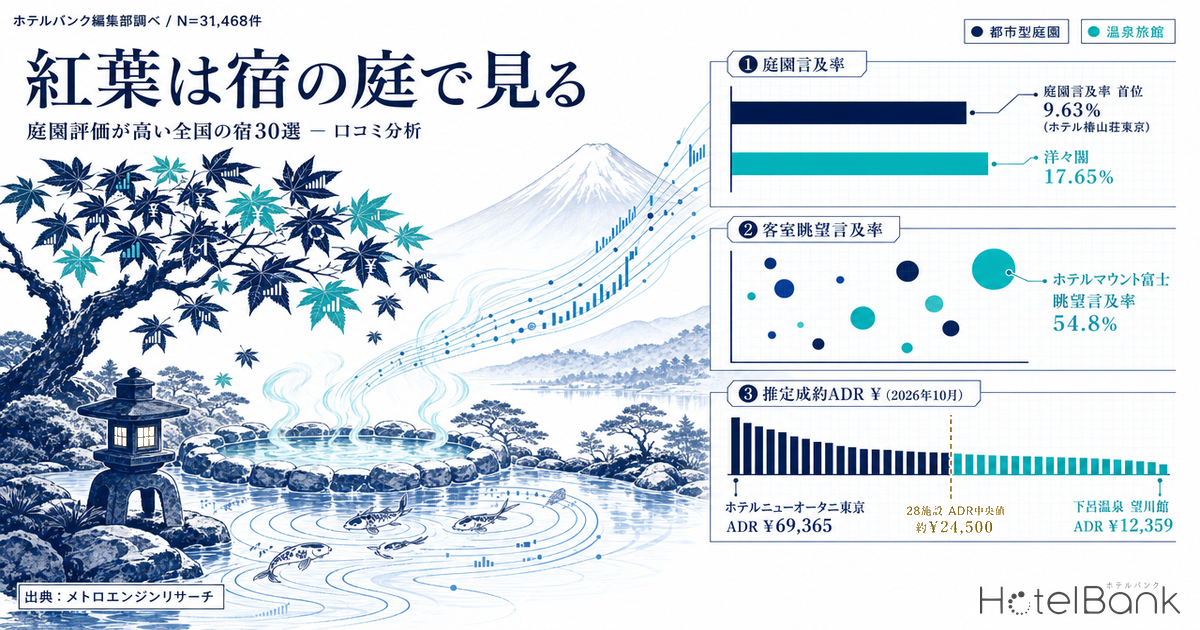
Japan’s famous autumn-foliage spots have become places where you queue more than you look. At the temples of Kyoto and the gorges of Nikko, a peak-season weekend leaves little room to take in the colour at your own pace. So here is a different idea: make the accommodation itself the foliage destination. Stay somewhere with a garden, and the trees turning colour in the clear morning air are yours alone. This article ranks properties across Japan whose gardens are most highly rated in guest reviews, and reads their stay value through two distinct types — urban gardens and onsen ryokan.
Metric Definitions Used in This Article
- Garden mention rate: the share of a property’s guest reviews (trailing 24 months, N=31,468 reviews aggregated) that refer positively to its garden. The higher the value, the more the garden sits at the centre of the stay experience. Note that the ranking order in this article is not by mention rate but by the number of reviews mentioning the garden (mention rate × review base). HotelBank Editorial Team research.
- View / open-air bath / breakfast-view mention rates: likewise from reviews, the share referring positively to the room view, the open-air bath, and a breakfast venue with a good outlook. Used to measure how closely these run alongside the garden.
- ADR (estimated settled rate): an estimated settled rate (tax-exclusive equivalent) calculated by applying category-specific correction coefficients to the lowest published plan level each property lists on OTAs (double occupancy, per-room rate, tax included). Cross-checked against property-level results disclosed by listed hotel REITs (91 properties, trailing 3 months), the median error is approximately 7%. These are estimates and differ from each property’s actual transacted rates and accounting figures. This article uses the October 2026 level (peak foliage season).
- Data sources: reviews = HotelBank Editorial Team research / ADR = MetroEngines Research
- — Hotel Chinzanso Tokyo leads on garden mentions — 9.63% of its N=1,412 reviews (136 reviews) mention the garden, the highest mention count nationwide.
- — 70% of the 30 ranked properties (21) are onsen ryokan. Their median open-air bath mention rate reaches 11.7%.
- — The median estimated settled ADR for October is about ¥24,500 (28 properties). Regional onsen ryokan offer garden-plus-open-air-bath stays in the ¥20,000s.
- — Spread across 17 prefectures, allowing an itinerary that follows the foliage front south from late September to early December.
- — The median view mention rate is 9.6%. Leaders such as Hotel Mount Fuji at 54.8% stand out for the depth of their “designed for watching the seasons” approach.
The foliage front opens in late September and moves south through early December
According to peak-viewing forecasts from the Japan Weather Association and others, the autumn foliage front typically begins in the highlands of Hokkaido and Tohoku in mid-to-late September, reaches the mountains of Tohoku and Kanto in October, and moves south to the lowlands of western Japan and Kyushu from late November into early December. In other words, for roughly two and a half months, somewhere in Japan is always at peak colour. For travellers who want to avoid the crowds at the famous spots, the question is how to ride that long front.
The properties that rank highly here are scattered nationwide — from Tokyo and Kanagawa to Yamanashi, Shimane, Gifu and Kyushu. Choose your stays in step with the front moving south and you can keep “watching the autumn colour in the garden of the place you are staying” from late September through to early December: a geographical depth that few single destinations can match. At the famous spots themselves — Kyoto, Takayama, Nikko — the pull-forward of foliage-season bookings by Western long-haul travellers is already visible in forward rates, which is precisely the crowding this article proposes to sidestep.
The top 15 stays where the garden is the centre of stay value
The chart below shows the garden mention rate for the 15 properties with the highest number of reviews mentioning the garden (ordered by mention count; bar length shows mention rate). First is Hotel Chinzanso Tokyo (Bunkyo-ku, Tokyo), where 9.63% of N=1,412 reviews — roughly 136 — mention the garden. Set in central Tokyo yet holding a vast strolling garden, it is clearly a property where the garden is the lead actor of the stay. Second is Yoshiike Ryokan (Hakone, Kanagawa) at 11.43%, and sixth Yunosuke no Yado Chorakuen (Tamatsukuri Onsen, Shimane) at 12.12% — onsen ryokan line up with high mention rates too. The single highest mention rate is the 17.65% of ninth-placed Yoyokaku (Karatsu, Saga); because mention rates jump more easily at properties with a small review base, they need to be read together with N.
Source: HotelBank Editorial Team research (review aggregation, trailing 24 months)
Urban gardens and onsen ryokan — two characters
The 30 ranked properties fall into two types of very different character. The first is the urban garden: Hotel Chinzanso Tokyo, Grand Prince Hotel New Takanawa and Takanawa, Hotel New Otani Tokyo, Hotel Gajoen Tokyo, and Hotel New Grand in Yokohama. All are large hotels in central or urban locations that hold a historic strolling or Japanese garden on site, with banquet halls and restaurants designed to look out over it. Call them the “urban oasis” type — the whole experience completes itself inside the city.
The second is the onsen ryokan: Yoshiike Ryokan and Yama no Hotel (Hakone), Chorakuen and Kyokusui no Niwa Hotel Gyokusen (Tamatsukuri), Hotel Kaneyamaen (Fujisan Onsen), Bosenkan and Suimeikan (Gero) — 70% of this ranking, or 21 properties. What distinguishes them is that the garden comes paired with an open-air bath: the median open-air bath mention rate across the 21 onsen ryokan reaches 11.7%. Chorakuen at 47.32%, Tenseien at 25.37% and Kaneyamaen at 24.0% show that soaking in the bath while looking out at the garden is the core of what guests value. Where an open-air bath and a strong view overlap, the two mention rates tend to rise together rather than trade off — the pairing is additive, not a choice between them.
The depth of “design for watching the seasons” — garden × view cross-analysis
Do properties with strong garden ratings also rate well on the view from the room? The scatter plot below takes the garden mention rate on the horizontal axis and the room-view mention rate on the vertical, plotting each property. Circle size represents the number of reviews.
Source: HotelBank Editorial Team research (review aggregation, trailing 24 months)
The further towards the upper right, the thicker a property’s ratings on both garden and room view. Hotel Mount Fuji (Lake Yamanaka) stands apart with a 54.8% view mention rate — a prime example of “design for watching the seasons”, where the garden and the views of Mt. Fuji and the lake become one. Fujisan Onsen Hotel Kaneyamaen (38.31%), Yama no Hotel (38.87%), Hotel New Grand (32.22%) and Mars Garden Wood Gotemba (31.65%) also rate highly on view. Mentions of a breakfast venue with a good outlook show up at Yama no Hotel and New Tagawa among others, where the flow of enjoying the garden or the scenery in the morning light adds further depth to stay value. The median view mention rate across the 30 garden-ranked properties is 9.6%, and the leaders sit well above it.
Garden stays scattered nationwide — distribution map
Plotted on a map, the 30 ranked properties are led by Tokyo (6 properties), followed by Kanagawa and Yamanashi (4 each) and Shimane and Gifu (2 each), spreading across 17 prefectures from Fukushima to Nagasaki. Navy indicates urban gardens, blue onsen ryokan. Circle size is a rough guide to room count.
Source: HotelBank Editorial Team research
That geographical spread maps directly onto the foliage front moving south. Late September to October in Tohoku, Hakone and the foothills of Mt. Fuji; November in Gero, Tamatsukuri and Dogo; late November into December in Unzen in Kyushu — an itinerary of garden stays that chases the front down the country.
ADR bands at peak foliage — where do garden stays sit on price?
At what price do properties with gardens sit in October 2026, the foliage peak? The chart below lines up estimated settled ADR by property (two central-Tokyo luxury properties are outside the scope of estimated settled ADR and are not shown). The median across 28 properties is about ¥24,500, ranging from Hotel New Otani Tokyo at the top (about ¥69,400) down to regional onsen ryokan in the ¥12,000–20,000s.
Source: MetroEngines Research (October 2026, estimated settled ADR)
What stands out is that for the quality of the garden on offer, regional onsen ryokan can be had at around ¥20,000. Gero Onsen Bosenkan (about ¥12,400), Shikisai Ichiriki (about ¥20,900) and Awazu Onsen Hoshi (about ¥19,300) are among the many properties that combine a garden with an open-air bath at a reachable price point. That contrasts with the large urban garden hotels distributed across the ¥30,000–70,000 range: on cost-performance for the experience of “watching the autumn colour in a garden”, the regional ryokan win. Rates at the major onsen destinations do firm up across the autumn season generally, so the gap is a seasonal read rather than a permanent one.
Garden rating ranking TOP 30 (full list)
| Rank | Property | Location | Type | Rooms | Reviews | Garden mention rate | Oct ADR |
|---|---|---|---|---|---|---|---|
| 1 | Hotel Chinzanso Tokyo | Tokyo | Urban garden | 267 | 1,412 | 9.63% | — |
| 2 | Yoshiike Ryokan | Kanagawa | Onsen ryokan | 64 | 936 | 11.43% | ¥29,438 |
| 3 | Grand Prince Hotel New Takanawa | Tokyo | Urban garden | 908 | 2,960 | 3.28% | ¥36,616 |
| 4 | Yama no Hotel (Hakone) | Kanagawa | Onsen ryokan | 89 | 1,060 | 5.57% | ¥30,693 |
| 5 | Fujisan Onsen Hotel Kaneyamaen | Yamanashi | Onsen ryokan | 126 | 650 | 8.0% | ¥34,619 |
| 6 | Yunosuke no Yado Chorakuen | Shimane | Onsen ryokan | 69 | 429 | 12.12% | ¥22,558 |
| 7 | Shikisai Ichiriki | Fukushima | Onsen ryokan | 66 | 388 | 11.6% | ¥20,867 |
| 8 | Grand Prince Hotel Takanawa | Tokyo | Urban garden | 376 | 305 | 13.11% | ¥32,257 |
| 9 | Yoyokaku | Saga | Onsen ryokan | 20 | 221 | 17.65% | ¥17,533 |
| 10 | Tenseien | Kanagawa | Onsen ryokan | 198 | 1,218 | 3.2% | ¥24,856 |
| 11 | Art Hotel Kokura New Tagawa | Fukuoka | Urban garden | 89 | 547 | 6.58% | ¥10,365 |
| 12 | Hotel Niwa Tokyo | Tokyo | Urban garden | 229 | 2,118 | 1.7% | ¥47,649 |
| 13 | Hotel New Otani Tokyo | Tokyo | Urban garden | 1479 | 407 | 8.35% | ¥69,365 |
| 14 | Hohoemi no Yado Takinoyu | Yamagata | Onsen ryokan | 89 | 437 | 7.55% | ¥26,310 |
| 15 | Gero Onsen Bosenkan | Gifu | Onsen ryokan | 76 | 1,273 | 2.36% | ¥12,359 |
| 16 | Ooedo Onsen Monogatari Isawa Onsen Hotel Shinko | Yamanashi | Onsen ryokan | 107 | 508 | 5.91% | ¥17,894 |
| 17 | Dogo Onsen Funaya | Ehime | Onsen ryokan | 58 | 631 | 4.6% | ¥34,185 |
| 18 | Gero Onsen Suimeikan | Gifu | Onsen ryokan | 264 | 2,808 | 1.0% | ¥18,742 |
| 19 | Hotel MyStays Premier Narita | Chiba | Urban garden | 711 | 3,416 | 0.82% | ¥8,626 |
| 20 | Ooedo Onsen Monogatari Premium Saiki Bekkan | Tottori | Onsen ryokan | 70 | 636 | 3.93% | ¥24,083 |
| 21 | Kyokusui no Niwa Hotel Gyokusen | Shimane | Onsen ryokan | 124 | 655 | 3.82% | ¥21,741 |
| 22 | Tokiwa Hotel | Yamanashi | Onsen ryokan | 50 | 355 | 7.04% | ¥35,478 |
| 23 | Hotel New Grand | Kanagawa | Urban garden | 238 | 3,461 | 0.66% | ¥32,855 |
| 24 | Hotel Gajoen Tokyo | Tokyo | Urban garden | 60 | 747 | 2.95% | — |
| 25 | Awazu Onsen Hoshi | Ishikawa | Onsen ryokan | 65 | 342 | 6.14% | ¥19,279 |
| 26 | Fujiya (Niigata) | Niigata | Onsen ryokan | 64 | 517 | 4.06% | ¥27,282 |
| 27 | Hotel Resort & Restaurant Mars Garden Wood Gotemba | Shizuoka | Onsen ryokan | 61 | 635 | 3.15% | ¥19,461 |
| 28 | Unzen Miyazaki Ryokan | Nagasaki | Onsen ryokan | 98 | 387 | 5.17% | ¥38,195 |
| 29 | Gensen Yu no Yado Matsunoi | Gunma | Onsen ryokan | 225 | 956 | 1.88% | ¥21,760 |
| 30 | Hotel Mount Fuji | Yamanashi | Onsen ryokan | 53 | 1,053 | 1.71% | ¥21,723 |
Source: HotelBank Editorial Team research (reviews) / MetroEngines Research (ADR). Garden mention rates cover the trailing 24 months; properties with 30 or more mentions were prioritised and the top 30 by mention count are listed.
Conclusion — skip the crowds and keep autumn in the garden to yourself
If you want to avoid the weekend crush at the famous foliage spots, the smart move is to relocate the destination to the garden of the place you are staying. What this ranking shows comes down to four points: (1) properties where the garden is the lead actor of the stay are spread across 17 prefectures and can be toured in step with the foliage front moving south; (2) they divide into two types — urban gardens and onsen ryokan — with the latter pairing garden and open-air bath; (3) the higher a property’s view rating, the more depth there is to its “design for watching the seasons”; and (4) at a regional onsen ryokan you can enjoy an autumn of garden plus open-air bath for around ¥20,000.
The ranking here reflects tendencies in review aggregation as of the time of writing, and the timing of the colour shifts from year to year with temperature. Check the latest peak-viewing information with each property and with weather services before you travel, and plan a quiet autumn night away.
⚠ Note on ADR for future dates: the October and November 2026 ADR figures in this article are estimates derived by applying corrections to the selling prices published on OTAs at the time of research, and will move as the check-in date approaches. More than 30 days remain until the foliage peak as of writing, so both inventory and pricing may still shift.
Related Reading
- Review NLP Maps Japan’s Top Scenic Open-Air Bath Regions
- Hotels Where Room-View Ratings Are Rising: National TOP 30 (Summer 2026 Fireworks Season)
References & Sources
- HotelBank Editorial Team research — NLP analysis of guest reviews (trailing 24 months, N=31,468 reviews aggregated)
- MetroEngines Research — estimated settled ADR (October 2026, corrected by cross-check against disclosed results for 91 properties)
- Hankyu Travel International, “Autumn Foliage 2026: Peak Viewing Times” (Japanese)
- Japan Weather Association, tenki.jp (autumn foliage peak forecasts, Japanese)
■ Data sources
Reviews = HotelBank Editorial Team research (NLP analysis of guest reviews, trailing 24 months, N=31,468 reviews aggregated). Properties with 30 or more garden mentions were prioritised, and the top 30 by mention count are listed. ADR = MetroEngines Research estimated settled ADR (October 2026). Foliage peak timing = Japan Weather Association tenki.jp and Hankyu Travel International peak-viewing forecasts.
■ Calculation assumptions
Garden mention rate = the share of positive garden mentions among all of a property’s reviews. Ranking order is by mention count (mention rate × review base), not by mention rate. ADR is an estimated settled rate derived by applying category-specific correction coefficients to the lowest published plan level each property lists on OTAs (double occupancy, per-room rate, tax included), using the October 2026 level that corresponds to the foliage peak. The median ADR is based on the 28 properties for which an estimated settled ADR was available (two central-Tokyo luxury properties are out of scope).
■ Limitations and caveats
The smaller a property’s review base, the more easily its mention rate jumps; mention rates must always be read together with N. The October and November 2026 ADR figures are estimates based on published prices for future dates and will move as check-in approaches. Cross-checked against property-level results disclosed by listed hotel REITs (91 properties, trailing 3 months), the median error is approximately 7%. Because the timing of the colour shifts with each year’s temperatures, checking the latest peak-viewing information before travelling is recommended.